
Part 2 of Women Who Made Headlines
Five Years Among the Headhunters
 @germancowboy
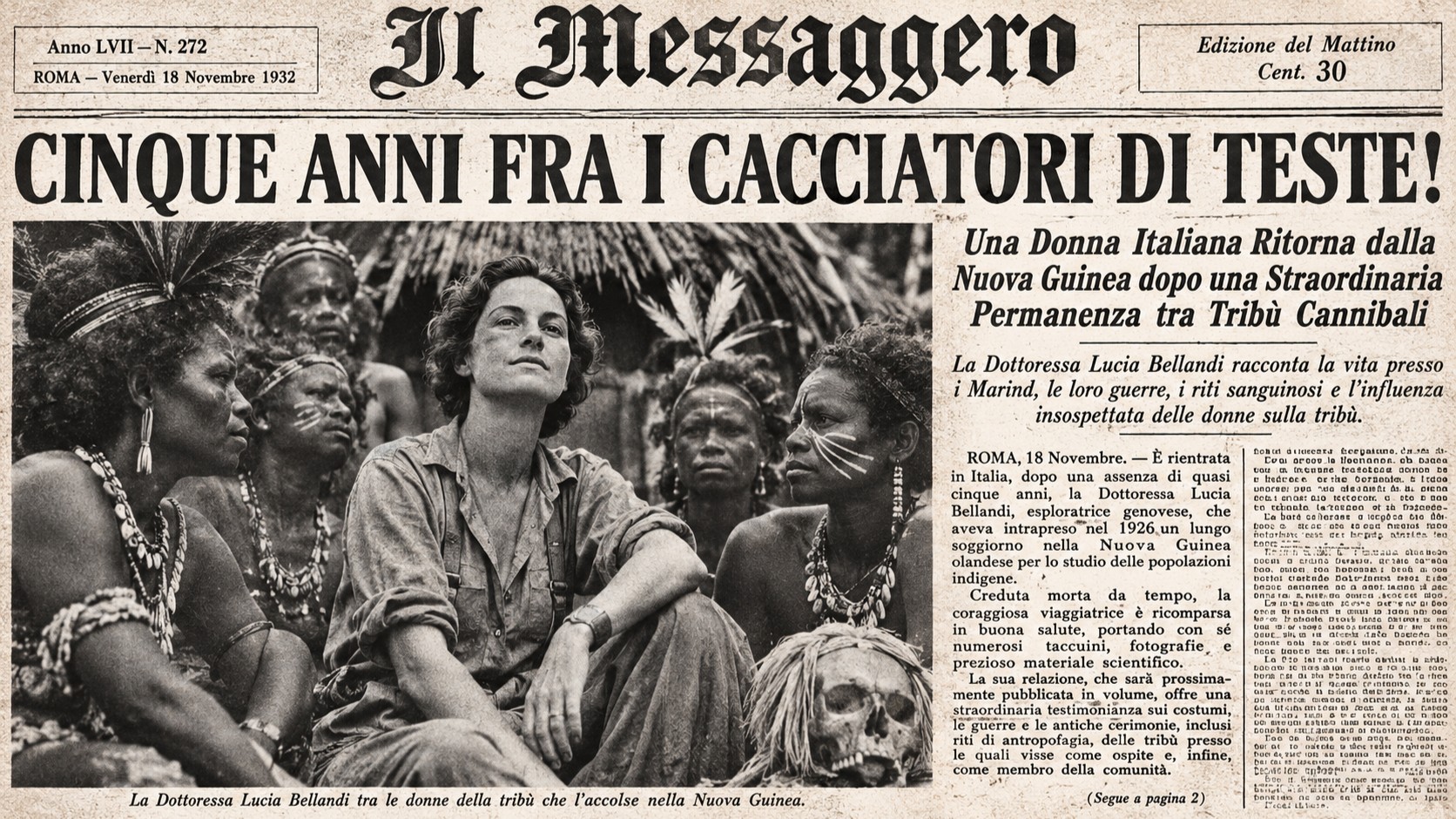
THE EXTRAORDINARY DISCOVERIES OF DOTTORESSA LUCIA BELLANDI · ROME, NOVEMBER 18, 1932
CINQUE ANNI FRA I CACCIATORI DI TESTE!
Italian Woman Returns After Five Years Among the Headhunters of New Guinea
A Genoese explorer describes forbidden ceremonies, jungle warfare, and a mysterious council of women — presumed dead for nearly three years, she returns with extraordinary photographs, notebooks, and a remarkable story of survival.
ROME, November 18, 1932. — A young Italian woman whose name had long since disappeared from the lists of European travelers has returned from the tropical forests of New Guinea with an account so extraordinary that several distinguished authorities have already requested an examination of her papers.
Dottoressa Lucia Bellandi, thirty-five years of age, daughter of the late Professor Vittorio Bellandi of Genoa, claims to have spent nearly five years among a community of the Marind people, whose headhunting expeditions and ancient ceremonies have for decades troubled the colonial authorities of the Netherlands Indies.
She has returned with forty-three notebooks, several hundred photographic plates, numerous botanical specimens, and scars which, she declares, tell only a small part of her adventures.
Most remarkable of all, she insists that during her long residence she was not merely tolerated as a foreign guest but eventually accepted into the household of one of the village's most influential women.
"They were not the monsters of the sensational books," she told our correspondent. "They were human beings, capable of terrible cruelty and extraordinary tenderness. I witnessed both."
The daughter who preferred jungles to drawing rooms
Born in Genoa in March 1897, Lucia Bellandi enjoyed an education of unusual distinction.
Her father, a physician with a particular interest in tropical diseases, encouraged her scientific ambitions from childhood. Her mother, a schoolteacher, supplied the languages and literature which were to prove equally useful.
After studying natural sciences and ethnology, Bellandi devoted herself to tropical medicine, photography, and the comparative study of indigenous societies.
By twenty-seven she had already traveled through Egypt, Ceylon, Java, and portions of the Malay Archipelago.
She spoke French, English, German, and sufficient Dutch and Malay to converse with traders and colonial officials.
But it was not sufficient merely to visit distant countries.
"I wished to know what happened after the expedition departed," she explained. "The visiting traveler sees a ceremony. The woman who remains sees the quarrel before it, the preparations, and the consequences afterward."
Her opportunity came in 1926, when she secured passage aboard a Dutch trading vessel bound for southern New Guinea.
She carried a camera, medical instruments, quinine, a small assortment of surgical supplies, and enough funds to maintain herself for eighteen months.
She would not see Italy again for more than five years.
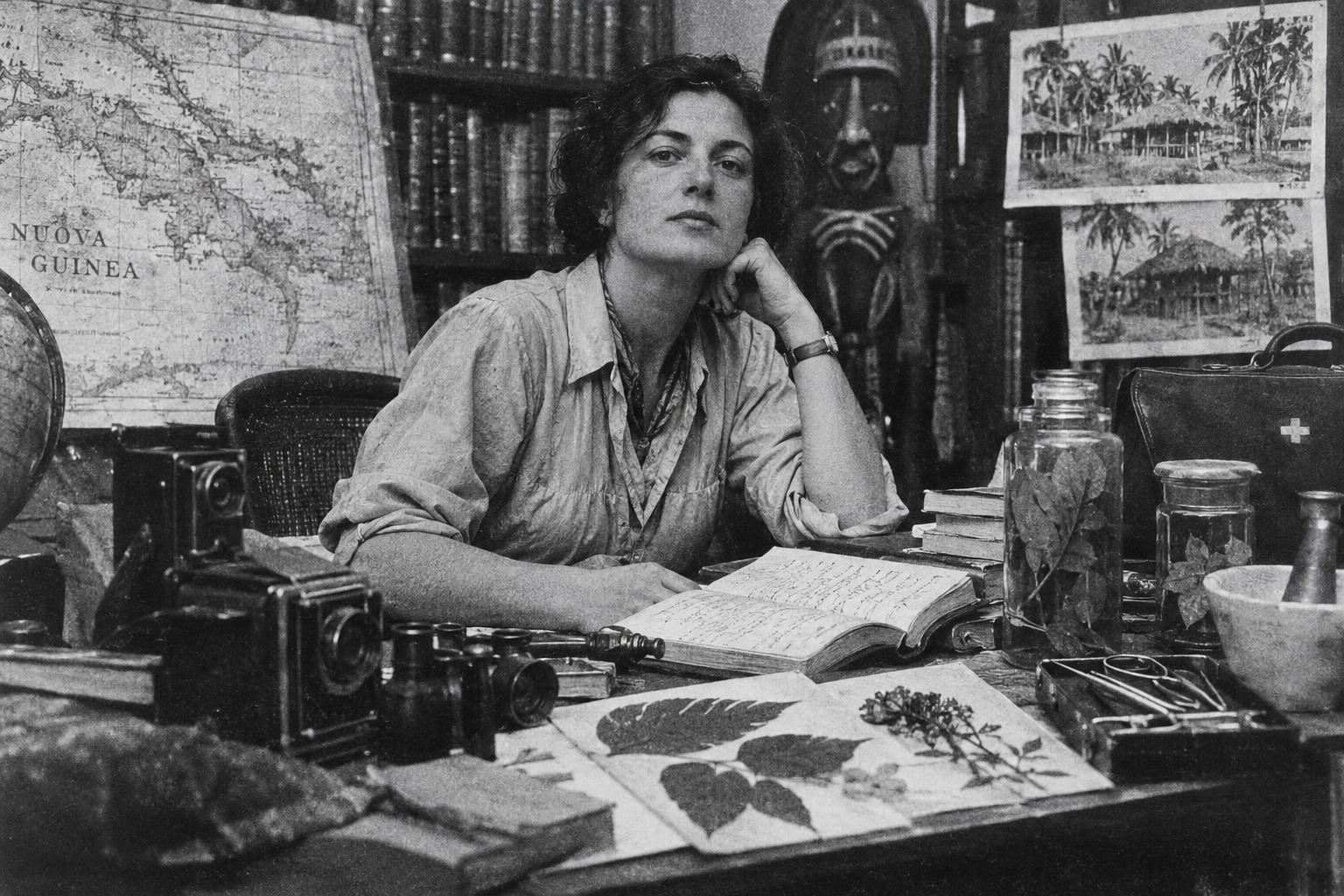
Dottoressa Lucia Bellandi surrounded by the maps, scientific instruments, and books with which she prepared for her expedition to New Guinea.
The river from which no letter came
Bellandi first established herself near Merauke, where Dutch officials had warned her against venturing into the more remote settlements without adequate protection.
She nevertheless arranged to accompany local traders into the river country, where she hoped to study the customs of communities whose lives remained little understood by European scholars.
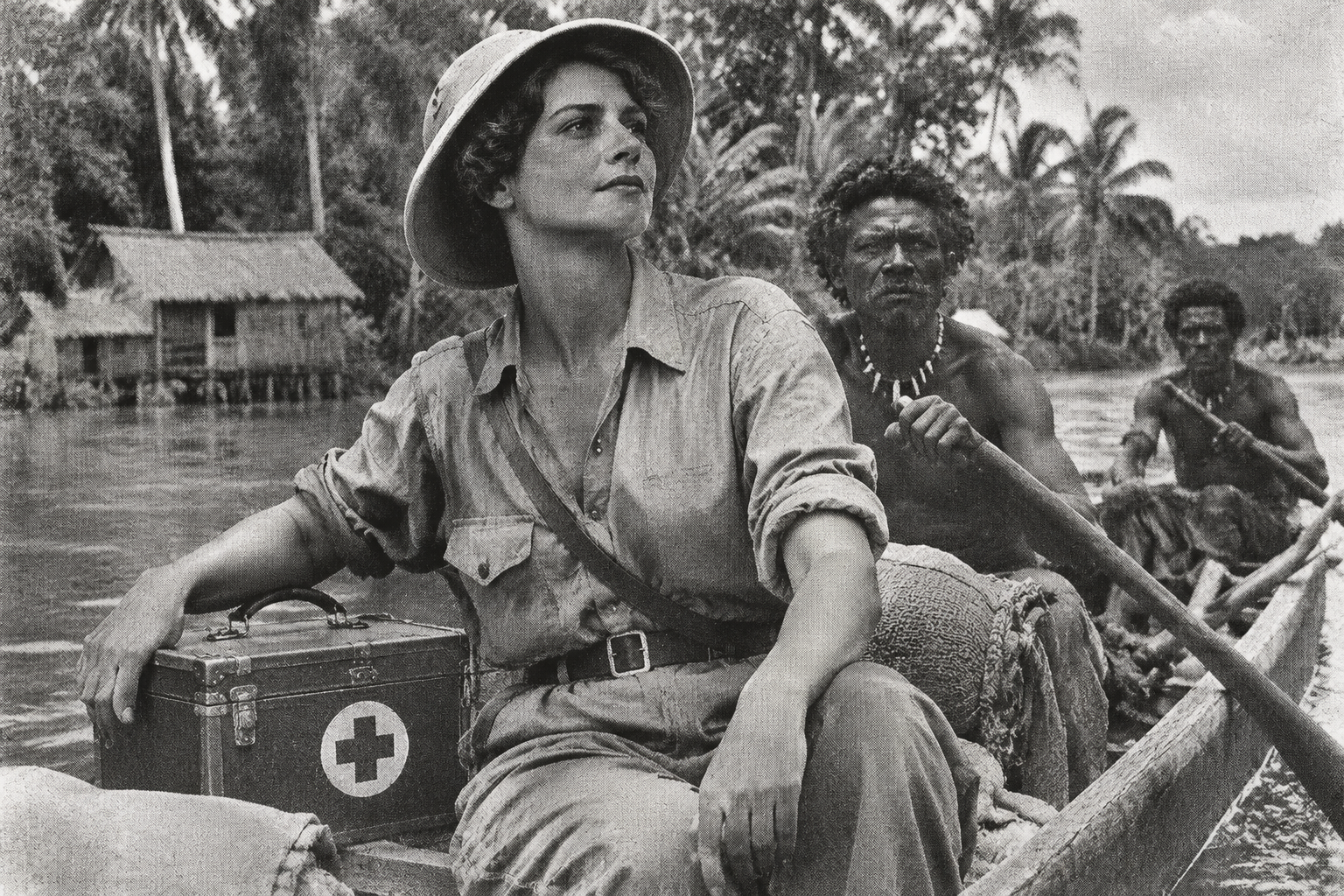
Accompanied by local guides, the Italian explorer makes her way along one of New Guinea's remote waterways toward the villages of the interior.
After several weeks, the party was forced to turn back by illness and reports of fighting.
Bellandi refused to accompany them.
With the assistance of a local interpreter she had befriended, she approached a riverside village whose inhabitants regarded her with profound suspicion.
Her first night was spent beneath a leaking shelter, with her medical case serving as a pillow.
For six days she was watched closely and permitted to move only within a limited part of the settlement.
A feverish child changed everything.
When the boy's condition worsened, Bellandi was summoned by his mother. She attended the child through two nights, using the medicines at her disposal and carefully explaining her actions through the interpreter.
The boy recovered.
His grandmother, an elderly woman whom Bellandi calls Marewa, subsequently invited the stranger to remain in her household.
It was the beginning of a relationship which would determine the remainder of the Italian's extraordinary adventure.
Five years without Europe
The first year was almost entirely occupied with learning.
Bellandi abandoned European clothing in favor of garments more suitable to the climate, lived upon local foods, accompanied women gathering sago and fishing in the waterways, and gradually learned to communicate without an interpreter.
Her notebooks contain detailed descriptions of domestic life, children's games, food preparation, medicinal plants, marriage customs, and mourning ceremonies.
She was particularly impressed by the skill of the women, who possessed intimate knowledge of the rivers, forests, seasons, and the numerous dangers of their environment.
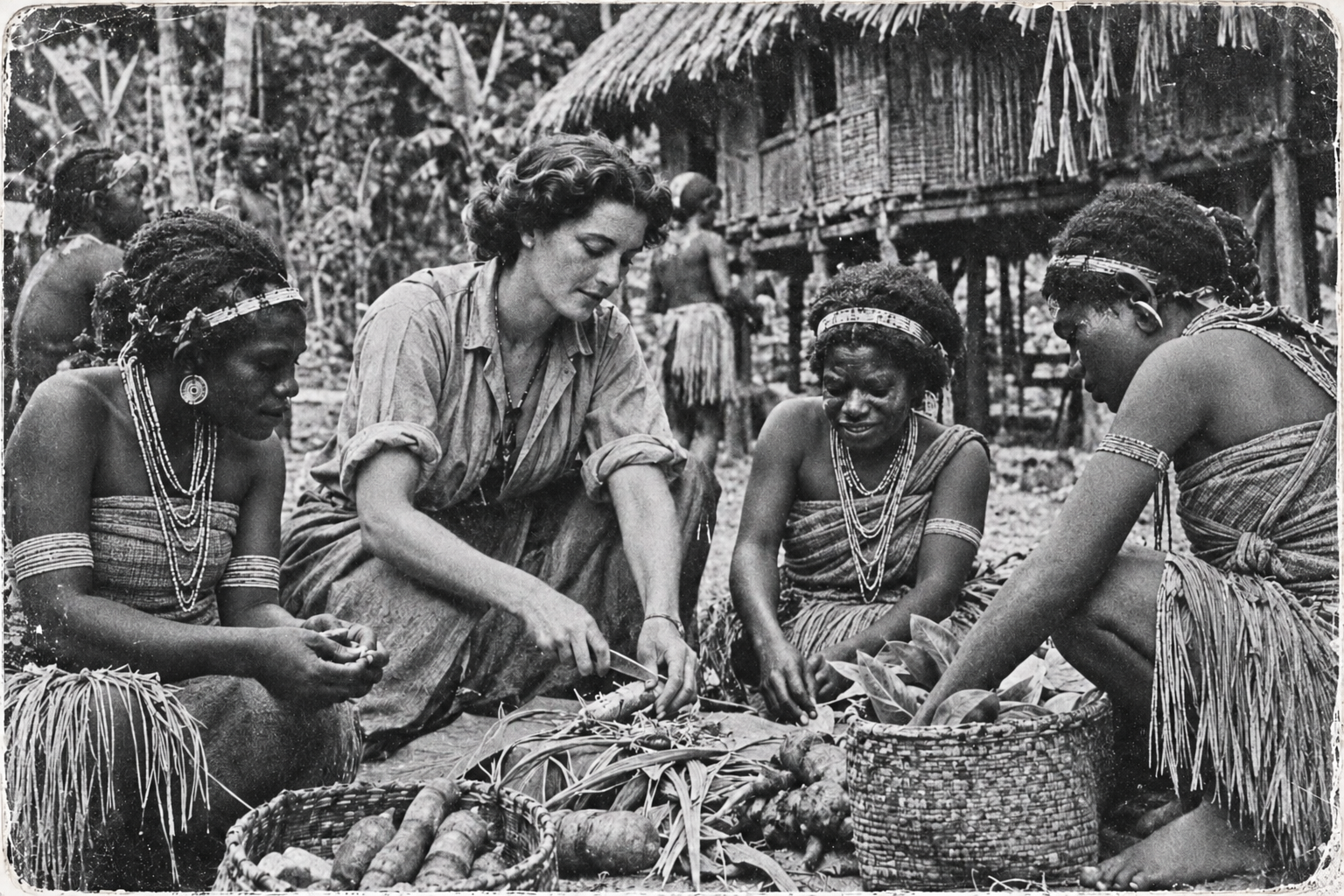
Dottoressa Belland assisting the women of her adopted village in the preparation of food, having gradually acquired their language and daily customs.
"They could recognize a change in the weather before I had noticed a cloud," she recalled. "They could hear the approach of a canoe long before I saw it. In the jungle, they were my professors."
But the conditions were severe.
Malaria nearly killed her in 1928. Twice she suffered serious infections. On one occasion, a canoe overturned in a swollen river, carrying away her camera and several months of photographic work.
For seventeen days she was confined to a raised sleeping platform, too weak to stand.
Marewa and her relatives cared for her throughout the illness.
Bellandi believes that she owes them her life.
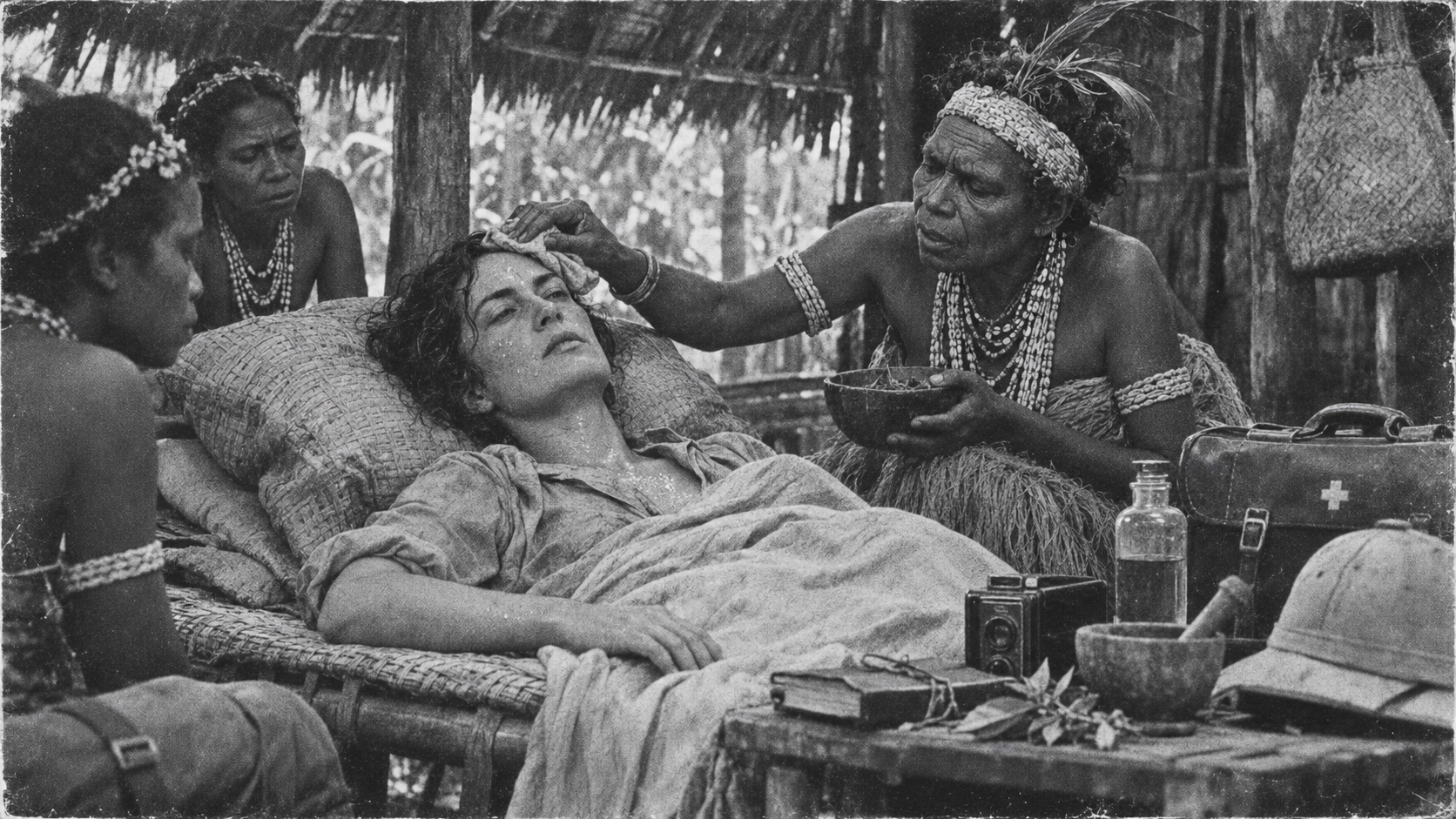
Gravely weakened by malaria, Dottoressa Bellandi lies under the watchful care of Marewa, the elderly woman to whom she later attributed the saving of her life.
By 1929, the occasional letters she had managed to dispatch had ceased altogether.
Rumors reached the Dutch settlements that the Italian woman had died in the interior.
Her family in Genoa eventually received an official communication stating that no reliable information concerning her whereabouts could be obtained.
Bellandi, meanwhile, was very much alive.
And she was about to witness something for which no scientific training could have prepared her.
The night of the returning warriors
It was during her third year that Bellandi witnessed the return of a war party from a raid against a rival settlement.
The men arrived by canoe shortly before sunset, accompanied by shouting, drums, and the unmistakable signs of victory.
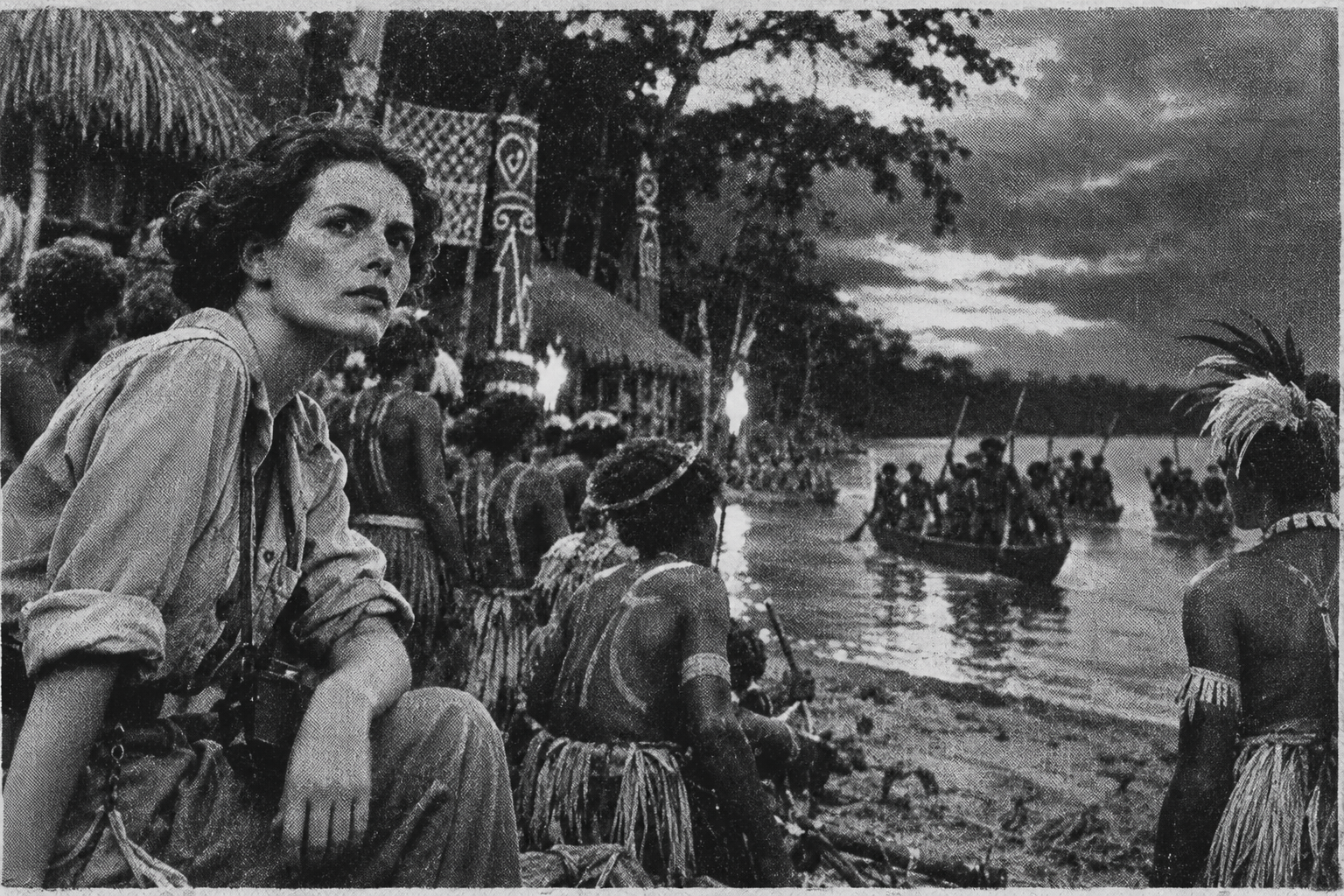
The return of a war party at dusk, an occasion which exposed the Italian traveler to ceremonies and customs she had previously known only from scholarly accounts.
Among the objects carried ashore were human heads.
Bellandi makes no attempt to conceal her horror.
"I had read descriptions of such customs," she stated. "But there is an immeasurable distance between reading of a thing in a comfortable European library and finding oneself standing a few yards from it."
The ensuing ceremonies continued far into the night.
She describes the beating of drums, the recitation of ancestral names, and the participation of families whose members had been killed during earlier conflicts.
During this period she also obtained accounts of ceremonial cannibalism, a practice which she insists must be distinguished from the ordinary diet and daily existence of the community.
She records one occasion upon which human remains were prepared in connection with a ceremony following warfare.
The sight so disturbed her that she withdrew to Marewa's dwelling.
The older woman found her there.
According to Bellandi, Marewa regarded the European's distress with neither surprise nor resentment.
After a long silence, she began speaking about the deaths of her own relatives and the obligations which the living believed they owed to the dead.
"I understood her words," Bellandi wrote, "but I could not share her convictions. There are things a traveler may describe without ever learning to accept."
Yet it was the events of the following morning which led to her most astonishing discovery.
The women who could prevent a war
European accounts of New Guinea warfare have generally devoted their attention to the warriors, their weapons, and the ceremonies associated with victory.
Bellandi's prolonged residence among the women of the settlement enabled her to observe another side of village affairs.
She describes a gathering of senior women, held apart from the principal men's assembly, at which disputes involving marriage obligations, the distribution of food, and the consequences of warfare were considered.
Marewa, despite her advanced age, commanded considerable respect.
On one occasion, when preparations were underway for a retaliatory expedition, she and several other women openly opposed the departure.
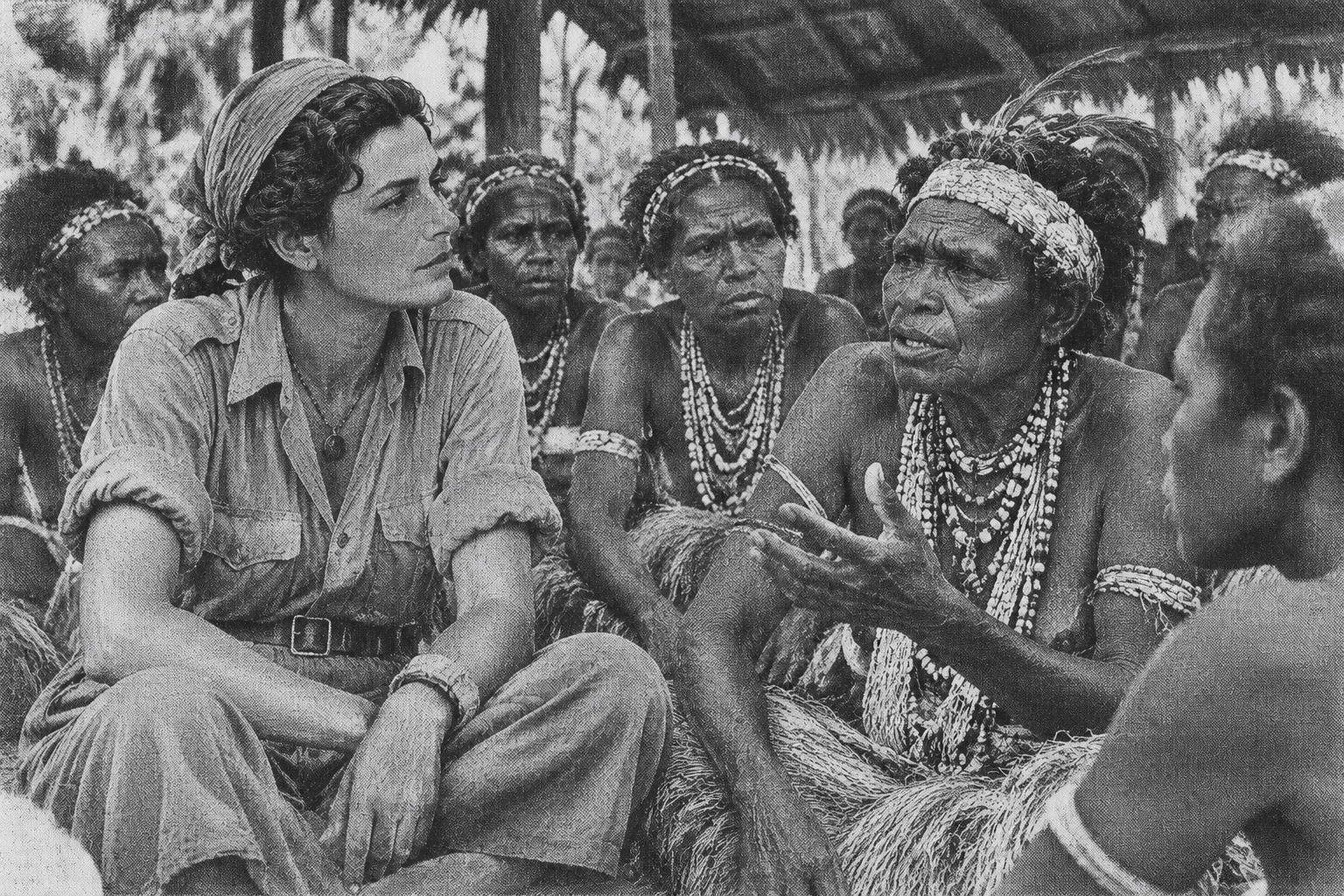
Marewa addresses a gathering of senior village women in the presence of Dottoressa Bellandi, revealing an influence over tribal affairs seldom described by European travelers.
Bellandi maintains that the proposed raid was subsequently abandoned.
"The men carried the spears," she remarked, "but they did not always decide when the spears should be lifted."
This observation has attracted particular attention among scholars who have examined her preliminary notes.
Whether such influence extended to other settlements remains uncertain.
Bellandi herself cautions against making universal conclusions from the circumstances of a single community.
Nevertheless, her account suggests that the domestic and political influence of women in the region has received considerably less attention than it deserves.
The stranger who was given a name
In the fourth year of her residence, Bellandi was invited to participate in a household ceremony marking the remembrance of deceased relatives.
During this gathering, Marewa bestowed upon her a name which the Italian translates approximately as "The Woman Who Came From Beyond the Water."
The occasion appears to have been deeply affecting.
"I had gone there as a collector of knowledge," Bellandi recalled. "I discovered, to my great embarrassment, that I had become part of the lives I was attempting to describe."
Her position nevertheless remained precarious.
Visitors from other settlements were sometimes suspicious of the foreign woman, and her cameras were occasionally regarded with apprehension.
In 1930 a dispute involving neighboring communities threatened to engulf the village in renewed fighting.
Bellandi was advised to leave.
She refused.
It was only when several houses were destroyed and one of her closest companions was seriously wounded that she agreed to accompany a party traveling toward the coast.
Even then, her departure was postponed by illness.
By the time she finally left the settlement in early 1931, she had spent almost five years in the region.
Marewa accompanied her to the river.
The two women exchanged small gifts.
Bellandi presented her friend with a sewing needle and a polished metal mirror.
Marewa gave the Italian a woven carrying bag, a carved wooden ornament, and a small collection of personal possessions intended as remembrances.
"She asked whether I should return," Bellandi told us.
"What did you answer?"
"I told her I would try."
A dangerous return to civilization
Bellandi's journey back to the coast was nearly as hazardous as her arrival.
Heavy rains had swollen the rivers, supplies were exhausted, and the party was obliged to abandon several valuable specimens.
During the final weeks, she developed another fever which left her temporarily delirious.
A passing trading vessel eventually carried her to Merauke, where her appearance occasioned considerable astonishment.
Several officials had believed her dead.
From there she made her way to Java and subsequently to Europe, arriving in Italy in the autumn of 1931.
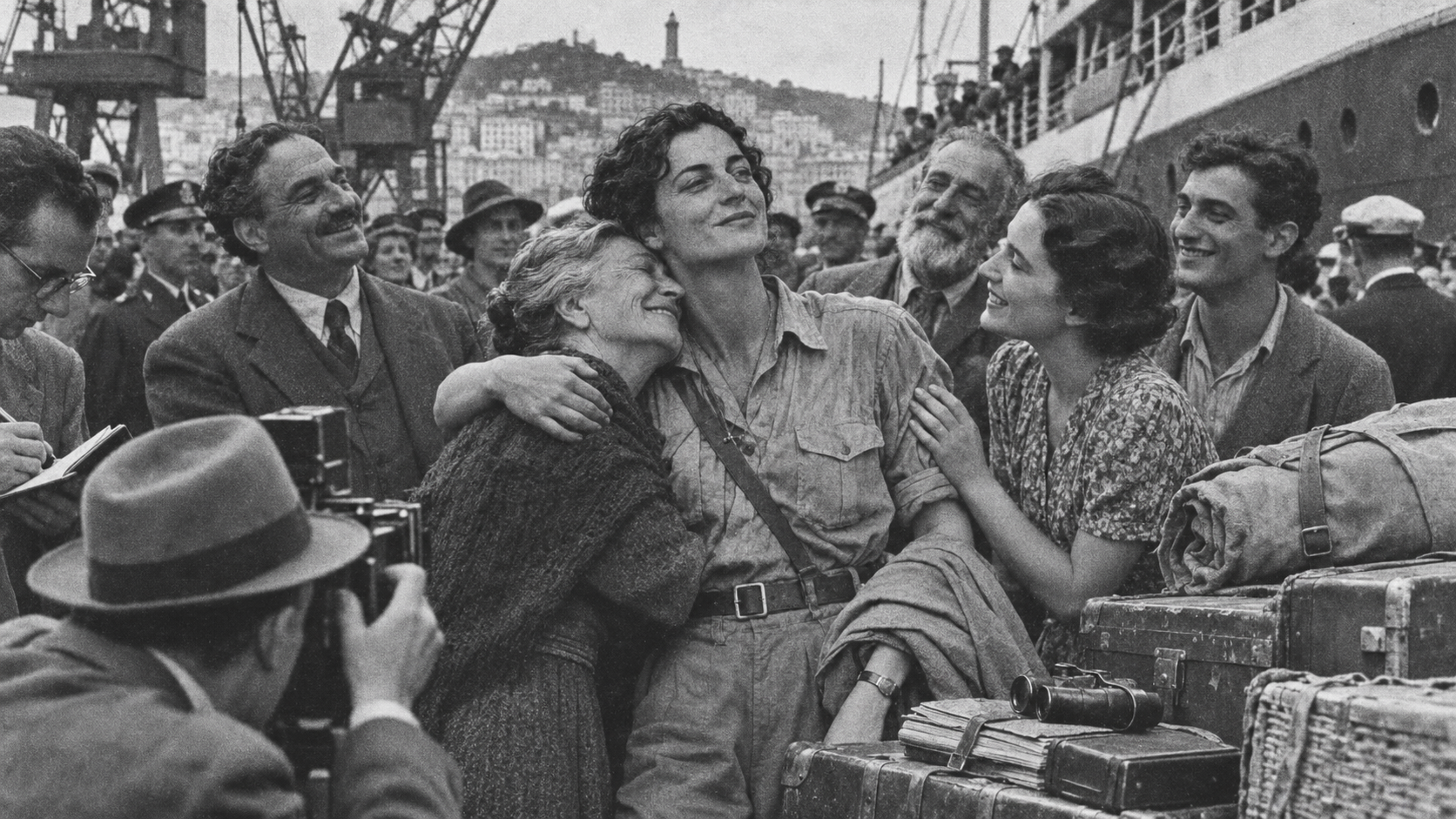
Dottoressa Bellandi welcomed by relatives and friends upon her return to Genoa, bringing to an end five years of extraordinary adventures in the tropical forests of New Guinea.
She had lost much of her luggage and nearly a third of her original body weight.
But her most valuable notebooks survived.
Her first months at home were spent recovering her health, restoring damaged photographic negatives, and arranging the extensive material collected during her absence.
A remarkable book
Five Years Among the Headhunters — Life, Death and the Women of New Guinea
Now published under the Italian title Cinque Anni fra i Cacciatori di Teste — Vita, Morte e le Donne della Nuova Guinea, Dottoressa Bellandi's extraordinary narrative has already attracted the attention of Italian booksellers and several foreign publishers.
The substantial illustrated volume contains accounts of village life, ceremonies, warfare, traditional medicine, and the author's own remarkable experiences.
Particular interest attaches to her photographs of domestic life and women's activities, subjects frequently neglected by earlier expeditions.
An appendix includes vocabularies, botanical observations, and descriptions of carved objects whose religious significance Bellandi considers insufficiently understood.
Several reviewers have questioned the accuracy of portions of her narrative, particularly those concerning ceremonies seldom witnessed by Europeans.
Others have praised the author's refusal to portray the inhabitants merely as figures of terror.
During our interview, Bellandi was asked whether she feared the people among whom she had lived.
"At first, very much," she replied.
"And afterward?"
"Sometimes. But I also feared the rivers, the fever, and my own ignorance. Fear is not a sufficient reason to misunderstand people."
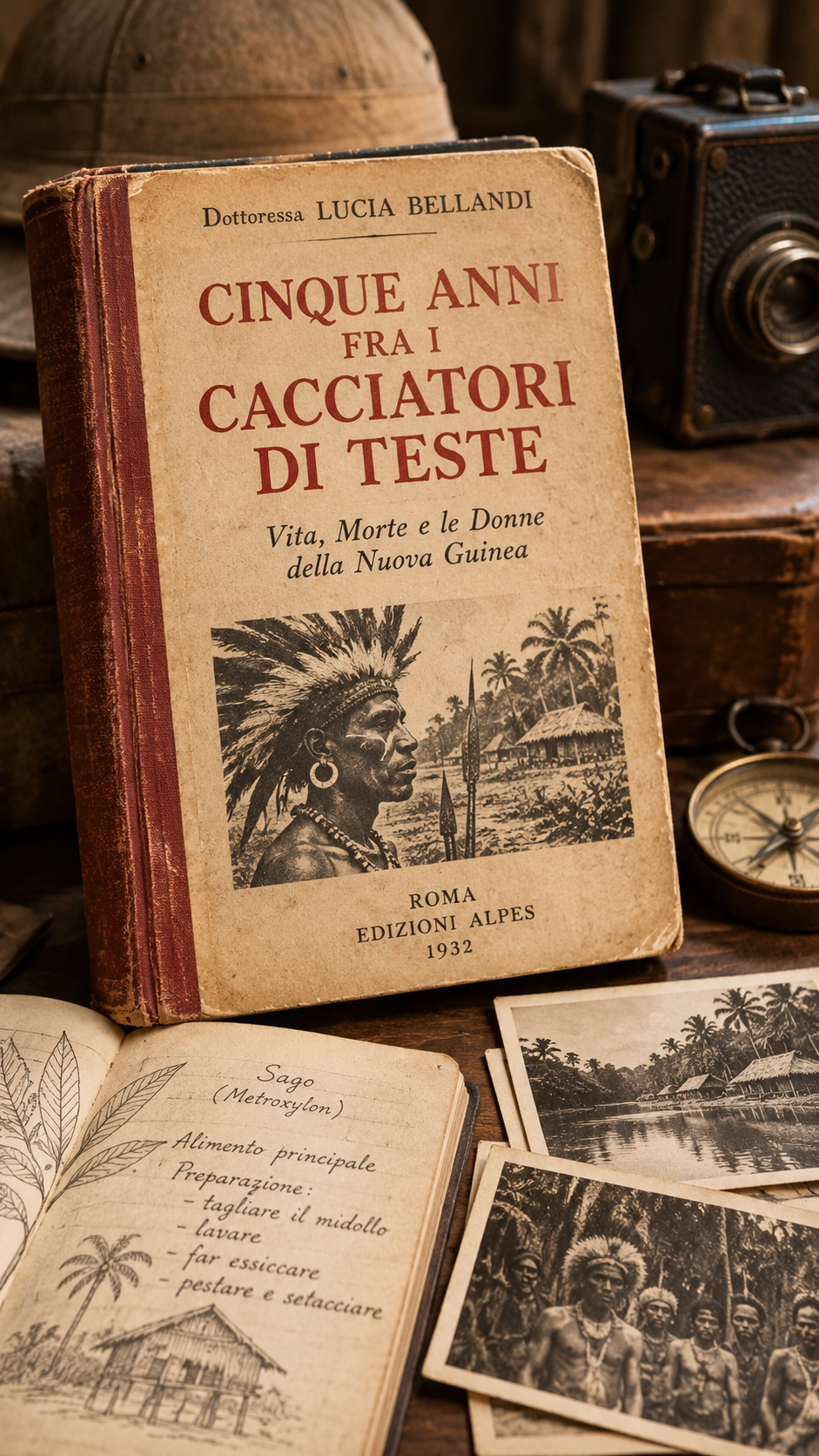
The celebrated first edition of Dottoressa Bellandi's “Cinque Anni fra i Cacciatori di Teste,” published in Rome in 1932, together with her original field notebooks, photographs, and scientific instruments.
The question Rome cannot stop asking
There remains, however, one question which has attracted greater curiosity than almost any other.
Did Dottoressa Bellandi herself take part in the ceremonies she describes?
She emphatically denies having participated in cannibalism or in acts of violence against another community.
But she acknowledges that there are details of her adopted household's private ceremonies which she has deliberately omitted from her published account.
"Not every confidence belongs to the public," she declared.
When pressed to explain, she merely smiled.
For the present, the celebrated traveler intends to remain in Genoa, where she is preparing a collection of scientific papers concerning the medical knowledge and botanical practices of the people she came to know.
She has also begun corresponding with institutions interested in exhibiting her photographs.
Whether another expedition is contemplated, she refuses to say.
Our correspondent finally asked whether five years among people whose customs had so profoundly shocked her had altered her opinion of civilization.
Dottoressa Bellandi considered the question for some moments.
Then she answered:
"I have lived among men who kept the heads of their enemies, and I have returned to a Europe where we build monuments to men who send thousands to their deaths. I am no longer certain which of us has the greater need to explain ourselves."
The interview ended shortly afterward.
Editor's Note: This article is a work of historical fiction, written in the style of a contemporary newspaper report. The central character, her personal experiences, interviews, and book are fictional. The geographical setting and certain historical practices are based on documented accounts of southern New Guinea in the early twentieth century.
Writing one? Publish your story on the BudgetPixel blog.





 @crabmouse

 @EternaSky

 @CaylaCatz


 @Sealine