
Part 1 of Women Who Made Headlines
The Woman Who Crossed Two Forbidden Worlds
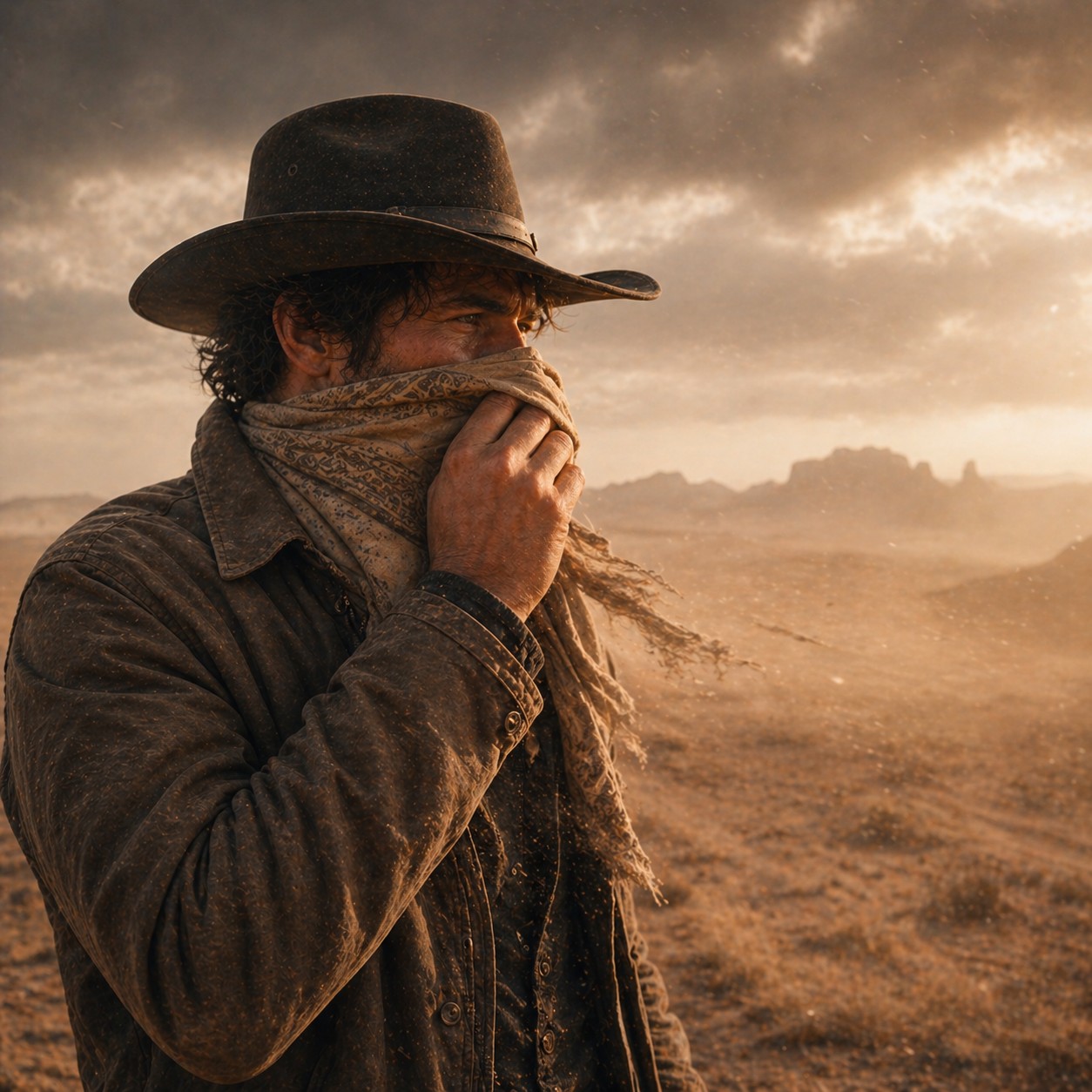 @germancowboy
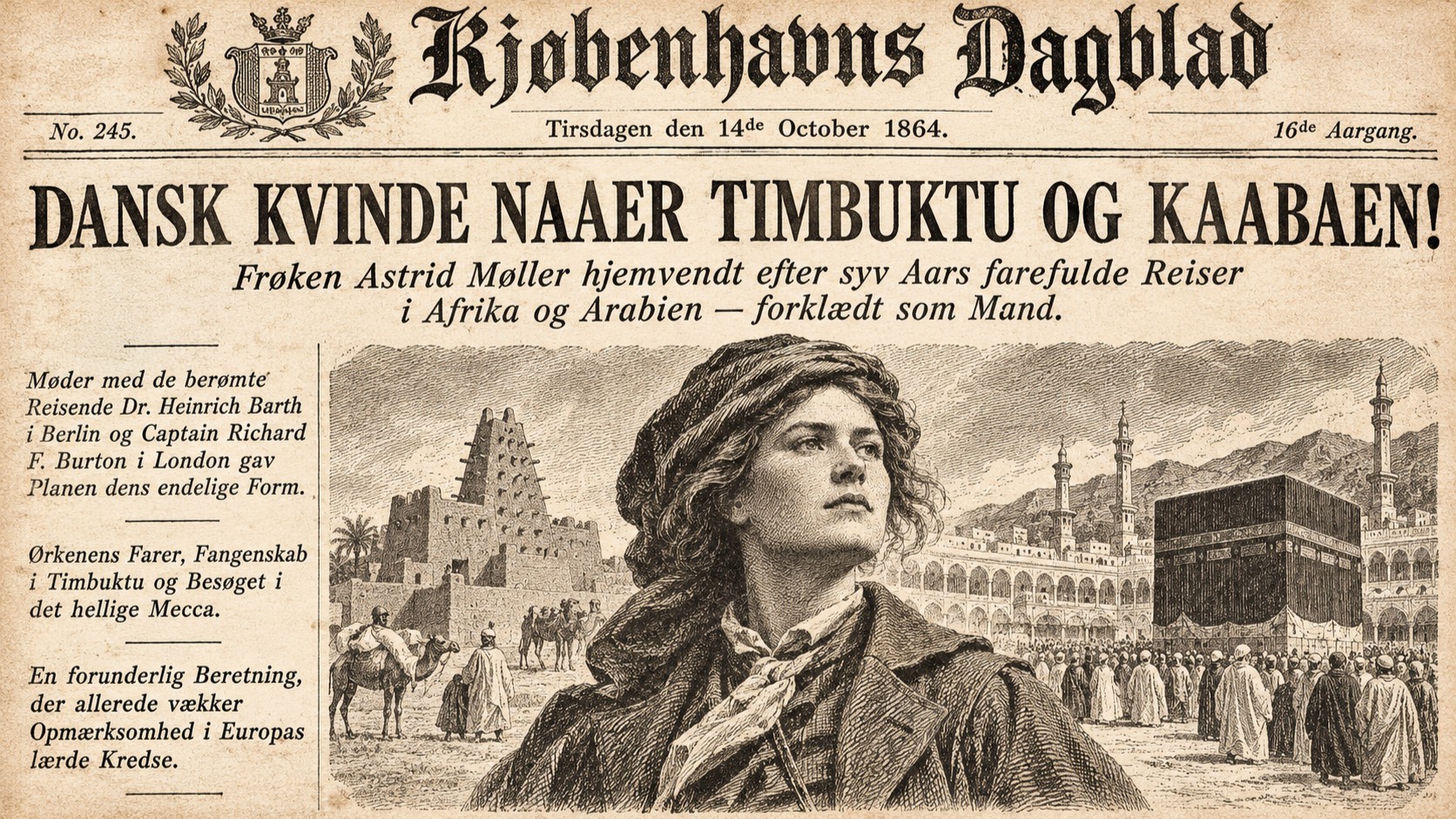
THE EXTRAORDINARY DISCOVERIES OF FRØKEN ASTRID MØLLER · OCTOBER 14, 1864
DANISH WOMAN REACHES TIMBUKTU AND THE KAABA!
Disguised as a man, Frøken Astrid Møller returns from seven years of extraordinary travels — encounters with celebrated explorers, imprisonment, desert storms, and a journey into the sacred city of Mecca.
COPENHAGEN, October 14, 1864. — At a time when the affairs of our unhappy kingdom have occupied nearly every column of the European press, an event of the most singular character has attracted considerable attention among the learned gentlemen of this capital.
Frøken Astrid Møller, aged thirty-one, daughter of the late Captain Frederik Møller of Copenhagen, has returned from a journey which, if her accounts are confirmed, must be regarded as among the most remarkable ever undertaken by a Danish traveler, whether man or woman.
For nearly seven years she has traveled under the assumed name of Arne Møller, passing herself off as a young gentleman engaged in the study of geography, languages, and the customs of foreign nations.
During that time she has crossed the Sahara, entered the celebrated city of Timbuktu, traversed portions of the Ottoman dominions, and finally stood before the Kaaba in the holy city of Mecca.
That the traveler responsible for these exploits should prove to be a woman has occasioned no small astonishment.
A most unusual education
Frøken Møller was born in Copenhagen in February 1833, the second daughter of a merchant captain whose vessels traded with the Mediterranean ports.
Her father, a man of considerable education and uncommon opinions, insisted that his daughters receive instruction ordinarily reserved for sons.
By her sixteenth year, Astrid had acquired French, German, English, and Latin, besides elementary knowledge of astronomy, mathematics, navigation, and the drawing of maps.
She subsequently devoted herself to the study of Arabic, receiving private instruction from a scholar acquainted with the languages of the Levant.
She is also said to possess a practical knowledge of first aid, botanical collecting, surveying instruments, and the use of firearms.
Her mother, who died while Astrid was still young, had hoped that these accomplishments might eventually secure her daughter a respectable position as a governess.
Frøken Møller appears to have entertained quite different ambitions.
"When my father showed me a map," she told our correspondent, "I was less interested in what had been drawn upon it than in what had been left blank."
A modest inheritance, supplemented by the proceeds of translating foreign books, provided the means for her first travels.
Her original intention was to visit Constantinople and Egypt.
She admits that this plan was abandoned almost immediately.
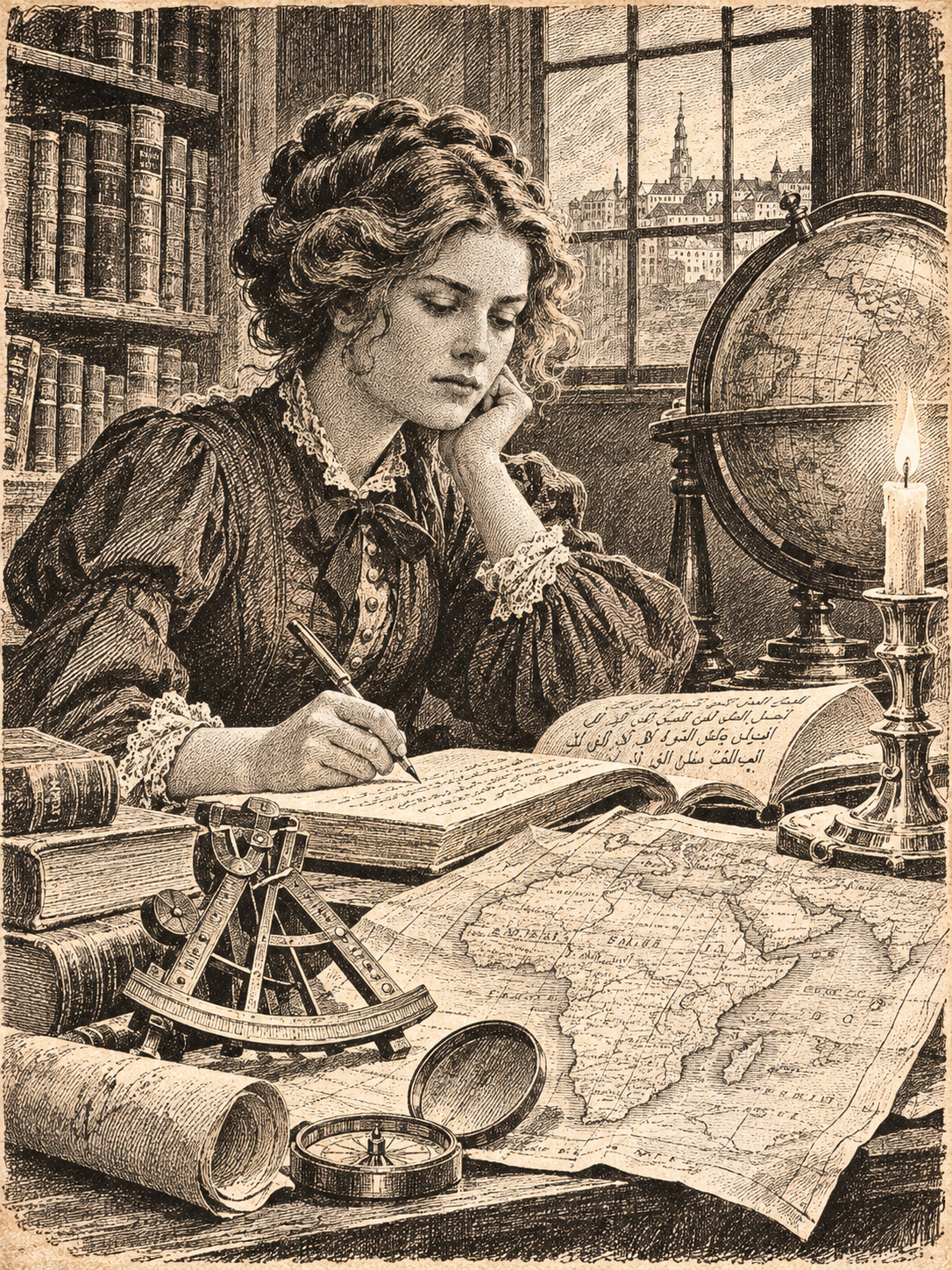
Frøken Møller at her studies in Copenhagen, preparing for the remarkable journeys that would astonish the learned societies of Europe.
Two celebrated explorers
Among the most remarkable claims made by Frøken Møller are her acquaintances with two gentlemen whose names are already familiar to readers of geographical literature.
During a visit to Berlin in 1856, she is said to have obtained an introduction to Dr. Heinrich Barth, the distinguished German traveler who had returned from his celebrated explorations of Central Africa the previous year.
Dr. Barth, whose experiences included a prolonged residence in Timbuktu, reportedly examined her geographical notebooks and questioned her concerning her knowledge of Arabic.
According to Frøken Møller, he initially regarded her proposed journey as exceedingly imprudent.
When she announced her intention to travel without revealing her sex, he is reported to have replied:
"Then, Fräulein, you must be twice as careful as the ordinary traveler, for you will have twice as much to conceal."
She credits him with valuable observations concerning caravan routes, regional politics, and the necessity of obtaining trustworthy local protection.
A subsequent visit to London brought her into contact with Captain Richard Francis Burton, already renowned for his journey to Mecca in 1853.
Captain Burton is said to have been greatly amused by her ambitions, though considerably less amused by the danger in which she proposed to place herself.
"He told me that clothing alone would deceive nobody," she recalled. "One must understand how to speak, how to eat, when to remain silent, and, above all, when not to ask questions."
Whether these distinguished gentlemen would recognize every particular of the conversations attributed to them remains to be established.
There can be little doubt, however, that Frøken Møller had made an unusually thorough study of their published researches.
The road to Timbuktu
In the spring of 1857, the young Dane departed Europe, traveling first through the Mediterranean and subsequently entering North Africa.
There she adopted the identity of Arne Møller, a young merchant's assistant of Danish extraction who had lived abroad since childhood.
Her hair was cut short, her figure concealed beneath loose garments, and her voice carefully trained to a lower register.
For several months she traveled with merchants, learning the requirements of caravan life before attempting the great desert crossing.
The hardships were formidable.
During one passage through the Sahara, a violent sandstorm separated her from the principal caravan. For two days she wandered with a single exhausted camel and a water skin containing scarcely enough to sustain her until morning.
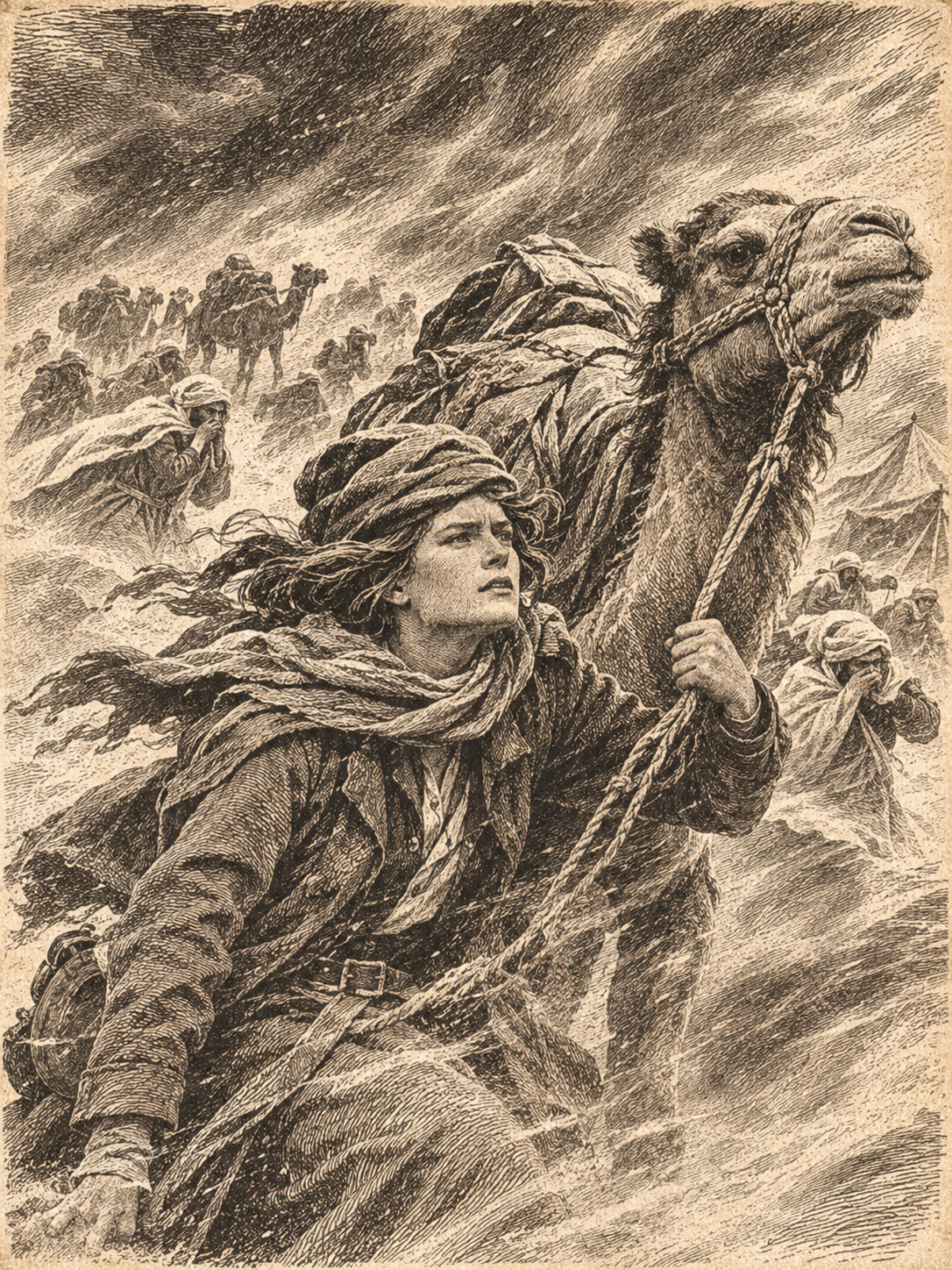
Separated from her caravan in the Sahara, Frøken Møller struggles against the desert winds with little water and only a single camel.
On another occasion, fever confined her to a miserable shelter for seventeen days, during which she was attended by an elderly local woman who, Frøken Møller believes, discovered her secret.
"She looked at me for a long time," the traveler remembered. "Then she brought another blanket, told the men I was not to be disturbed, and never spoke of the matter again."
By 1860, after numerous delays, journeys through the western Sudan, and an extended illness, she at last entered Timbuktu.
The city, so long celebrated in European accounts for its supposed riches, did not entirely correspond with her expectations.
She discovered a place of commerce and religious learning, with important mosques, markets, and collections of manuscripts, but none of the fabulous streets of gold described in popular stories.
Her attention was particularly attracted by its scholars and booksellers.
She claims to have copied several passages from manuscripts concerning the history of the Songhai Empire, together with astronomical calculations and accounts of older caravan routes.
One local scholar, whose name she records as Abdallah ibn Mahmud, allegedly permitted her to examine a small private collection after discovering her familiarity with Arabic.
She spent many evenings copying notes by lamplight, keeping her private journal carefully concealed.
"It was not gold I found in Timbuktu," she declared. "It was learning. And that, gentlemen, is a far greater treasure."
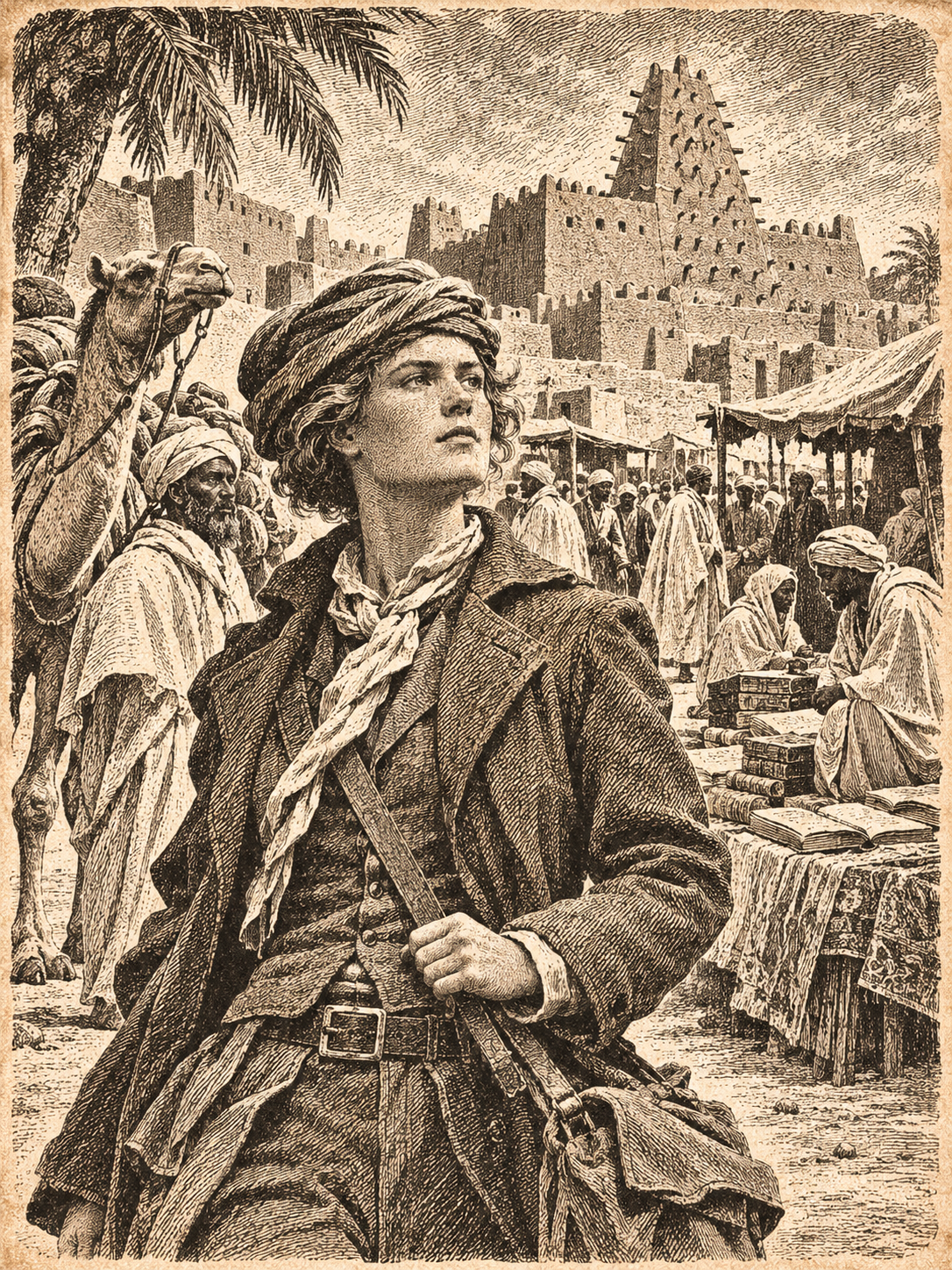
The Danish traveler enters the celebrated city of Timbuktu in 1860, after years of hardship and perilous journeys across Africa.
A discovery nearly paid for with her life
Her residence in the city was not without danger.
An accusation that she was a foreign spy brought her before a local authority, and she was detained for several days while the nature of her travels was investigated.
Her books and papers were examined, though the most important portions of her journal had been entrusted to a sympathetic merchant.
It was only through the intervention of local acquaintances, together with assurances that she had no political purpose, that she was permitted to depart.
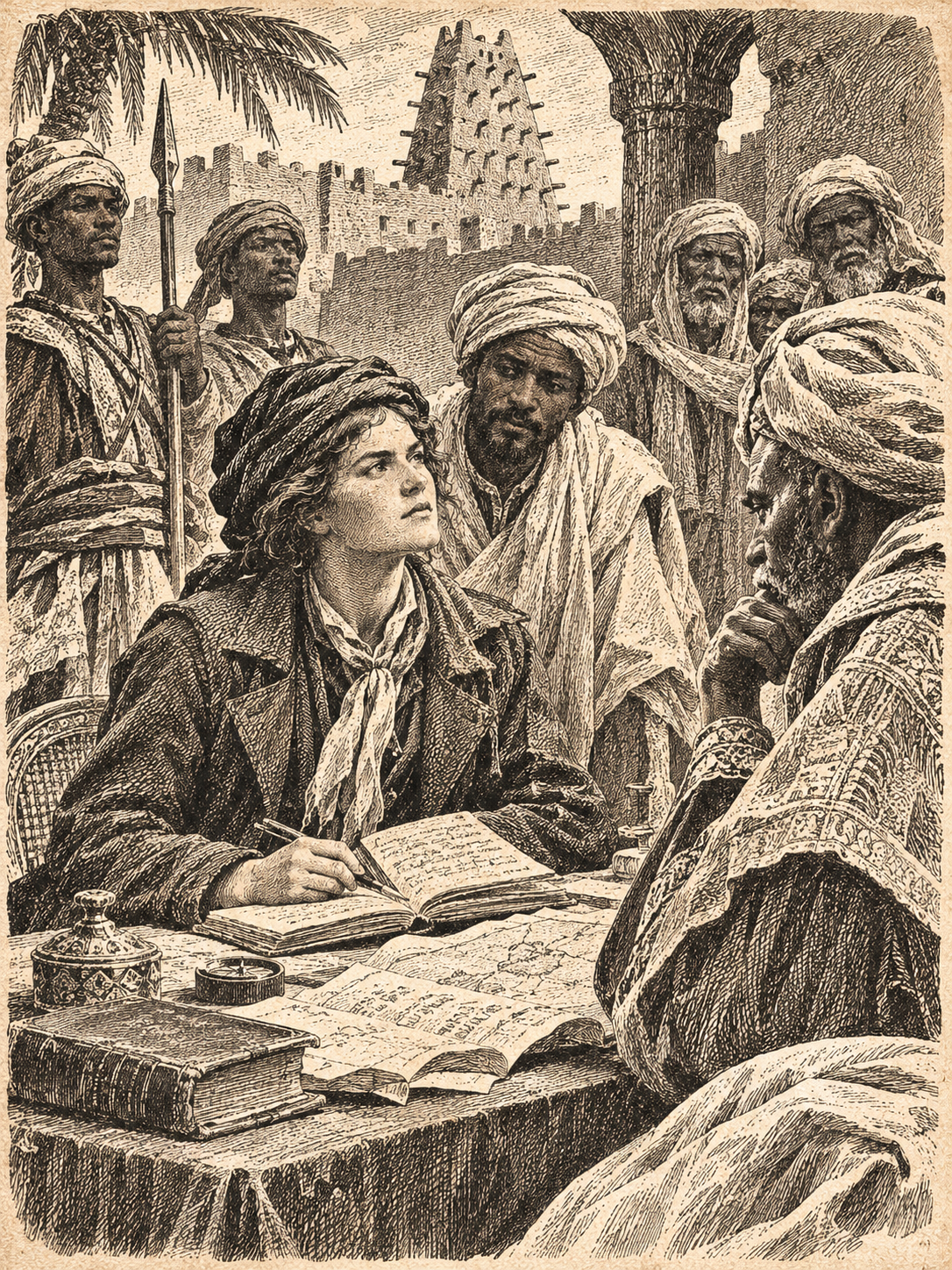
Suspected of espionage, Frøken Møller is summoned before local authorities in Timbuktu, where her papers and true identity are placed in grave danger.
She subsequently made her way northward and eastward, sometimes traveling with merchants, at other times accompanying caravans of pilgrims.
Two members of one party died of illness, and another traveler was lost during a desert crossing.
A second attack of fever left her so weakened that she was obliged to remain in Cairo for several months.
There she began preparations for the most extraordinary, and unquestionably the most dangerous, undertaking of her travels.
Within sight of the Kaaba
Having already studied the published accounts of Captain Burton, Frøken Møller determined to attempt an entrance into Mecca.
She was aware that the holy city was closed to non-Muslims and that discovery of her deception might bring grave consequences.
She therefore spent much of 1861 perfecting her knowledge of religious practices, local customs, and the Arabic expressions necessary for travel among pilgrims.
It must be observed that women themselves are not excluded from the pilgrimage. Frøken Møller's masculine disguise was intended to preserve the independent identity under which she had traveled for so many years, rather than to overcome any general prohibition upon women entering Mecca.
In 1862 she traveled through the Red Sea to the Arabian coast and subsequently joined a caravan bound for the sacred city.
Her account of the final approach is among the most remarkable passages in her journal.
For several days she was scarcely able to sleep, so fearful was she that a chance word or gesture might expose her identity.
At length the caravan entered Mecca.
She describes crowded streets, pilgrims of many nations, and the extraordinary atmosphere surrounding the great mosque.
There, at last, she beheld the Kaaba.
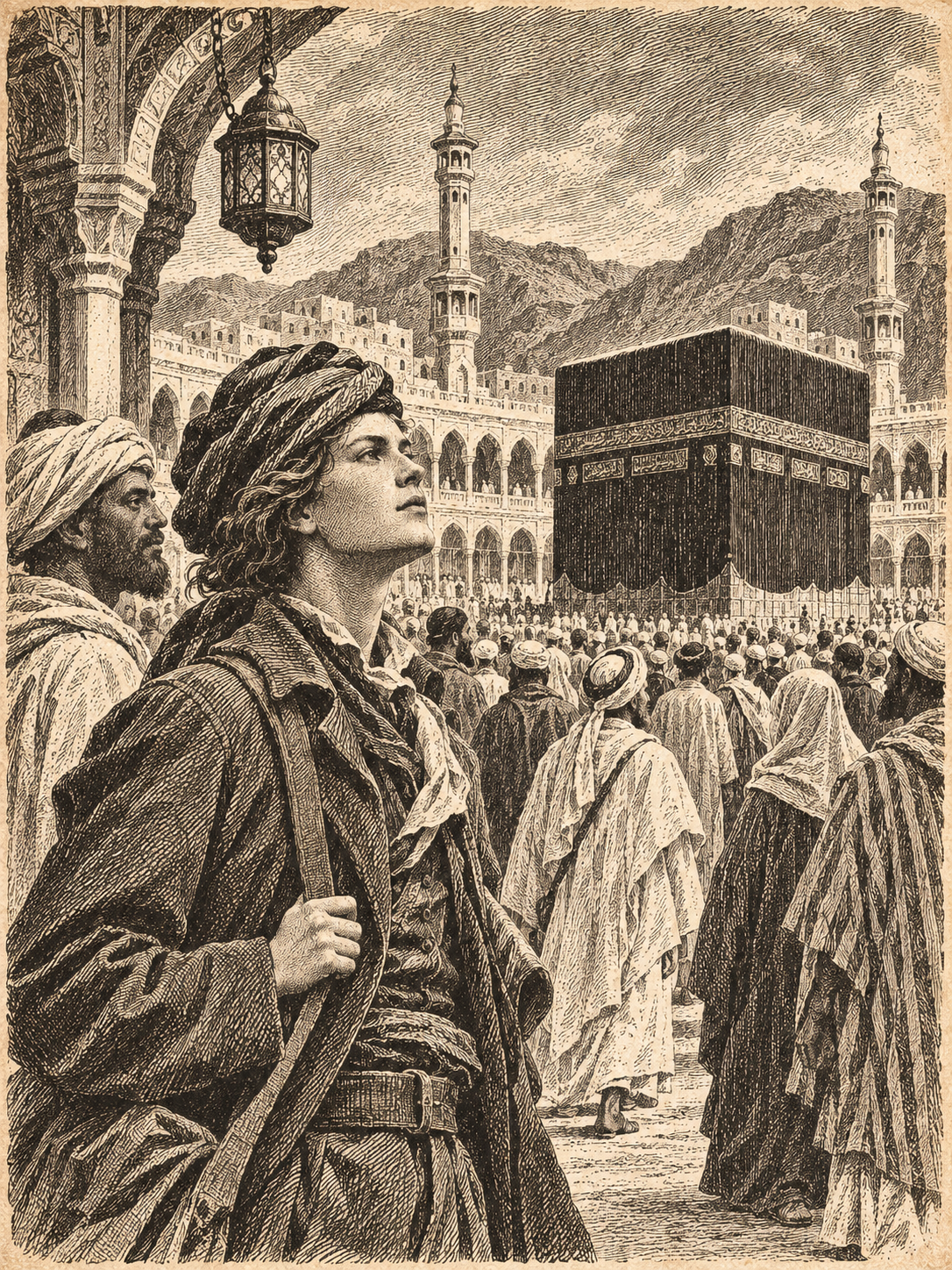
Disguised as a male traveler, Frøken Møller beholds the sacred Kaaba in Mecca in 1862, fulfilling the most audacious ambition of her extraordinary expedition.
"For a moment," she told our correspondent, "I forgot the dangers through which I had passed. I saw neither the journey behind me nor the long road home. I saw only the place which I had crossed half the world to behold."
She remained only a brief time.
A fellow traveler, suspicious of her reluctance to join certain communal activities, began questioning her origins and religious education.
Fearing discovery, she departed at the earliest opportunity.
She refuses to disclose the names of several persons who assisted her, stating that their kindness should not be repaid by bringing them unwelcome attention.
The secret revealed
Frøken Møller reached Europe again in 1863, having spent almost seven years away from Denmark.
By then her face had been darkened by the sun, her hands hardened by travel, and her constitution weakened by repeated illness.
She arrived at a relative's residence in Copenhagen wearing the same masculine clothing in which she had undertaken much of her journey.
It is said that the servant refused her admission, believing her to be an unfamiliar foreign gentleman.
Only after she identified herself and related certain private family particulars was she recognized.
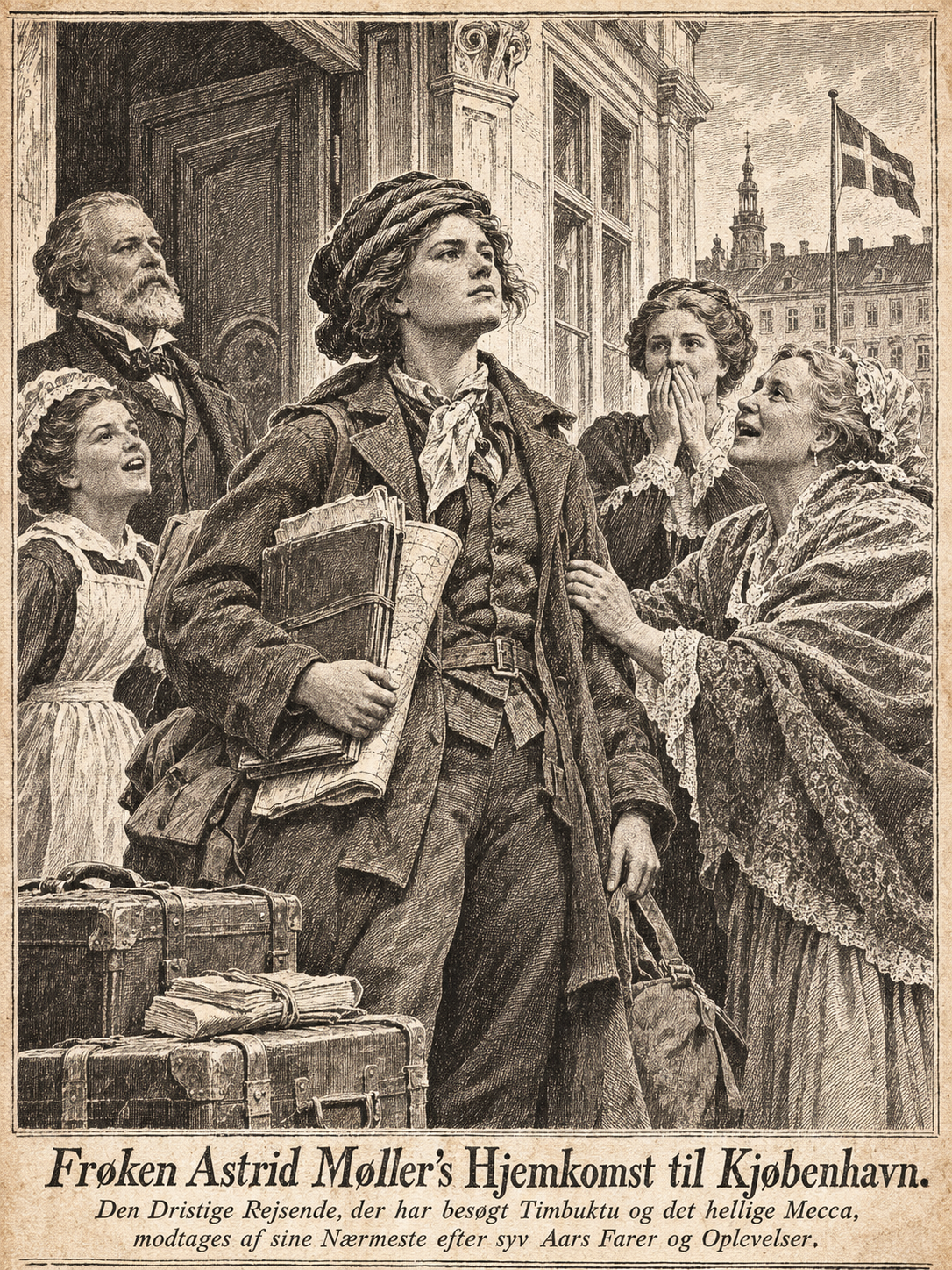
After seven years abroad, the intrepid explorer returns to her astonished relatives, bearing trunks filled with journals, maps, and accounts of distant lands.
Her surviving notebooks, maps, sketches, and manuscripts filled several trunks.
Some had been damaged by water, others by insects, while an entire volume of observations was lost when a pack animal fell during a mountain crossing.
Nevertheless, sufficient material remained to occupy her for many months.
And it is this material which has now given rise to what promises to become one of the most remarkable publications of recent years.
The Book That Astonished the Reading Public
A literary sensation has appeared in the bookshops of Copenhagen.
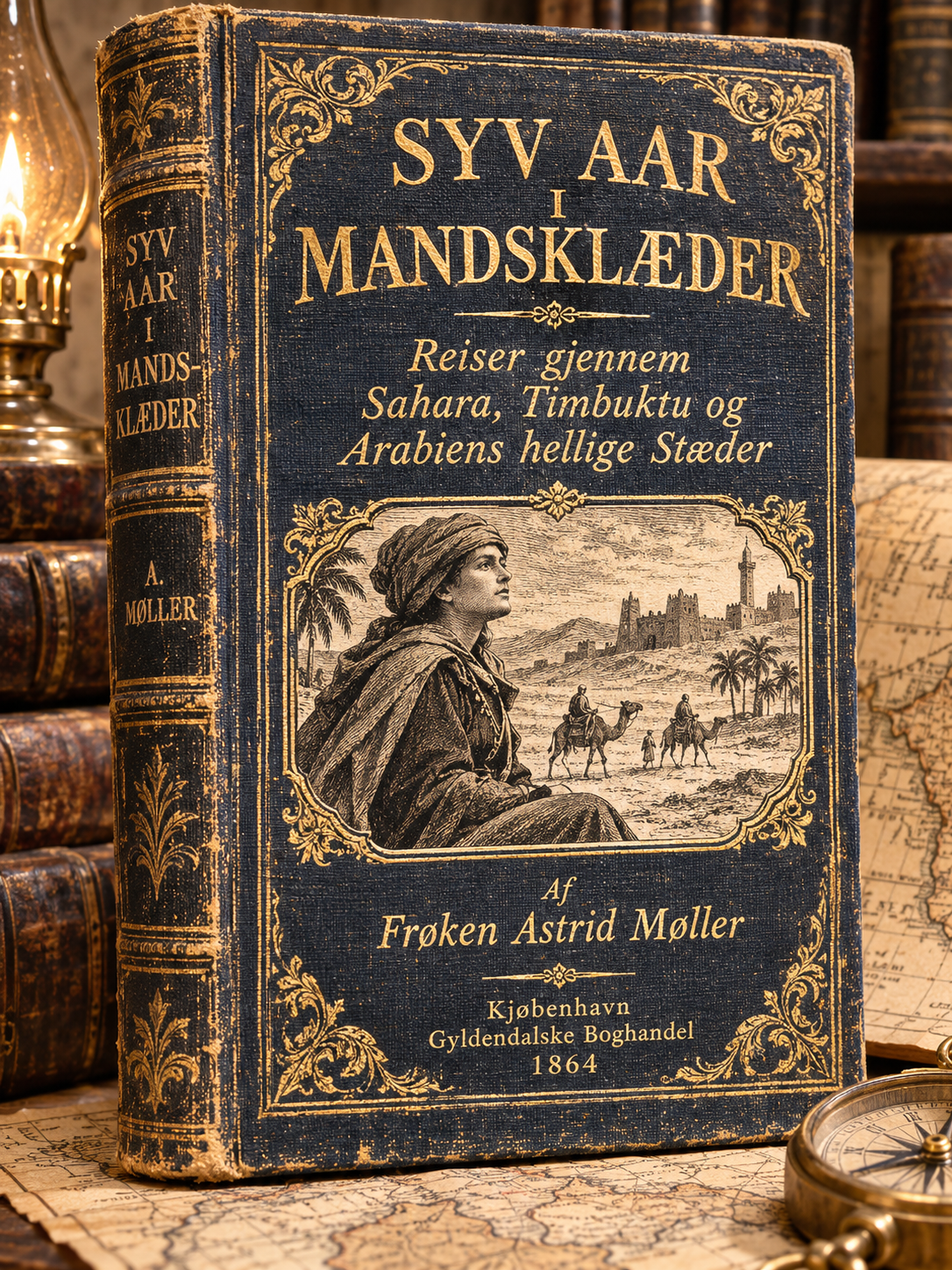
Published only last month, Frøken Møller's extraordinary account, Syv Aar i Mandsklæder (Seven Years in Men's Clothing), has already attracted considerable attention among scholars, travelers, and the reading public.
The volume contains her personal journals, geographical observations, descriptions of distant peoples, and numerous illustrations prepared from sketches made during her travels.
Particular interest surrounds her descriptions of Timbuktu and the holy city of Mecca, together with her remarkable account of the hardships endured while traveling under a masculine identity.
We understand that the first printing has met with unexpected demand, while negotiations concerning German and English translations are already underway.
Not all gentlemen of the geographical profession have accepted her claims without question. Yet even her severest critics acknowledge the unusual knowledge of languages, geography, and foreign customs displayed throughout the work.
Frøken Møller appears little troubled by the controversy.
"I have written what I witnessed," she informed our correspondent. "Those who doubt me are welcome to undertake the journey themselves."
The publisher has announced that a second printing is under consideration.
What remains to be discovered?
There is now considerable speculation concerning the future of this singular woman.
Will she be invited to address the geographical societies of Europe? Will the authorities of Copenhagen examine her manuscripts? And will the distinguished travelers whose names occur in her journal lend their support to her extraordinary claims?
For the present, Frøken Møller has expressed a desire to recover her health and complete the arrangements for her book.
She has, however, refused to promise that her traveling days are finished.
When asked whether seven years of danger, illness, and hardship had finally satisfied her curiosity, she smiled.
"Certainly not," she replied. "I have seen enough of the world to know how little of it I have seen."
And with that observation, the most extraordinary Danish traveler of recent years closed her notebook.
Editor's Note: This article is a work of historical fiction. Although it incorporates authentic historical settings, events, and personalities, the central character and her adventures are products of the author's imagination. The story has been written in the journalistic style of its period to recreate the atmosphere of a contemporary newspaper report.
Writing one? Publish your story on the BudgetPixel blog.





 @CaylaCatz

 @EternaSky
 @crabmouse

 @DavidP

 @monkeydude69