
Part 4 of The AI Creative Workshop
Same Woman, Different Scene!
 @germancowboy
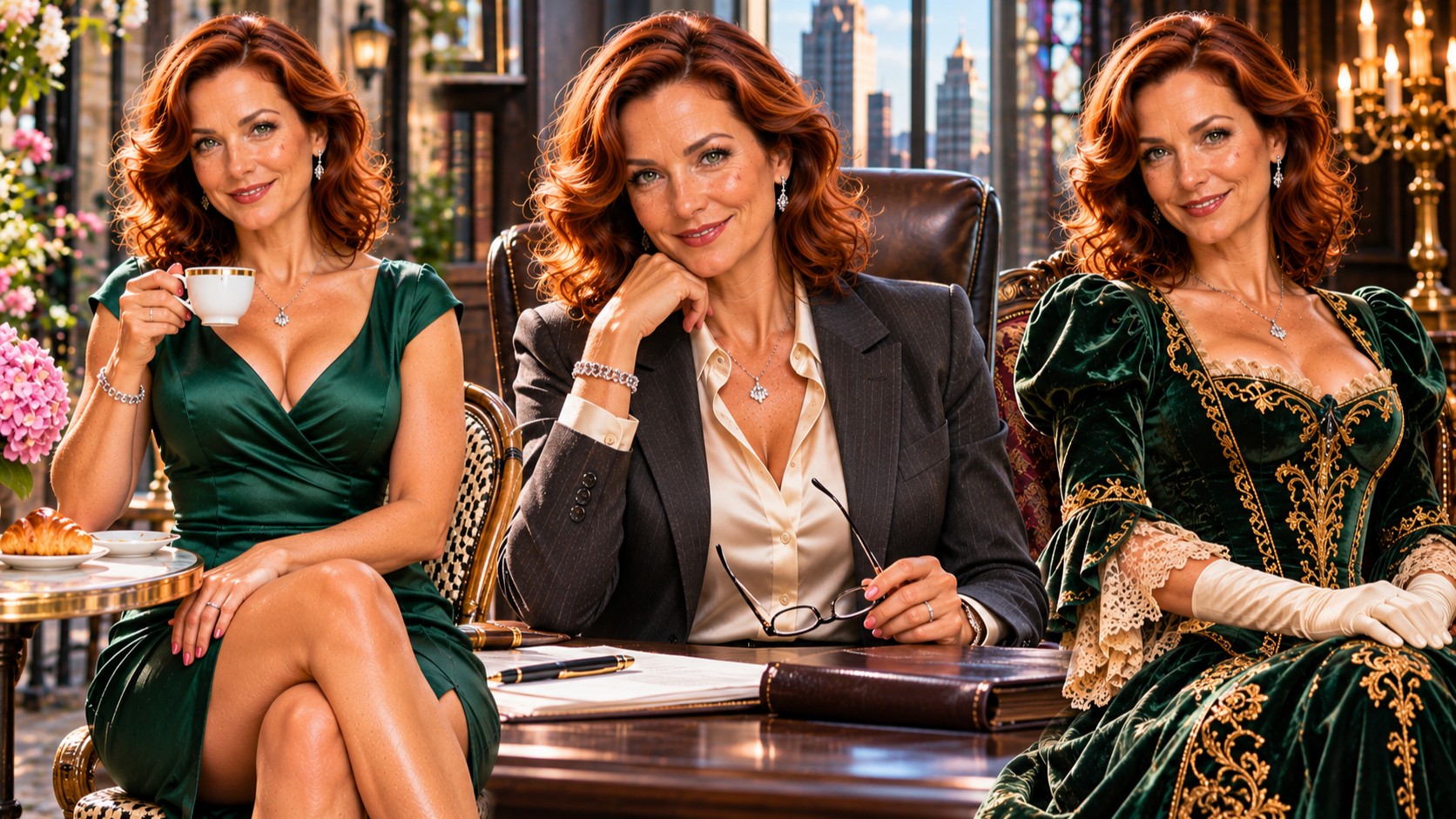
How to Keep AI Characters Consistent
Quick How-To Guide — One Woman, Six Scenes, and the Challenge of Making Her Look Like Herself
Who Is That Woman, and What Happened to the Original?
You've created a beautiful AI image.
Your character looks perfect. Her face is exactly what you imagined, her hairstyle is gorgeous, and her outfit is just right.
Now you'd like to show her somewhere else.
Perhaps she is leaving a luxury hotel, sitting in a restaurant, walking through a rainy city, or enjoying a quiet evening at home.
You enter another prompt, describe the same woman, and generate the next image.
And suddenly...
Who is this stranger?
Her hair has changed. Her face is different. She looks ten years younger. Her eyes have changed color. And somehow, she's wearing an entirely different outfit.
Welcome to one of the biggest challenges in AI image storytelling: character consistency.
A person who appears perfectly recognizable in one generated image may look surprisingly different in the next.
Fortunately, there are several techniques that can help.
For this tutorial, we're going to create one fictional character and follow her through six different scenes, changing her surroundings and activities while keeping her essential appearance consistent.
1. Create a Character Before You Create a Scene
One of the most useful habits in AI image creation is to define your character before writing the scene.
Instead of describing a woman differently every time, create a standard character description that can be reused.
For our examples, meet Victoria Bennett.
Victoria is a striking 47-year-old woman with shoulder-length copper-red hair styled in soft waves, green eyes, fair skin with subtle freckles across her nose, an oval face, a gently defined jawline, and a distinctive small beauty mark beneath her left eye.
She has a confident but approachable expression and a sophisticated personal style.
These features will be our reference points.
Character description:
Victoria Bennett, a striking 47-year-old woman with shoulder-length copper-red hair styled in soft waves, green eyes, fair skin with subtle freckles across her nose, an oval face, a gently defined jawline, and a distinctive small beauty mark beneath her left eye. Natural facial proportions, realistic skin texture, confident and approachable expression.
We'll repeat this description in every example.
Example Prompt 1 — Meet Victoria Bennett
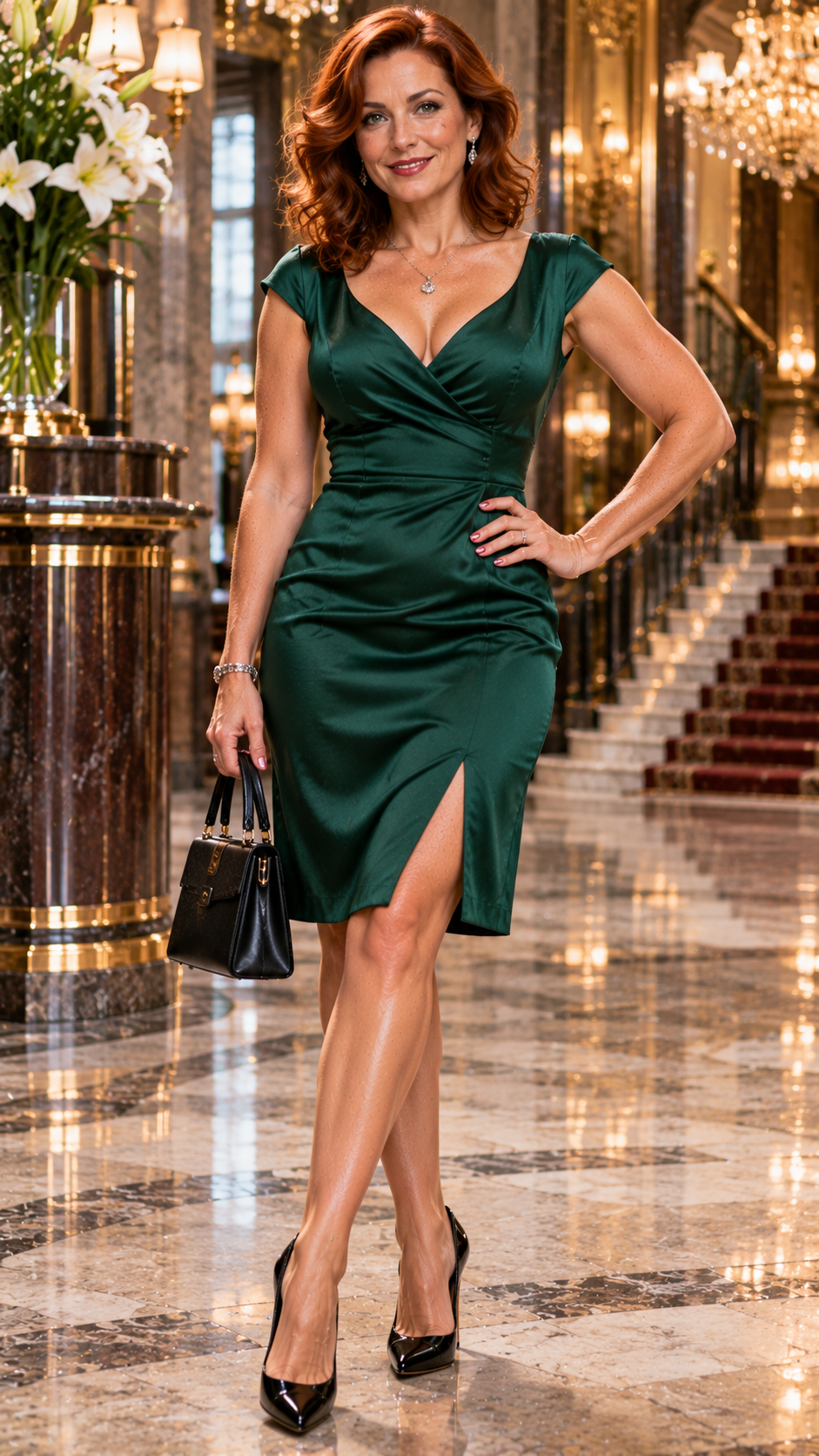
Victoria Bennett, a striking 47-year-old woman with shoulder-length copper-red hair styled in soft waves, green eyes, fair skin with subtle freckles across her nose, an oval face, a gently defined jawline, and a distinctive small beauty mark beneath her left eye. She wears a beautifully tailored emerald-green knee-length cocktail dress and glossy black high-heeled pumps.
Victoria stands confidently inside the entrance hall of a luxurious historic hotel, one hand resting lightly on her hip and the other holding a small black handbag. She looks directly toward the camera with a friendly, knowing smile.
Full-body fashion portrait, warm golden interior lighting, elegant marble floors, sophisticated cinematic photorealism, natural facial proportions, realistic skin texture, 9:16 vertical composition.
Why it helps: This first image establishes the character's recognizable appearance. It can also become the reference photograph for later scenes.
2. Keep the Face, Change the Location
Now comes the first real test.
We want Victoria to appear somewhere completely different without becoming a different woman.
The easiest approach is to keep her character description identical and change only the surrounding scene and activity.
Avoid reinventing her appearance with new adjectives.
If her first prompt describes shoulder-length copper-red hair, don't suddenly describe long auburn curls unless you actually want a different hairstyle.
Example Prompt 2 — An Afternoon at the Café
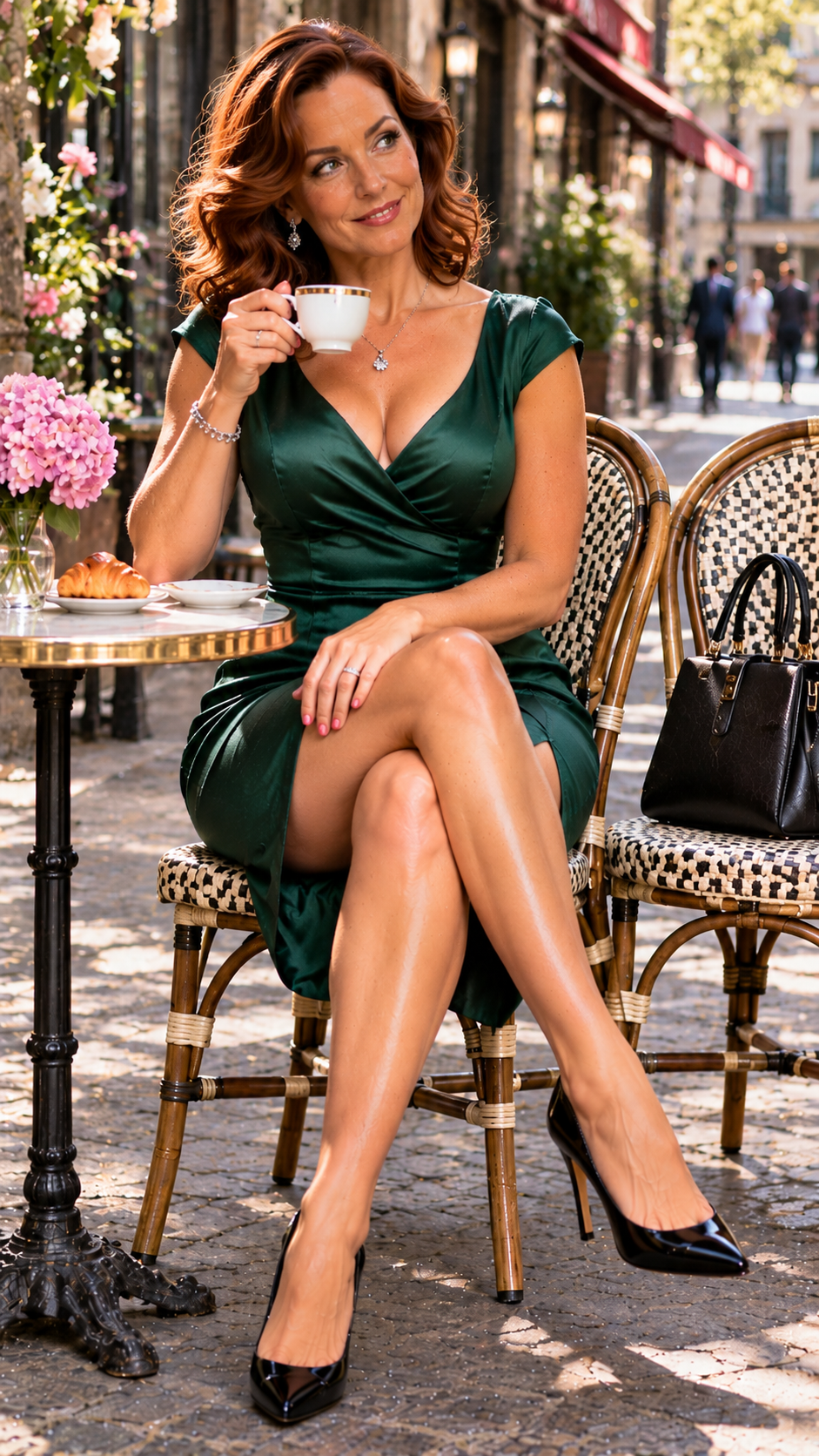
Victoria Bennett, a striking 47-year-old woman with shoulder-length copper-red hair styled in soft waves, green eyes, fair skin with subtle freckles across her nose, an oval face, a gently defined jawline, and a distinctive small beauty mark beneath her left eye.
She wears the same beautifully tailored emerald-green knee-length cocktail dress and glossy black high-heeled pumps as in her original hotel portrait.
Victoria sits at a small outdoor café table on a charming European city street, holding a porcelain coffee cup while smiling thoughtfully toward the camera. Her black handbag rests on the empty chair beside her.
The photographer captures her from a natural three-quarter angle, with her facial features clearly visible and her complete seated figure included. Warm afternoon sunlight, attractive historic architecture, sophisticated lifestyle magazine photography, cinematic photorealism, 9:16 vertical composition.
Why it helps: Only the location, posture, and activity have changed. Victoria's core appearance and clothing remain the same.
However, remember that phrases such as the same woman or the same dress are most useful when the image generator can actually see the earlier image. Without that visual reference, the written character description does most of the work.

3. Change the Clothing Without Changing the Woman
Character consistency doesn't mean someone must wear the same dress forever!
In illustrated stories, characters naturally change clothes.
The trick is to separate permanent physical characteristics from temporary details such as outfits, jewelry, and accessories.
Victoria's face, age, eye color, and hairstyle remain consistent.
Her clothing can change to suit the occasion.
Example Prompt 3 — The Businesswoman
Victoria Bennett, a striking 47-year-old woman with shoulder-length copper-red hair styled in soft waves, green eyes, fair skin with subtle freckles across her nose, an oval face, a gently defined jawline, and a distinctive small beauty mark beneath her left eye.
Victoria now wears an elegant charcoal-gray tailored business suit, an ivory silk blouse, and black leather high-heeled pumps. Her copper-red hair retains its familiar shoulder-length soft waves.
She stands beside a large mahogany desk inside a sophisticated executive office overlooking the city skyline. One hand rests on a closed leather portfolio while the other holds her reading glasses. She looks toward the camera with a confident, professional smile.
Natural facial proportions, realistic skin texture, full-body executive fashion photography, beautifully balanced composition, soft afternoon window lighting, cinematic photorealism, 9:16 vertical format.
Why it helps: The clothing and setting change, but the underlying character description stays intact.
This is especially useful when illustrating stories that take place over several days or weeks.
4. Change the Lighting Without Changing Her Identity
Lighting can dramatically change how a person appears.
A face photographed in warm afternoon sunlight may look surprisingly different under blue neon lights or harsh overhead illumination.
Even in real photography, shadows and highlights influence facial appearance.
AI image generators sometimes exaggerate those changes.
To improve consistency, keep the character's description stable while specifying how the lighting affects the scene.
Example Prompt 4 — A Rainy Night in the City
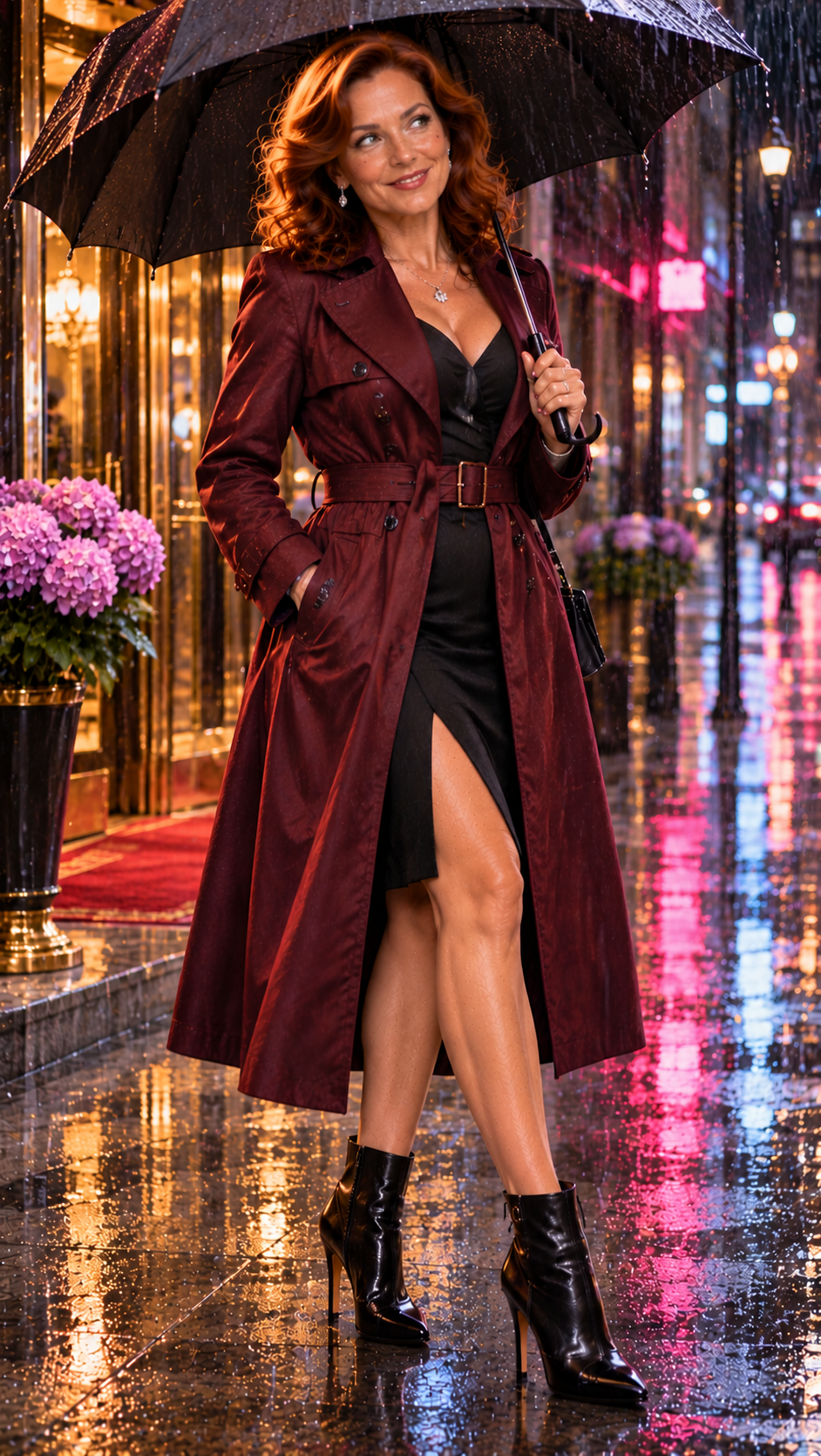
Victoria Bennett, a striking 47-year-old woman with shoulder-length copper-red hair styled in soft waves, green eyes, fair skin with subtle freckles across her nose, an oval face, a gently defined jawline, and a distinctive small beauty mark beneath her left eye.
She wears a sophisticated dark burgundy trench coat over a fitted black dress, with elegant black high-heeled ankle boots. Her familiar copper-red hair falls in soft waves around her shoulders.
Victoria stands beneath the illuminated entrance of a luxury hotel on a rainy evening, holding a black umbrella and looking toward the camera with a playful smile.
Pink and blue neon reflections illuminate the wet pavement, while soft frontal lighting keeps her facial features clearly visible. Complete figure from head to toe, realistic facial proportions, natural skin texture, cinematic nighttime fashion photography, 9:16 vertical composition.
Why it helps: The setting and lighting are dramatically different, but the subject's recognizable characteristics remain part of the prompt.
If the model changes her face too much, try more balanced lighting rather than relying exclusively on dramatic colored shadows.
5. Keep the Character Recognizable From Different Angles
A character may look wonderfully consistent in frontal portraits but become almost unrecognizable when photographed from the side.
Profiles, over-the-shoulder views, and unusual camera angles give image generators fewer familiar facial details to work with.
This becomes particularly challenging when creating illustrations for an ongoing story.
One useful approach is to introduce new camera angles gradually.
Start with a three-quarter portrait where both eyes and most of the face remain visible.
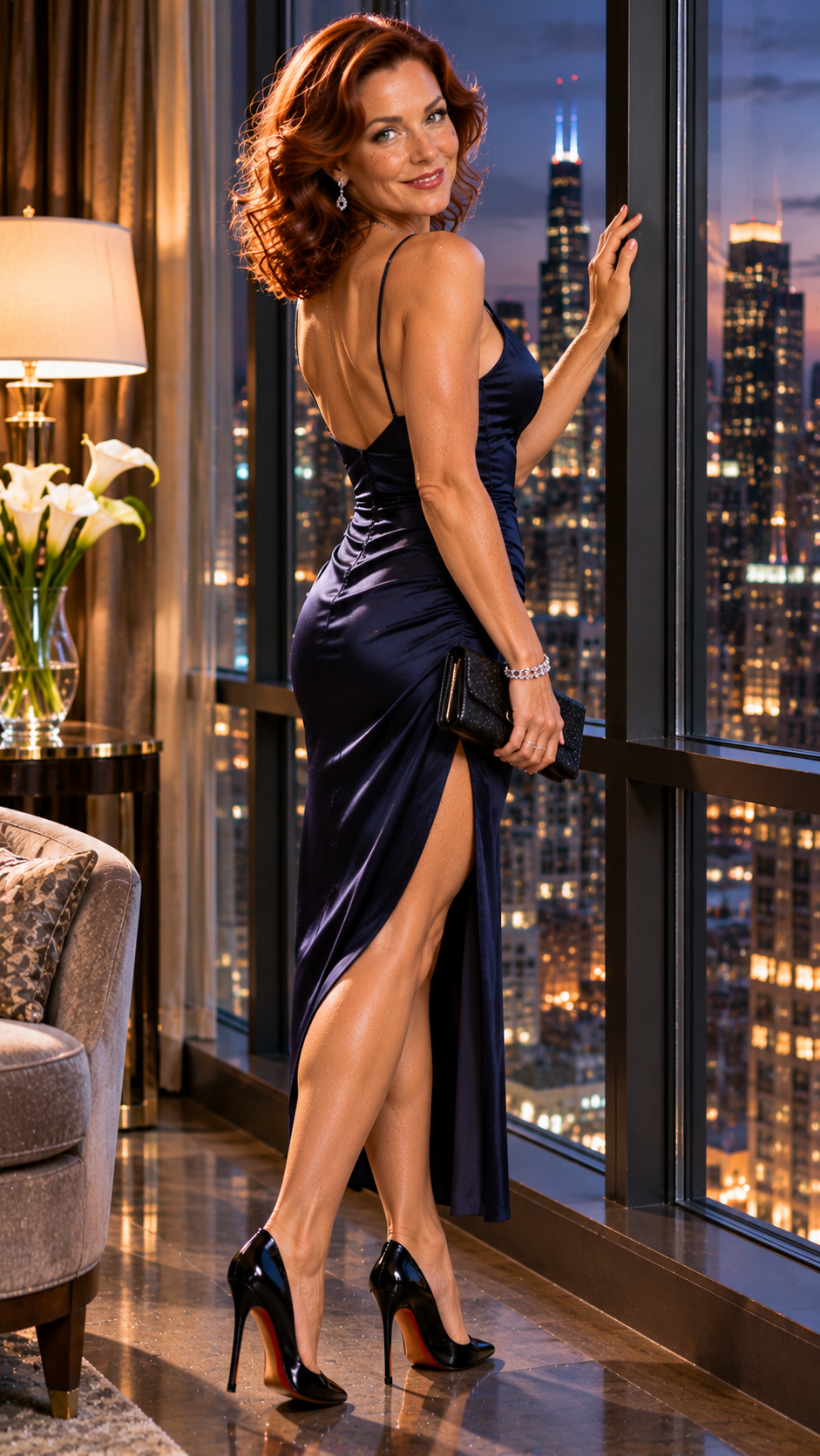
Example Prompt 5 — The Woman at the Window
Victoria Bennett, a striking 47-year-old woman with shoulder-length copper-red hair styled in soft waves, green eyes, fair skin with subtle freckles across her nose, an oval face, a gently defined jawline, and a distinctive small beauty mark beneath her left eye.
She wears an elegant midnight-blue evening dress and matching black high-heeled shoes.
Victoria stands beside a tall window in a luxurious penthouse apartment overlooking the illuminated city skyline. Her body faces partially toward the window, but she turns her head and shoulders back toward the camera, revealing both green eyes and her familiar facial features.
One hand rests naturally on the window frame while the other holds a small evening handbag. She offers a quiet, amused smile.
Beautiful three-quarter camera angle, realistic facial proportions, warm interior light balancing the cool blue city lights outside, full-body cinematic fashion portrait, 9:16 vertical composition.
Why it helps: The three-quarter camera angle introduces variety while retaining enough facial information to recognize the character.
For more extreme profile views, a genuine reference image becomes particularly valuable.
6. Put Her Into a Completely Different World
Now for the ultimate test!
We've shown Victoria in a hotel, a café, an office, a rainy street, and a penthouse.
But what happens when we place her in an entirely different environment?
Perhaps we're illustrating a historical fantasy, an alternate reality, or a story set in another era.
Her clothing and surroundings may change completely, but we still want readers to recognize her.
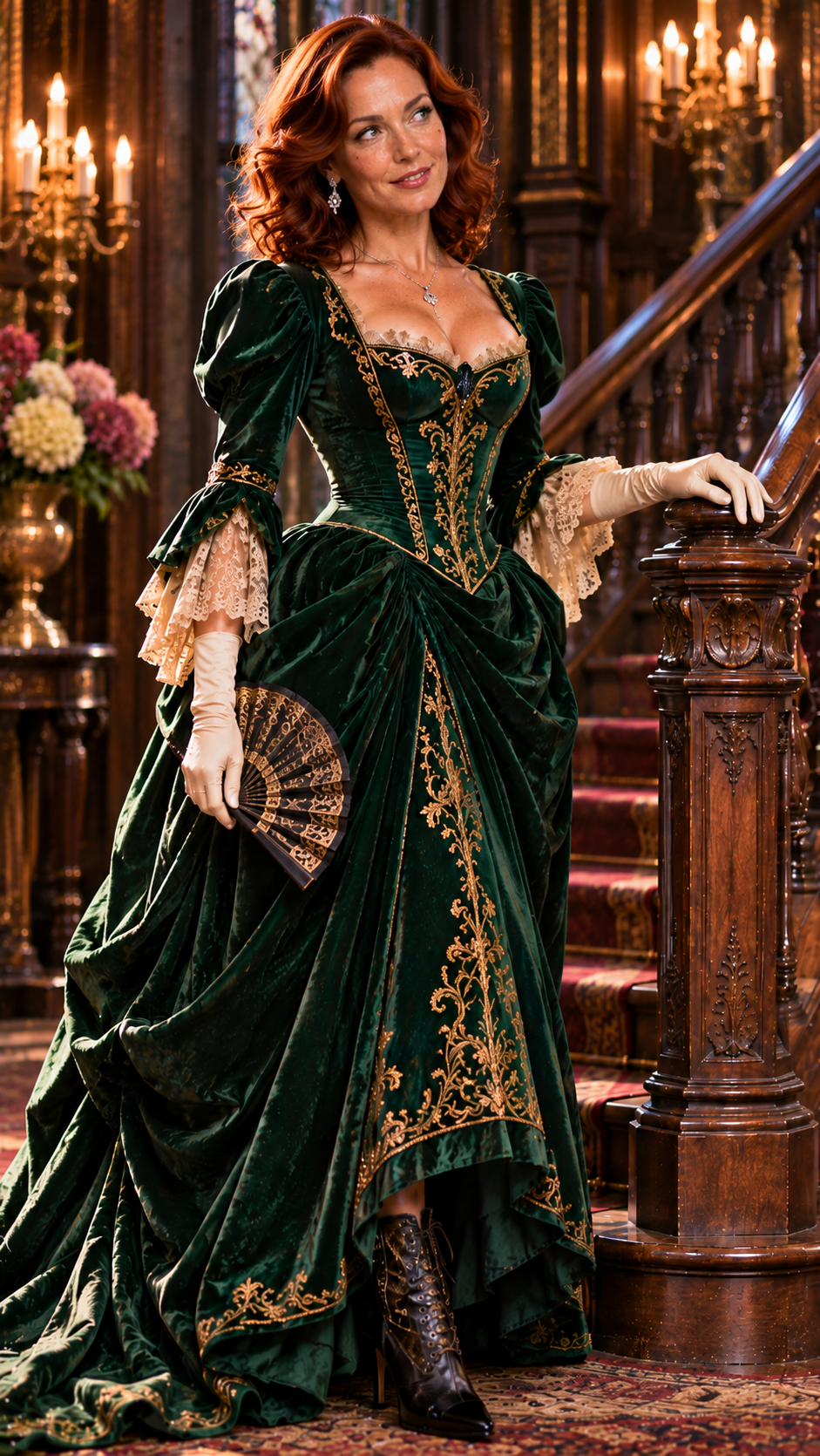
Example Prompt 6 — Victoria in Another Century
Victoria Bennett, a striking 47-year-old woman with shoulder-length copper-red hair styled in soft waves, green eyes, fair skin with subtle freckles across her nose, an oval face, a gently defined jawline, and a distinctive small beauty mark beneath her left eye.
Victoria appears in an imaginative Victorian-era setting, wearing a magnificent emerald-green velvet gown with a fitted bodice, elegant long sleeves, intricate gold embroidery, and historically inspired dark leather heeled boots. Her copper-red hair retains its recognizable color and soft waves, arranged neatly around her shoulders.
She stands beside an ornate carved staircase inside a grand nineteenth-century mansion, one gloved hand resting on the banister. She looks confidently toward the camera with her familiar knowing smile.
Beautiful candlelit interior, elaborate historical architecture, realistic facial proportions, sophisticated period fashion photography, cinematic photorealism, full-body 9:16 vertical composition.
Why it helps: The character remains visually recognizable while almost everything else changes.
This technique can be useful for alternative-history images, fantasy adventures, time-travel stories, and creative fashion collections.
7. Use a Reference Image Whenever Possible
Here's the most important practical advice in this entire tutorial.
If your image generator supports reference images, use them!
Text descriptions can improve consistency, but they're not a substitute for an actual visual reference.
A written description such as 47-year-old redhead with green eyes could describe thousands of different women.
A photograph provides much more information about the shape of her face, the placement of her features, her hairstyle, and her overall appearance.
For better results:
Choose one successful character portrait as your starting reference.
Use the same original reference across multiple scenes when possible.
Preserve her defining physical characteristics.
Change the setting, clothing, pose, and activity separately.
Review the results for unwanted changes before continuing the series.
Some image generators also offer character-reference features, image-to-image workflows, or other identity-consistency controls.
These can be much more reliable than relying on text alone, although their effectiveness varies.
One more useful tip: Don't automatically use the latest generated image as the reference for the next one.
Small changes can accumulate from image to image. If Victoria looks slightly different in Scene 2, and you use Scene 2 to generate Scene 3, those differences may become even more noticeable.
Whenever possible, return to your original character reference.
8. Create a Character Sheet
For longer illustrated stories, I recommend creating a simple character sheet before producing dozens of images.
It doesn't have to be complicated.
For Victoria, we might record:
Name = Victoria Bennett
Age = 47
Hair = Shoulder-length copper-red, soft waves
Eyes = Green
Skin = Fair with subtle freckles across the nose
Face = Oval, gently defined jawline
Distinctive feature = Small beauty mark beneath her left eye
Expression = Confident, approachable, often amused
Default style = Sophisticated fashion, tailored dresses, elegant heels
Reference image = Original hotel portrait
This makes it easier to reuse the same character description without accidentally changing important details.
You could also create a visual reference sheet containing frontal, three-quarter, and side views, provided the generator can maintain her identity across those images.
9. Watch Out for Character Drift
Character drift happens when a recurring person gradually changes appearance.
Sometimes the changes are subtle.
Her hair becomes slightly darker.
Her eyes change shape.
She appears a few years younger.
Her face becomes narrower.
By the sixth image, she may no longer resemble the woman from the first scene.
One way to reduce this problem is to compare every new image with the original portrait.
Ask yourself:
Does she still look approximately 47?
Are her hair color and hairstyle consistent?
Do her eyes and facial proportions look similar?
Is her distinctive beauty mark still present?
Does she still look like the same person, rather than someone with similar coloring?
If the answer is no, consider regenerating the scene from the original reference instead of continuing with the changed appearance.
And remember that AI-generated beauty marks, freckles, jewelry, and other tiny details may not be reproduced perfectly.
They're helpful identifiers, not guarantees.
10. When the AI Just Won't Cooperate
Sometimes, despite all our efforts, the generator keeps changing the character.
You repeat her description.
You use the same clothing.
You specify her age.
You carefully explain her hairstyle.
And somehow, the model produces someone who looks like Victoria's younger cousin!
At that point, don't spend endless attempts adding more adjectives.
Try a different approach.
Use an original image reference.
Simplify the camera angle.
Return to more neutral lighting.
Reduce unnecessary changes to the scene.
Or try another model that provides stronger character-consistency features.
Sometimes a generator is excellent at creating spectacular individual portraits but less successful at maintaining the same fictional person across a series.
That doesn't make it useless.
It simply means a different tool may be better suited to your particular project.

11. Keep the Same Face, Not the Same Pose!
Here's an interesting problem we discovered while creating the illustrations for this very tutorial!
Victoria Bennett appeared in six completely different scenes. She visited a luxurious hotel, enjoyed coffee at an outdoor café, worked in an executive office, explored the city on a rainy evening, admired the skyline from a penthouse, and even traveled back to Victorian times.
And throughout those images, she remained remarkably recognizable.
Wonderful, right?
Well, almost!
Look carefully at her face in all six illustrations.
Despite changing her clothing, surroundings, and body positions, Victoria repeatedly displays almost exactly the same head angle, slight tilt, and familiar smile.
Character Consistency Doesn't Mean Identical Expressions
When creating an illustrated story, we want our characters to remain recognizable while responding naturally to different situations.
A woman enjoying coffee might smile warmly at the camera.
The same woman working in her office might look thoughtfully at a document.
Walking through a rainy city, she might glance upward at the illuminated buildings.
And during an emotional conversation, she might turn toward another person with an entirely different expression.
The face should remain recognizable, but the head position, gaze, and expression should change naturally with the scene.
Describe the Head Position Separately
Instead of simply asking for the same character in a different setting, describe exactly how she holds her head and where she's looking.
Here are six useful variations:
Direct frontal portrait = Head upright, shoulders facing the camera, both eyes looking directly toward the viewer
True side profile = Head turned approximately 90 degrees, showing one side of her face as she looks into the distance
Looking downward = Chin lowered naturally, eyes focused on a book, document, or object in her hands
Looking upward = Chin raised slightly, eyes directed toward something above her
Over-the-shoulder glance = Body facing away, head turned back toward the camera
Natural laughter = Head turned toward another person, eyes slightly narrowed, mouth open in a genuine laugh
These variations give the image generator specific directions rather than leaving it to repeat a familiar portrait.
Example Prompt — Victoria Looks Away From the Camera
Victoria Bennett, a striking 47-year-old woman with shoulder-length copper-red hair styled in soft waves, green eyes, fair skin with subtle freckles across her nose, an oval face, a gently defined jawline, and a distinctive small beauty mark beneath her left eye.
She wears an elegant ivory blouse, a fitted charcoal-gray pencil skirt, and black high-heeled pumps.
Victoria sits sideways at a polished wooden desk inside her luxurious executive office, carefully studying a handwritten letter. Her head is turned toward the document, her chin lowered naturally, and her eyes focused on the paper rather than the camera. Her expression is thoughtful and slightly concerned, with relaxed lips rather than her familiar smile.
The photographer captures her from a natural three-quarter side angle, clearly showing her distinctive copper-red hair and recognizable facial profile. Soft afternoon window lighting, realistic skin texture, natural facial anatomy, cinematic photorealism, 9:16 vertical composition.
Why it helps: We're retaining Victoria's defining physical characteristics while deliberately changing her gaze, head angle, and emotional expression.
Don't Overdo the Instructions
There's one more little trap.
Trying to control every facial muscle individually can make a prompt unnecessarily complicated.
Instructions such as raise the left eyebrow, lower the right eyelid, tilt the chin five degrees, rotate the neck thirty degrees may confuse the generator rather than help it.
Instead, concentrate on three simple things:
Head direction = Where is she facing?
Eye direction = What is she looking at?
Expression = What is she feeling?
Those three details often provide enough guidance to create a more natural variety of poses.
The Real Challenge
There's an important tradeoff worth understanding.
An AI generator may find it easier to reproduce a recognizable character when her head stays at a familiar angle. Change the viewpoint dramatically, and maintaining that identity can become more difficult.
That's where a collection of reference photographs showing the same character from different angles can be especially helpful.
And sometimes a slightly different camera position is enough to introduce variety without losing the character's identity.
Remember: We want Victoria to remain Victoria, not become a collection of identical headshots pasted into different backgrounds!
The goal is a believable person who can smile, laugh, worry, think, look away, and react naturally while remaining unmistakably herself.
Final Thoughts
Creating a beautiful AI-generated woman is one thing.
Making that same woman appear consistently in six, twelve, or twenty different scenes is an entirely different challenge.
The secret is to distinguish between what belongs to the character and what belongs to the scene.
Her age, facial features, eye color, and distinctive characteristics establish who she is.
Her clothing, surroundings, lighting, and activities establish what she's doing.
Keep the character consistent. Let the world around her change.
Use repeatable descriptions, strong reference images when available, and a little patience.
And when your leading lady suddenly turns into someone else halfway through the story, don't rewrite the entire adventure.
Bring back the original Victoria!
Happy creating!



 @crabmouse

 @EternaSky
 @CaylaCatz

 @DavidP
 @pikpoo

 @Sealine