The Best AI Image Generator in 2026, Ranked by 54,000 Blind Votes
As of October 26, 2026, GPT Image 2.5 Sunburst and GPT Image 2.5 Flare are tied as the best AI image generator in BudgetPixel's blind Model Arena, based on more than 54,000 votes from about 1,400 signed-in members. Nano Banana 2 Lite is third and narrowly first in the prompt-adherence vote, Muse Image 1.0 is the best value, and Nano Banana 2.1 is the fastest model in the top five.
 By BudgetPixel Team15 min readFacts verified
On this page
GPT Image 2.5 Sunburst and GPT Image 2.5 Flare are tied as the best AI image generator in 2026, going by more than 54,000 blind votes in BudgetPixel's Model Arena. Voters see two pictures made from the same prompt, with the model names hidden, and pick the better one. On October 26, 2026, the two GPT Image models led all 20 models with ratings of 1610 and 1609, too close for the votes to split, and about 65 points clear of third place.
The best model overall isn't always the best one for your job, though. So we also ranked each kind of picture, and checked price, speed and how often each model says no. At the end there's a step-by-step guide to testing the top models on your own idea.
Which AI image generator is best in 2026?
One of OpenAI's two GPT Image 2.5 models. Between them, Sunburst and Flare take first place in nine of the ten categories we test, and their overall ratings sit inside each other's margin of error, so the votes can't separate them.
Which of the two? They cost the same per picture. Flare is OpenAI's faster everyday version (27 seconds a picture against 34) and Sunburst its most capable one, built for precise edits. Start with Flare, and switch to Sunburst when you're editing.
Behind them there's a clear gap, then a crowd. Google's Nano Banana 2 Lite is third at 1545, and the next six models sit within 32 points of it: Google's Nano Banana 2.1, xAI's Grok Imagine Image 2, ByteDance's Seedream 5.0 Pro, Midjourney V8.2, ByteDance's Seedream 5.0 Flash and Meta's Muse Image 1.0. In a pack that tight, any one of them beats its neighbor only slightly more often than it loses.
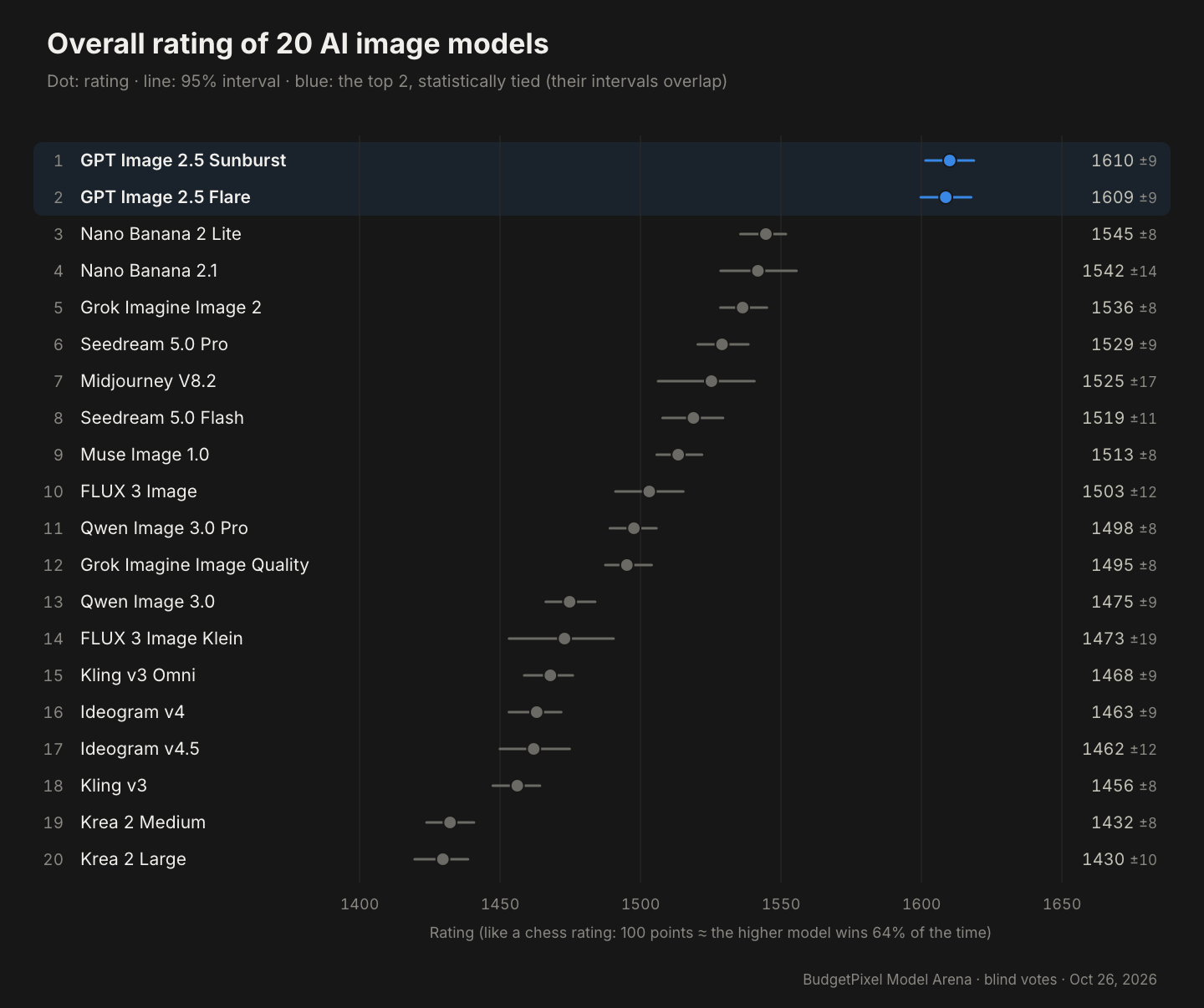
A rating works like a chess rating. A model 100 points above another wins about 64% of their head-to-head votes (a tie counts as half). At 65 points, roughly the gap between the leaders and third place, it wins about 59%.
| Rank | Model | Rating | Credits | Seconds |
|---|---|---|---|---|
| 1 | GPT Image 2.5 Sunburst | 1610 ±9 | 40 | 34.5 |
| 2 | GPT Image 2.5 Flare | 1609 ±9 | 40 | 27.4 |
| 3 | Nano Banana 2 Lite | 1545 ±8 | 40 | 16.8 |
| 4 | Nano Banana 2.1 | 1542 ±14 | 45 | 13.4 |
| 5 | Grok Imagine Image 2 | 1536 ±8 | 50 | 16.7 |
| 6 | Seedream 5.0 Pro | 1529 ±9 | 55 | 36.9 |
| 7 | Midjourney V8.2 | 1525 ±17 | 40 | 108.9 |
| 8 | Seedream 5.0 Flash | 1519 ±11 | 25 | 25.8 |
| 9 | Muse Image 1.0 | 1513 ±8 | 12 | 13.3 |
| 10 | FLUX 3 Image | 1503 ±12 | 65 | 24.2 |
| 11 | Qwen Image 3.0 Pro | 1498 ±8 | 45 | 10.6 |
| 12 | Grok Imagine Image Quality | 1495 ±8 | 80 | 5.3 |
| 13 | Qwen Image 3.0 | 1475 ±9 | 40 | 7.4 |
| 14 | FLUX 3 Image Klein | 1473 ±19 | 12 | 6.5 |
| 15 | Kling v3 Omni | 1468 ±9 | 35 | 36.1 |
| 16 | Ideogram v4 | 1463 ±9 | 40 | 14.2 |
| 17 | Ideogram v4.5 | 1462 ±12 | 80 | 13.6 |
| 18 | Kling v3 | 1456 ±8 | 35 | 27.8 |
| 19 | Krea 2 Medium | 1432 ±8 | 40 | 17.1 |
| 20 | Krea 2 Large | 1430 ±10 | 80 | 32.8 |
Credits and seconds are per picture. Credits are BudgetPixel's currency: 1,000 cost $1 in a credit pack, so 40 credits is 4 cents. The ± is the margin of error.
The board moves. In the week to October 26, Nano Banana 2 Lite rose from fifth to third, Midjourney V8.2 slipped from fourth to seventh, and Nano Banana 2.1, which only joined the arena on October 6, went from third to fourth. The newest arrival, FLUX 3 Image Klein (October 15), is 14th so far, with the widest margin on the board because it has the fewest votes. The live board updates every night on the arena leaderboard, and we refresh this article every month.
How does the Model Arena rank AI image models?
By asking people which picture is better without telling them who made it.
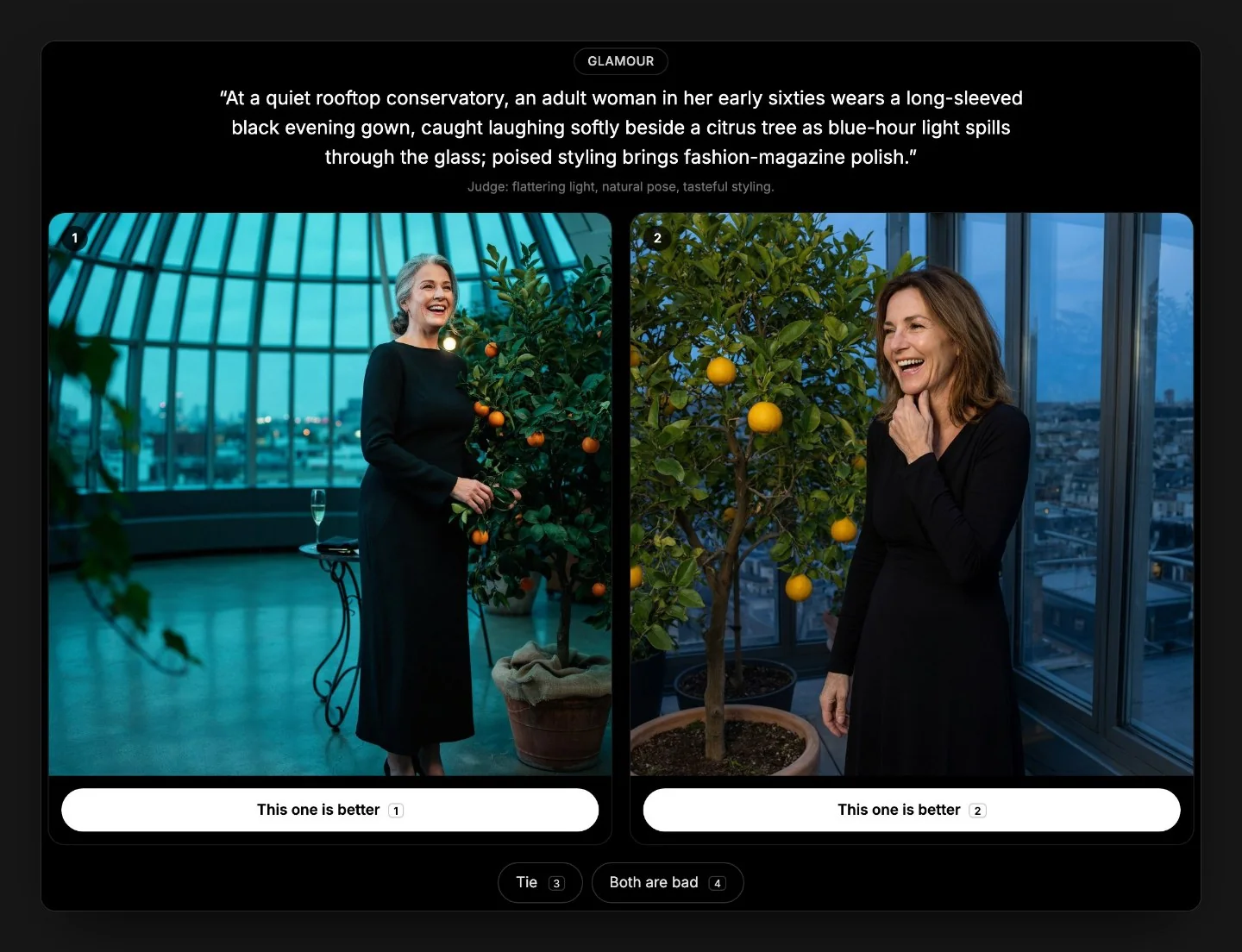
- Same prompt, same settings. Every model gets the prompt word for word, with nothing rewritten, at its default settings. Each makes one picture per prompt ahead of time; nothing is generated while you vote.
- Blind pairs. The two pictures carry no model names until after you vote.
- Four answers. This one, that one, a tie, or both bad, which counts as a tie.
- Guards against noise and gaming. A vote only counts once both pictures have been on screen for three seconds. Each person votes on a pair once, and up to 30 times a day. Hidden check pairs with a known answer catch careless voters, whose votes then count for less or not at all. And only signed-in members' votes count once a category has 200 of them, which every category now has.
- Ratings with error bars. Every night the votes are refitted into ratings (a Bradley-Terry fit, on the same scale as chess Elo ratings), with 95% intervals from 300 resamples. A model gets a rank in a category once it has 40 votes there.
- What the numbers count. 60,463 votes had been cast by October 26. The ratings rest on the 54,000-plus of them from about 1,400 signed-in members; the rest are the hidden check votes, visitors' votes and votes from people who kept failing the checks.
- The 20 newest models. The vote holds the 20 most recently released text-to-image models. When a new one arrives, the oldest leaves.
- More than 450 prompts in ten categories, with new ones added every day. None of them name brands, real people or children, and the text prompts use made-up words and shop names.
What the arena doesn't tell you: it tests making a picture from text, not editing a picture you upload. Each model gets one try per prompt, so a lucky or unlucky picture can tip a close pair. And our voters are signed-in BudgetPixel members rather than a hired panel, so their taste is part of the result. That's why the margins are on the chart, and why we checked the close calls ourselves below. BudgetPixel runs the arena and sells all 20 models, but makes none of them.
Which AI image generator is best for each kind of picture?
| Category | 1st | 2nd | 3rd |
|---|---|---|---|
| Photorealism | GPT Image 2.5 Flare | GPT Image 2.5 Sunburst | Nano Banana 2.1 |
| Portrait & fashion | GPT Image 2.5 Sunburst | GPT Image 2.5 Flare | Grok Imagine Image 2 |
| Product & commercial | GPT Image 2.5 Sunburst | GPT Image 2.5 Flare | Nano Banana 2 Lite |
| Illustration & anime | GPT Image 2.5 Flare | GPT Image 2.5 Sunburst | Grok Imagine Image 2 |
| Concept art & fantasy | GPT Image 2.5 Sunburst | GPT Image 2.5 Flare | Grok Imagine Image 2 |
| Landscape & nature | GPT Image 2.5 Sunburst | GPT Image 2.5 Flare | Grok Imagine Image 2 |
| Architecture & interiors | GPT Image 2.5 Sunburst | GPT Image 2.5 Flare | Nano Banana 2 Lite |
| Typography | GPT Image 2.5 Flare | GPT Image 2.5 Sunburst | Nano Banana 2.1 |
| Prompt adherence | Nano Banana 2 Lite | GPT Image 2.5 Sunburst | GPT Image 2.5 Flare |
| Glamour | GPT Image 2.5 Flare | GPT Image 2.5 Sunburst | Seedream 5.0 Pro |
The GPT Image pair takes the top two places almost everywhere, and in several categories, typography and photorealism among them, the leader is only narrowly ahead of its twin. If you want something faster or less strict, read the 3rd-place column (none of these is cheaper):
- Grok Imagine Image 2: third for portraits, illustration, concept art and landscapes.
- Nano Banana 2 Lite for products and buildings, and narrowly first for exact instructions.
- Nano Banana 2.1 for photos and text.
- Seedream 5.0 Pro for fashion-style glamour shots, and it refused none of our prompts.
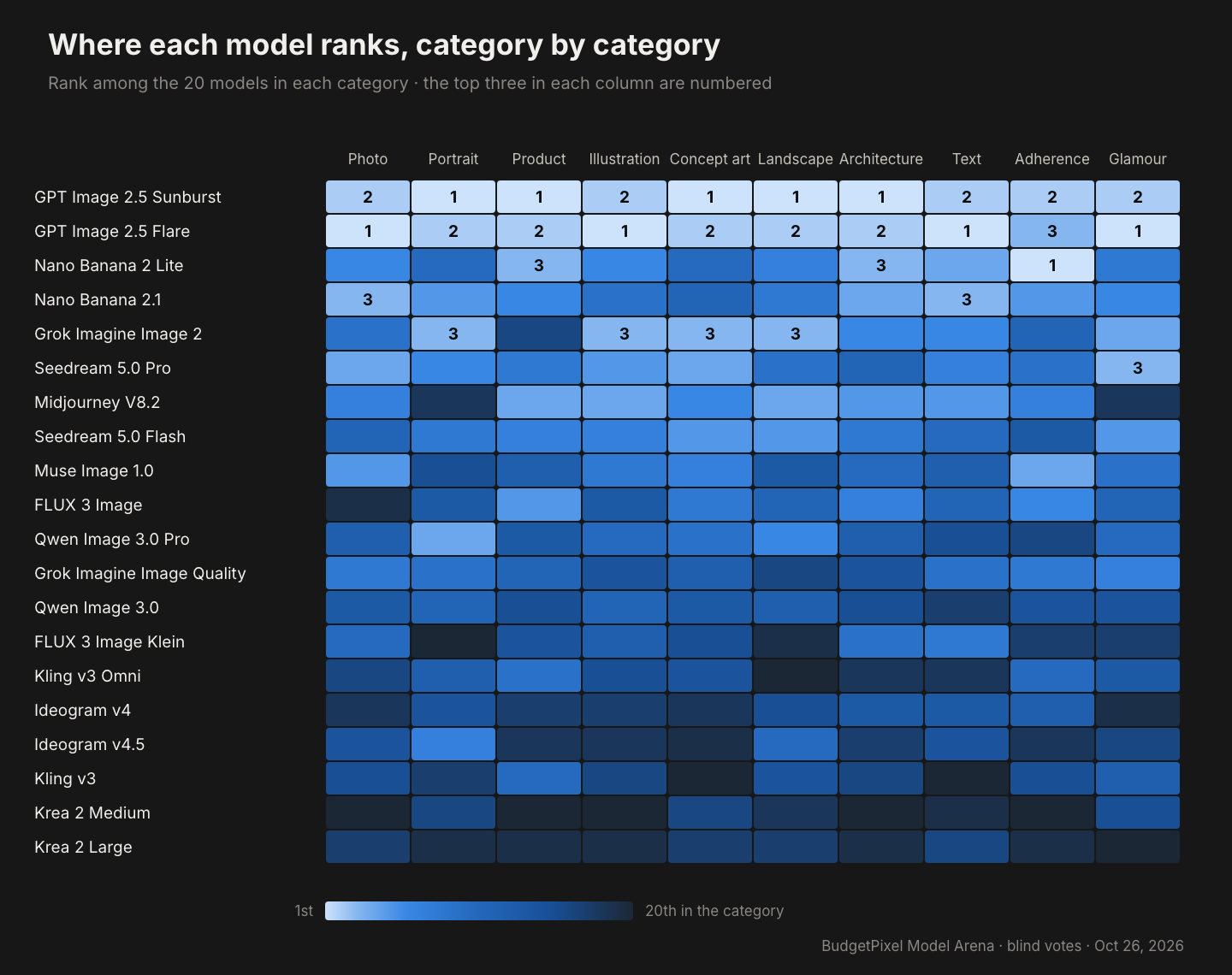
Some models are specialists. Midjourney V8.2 is fourth for products, landscapes and illustration, but 18th for portraits. FLUX 3 Image is fifth for product shots and 19th for photorealism. If your work is mostly one kind of picture, choose by that column, not by the overall rank.
Which AI image generator gets text right?
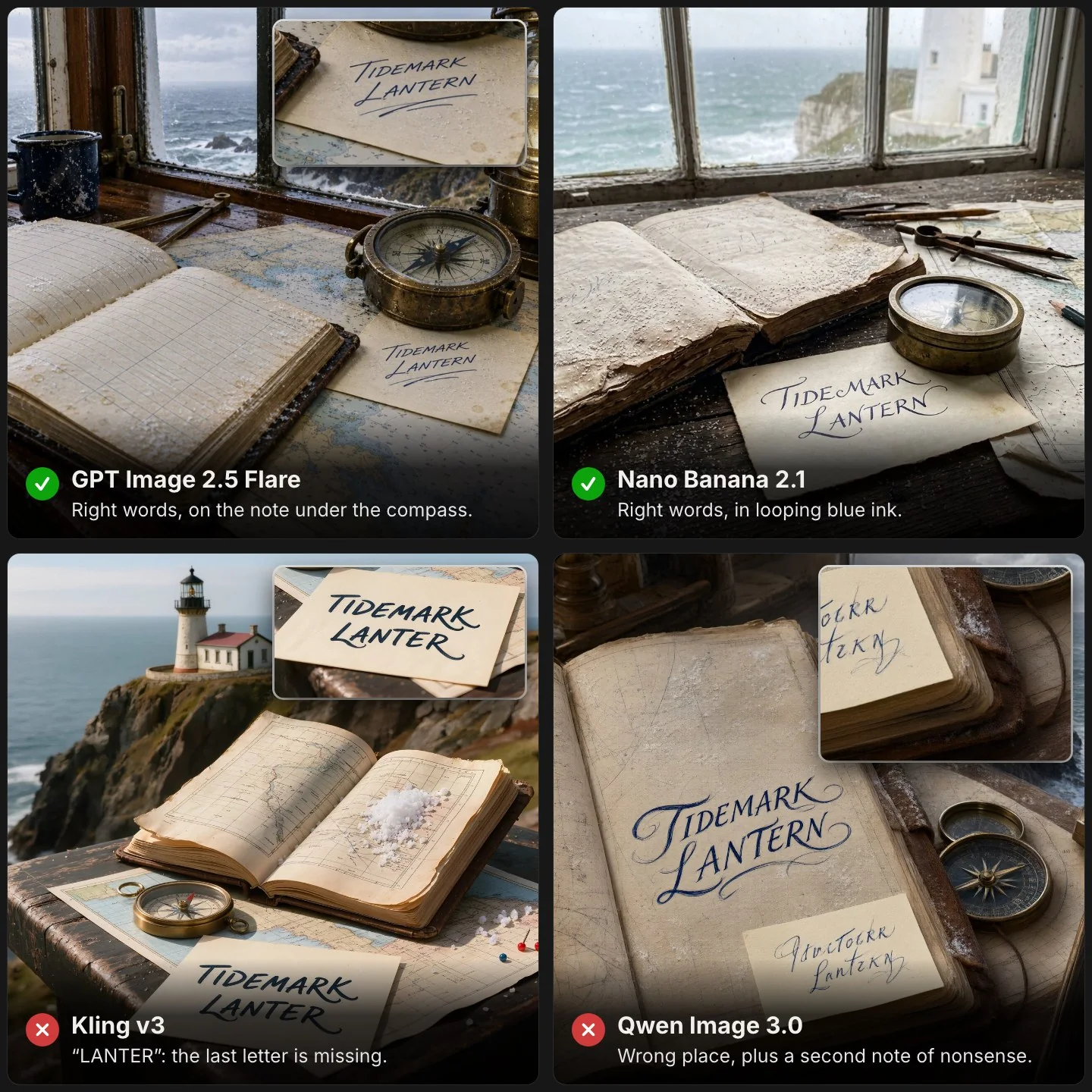
GPT Image 2.5 Flare narrowly leads the typography category, ahead of Sunburst, with Nano Banana 2.1 third. Good lettering isn't rare anymore, but it isn't guaranteed either. Here is one prompt from the typography set:
Beside a cliffside lighthouse, a salt-speckled logbook lies open on a chart table; "TIDEMARK LANTERN" is handwritten in looping dark-blue ink across a cream note tucked beneath the compass, with no other legible writing.
A few habits help on every model:
- Put the exact words in quotes. Short phrases come out right more often than long sentences.
- Say where the text goes and what it's printed on, such as "on a cream note tucked beneath the compass."
- Add "no other legible writing" when stray text would spoil the picture.
- Zoom in and check every letter before you post. One missing letter is easy to miss at thumbnail size.
Which AI image generator follows instructions best?
Nano Banana 2 Lite, narrowly. It leads the prompt-adherence category, where voters check that everything asked for is there, in the right number, color and place, by 21 points over GPT Image 2.5 Sunburst, inside the margin of error. Flare is third. One of the prompts:
Exactly four enamel camping cups form a vertical tower on a pale wooden shelf, bottom to top: red, yellow, blue, white; all handles face right. Soft morning light, nothing else.
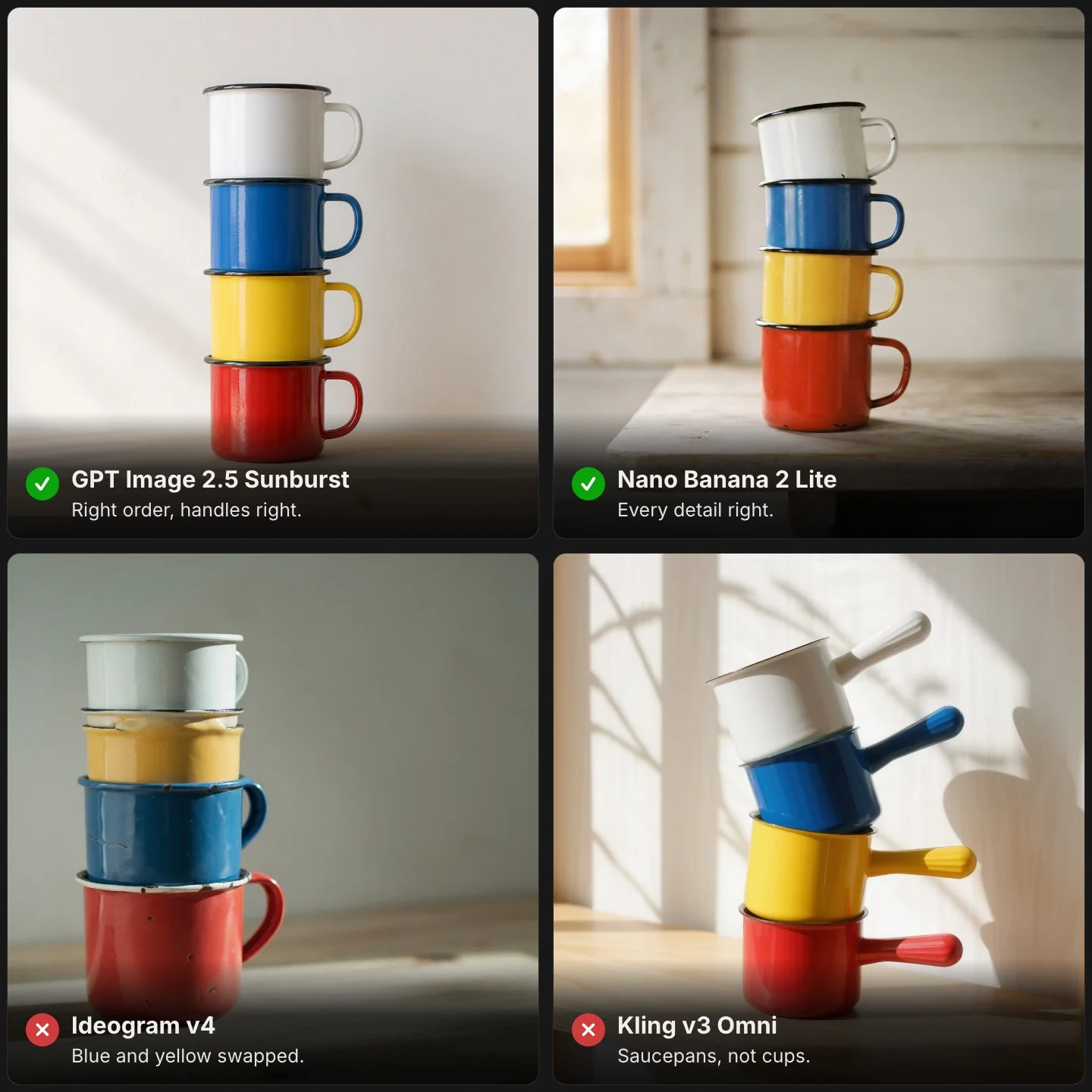
Look at the bottom-left picture. Ideogram v4 swapped the blue and yellow cups, and it still won 7 of its 11 votes on this prompt. People judge a whole picture at a glance, so a wrong detail can slip past them. If your brief has numbers, colors or an order, check them yourself, whichever model you use.
To get more exact results from any model, write counts as numbers ("exactly four"), give the order outright ("bottom to top", "left to right"), and end with "nothing else" so the model doesn't add extras.
Which AI image generator is the best value?
Price and quality barely move together. The two best models cost 40 credits a picture, the same as several models far down the board, and every model priced at 80 credits ranks 12th or lower.
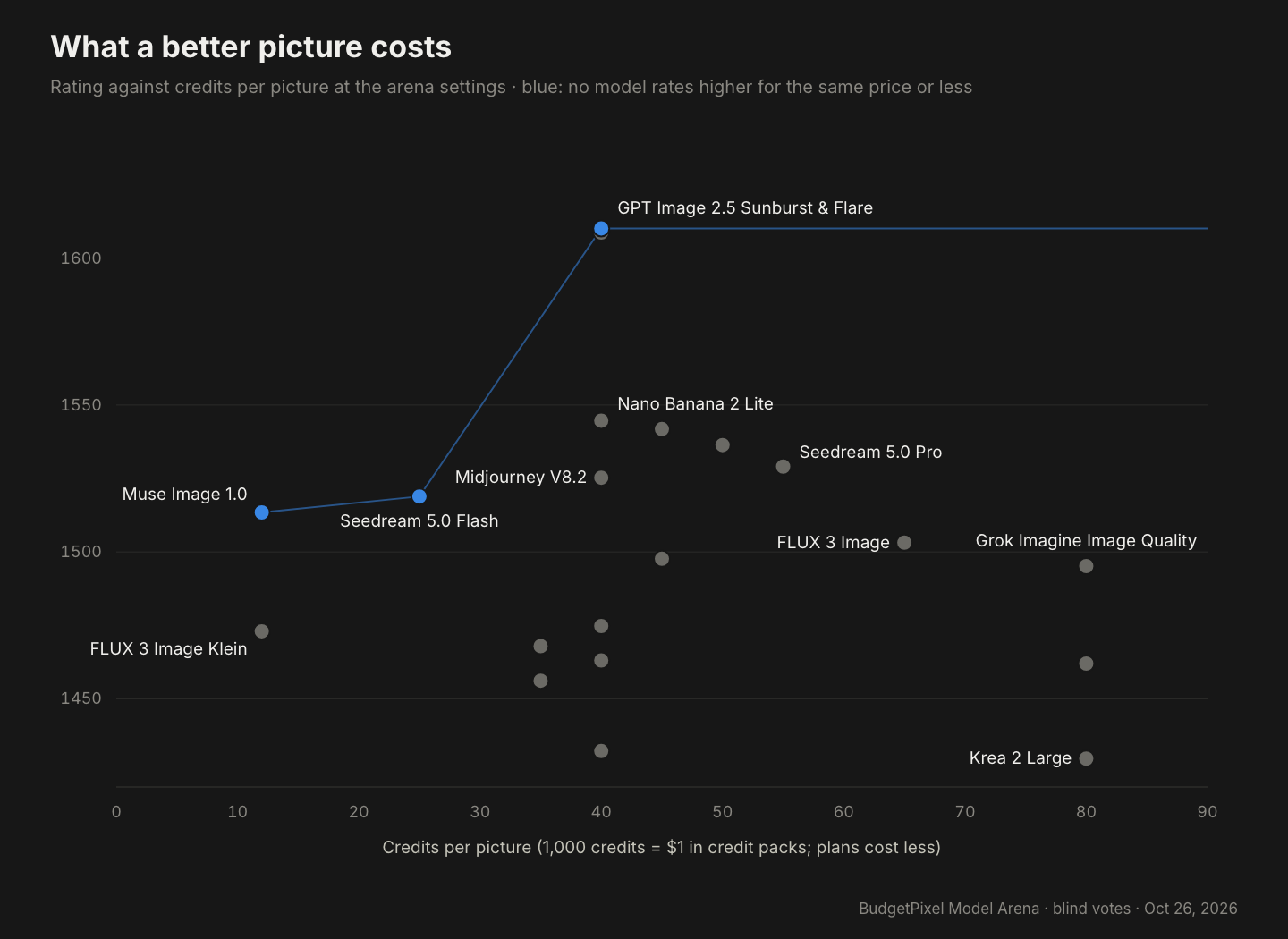
The value picks:
- Muse Image 1.0: ninth overall and fourth for prompt adherence, at 12 credits a picture.
- Seedream 5.0 Flash: eighth overall at 25 credits.
- GPT Image 2.5 Flare and Sunburst: the best pictures on the board, at 40 credits.
About the prices: they're each model's standard price for one square picture at its default settings, 1K (about 1024 × 1024 pixels) on most models. Bigger sizes and higher quality cost more on most models; GPT Image 2.5, for example, goes from 40 credits at 1K to 80 at 2K at the same quality. Midjourney V8.2 always makes four pictures a run (160 credits) and needs a paid plan. On BudgetPixel, 1,000 credits cost $1 in a credit pack and less on a monthly plan, and the free plan's 300 monthly credits cover seven GPT Image 2.5 pictures or 25 on Muse Image 1.0.
Which AI image generator is the fastest?
Grok Imagine Image Quality, at a median of 5.3 seconds a picture, followed by FLUX 3 Image Klein (6.5) and Qwen Image 3.0 (7.4). None of the three makes the top ten, though. Among the top five, Nano Banana 2.1 is quickest at 13.4 seconds.
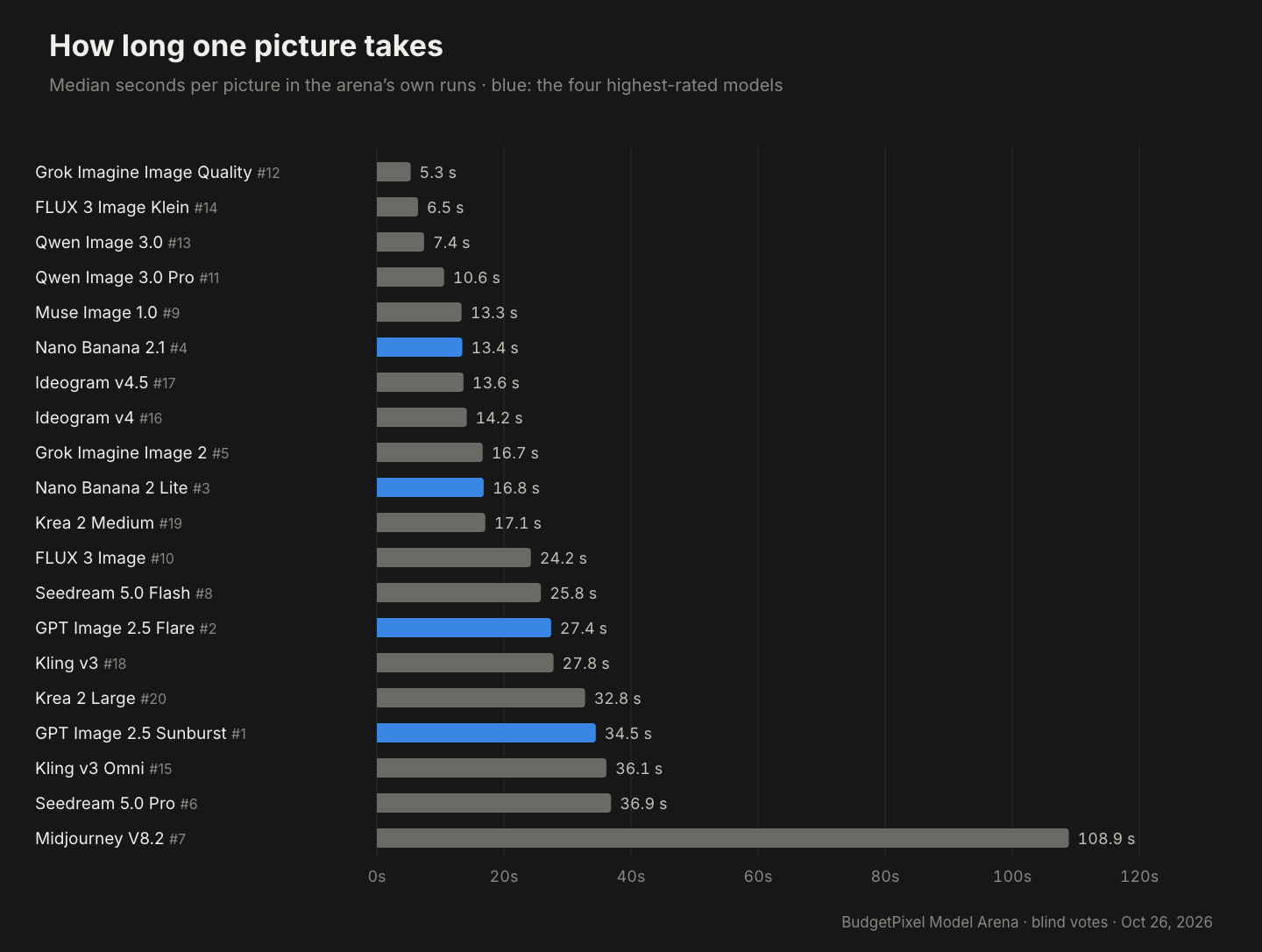
The top two take about half a minute: 27 seconds for Flare and 34 for Sunburst. Midjourney V8.2 is the slow one, at about 109 seconds, and one attempt in six returned no picture at all, the highest failure rate on the board. The arena keeps a separate board of the fastest AI image models.
Which AI image generators refuse the most prompts?
Every model comes with its maker's content filter, and some filters are much stricter than others. Here is how many of the arena's prompts each model declined:
| Model | Prompts refused |
|---|---|
| GPT Image 2.5 Flare | 36 of 452 (8.0%) |
| GPT Image 2.5 Sunburst | 35 of 453 (7.7%) |
| Grok Imagine Image 2 | 19 of 452 (4.2%) |
| Grok Imagine Image Quality | 12 of 453 (2.6%) |
| Nano Banana 2 Lite | 10 of 452 (2.2%) |
| Muse Image 1.0 | 9 of 453 (2.0%) |
| Krea 2 Medium | 6 of 453 (1.3%) |
| Krea 2 Large | 5 of 452 (1.1%) |
| Ideogram v4.5 | 3 of 287 (1.0%) |
| Nano Banana 2.1 | 1 of 232 (0.4%) |
| FLUX 3 Image | 1 of 252 (0.4%) |
The other nine refused none: Seedream 5.0 Pro, Seedream 5.0 Flash, Midjourney V8.2, Qwen Image 3.0 Pro, Qwen Image 3.0, FLUX 3 Image Klein, Kling v3 Omni, Ideogram v4 and Kling v3. Models that joined the arena later have rendered fewer prompts, which is why the totals differ.
None of our prompts ask for anything explicit. The glamour category, for example, shows adults in swimwear, evening wear or sportswear. Strict filters still trip on some of those, and on some ordinary prompts too. On BudgetPixel a refused picture costs nothing, and the model picker labels models with how strict their filter is before you choose.
Which AI image generator should you use?
| If you want | Use | Why |
|---|---|---|
| The best picture, whatever the subject | GPT Image 2.5 Flare or Sunburst | Tied for first, and in the top three of every category |
| Text on signs, posters or packaging | GPT Image 2.5 Flare, then Nano Banana 2.1 | First and third for typography |
| Exact counts, colors and positions | Nano Banana 2 Lite | Narrowly first for prompt adherence |
| Portraits and fashion | GPT Image 2.5 Sunburst, or Grok Imagine Image 2 | First, and the best of the rest |
| Product shots | GPT Image 2.5 Sunburst, or Nano Banana 2 Lite | First, and third |
| Illustration and fantasy art | GPT Image 2.5 Flare (illustration) or Sunburst (fantasy), or Grok Imagine Image 2 | First in each; Grok is third in both |
| The most pictures for your credits | Muse Image 1.0 | Ninth overall at 12 credits |
| Speed | Nano Banana 2.1, Muse Image 1.0, or Grok Imagine Image Quality | 13 seconds and fourth overall; 13 seconds at 12 credits; 5 seconds and 12th |
| Fewer refused prompts | Seedream 5.0 Pro | Sixth overall, and it refused none of ours |
How to compare AI image generators on your own prompt
Rankings are averages. The surest test is your own prompt on two or three models, side by side. Here's how to do it on BudgetPixel:
- Open the Image Workshop. In the menu it's under Create, then Images.
- Pick your first model. Click Switch next to the model name, then search or filter by maker. Each card shows the price per picture and a label for how strict the model's content filter is.
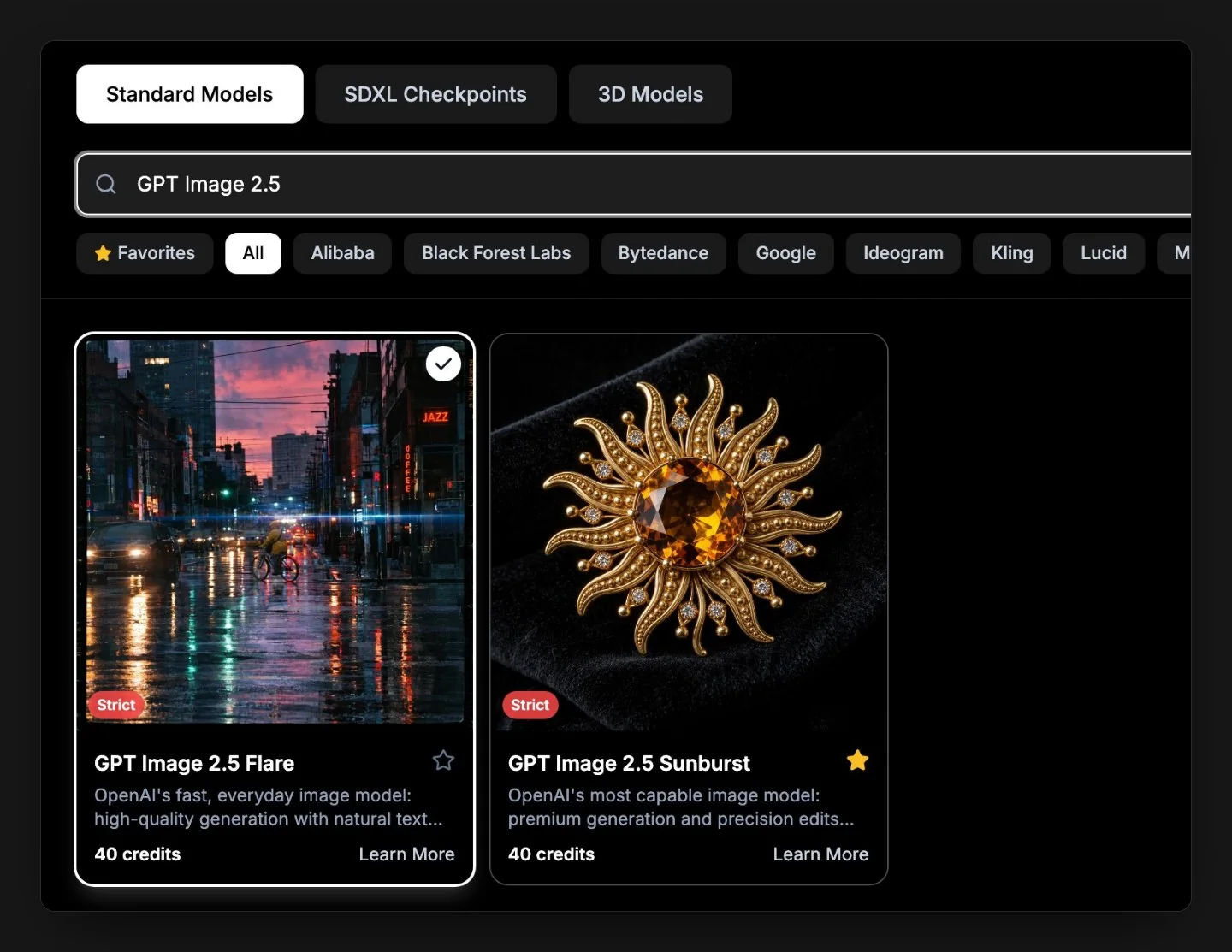
- Write your prompt. Be specific about the subject, the setting, the light and any words that should appear (in quotes). Then choose the aspect ratio and how many pictures you want, from one to four (Midjourney V8.2 always makes four).
- Set quality and size under Advanced. The Generate button shows the total before anything runs. The screenshot below is set to 2K, so one picture on GPT Image 2.5 Flare at medium quality shows 80 credits; at 1K it's 40.
- Generate, then switch models and generate again. Your prompt stays in the box, so you're comparing like with like, and the results line up under Recent Images.
- Judge on what matters to you: words spelled right, counts right, natural faces and hands, the look you're after.
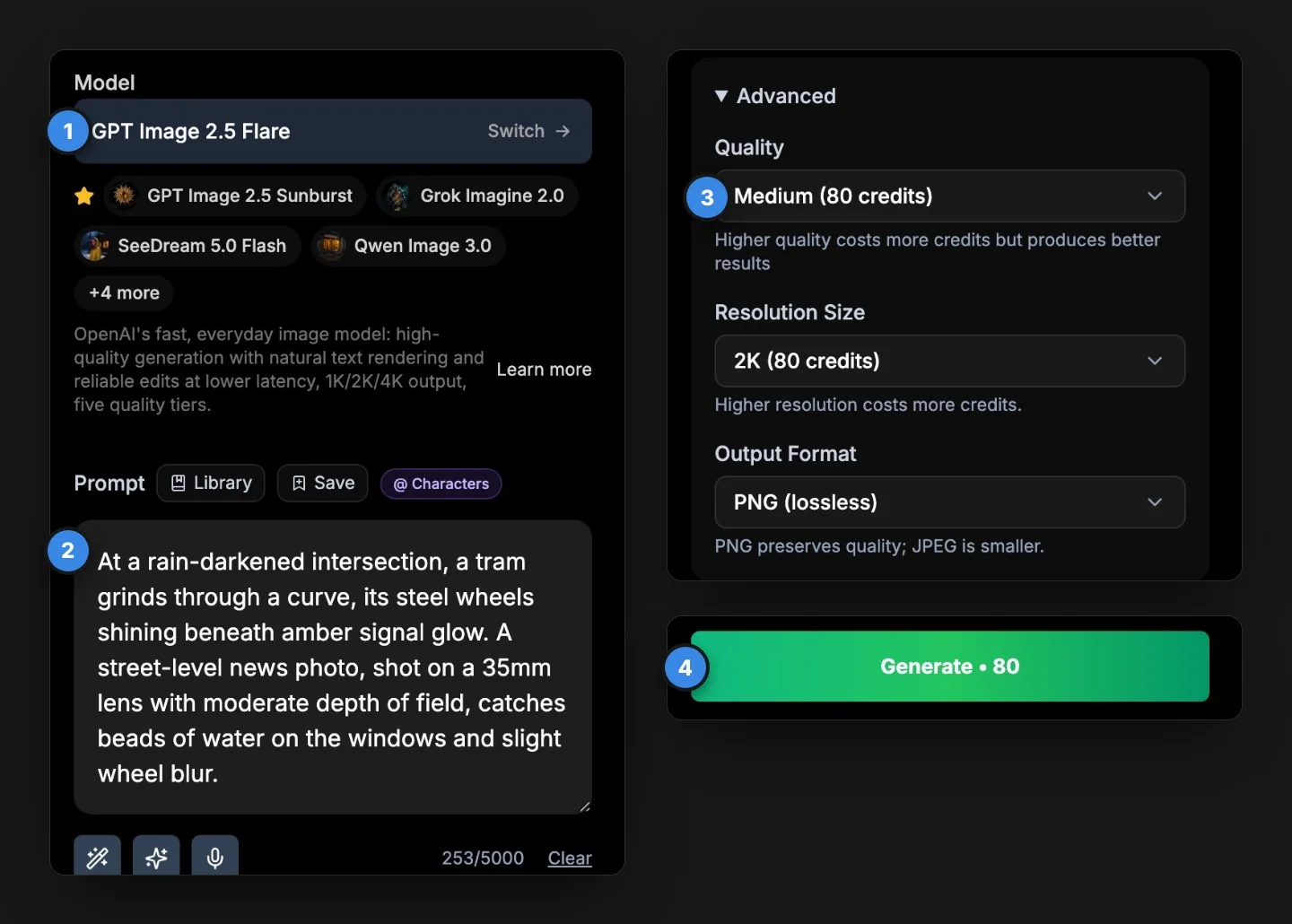
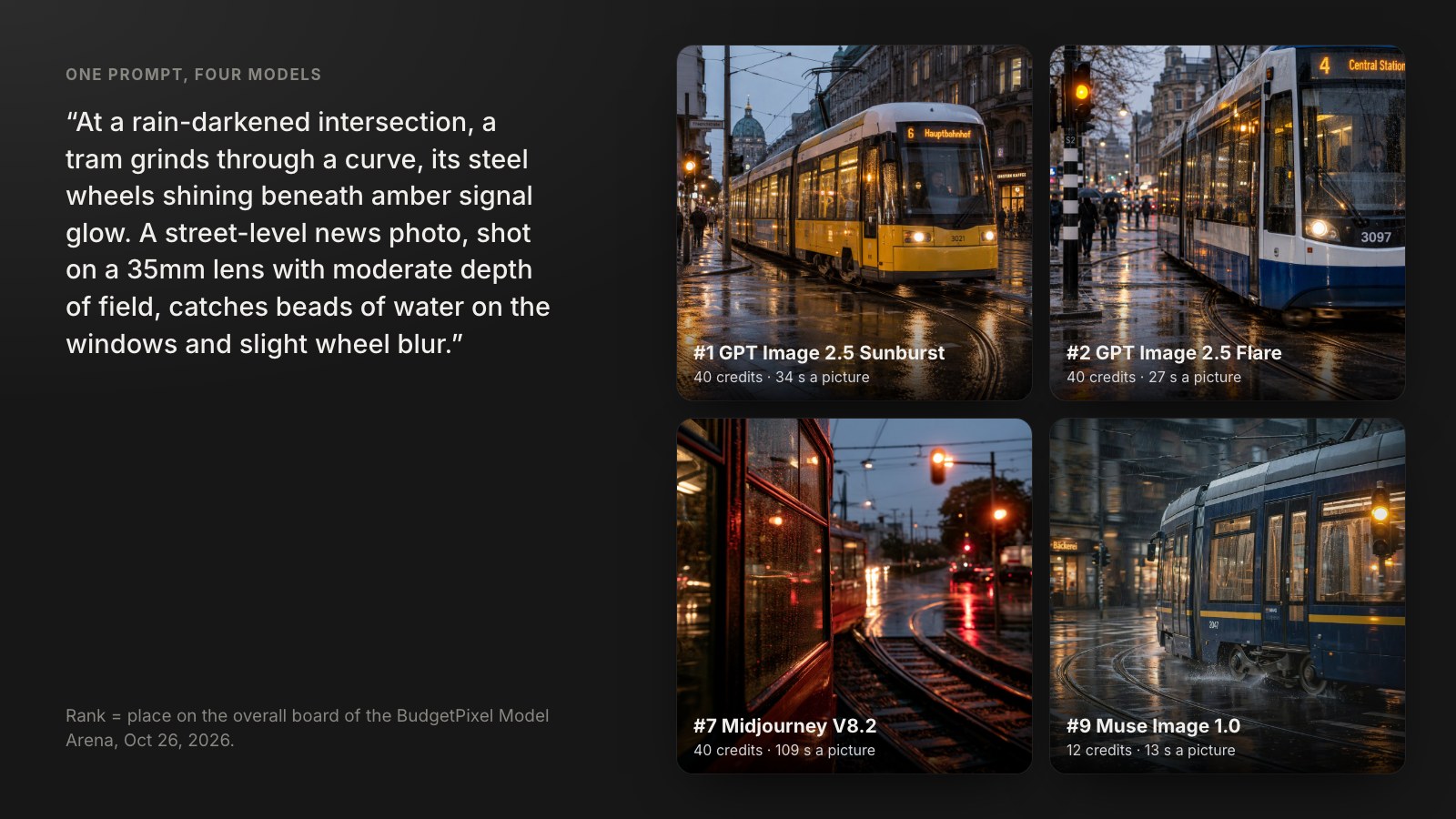
You can also open the workshop with a model and a prompt already filled in. This link loads the tram prompt from the top of this article on GPT Image 2.5 Flare.
Want to see more matchups first? Vote in the arena. After each vote, the two models are revealed, with a link to try that prompt on either one. Signed-in members with a verified email can earn 50 credits a day once their first 10 votes are in.
Questions people ask
What is the best AI image generator in 2026?
In BudgetPixel's blind Model Arena, GPT Image 2.5 Sunburst (rating 1610) and GPT Image 2.5 Flare (1609) are tied for first as of October 26, 2026, based on more than 54,000 votes from signed-in members. Nano Banana 2 Lite is third at 1545.
Is GPT Image 2.5 better than Nano Banana?
Overall, yes. Both GPT Image 2.5 models rate about 65 points above Nano Banana 2 Lite, which means they win roughly 59% of head-to-head votes, counting a tie as half. Nano Banana 2 Lite narrowly leads the prompt-adherence category, though, and Nano Banana 2.1 is faster: 13 seconds a picture against about 30.
Which AI image generator is best for text in images?
GPT Image 2.5 Flare narrowly leads the typography category, followed by GPT Image 2.5 Sunburst and Nano Banana 2.1. Even the best models sometimes drop a letter or add words, so check every letter before you publish.
Which AI image generator is best for realistic photos?
GPT Image 2.5 Flare leads photorealism, with Sunburst second and Nano Banana 2.1 third. For portraits, Sunburst leads and Grok Imagine Image 2 is the best of the rest.
What is the cheapest good AI image generator?
Muse Image 1.0 ranks ninth of 20 overall and fourth for prompt adherence at 12 credits a picture. Seedream 5.0 Flash ranks eighth at 25 credits. On BudgetPixel, 1,000 credits cost $1 in a credit pack and less on a monthly plan.
Which AI image generator is the fastest?
Grok Imagine Image Quality takes a median 5.3 seconds a picture, FLUX 3 Image Klein 6.5 and Qwen Image 3.0 7.4. Among the top five, Nano Banana 2.1 is quickest at 13.4 seconds. Midjourney V8.2 is the slowest, at about 109 seconds.
Is Midjourney still the best AI image generator?
Not in our arena. Midjourney V8.2 ranks seventh of 20 overall. It is fourth for product shots, landscapes and illustration, but 18th for portraits, and it is the slowest model on the board.
How is the ranking calculated?
Voters see two pictures from the same prompt with the model names hidden, and pick the better one, call a tie, or mark both bad. Every night the votes of signed-in members are refitted into ratings with 95% intervals, and a model is ranked in a category once it has 40 votes there.
Can I use all of these models on BudgetPixel?
Yes. All 20 are in the Image Workshop on one account, and the Generate button shows the price before anything runs. Midjourney V8.2 needs a paid plan and always makes four pictures a run. A picture that fails or is refused costs nothing.
See for yourself
All 20 models are in the Image Workshop. The price shows on the Generate button before anything runs.