
Part 125 of The Forgotten Love Chronicles
The Forgotten Love Chronicles Volume Two — Chapter 126: The Forgotten Christmas Violin That Played by Itself in an Empty Train Station—and Reunited Two Souls Who Had Waited Forty Years to Say Goodbye 🎻🚂❄️🎄🪽❤️✨
 @archangeltara
The Forgotten Love Chronicles
Volume Two — Chapter 126: The Forgotten Christmas Violin That Played by Itself in an Empty Train Station—and Reunited Two Souls Who Had Waited Forty Years to Say Goodbye 🎻🚂❄️🎄🪽❤️✨
📷 Image Placement
🎨 Image Prompt
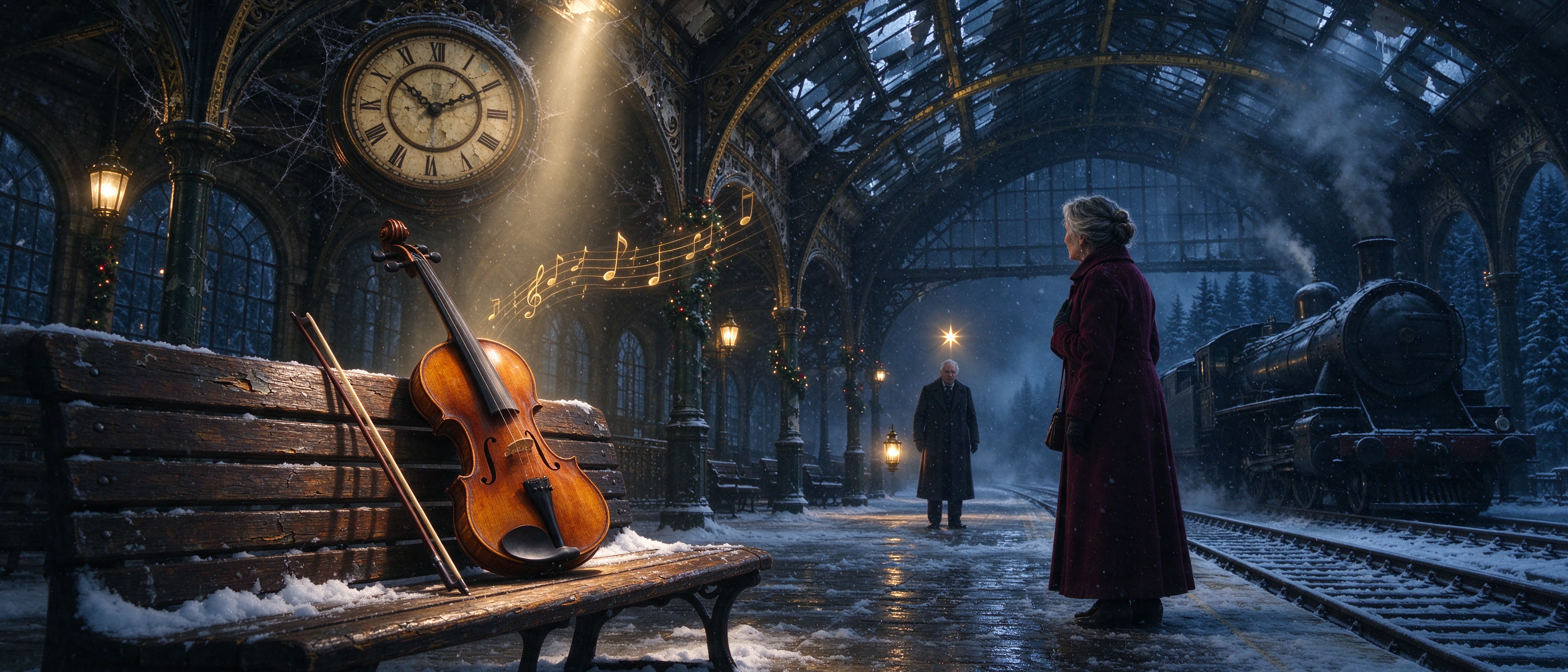
Create a breathtaking, ultra-photorealistic cinematic Christmas scene inside an abandoned Victorian railway station on a snowy winter night. An antique wooden violin rests on a weathered wooden bench beneath an enormous station clock, its polished amber surface illuminated by a mysterious shaft of golden light. The violin bow lies beside it, yet delicate musical notes seem to shimmer in the cold air as though an invisible musician is playing. Snow drifts through a broken section of the station roof, while vintage brass lanterns glow along the platform. At the far end, an elderly woman wearing a deep burgundy winter coat stands frozen in astonishment, one gloved hand pressed against her heart. In the mist beyond the tracks, the faint silhouette of an elderly man holding a railway conductor's lantern appears beneath a distant Christmas star. Snow-covered railway lines disappear into a moonlit forest, and an old steam locomotive rests in the background. Exquisite Victorian architecture, realistic aging textures, atmospheric snowfall, heavenly golden light, cinematic depth, profound emotional storytelling, magical realism, 8K masterpiece quality, photorealistic human expressions, no cartoon styling, no distorted anatomy, no unwanted text.
“Some goodbyes are never spoken. They wait inside old songs, forgotten places, and hearts that have never truly stopped listening.”
The violin began playing at 11:47 p.m.
That was the precise time recorded by the old station clock in Bellweather.
The clock had stopped working forty years earlier.
Its hands had remained frozen at eleven forty-seven ever since the night the last passenger train departed from Platform Three.
Yet on the first Christmas Eve after four decades of silence, the clock began ticking again.
One minute.
Then another.
And at 11:47 p.m., a violin played.
The music drifted through the abandoned station like a whisper from another lifetime.
It was a gentle melody.
Sad, but not hopeless.
Familiar, yet impossible to place.
It sounded like someone remembering a promise made long ago.
The townspeople heard it from their homes.
A baker stopped kneading dough.
A nurse paused beside a hospital window.
An elderly couple sat upright in bed, certain they had heard a song they had not listened to since their wedding day.
And at the end of Willow Street, a seventy-two-year-old woman dropped the teacup she was holding.
She knew that melody.
She had not heard it for forty years.
But she could have recognized it among a thousand orchestras.
Her name was Eleanor Whitmore.
And the music belonged to the only man she had ever loved.
📷 Image Placement — The Woman Who Never Forgot the Song
🎨 Image Prompt
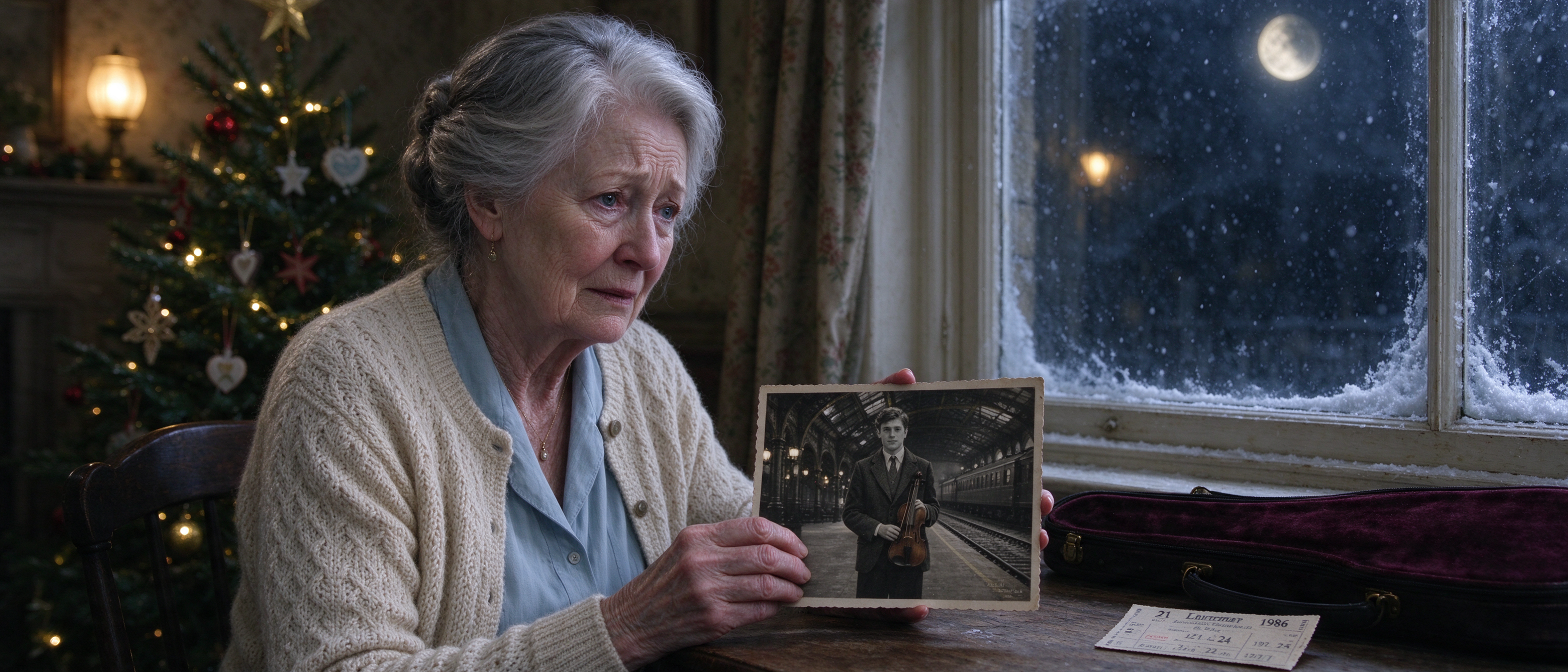
An intimate, photorealistic cinematic portrait of a seventy-two-year-old woman sitting beside a frosted window in a modest Victorian cottage on Christmas Eve. Eleanor Whitmore has silver hair pinned loosely at the back of her head, kind blue-gray eyes, and a face marked by a lifetime of tenderness and quiet sorrow. She wears a cream knitted cardigan over a pale blue blouse. Her hands tremble as she holds an old black-and-white photograph of a young violinist standing beside a railway platform in the 1980s. A small Christmas tree glows in the background, decorated with handmade ornaments and delicate golden lights. On the table lies a faded train ticket dated December 24, 1986, beside a closed velvet violin case. Moonlight and warm lamplight illuminate the room, while snow falls outside. Realistic skin texture, nuanced emotion, cinematic shallow depth of field, exquisite detail, 8K photorealism, nostalgic Christmas atmosphere, longing, and enduring love.
Eleanor had been twenty-nine when she first heard the melody.
It was a cold December afternoon in 1986.
She had been standing on Platform Three, holding a small suitcase and trying not to cry.
Her father had recently died.
The little bookshop where she worked had closed.
And the man she loved had received an offer to join a touring orchestra in Europe.
His name was Samuel Bennett.
He was twenty-eight, tall and slender, with dark hair that always fell over his forehead whenever he played the violin.
He had a quiet smile.
A thoughtful manner.
And a habit of tapping his fingers against his knee whenever he was composing music in his head.
Samuel had first played for Eleanor outside a bakery.
She had been carrying a box of books when the wind caught her scarf and sent it sailing across the street.
Samuel retrieved it.
Then, noticing that she was upset, he sat on a nearby bench and played a little tune on the violin he carried everywhere.
It was not a famous composition.
It had no grand title.
It was simply a melody he had invented while waiting for a train.
But Eleanor had stopped crying.
And when he finished, she had smiled for the first time that week.
“What is it called?” she asked.
Samuel considered the question.
“I'm not sure yet.”
“Then you should name it.”
He looked at her.
“Perhaps I'll call it The Place Where We Begin.”
She laughed.
“That sounds rather grand for a little tune played outside a bakery.”
“Then I'll have to make it grand enough to deserve the name.”
Over the following two years, Samuel played the melody whenever Eleanor felt discouraged.
He played it in the rain.
He played it beneath the trees in the town park.
He played it beside the river when the summer air smelled of honeysuckle.
And every Christmas, he played it at the station while they waited for the train that would take them to visit Eleanor's aunt.
They dreamed of a small house.
A garden.
A music room with a window overlooking the street.
Samuel promised that one day he would write music for children who had never heard an orchestra.
Eleanor promised she would open a bookshop where anyone could sit and read without being asked to buy anything.
Their dreams were ordinary.
And that was what made them precious.
Then came the offer from Europe.
Samuel had been invited to audition for a prestigious orchestra.
The opportunity could change his life.
It was everything he had worked toward since childhood.
But it required him to leave for at least two years.
Eleanor encouraged him to go.
She told him she would wait.
He promised he would return.
And on Christmas Eve, 1986, they met at Bellweather Station for his departure.
Samuel carried a battered suitcase and his violin case.
Eleanor carried a small paper parcel containing a silver pocket watch.
She had saved for months to buy it.
On the back, she had engraved six words:
Until every journey brings you home.
Samuel had cried when he saw it.
Then he had taken his violin from its case.
He played The Place Where We Begin beneath the enormous station clock.
The final notes floated over the platform.
Eleanor rested her head against his shoulder.
“When will you come back?” she whispered.
Samuel kissed her forehead.
“Christmas.”
“Which Christmas?”
He smiled.
“The first one I can.”
Then the train whistle sounded.
Samuel boarded.
Eleanor watched him through the window until the train disappeared into the snowy darkness.
He had promised to write.
He had promised to call.
He had promised to return.
And Eleanor had believed him.
But the letters never arrived.
Not one.
She wrote to the orchestra.
She sent letters to the address Samuel had given her.
She contacted the agency that had arranged his audition.
Eventually, she received a brief reply stating that Samuel Bennett had left the orchestra shortly after arriving in Europe.
No forwarding address was available.
No further information could be provided.
Eleanor searched for him for years.
She asked musicians who traveled through Bellweather.
She wrote to concert halls.
She placed notices in newspapers.
She visited railway stations whenever she heard of a traveling violinist who resembled Samuel.
Nothing.
Time passed.
Her mother became ill.
Eleanor cared for her until she died.
The bookshop she had dreamed of opening never happened.
She worked in the town library instead.
She never married.
And although she made friends, traveled occasionally, and built a life filled with quiet kindness, she never stopped wondering what had happened to the man who had promised to come home.
For forty years, she carried the silver pocket watch in a small velvet box.
It had stopped working decades earlier.
She never repaired it.
She could not bear to change the hands.
They showed 11:47.
The precise moment the train had disappeared into the snow.
And now, on Christmas Eve, a violin was playing the melody Samuel had composed for her.
Eleanor rose so quickly that her chair scraped across the floor.
She reached for her coat.
Then she took the old photograph from the table.
Outside, the snow was falling harder.
She did not know who was playing.
She did not know why the station clock had started ticking.
But she knew one thing.
She could not let the music end without finding out where it had come from.
📷 Image Placement — The Station That Time Forgot
🎨 Image Prompt
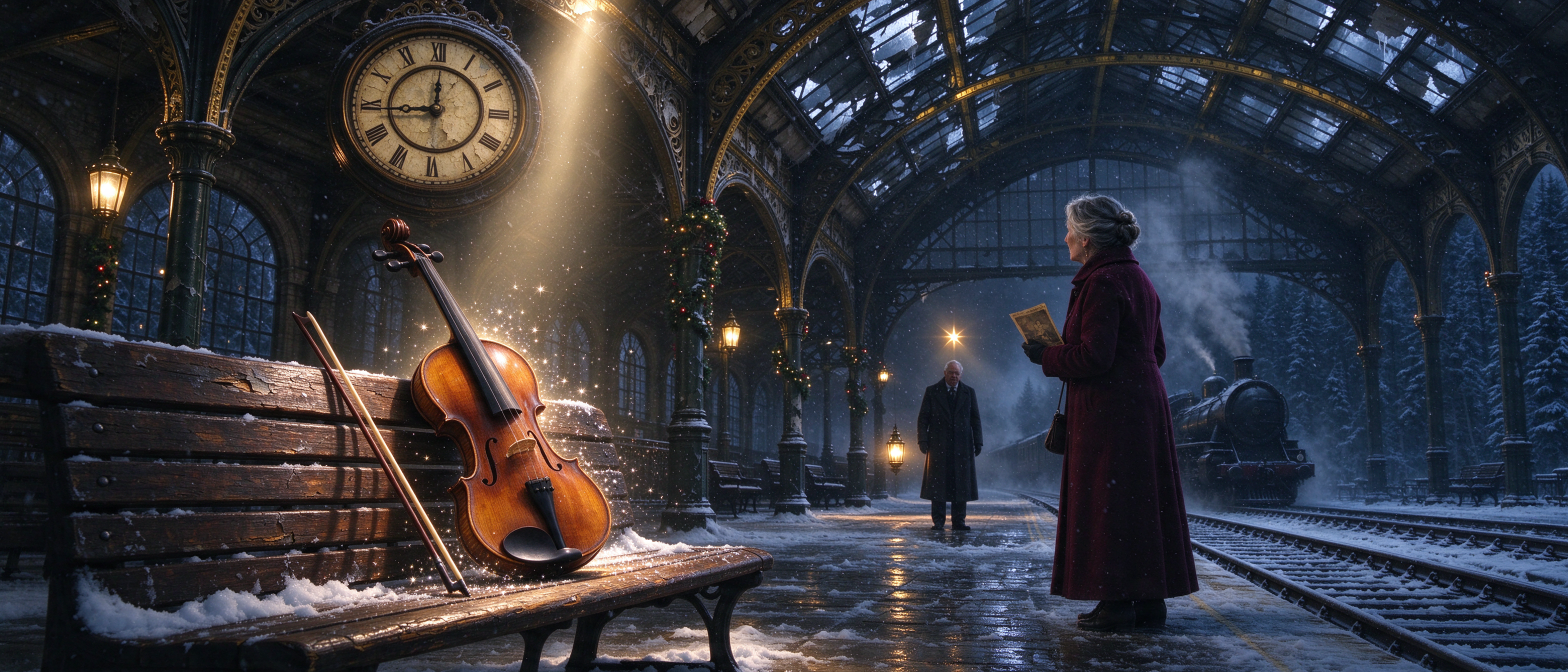
A sweeping cinematic wide shot of Bellweather's abandoned Victorian railway station on Christmas Eve. Snow blankets the platform, the old iron canopy, and the tracks disappearing into a forest. Antique brass lanterns glow beneath ornate iron beams. A massive station clock, its hands moving for the first time in forty years, reads 11:47 p.m. An elderly woman in a burgundy coat stands near Platform Three, holding a faded photograph and staring toward a wooden bench where an antique violin rests. The violin appears to vibrate gently as an invisible melody fills the air. A delicate dusting of snow sparkles around it like tiny stars. Beyond the platform, mist forms the faint outline of a departing steam train. Luminous golden and silver lighting, intricate Victorian architecture, realistic snow and wood textures, cinematic atmosphere, 8K photorealism, mysterious but emotionally grounded magical realism.
Eleanor reached the station at 11:32 p.m.
The gate was supposed to be locked.
It had been locked for decades.
But that night, it stood open.
A path had been cleared through the snow.
Lanterns glowed along the walkway, although the railway company had removed the electrical supply years earlier.
Eleanor walked slowly toward the entrance.
Her boots crunched against the frozen ground.
The old station sign hung crookedly above the doors.
The letters had faded, but she could still read the name.
BELLWEATHER.
She pushed open the door.
The music grew louder.
It seemed to come from Platform Three.
Eleanor hurried through the waiting room.
Dust covered the ticket counter.
A torn timetable hung on the wall.
The old wooden benches remained where they had stood forty years earlier.
But the station did not feel abandoned.
It felt as though someone had just stepped away for a moment.
A small wreath hung above the ticket window.
A brass lantern burned beside the platform doors.
And beneath the great clock, the violin rested on the very bench where Samuel had once played for her.
Eleanor stopped.
It was an old instrument.
The wood had darkened with age.
The varnish was worn near the chin rest.
A thin crack ran along the lower edge, repaired with care.
She knew that violin.
She had watched Samuel polish it every Sunday morning.
She had helped him choose the replacement strings.
She had held it once while he tied his shoelaces beside the river.
And she remembered the tiny silver star he had carved into the wood near the tailpiece.
Eleanor approached.
Her fingers trembled.
“Samuel?”
The melody stopped.
Silence settled over the platform.
Then the station clock began to chime.
Once.
Twice.
Three times.
The hands moved.
The old mechanism sounded impossibly loud in the empty building.
Eleanor stared at the clock.
It was still eleven forty-seven.
Then she noticed something beside the violin.
A small envelope.
Her name was written across the front.
Eleanor.
The handwriting was unmistakable.
Samuel's handwriting.
She pressed her hand against her mouth.
“No.”
She picked up the envelope.
The paper felt old and fragile.
A date was written in the corner.
December 24, 1986.
Eleanor could hardly breathe.
The letter had been written on the night Samuel left.
Forty years earlier.
She opened it carefully.
Inside was a single sheet of paper.
My dearest Eleanor,
If you are reading this, then I have failed to tell you something I should have said before boarding the train.
There is something I must explain.
I love you.
I have loved you since the day you caught my terrible little melody outside the bakery and pretended it was worth listening to.
I am frightened of leaving you.
But I am even more frightened of staying and spending the rest of my life wondering whether I was brave enough to follow the music inside me.
Please understand that leaving does not mean I love you less.
I will write as soon as I arrive.
I will return when I can.
And when I do, I will play our song again.
Until then, keep the little bookshop in your heart.
I will keep the music.
Always yours,
Samuel.
Eleanor lowered the letter.
Her tears fell onto the paper.
For forty years, she had believed Samuel had simply vanished.
She had imagined that he had forgotten her.
That he had met someone else.
That the life he wanted had become so wonderful he no longer wished to return.
But the letter said none of those things.
It said he had loved her.
It said he had been afraid.
It said he had intended to come home.
And it left one terrible question unanswered.
If he had written the letter, why had she never received it?
Eleanor turned it over.
On the back, a second line had been written in smaller handwriting.
If the train takes me somewhere I cannot return from, please know that I never meant to leave you alone.
She closed her eyes.
Outside, the wind swept snow across the tracks.
And somewhere in the darkness, the violin began to play again.
📷 Image Placement — The Conductor's Forgotten Lantern
🎨 Image Prompt
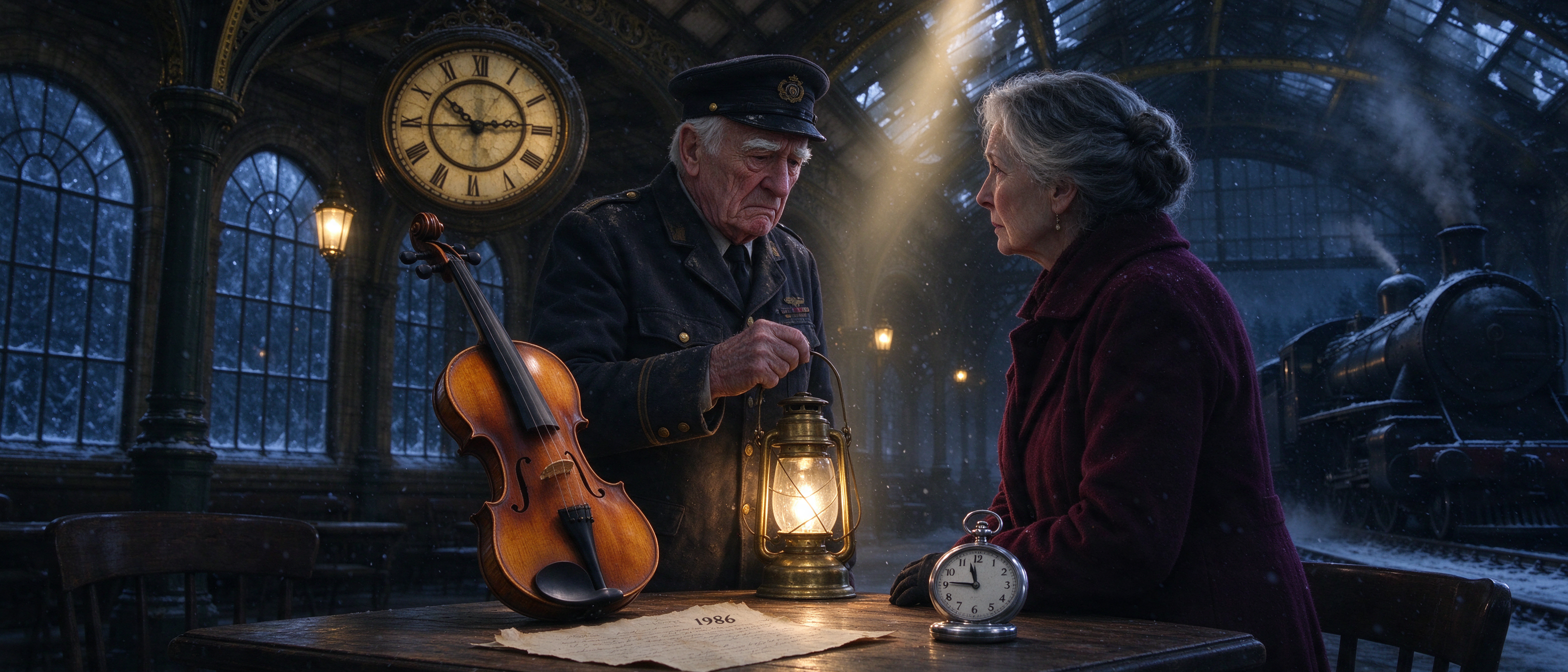
A dramatic, photorealistic cinematic scene inside an old railway station waiting room. An elderly man in his late eighties, wearing a weathered railway conductor's uniform and holding a brass lantern, stands opposite a seventy-two-year-old woman in a burgundy winter coat. His silver eyebrows and lined face reveal a lifetime of memories. On the table between them lie an antique violin, a faded letter dated 1986, and a silver pocket watch stopped at 11:47. Snow drifts past the tall windows, and the golden station clock glows in the background. The man's expression is heavy with a secret he has carried for forty years. Warm lantern light illuminates their faces, contrasting with the cool blue moonlight outside. Highly realistic age details, authentic period objects, cinematic composition, 8K detail, emotional suspense, atmosphere of regret, remembrance, and truth.
“Eleanor Whitmore?”
The voice came from behind her.
She turned sharply.
An elderly man stood at the entrance to the waiting room.
He wore a dark railway uniform with brass buttons.
A conductor's cap rested in his hands.
His face was thin, and his white hair had been combed carefully across his head.
Eleanor recognized him.
“Mr. Harris?”
The man nodded.
His name was Arthur Harris.
He had been the conductor of the last passenger train to leave Bellweather in 1986.
He had retired years ago.
Eleanor had not seen him since the station closed.
“What are you doing here?” she asked.
Arthur glanced toward the violin.
“I heard the music.”
“You heard it too?”
“I've been hearing it every Christmas Eve for forty years.”
Eleanor stared at him.
“Every year?”
Arthur nodded.
“But tonight is the first time the station clock has moved.”
He approached the bench and looked at the letter in her hands.
“You found it.”
“Did you know it was here?”
Arthur's face tightened.
“I knew it existed.”
Eleanor felt a chill move through her.
“Then why didn't I receive it?”
The old conductor removed his cap.
He held it against his chest.
“Because I was the one who took it from Samuel.”
Eleanor stared at him.
“What?”
Arthur looked toward the platform.
“Samuel gave me that letter before he boarded. He asked me to deliver it to you if he couldn't send it himself.”
“Why didn't you?”
Arthur closed his eyes.
“Because I never got the chance.”
He took a slow breath.
“That night, the train was delayed by the snowstorm. We had been warned about unstable conditions along the northern line. The railway company wanted us to wait until morning, but the orchestra's travel coordinator insisted that the passengers continue to the connecting station.”
Eleanor gripped the letter.
“What happened?”
“The train left Bellweather shortly before midnight. I was on board.”
Arthur paused.
“A little beyond the town, we encountered a fallen tree on the line. The engineer managed to stop the train, but the rear carriage was damaged when another section of the tree struck it.”
Eleanor covered her mouth.
“Was Samuel hurt?”
Arthur nodded slowly.
“He was in the last passenger carriage. Several people were injured. Samuel helped the conductor and two passengers get out through a broken window.”
Eleanor's eyes filled.
“He helped them?”
“He did. He carried a little girl through the snow and stayed with her until the rescue team arrived.”
Arthur looked down at his hands.
“But Samuel himself was badly injured.”
The room seemed to tilt around Eleanor.
“Did he die?”
Arthur's eyes glistened.
“No.”
Eleanor released a breath she had been holding for forty years.
“Then where did he go?”
Arthur looked toward the dark tracks.
“He was taken to a hospital in another county. He had lost his identification, and the violin case was separated from his belongings during the evacuation.”
Eleanor frowned.
“But surely someone knew who he was.”
“Eventually, yes. But not immediately. He was unconscious for days. When he woke, he had suffered a serious head injury. His memory was confused.”
Arthur paused.
“He remembered his name. He remembered the orchestra. But he could not remember how to contact you.”
Eleanor sank onto the bench.
“Forty years?”
Arthur nodded.
“His recovery was long. He moved between hospitals and rehabilitation facilities. Eventually, he learned to play again, but he struggled with the memories of that night.”
Eleanor looked at the violin.
“Why didn't he search for me when he recovered?”
Arthur's face crumpled.
“He did.”
The answer came quietly.
“He returned to Bellweather several years later. He asked about you. But the address he remembered was gone. The bookshop had closed, your mother had moved, and you were no longer living in the same house.”
Eleanor stared at him.
“He could have asked someone.”
“He did. But by then, the records were incomplete. He was told you had moved away. He believed you had built a new life and did not want to disturb it.”
Eleanor began to cry.
“And I believed he had forgotten me.”
Arthur sat beside her.
“I am sorry.”
“Why didn't you tell me?”
“I tried to find you after the accident. I sent a letter to the address Samuel gave me. It came back undelivered.”
Eleanor shook her head.
“I lived in Bellweather for another thirty years.”
Arthur lowered his eyes.
“I know that now.”
He looked at the stopped pocket watch in her hand.
“I should have tried harder.”
The station grew quiet.
Eleanor stared at the violin.
For forty years, she had believed she was the one who had been left behind.
But Samuel had been searching too.
He had been injured.
He had struggled to recover.
He had returned to the town where they had said goodbye.
And he had believed that she had moved on without him.
Two people had spent four decades mourning the same lost love, each convinced the other had forgotten.
Eleanor pressed the letter against her chest.
“Where is he now?”
Arthur looked toward the entrance.
“He is waiting.”
Eleanor lifted her head.
“What?”
Arthur nodded.
“He is alive, Eleanor.”
Her breath caught.
“He is here?”
“Not inside the station.”
Arthur looked out toward the tracks.
“He lives in a care home just outside Bellweather. His health has been failing, and his memory has become unreliable. But there is one thing he still remembers clearly.”
Eleanor could barely speak.
“What?”
Arthur's eyes filled with tears.
“Your name.”
📷 Image Placement — The Man Who Remembered Her Name
🎨 Image Prompt
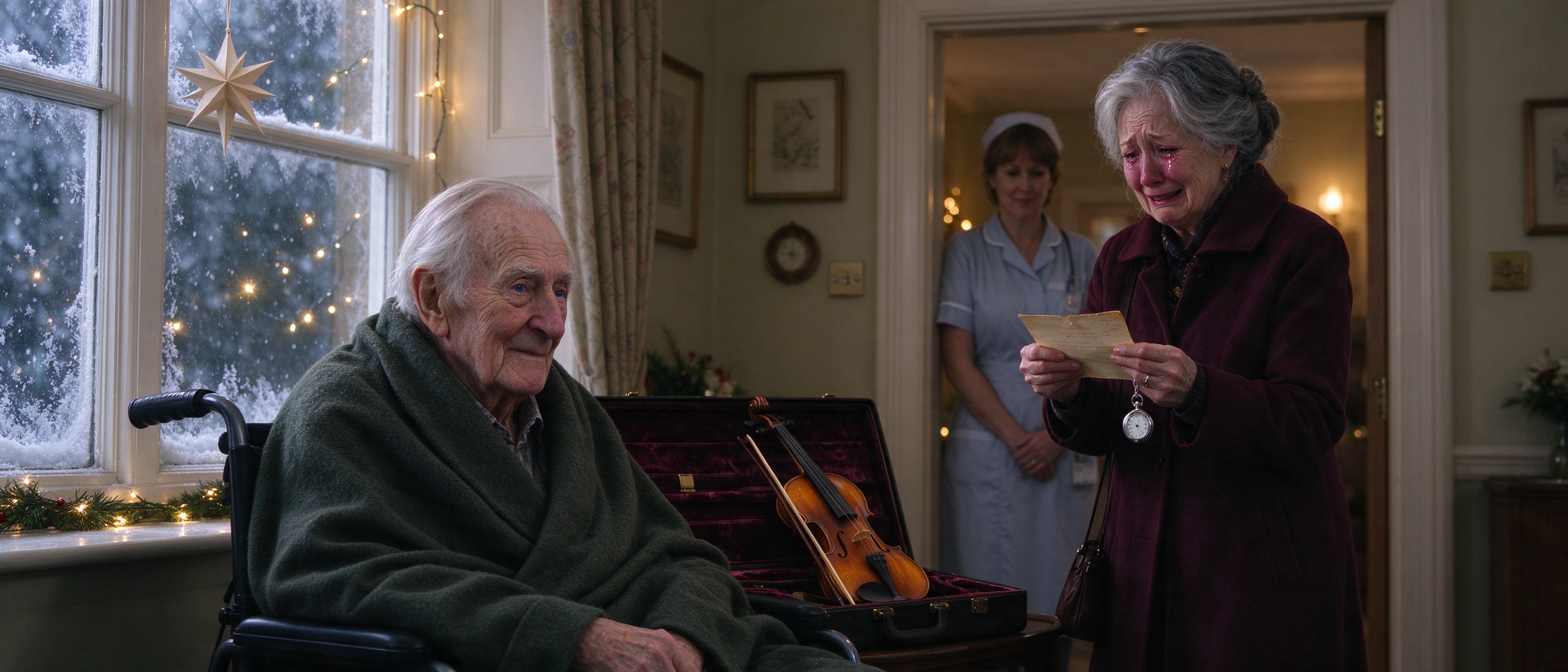
An emotionally moving cinematic scene in the entrance hall of a quiet residential care home on Christmas Eve. A frail eighty-eight-year-old man named Samuel Bennett sits beside a frosted window in a wheelchair, wrapped in a dark green wool blanket. His silver hair is thin, his face deeply lined, but his blue eyes retain a gentle musical sensitivity. A violin rests in a velvet-lined case beside him. In the doorway stands a seventy-two-year-old woman in a burgundy coat, holding an old letter and a silver pocket watch. Her eyes shine with tears as she recognizes the man she loved forty years earlier. A compassionate nurse stands discreetly nearby, allowing them privacy. Soft golden Christmas lights illuminate the room, snow falls beyond the glass, and a small paper star hangs from the window frame. Photorealistic human emotion, realistic elderly features, natural posture, cinematic lighting, 8K detail, quiet anticipation, tenderness, and the fragile possibility of reunion.
Eleanor did not remember leaving the station.
She remembered Arthur helping her into a waiting car.
She remembered the snow falling across the windshield.
She remembered the old conductor telling the driver to take the road past the church and continue toward the hills.
Everything else became a blur.
The care home stood on a quiet lane surrounded by bare trees.
It was a modest building with warm lights in every window.
A wreath decorated the front door.
Someone had placed a little wooden reindeer beside the entrance.
Inside, the hallway smelled of cinnamon and fresh coffee.
A nurse greeted Arthur by name.
Then she looked at Eleanor.
“You must be Eleanor.”
Eleanor nodded, unable to speak.
The nurse's expression softened.
“He has been asking about you.”
Eleanor pressed the letter against her chest.
“How long has he been here?”
“Almost three years.”
“Does he know I'm coming?”
The nurse hesitated.
“He knows someone is coming to see him. But his memory changes from day to day.”
Eleanor swallowed.
“What if he doesn't remember me?”
The nurse took her hand.
“Then you can introduce yourself.”
She paused.
“And if he does remember you, you can let that moment be whatever it needs to be.”
Eleanor nodded.
They walked down a quiet corridor.
A Christmas tree stood in the common room.
A few residents sat nearby, watching an old holiday film.
The nurse stopped outside a room at the end of the hall.
“He is here.”
Eleanor looked through the open doorway.
An elderly man sat beside the window.
His shoulders were narrow beneath a green wool blanket.
His hair was silver.
His hands rested quietly in his lap.
A violin case stood beside his chair.
He was looking out at the snow.
Eleanor could hardly breathe.
She had imagined this moment a thousand times.
In some dreams, Samuel had remained young.
In others, he had been angry.
Sometimes he had refused to speak.
Sometimes he had simply turned away.
But she had never imagined him looking so fragile.
She had never imagined that forty years could change a face so completely while leaving the heart so unprepared.
The nurse stepped inside.
“Samuel, you have a visitor.”
The old man turned his head.
His eyes moved toward Eleanor.
For several seconds, he simply looked at her.
Then he frowned slightly.
“I'm sorry,” he said. “Have we met?”
Eleanor felt her heart sink.
She forced herself to smile.
“My name is Eleanor.”
Samuel's expression changed.
He stared at her.
Then his eyes moved to the paper in her hands.
“Eleanor?”
She nodded.
His lips parted.
He looked suddenly frightened.
“No,” he whispered.
Eleanor stepped closer.
“Samuel?”
He began to tremble.
“No, no. It can't be.”
His eyes filled with tears.
“I waited for you.”
Eleanor covered her mouth.
“I waited for you too.”
Samuel stared at her as though he were trying to see through forty years of distance.
Then he lifted one trembling hand.
“Your hair,” he whispered. “It's silver.”
Eleanor laughed through her tears.
“So is yours.”
For a moment, he looked confused.
Then a small smile appeared on his face.
“The bakery,” he murmured.
Eleanor went still.
“What?”
“The bakery,” he repeated. “You dropped your books. Your scarf blew into the street.”
She began to cry.
“You remember?”
Samuel looked at her.
“I remember your laugh.”
He reached for her hand.
His fingers were cold and thin.
But when Eleanor took them, his expression softened.
“Eleanor,” he whispered. “I thought I had lost you.”
She sank into the chair beside him.
“Oh, Samuel.”
“I tried to come home.”
“I know.”
“I looked for you.”
“I know.”
He began to cry.
“I thought you had forgotten me.”
Eleanor shook her head.
“Never.”
For forty years, she had imagined that if she ever saw Samuel again, she would ask why he had left.
She would demand an explanation.
She would tell him how lonely she had been.
She would ask whether he had loved someone else.
But now, sitting beside him, she found that the most important question had changed.
She took his hand in both of hers.
“Do you remember our song?”
Samuel's eyes brightened.
He looked toward the violin case.
“The Place Where We Begin.”
Eleanor nodded.
“Yes.”
He smiled.
“I never finished it.”
She leaned closer.
“Then perhaps we can finish it together.”
📷 Image Placement — The Melody of a Second Chance
🎨 Image Prompt
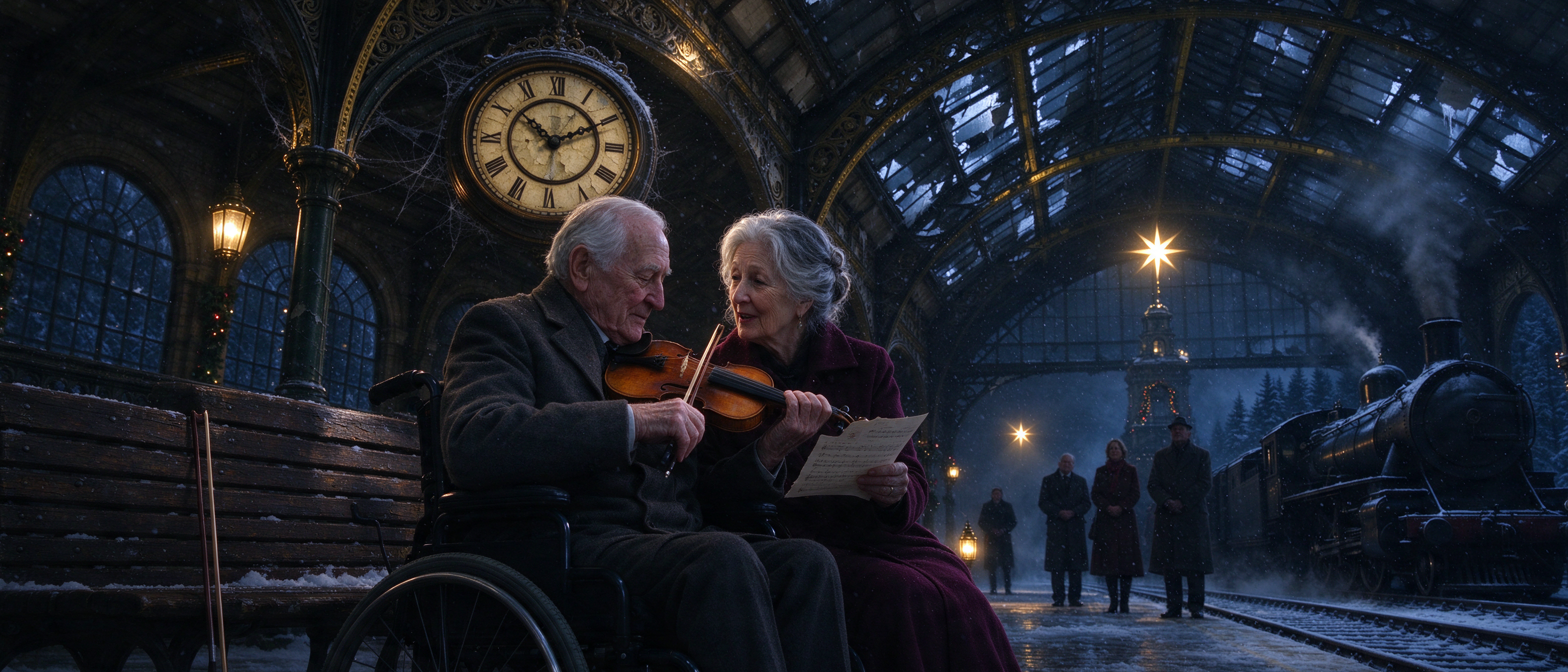
A stunning cinematic Christmas night scene inside Bellweather's restored but quiet railway station. An elderly man in a wheelchair sits beneath the enormous station clock, holding an antique violin beneath his chin while an elderly woman sits beside him, her silver hair softly illuminated by golden lantern light. She holds a small sheet of handwritten music and gently hums along as he plays their unfinished melody. Snow falls beyond the tall arched windows, and a magnificent Christmas star glows above the station tower. A few distant silhouettes of townspeople stand respectfully in the background, listening in silence. The atmosphere is tender, nostalgic, and almost sacred. Detailed aged violin wood, realistic elderly hands, lifelike facial expressions, intricate Victorian ironwork, warm gold against winter blue, photorealistic cinematic lighting, 8K masterpiece quality, emotional realism, no exaggerated fantasy.
Samuel's health was too fragile for a long outing.
The nurse reminded them of that twice.
But after Eleanor asked whether he might like to visit the station, Samuel looked toward the window and said something she would remember for the rest of her life.
“I've been waiting forty years to hear that clock again.”
The care home arranged a short visit.
Arthur offered to drive them.
The nurse accompanied them, bringing a warm blanket and Samuel's medication.
They arrived shortly before eleven.
The station stood beneath a clear winter sky.
Snow covered the platform.
The brass lanterns glowed.
And the great clock was moving.
Eleanor helped Samuel settle beside the old wooden bench.
The violin rested in his lap.
He ran his fingers over the worn wood.
“Still here,” he whispered.
Eleanor smiled.
“Still here.”
Samuel looked at her.
“Do you remember what you said when I first played our song?”
She laughed softly.
“I said you needed to give it a better name.”
“And you said it was too grand.”
“It was.”
He smiled.
“Then you said I should make it grand enough to deserve the name.”
Eleanor's eyes filled.
“I remember.”
Samuel lifted the violin.
His hands trembled.
For a moment, he struggled to position the bow.
Eleanor moved closer.
“Take your time.”
He nodded.
Then he began to play.
The first notes were faint.
A little uneven.
But they were unmistakable.
The melody drifted beneath the station clock.
It carried the memory of a bakery on a winter afternoon.
A young woman with a box of books.
A young man with a violin.
Two people who had dreamed of a little house and a bookshop and a future that seemed so certain.
Eleanor began to hum.
Samuel glanced at her.
His smile widened.
The melody grew stronger.
For a few moments, the years seemed to loosen their grip.
They were not twenty-nine and twenty-eight.
They were not seventy-two and eighty-eight.
They were simply Eleanor and Samuel, sitting together at the station where they had once said goodbye.
When the song ended, silence filled the platform.
Samuel lowered the violin.
Eleanor wiped her tears.
“That was beautiful.”
He looked at the instrument.
“I think it needs one more part.”
“What part?”
He turned toward her.
“The part where you come home.”
Eleanor took his hand.
“I'm here.”
He nodded.
“I know.”
For a moment, they sat quietly.
Then Samuel reached into the pocket of his cardigan and removed a small object wrapped in tissue paper.
Eleanor stared.
It was a silver pocket watch.
The matching watch she had given him forty years earlier.
Its chain had been repaired.
The metal was worn.
And on the back were the six words she had engraved before his departure.
Until every journey brings you home.
Eleanor began to cry.
“You kept it.”
Samuel nodded.
“Every day.”
“Why didn't you ever send it back?”
He looked confused.
“Send it back?”
“To me.”
Samuel's eyes filled with tears.
“Because it was yours.”
He held the watch carefully.
“And because I thought if I kept it, I would always remember where home was.”
Eleanor leaned forward and rested her forehead against his.
For forty years, she had believed the watch represented a promise broken.
Now she understood that Samuel had carried it through hospitals, rehabilitation centers, unfamiliar rooms, and years of uncertainty.
He had carried it because he had never forgotten the place where their story began.
And she had carried her own watch because she had never stopped hoping that one day he might return.
Neither had known that the other had kept the promise alive in the only way they could.
The station clock chimed eleven forty-seven.
Samuel looked up.
“It's time.”
Eleanor's heart tightened.
“Time for what?”
He smiled gently.
“To say goodbye properly.”
She shook her head.
“No.”
Samuel squeezed her hand.
“Eleanor, my love. I have spent forty years trying to find the right words.”
His voice trembled.
“I am sorry I left you waiting. I am sorry the world carried us in different directions. And I am sorry we lost so much time.”
Eleanor cried silently.
“But I need you to know that those years were not empty,” he continued. “Because wherever I went, I carried you with me.”
He lifted her hand to his lips.
“You were in every melody I played.”
He paused.
“You were in every Christmas song I heard.”
His eyes filled.
“And you were in every place I hoped to return to.”
Eleanor pressed his hand against her cheek.
“I loved you then.”
She swallowed.
“I love the man you are now.”
Samuel smiled.
“Then I have had a wonderful life.”
She shook her head through her tears.
“We both deserved more time.”
“Yes,” he whispered. “We did.”
They sat together beneath the old clock as snow fell beyond the windows.
They did not pretend that forty years could be recovered.
They did not try to make their reunion into a perfect ending.
They simply held hands.
And when Samuel's eyes began to close, Eleanor rested her head against his shoulder.
For the first time since 1986, neither of them was waiting for the other to return.
They were together.
And for that moment, it was enough.
📷 Image Placement — The Last Christmas Song
🎨 Image Prompt
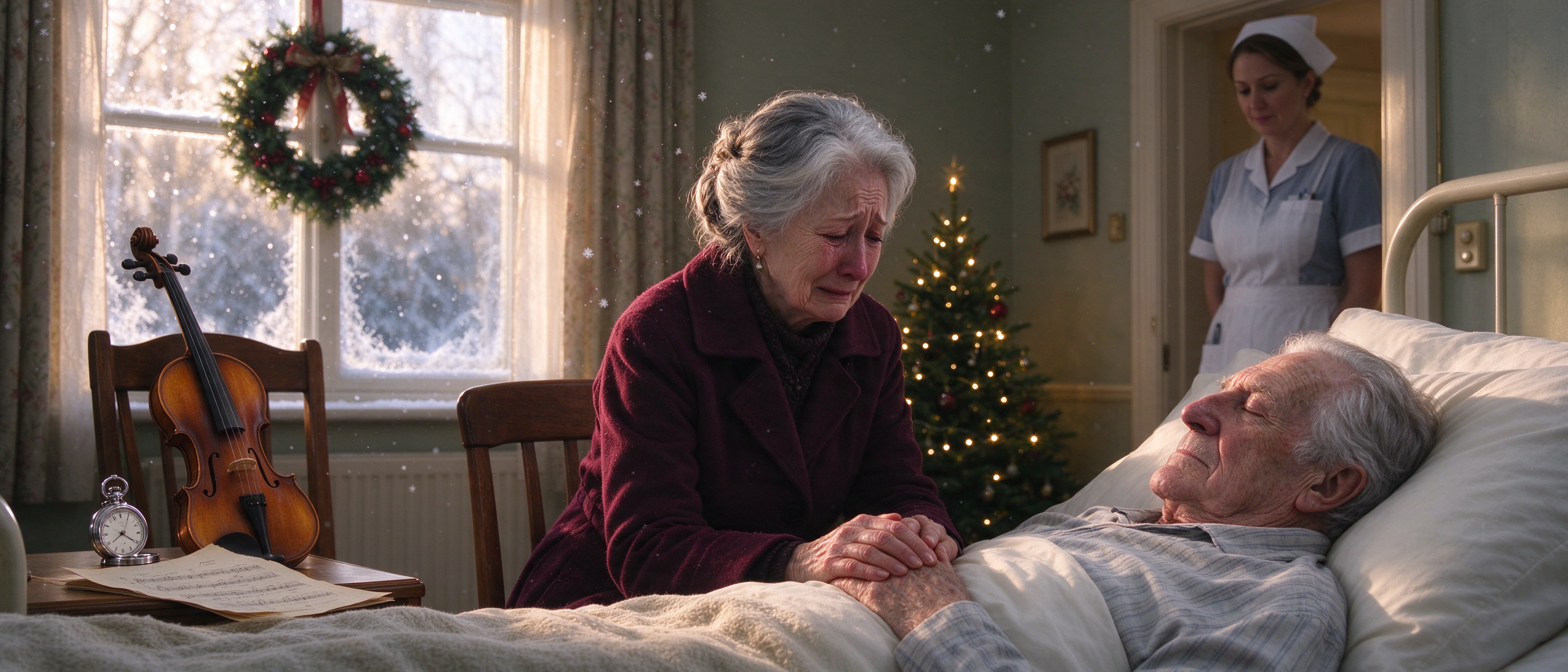
A tender, photorealistic cinematic scene in a peaceful care-home room at dawn on Christmas morning. An elderly woman with silver hair sits beside the bed of an elderly man with closed eyes and a peaceful expression. She gently holds his hand while a violin rests on a chair near the window. A small silver pocket watch lies on the bedside table beside a folded sheet of handwritten music. Soft winter sunlight pours through frosted glass, and delicate snowflakes drift past a wreath hanging outside. A tiny Christmas tree glows in the corner, casting warm golden reflections across the room. The woman's face shows profound sorrow mixed with gratitude and peace. A nurse stands quietly in the doorway, respectfully giving her space. Natural elderly features, realistic hands, intimate cinematic composition, exquisite lighting, 8K photorealism, deeply emotional but dignified atmosphere, no supernatural exaggeration.
Samuel died three days later.
He passed away quietly in his sleep, with Eleanor sitting beside him.
His last days had been peaceful.
He had spoken about the bakery.
He had asked whether Eleanor still liked the old Christmas songs.
He had laughed when she reminded him that he had once tried to cook dinner and nearly burned a pot of soup.
And he had asked her to promise something.
“Keep the violin,” he whispered.
Eleanor nodded.
“I will.”
“Play our song for someone.”
She held his hand.
“I don't know how to play the violin.”
Samuel smiled.
“Then hum it.”
She laughed softly through her tears.
“All right.”
He closed his eyes for a moment.
Then he opened them again.
“Eleanor?”
“Yes, my love?”
“Thank you for waiting.”
Her face crumpled.
“Oh, Samuel. I didn't know where you were.”
“I know.”
He squeezed her fingers.
“Then thank you for remembering.”
Those were the last words he spoke to her.
When he died, Eleanor did not feel that the years of waiting had suddenly become worthwhile.
She would never pretend that forty years apart were a gift.
They had been a loss.
A terrible, unnecessary loss.
But she was grateful that the final days had allowed them to speak honestly.
She was grateful that Samuel had known she had never forgotten him.
And she was grateful that, before he died, he had learned the truth too.
Neither had abandoned the other.
Neither had stopped loving.
They had been separated by circumstances neither could have understood at the time.
And although their lives had taken different paths, the melody they shared had survived.
At Samuel's funeral, Eleanor placed the silver pocket watch in his hands.
She kept the violin.
On Christmas morning, she returned to Bellweather Station.
The town had gathered to honor Samuel.
Children from the local music school stood beside the platform holding candles.
The bakery had sent trays of warm pastries.
Arthur Harris stood near the station clock, his conductor's cap held against his chest.
And Eleanor carried the violin.
She stood beneath the old clock.
Her hands trembled as she lifted the instrument.
She could not play.
But she remembered the melody.
So she began to hum.
Softly.
Carefully.
The Place Where We Begin.
A young violin student stepped forward.
Then another.
Together, they played the tune Samuel had composed forty years earlier.
The melody filled the station.
It traveled through the waiting room.
It drifted beneath the iron canopy.
It floated over the tracks and into the snowy trees beyond the town.
People began to cry.
Some remembered Samuel.
Some remembered Eleanor.
Some remembered the loved ones they had lost and the words they had never found the courage to say.
And as the final notes faded, the great station clock struck noon.
The violin rested quietly in Eleanor's arms.
She looked toward the tracks.
For one fleeting moment, she thought she saw a young man standing at the far end of the platform.
Dark hair.
A familiar smile.
A violin case in his hand.
He lifted his fingers in a small wave.
Then the snow drifted across the tracks, and the figure disappeared.
Eleanor did not try to explain what she had seen.
She simply closed her eyes and whispered:
“Until every journey brings you home.”
📷 Image Placement — The Music That Stayed Behind
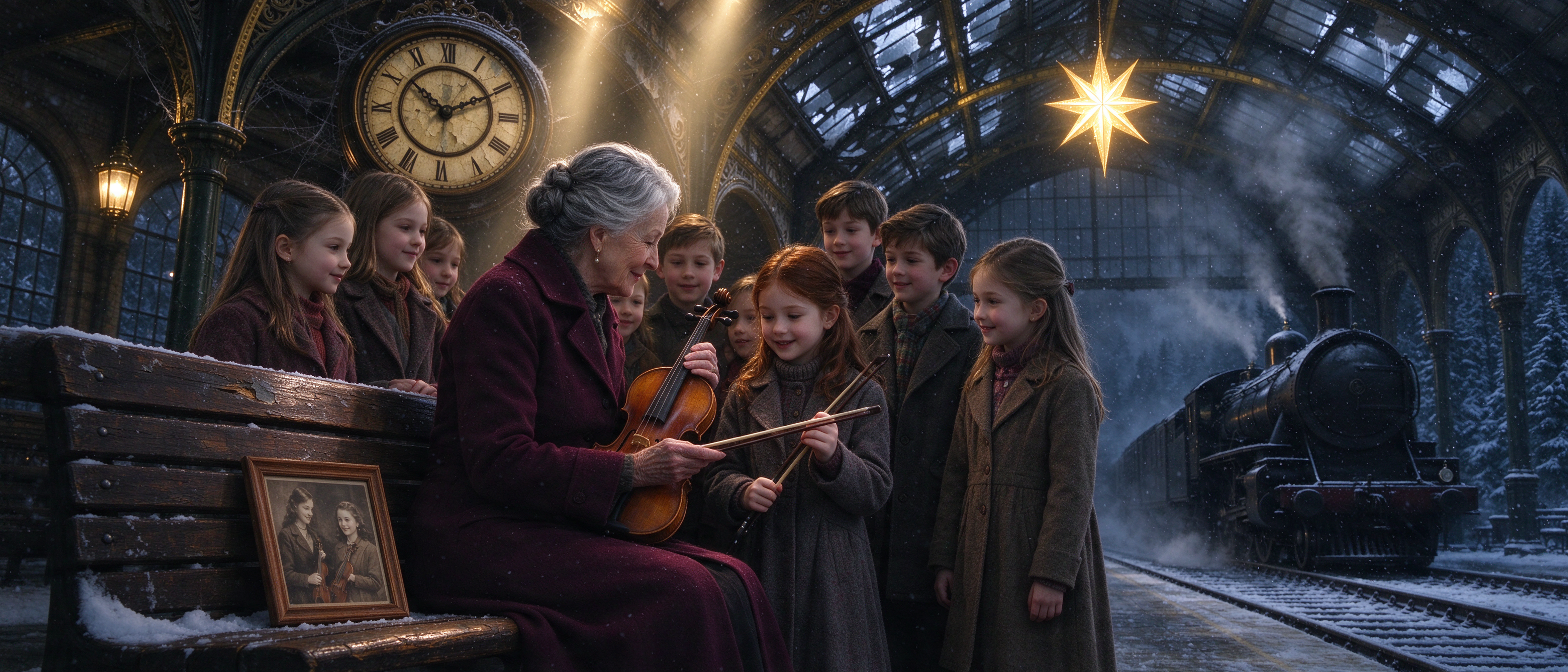
🎨 Image Prompt
A breathtaking, photorealistic cinematic Christmas scene one year later inside the restored Bellweather railway station. A seventy-three-year-old woman with silver hair sits on a wooden bench beneath the restored station clock, holding an antique violin while a circle of children from the local music school gathers around her. A young girl with chestnut hair carefully holds the bow as Eleanor gently guides her hands. An old photograph of a young violinist and a young woman rests in a small wooden frame on the bench. Golden lanterns illuminate the station, snow falls beyond the tall arched windows, and a magnificent Christmas star shines above the roof. In the distance, a vintage steam train approaches slowly through the winter mist. Warm light, realistic expressions of wonder and tenderness, detailed Victorian architecture, exquisite wood textures, cinematic composition, 8K masterpiece quality, nostalgic magical realism, themes of enduring love, memory, music, and hope passed from one generation to the next.
A year after Samuel's death, Eleanor returned to the station with a group of children from the local music school.
The railway company had restored Platform Three.
The old waiting room had been repaired.
The station clock had been cleaned and restarted.
And every Christmas Eve, the town now held a small concert in Samuel's memory.
Eleanor sat on the old wooden bench.
The violin rested beside her.
A little girl named Sophie approached, carrying a music book almost as large as her coat.
“Miss Whitmore?”
Eleanor smiled.
“Yes, dear?”
“Is it true that this violin belonged to someone you loved?”
Eleanor looked at the instrument.
“Yes.”
“Was he famous?”
She considered the question.
“Not in the way you might imagine.”
Sophie frowned.
“Then why is everyone here for him?”
Eleanor looked around the station.
At the children.
At the families.
At the old conductor standing near the clock.
At the people who had come carrying memories of their own.
“Because he made something beautiful,” she said. “And he shared it.”
Sophie studied the violin.
“Will you teach me the song?”
Eleanor smiled.
“If you promise to be patient with it.”
“I will.”
“And if you promise to share it with someone who needs it.”
Sophie nodded solemnly.
“I promise.”
Eleanor opened the music book.
The melody was written there in careful notes.
At the top of the page were the words Samuel had chosen forty years earlier.
The Place Where We Begin.
She placed the violin beneath Sophie's chin and gently guided her hands.
The first notes were uncertain.
The second attempt was a little better.
By the third, Sophie was smiling.
Eleanor watched her carefully.
She saw Samuel's patience in the way the child listened.
She saw his curiosity in the way she tilted her head when a note sounded different from what she expected.
And she saw something that had been missing from Eleanor's own life for many years.
A beginning.
Not a replacement for Samuel.
Not an attempt to pretend that the years apart had never happened.
But a new place where the music could continue.
As the children practiced, snow began falling outside the windows.
The great clock ticked steadily overhead.
And at exactly 11:47 p.m., the station bell rang once.
Everyone turned.
The sound was clear and beautiful.
A few children smiled.
One boy looked toward the roof.
Eleanor simply closed her eyes.
She could almost hear Samuel laughing.
She could almost hear him saying that the melody needed one more part.
And in her heart, she knew what that part was.
Not a perfect reunion.
Not a life without sorrow.
Not a promise that every lost love would return.
It was the knowledge that love could leave something behind that continued to comfort people long after the hands that created it had grown still.
The music would belong to Sophie now.
And to the children who would learn it after her.
And to the people who heard it and remembered someone they had loved.
Eleanor would never recover the forty years she had spent wondering.
She would never forget the pain of believing Samuel had abandoned her.
But she no longer had to carry that uncertainty.
She knew he had loved her.
He had known she loved him.
And in the final days of his life, they had found each other again.
Sometimes, that truth still brought tears.
Sometimes, it made her smile.
And every Christmas Eve, when the station grew quiet and the snow began to fall, Eleanor returned to Platform Three.
She placed her hand on the old wooden bench.
She looked up at the clock.
And she listened.
Because somewhere within the melody, she could still hear the young man who had once sat beside her and promised that he would come home.
And although his journey had ended, the music had not.
It moved through the station.
It traveled into the town.
It found its way into the hearts of children who had never met Samuel Bennett.
And it reminded them that love was not measured only by how long two people stood beside one another.
Sometimes, it was measured by what they gave the world while they were here.
A song.
A kindness.
A promise.
A memory.
Or a little light left shining in a place where someone might need to find their way.
And every year, as the final notes drifted into the snowy night, the old station clock continued ticking.
Not backward.
Not trying to recover the years that had passed.
But forward.
One second at a time.
One new beginning at a time.
And one beautiful melody at a time.
❤️ Life Lesson
There are few pains more difficult than believing someone you love has forgotten you.
When a person disappears from our lives without explanation, the mind begins creating answers to fill the silence.
Perhaps we were not important enough.
Perhaps they found someone better.
Perhaps our love was never real.
And sometimes, the absence of an answer becomes a wound that lasts longer than the separation itself.
Eleanor spent forty years believing Samuel had chosen a life without her.
Samuel spent much of that same time believing Eleanor had moved on.
Neither knew that the other had continued to care.
Their story reminds us that silence does not always mean a lack of love, but unanswered questions can cause real and lasting pain.
We cannot assume that every missing person will return, or that every broken relationship has a hidden explanation that will make the hurt disappear.
Sometimes, people leave because they make choices that hurt others.
Sometimes, circumstances separate people who desperately want to remain together.
And sometimes, the truth is never discovered.
But when we have the opportunity to communicate honestly, we should not underestimate the importance of saying what needs to be said.
Tell someone you love them.
Ask the difficult question.
Explain the misunderstanding.
Apologize when you have caused harm.
And when you can, do not leave the people who matter to you guessing about whether they still have a place in your heart.
Samuel and Eleanor could not recover forty years.
Their reunion did not erase the loneliness, the missed birthdays, the lost dreams, or the Christmases spent wondering.
Love cannot reverse time.
But the truth gave them something precious that uncertainty had taken away.
They finally understood what had happened.
They finally heard the words they had waited decades to hear.
And they were able to share a little time together without the terrible question of whether they had ever mattered to one another.
Their story also teaches us that a meaningful life does not have to unfold according to our original plans.
Eleanor never opened the bookshop she had dreamed of.
Samuel never completed the musical career he had imagined.
Their future changed in ways neither could have anticipated.
Yet the kindness they offered, the music Samuel created, and the love they carried became part of a story that reached far beyond their own lives.
We often imagine that our greatest accomplishments must be large enough for the world to notice.
But sometimes, the most lasting things we leave behind are quiet.
A song that comforts someone.
A lesson that gives a child confidence.
A kindness that inspires another kindness.
A memory that helps a grieving person keep going.
We may never know how far these gifts travel.
And we do not have to know.
The value of love is not determined only by how long we get to keep someone. It is also found in the beauty, courage, and compassion that love awakens within us.
If you are carrying an unanswered question, be gentle with yourself.
If there is a safe and appropriate way to seek the truth, you may choose to do so.
If reconciliation is possible, remember that it requires honesty and respect from everyone involved.
And if an answer never comes, remember that you do not have to spend your entire life waiting for someone else to explain your worth.
You mattered then.
You matter now.
And you deserve relationships in which care is expressed through more than promises.
You deserve honesty.
You deserve respect.
You deserve the freedom to move forward without blaming yourself for everything you could not control.
Sometimes, love returns in a way we never expected.
Sometimes, it arrives too late to restore what was lost, but early enough to bring peace.
And sometimes, love remains as a memory that helps us become more compassionate toward others.
Whatever form it takes, do not be afraid to let love teach you something beautiful.
You cannot always control the journey.
You cannot always prevent goodbye.
And you cannot always make time wait.
But you can choose to tell the truth while you have the chance.
You can choose to be kind.
You can choose to create something meaningful.
And you can choose to carry the best of the people you have loved into the life you are still living.
Because even when a song ends, its melody can continue in the hearts of those who heard it.
And even when a journey reaches its final station, the love shared along the way may still guide someone home.
❤️ Next Chapter
Chapter 127: The Little Girl Who Planted a Christmas Rose Beside a Forgotten Angel Statue—and Discovered the Secret of the Garden That Bloomed Only for the Brokenhearted 🌹👼❄️🎄❤️✨
Topics
Writing one? Publish your story on the BudgetPixel blog.

 @pocahontas



 @EternaSky
 @faerierealm
 @germancowboy