
The Forgotten Love Chronicles Volume Two — Chapter 124: The Little Boy Who Left His Teddy Bear Beside an Angel's Grave—and Discovered the Secret Behind the Snowfall That Never Melted 🧸🪽❄️🎄❤️✨
 @archangeltara
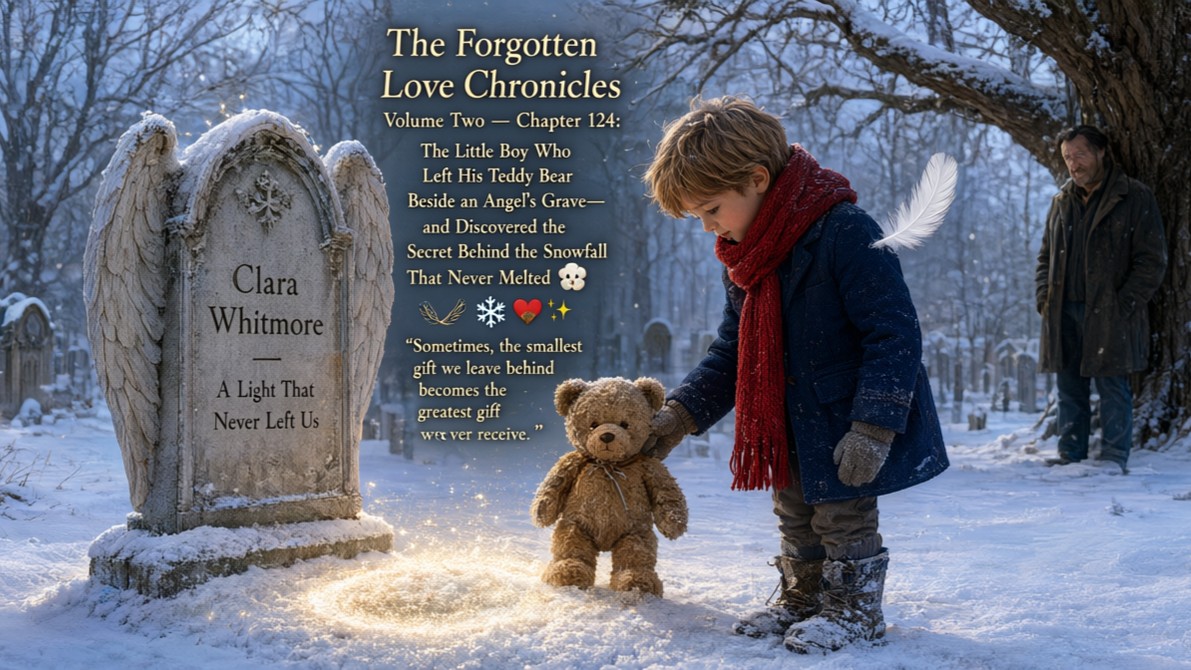
The Forgotten Love Chronicles
Volume Two — Chapter 124: The Little Boy Who Left His Teddy Bear Beside an Angel's Grave—and Discovered the Secret Behind the Snowfall That Never Melted 🧸🪽❄️🎄❤️✨
📷 Image Placement
🎨 Image Prompt
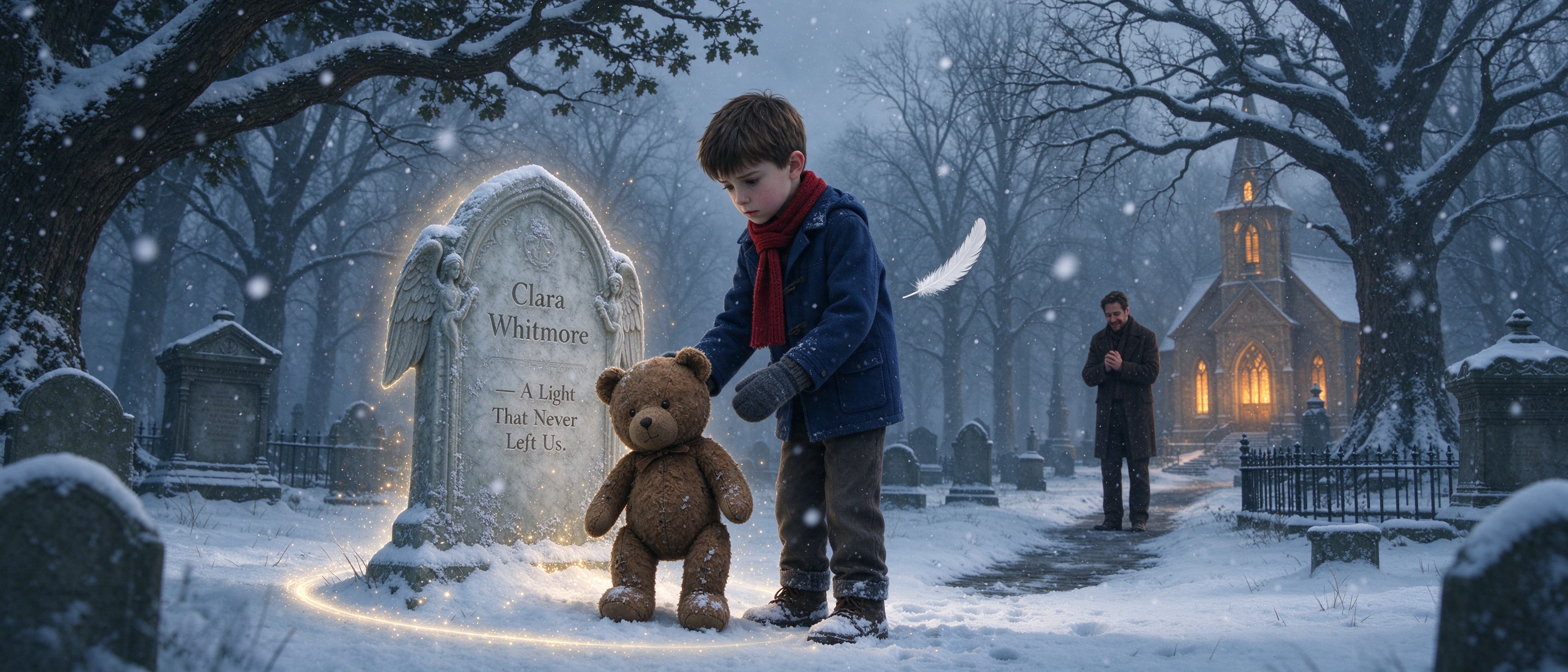
Create a breathtaking, ultra-photorealistic cinematic Christmas scene in a peaceful Victorian cemetery blanketed in pristine white snow. At the center stands an eight-year-old boy wearing a navy-blue winter coat, a knitted red scarf, wool mittens, and snow-covered boots. He gently places a well-loved, slightly worn brown teddy bear beside an old marble gravestone decorated with delicate angel wings. The inscription is partially obscured by frost and reads, “Clara Whitmore — A Light That Never Left Us.” Mysteriously, a small circle of luminous snow surrounds the grave, sparkling with tiny golden particles while the surrounding cemetery lies beneath ordinary winter snow. Tall bare trees stretch toward a silver-blue winter sky, and distant church windows glow warmly in the background. A single white feather floats beside the boy's shoulder. Far behind him, a loving but grieving father watches from beneath an ancient oak tree. Ethereal golden light, delicate falling snowflakes, extraordinary emotional depth, realistic human expressions, intricate textures, cinematic composition, volumetric lighting, shallow depth of field, masterpiece quality, 8K detail, magical realism, heavenly atmosphere, bittersweet hope, no cartoon styling, no distorted anatomy, no unwanted text.
“Sometimes, the smallest gift we leave behind becomes the greatest gift we ever receive.”
The snow had been falling over Bellweather for eleven days.
It covered the church steeple, softened the rooftops of the little houses, and transformed the town square into a Christmas postcard.
Icicles hung from the bakery awning.
Evergreen wreaths decorated the shop windows.
And every evening, the golden lights along Main Street shimmered through the falling flakes as if the stars had come down to visit the people who lived there.
But there was one place in Bellweather where the snow was different.
It was a small grave in the oldest corner of the cemetery.
Every winter, the snow gathered around that grave.
And every spring, when the snow melted everywhere else, the little patch surrounding the gravestone remained.
Even when the grass turned green.
Even when the flowers bloomed.
Even when the summer sun warmed the marble until it felt almost hot beneath a person's hand.
The snow never melted.
Some people called it a mystery.
Others called it a miracle.
Most had simply learned to walk past without asking questions.
But eight-year-old Noah Bennett had never been good at ignoring mysteries.
Especially when they involved angels.
And especially when Christmas was approaching.
📷 Image Placement — The Boy Who Missed His Mother
🎨 Image Prompt
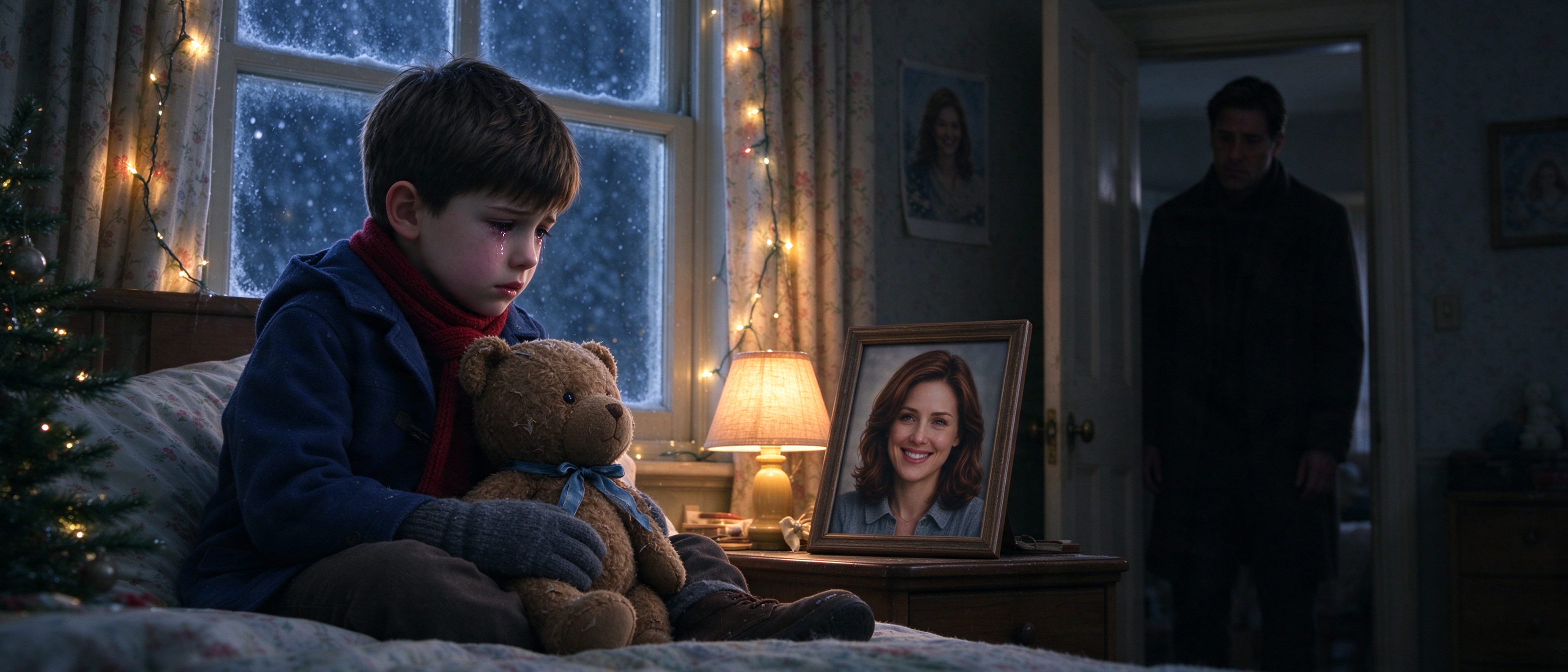
A deeply emotional cinematic interior of a modest child's bedroom on a snowy December evening. An eight-year-old boy named Noah sits beside a frosted window, holding a worn brown teddy bear with a faded blue ribbon around its neck. On the bedside table rests a framed photograph of a smiling mother with warm eyes and chestnut hair. Christmas lights glow softly around the window, but a small artificial Christmas tree in the corner remains undecorated. The boy's eyes glisten with unshed tears as he looks at the photograph. His father's silhouette is visible in the hallway, quietly watching but uncertain how to comfort his son. Blue winter moonlight mingles with warm amber lamplight, realistic expressions of grief and tenderness, delicate falling snow outside, intimate composition, photorealistic cinematic realism, exquisite detail, 8K, gentle heavenly atmosphere.
Noah's mother had died in the spring.
Her name was Emily.
She had been the sort of mother who sang while washing dishes, danced barefoot in the kitchen, and insisted that every thunderstorm needed a blanket fort.
She believed that ordinary days were full of extraordinary things.
A ladybug on the windowsill.
A rainbow reflected in a puddle.
A stranger who held the door for someone carrying too many groceries.
And snowflakes.
Especially snowflakes.
Whenever it snowed, Emily would catch one on her mitten and whisper, “Look closely, Noah. Every snowflake is a tiny reminder that the world can make something beautiful out of the cold.”
Noah had believed her.
He had believed nearly everything his mother told him.
She had also given him a teddy bear on his fifth birthday.
Its fur was brown, its nose was stitched crookedly, and one of its ears had been repaired with blue thread.
Noah named him Captain Buttons.
His mother had laughed at the name.
“Captain Buttons will be your brave companion,” she had told him. “He'll go wherever you go, even when you're afraid.”
For three years, Captain Buttons had accompanied Noah everywhere.
He had attended birthday parties.
He had survived a spilled bowl of spaghetti.
He had traveled to the beach, where he had accidentally been buried beneath a mountain of sand.
And he had slept beneath Noah's arm every night.
After Emily died, Noah held the teddy bear even more tightly.
Sometimes he imagined that the bear still carried a little of his mother's warmth.
Sometimes he pressed his face into its worn fur and tried to remember the exact sound of her laughter.
But memories were strange things.
Some days they came rushing back so clearly that Noah could almost hear her footsteps in the hallway.
Other days, he struggled to remember the precise shade of her eyes.
Those were the days that frightened him most.
He was afraid that if he forgot enough little things, he might somehow lose her all over again.
His father, Daniel, was struggling too.
Before Emily's death, Daniel had been a man who told terrible jokes, sang off-key in the car, and made pancakes shaped like dinosaurs.
Now he moved through the house quietly.
He went to work.
He prepared dinner.
He folded laundry.
He answered questions when Noah asked them.
But the easy laughter had disappeared from their home.
Their Christmas tree stood in the living room, half decorated.
The ornaments remained in their cardboard box.
Daniel had promised they would finish decorating it together.
That had been two weeks ago.
Neither of them had mentioned it since.
And as Christmas approached, Noah began to feel that the entire world was celebrating a happiness his family no longer knew how to find.
📷 Image Placement — The Secret Grave Beneath the Old Oak
🎨 Image Prompt
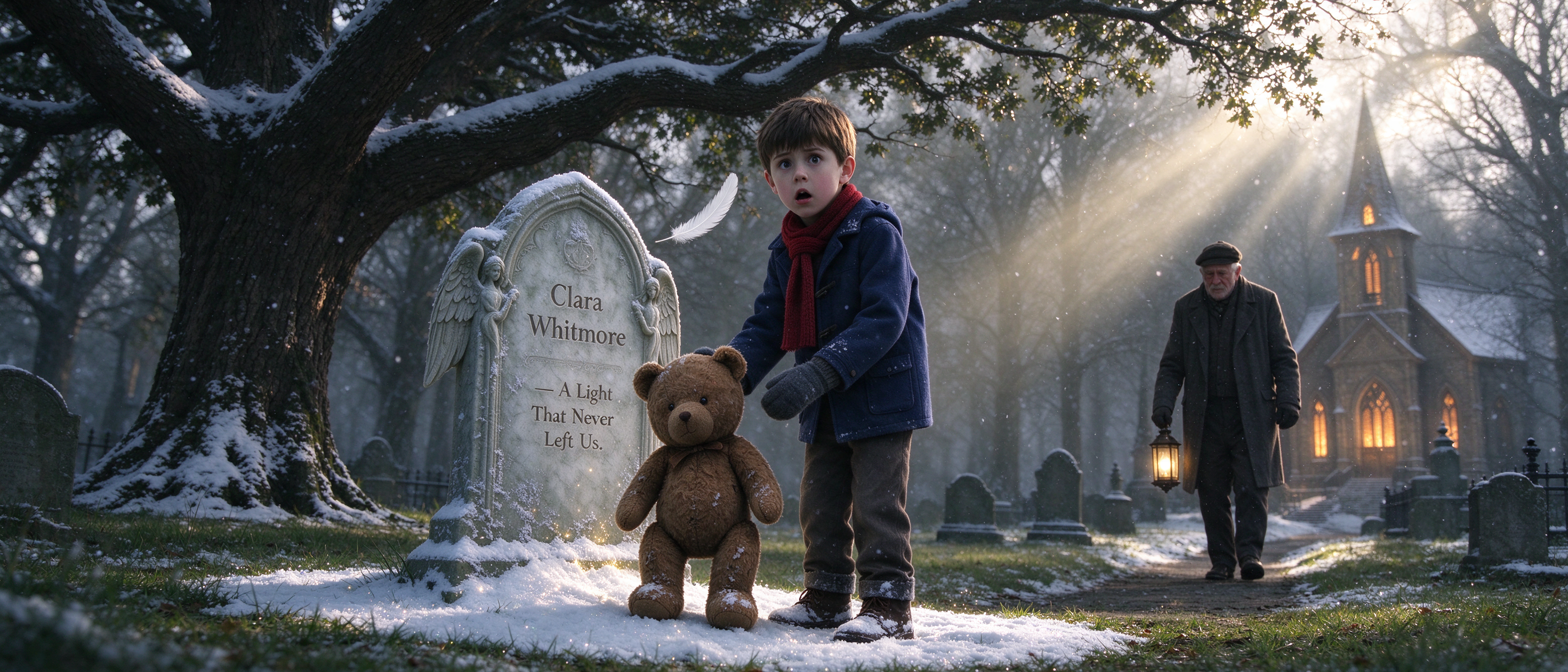
An enchanting, photorealistic winter cemetery beneath an enormous ancient oak tree, its twisted branches draped in snow. An eight-year-old boy in a navy coat and red scarf stands before a weathered marble gravestone carved with delicate angel wings. A small, perfectly preserved patch of sparkling snow surrounds the grave despite faint green grass visible elsewhere. The boy looks astonished as a white feather rests on the stone. In the distance, an elderly cemetery caretaker wearing a long charcoal coat and wool cap approaches along a narrow path carrying an antique lantern. Soft winter sunlight filters through the branches, creating golden rays in the falling snow. Quiet mystery, tenderness, heavenly symbolism, cinematic wide-angle composition, photorealistic textures, 8K detail, natural proportions, no cartoon effects.
Noah discovered the grave on a Thursday afternoon.
His father had taken him to the cemetery to place a small wreath on Emily's resting place.
Daniel knelt in the snow for a long time.
He spoke quietly to his wife, although Noah could not hear the words.
When his father finally stood, he brushed the snow from his knees and asked Noah if he was ready to go home.
Noah nodded.
But on the walk back toward the cemetery gates, something caught his attention.
A white feather lay on the snow.
It rested beside a narrow path that led beneath the oldest oak tree.
Noah stopped.
The feather was remarkably clean.
It had not been crushed by footprints or buried by the falling snow.
He picked it up carefully.
Then he noticed the grave.
It stood a short distance beyond the tree, almost hidden behind a curtain of snow-covered branches.
Unlike the other graves, this one had a small circle of snow surrounding it that seemed to sparkle.
Noah looked around.
The cemetery grass beneath the nearby trees was beginning to show through the thin winter covering.
But the snow around this particular gravestone was thick and white.
It looked as though winter had decided to make its home there.
Noah approached slowly.
The gravestone was old.
Its edges were worn, and delicate angel wings had been carved into the marble.
He brushed away a little snow and read the inscription.
Clara Whitmore.
A Light That Never Left Us.
Beneath the words were two dates.
Clara had died many years before Noah was born.
He stared at the stone.
“Were you an angel?” he whispered.
The wind moved gently through the oak branches.
A snowflake landed on his mitten.
Then another.
Noah looked down at Captain Buttons, who was tucked beneath his arm.
“You think she might be lonely?” he asked the bear.
The question sounded silly when he said it aloud.
But he had been lonely for months.
He knew what loneliness felt like.
He knew what it was like to wish someone would sit beside you without asking you to explain why you were sad.
He knew what it was like to miss a familiar voice.
And he knew what it was like to have something precious taken away.
Noah glanced back toward his father.
Daniel was standing near the gate, looking at his watch.
For a moment, Noah considered running after him.
Then he looked at the grave again.
A strange thought entered his mind.
Perhaps angels could become lonely too.
Perhaps the world forgot about them once their stories were no longer told.
And perhaps a teddy bear might make the perfect companion for someone who had spent too many winters alone.
Noah held Captain Buttons against his chest.
He had never spent a night without him.
Not once.
But suddenly, he knew what he wanted to do.
He walked to the gravestone and carefully placed the teddy bear beside it.
“There,” he whispered.
“Now you won't be alone for Christmas.”
He straightened the bear's little blue ribbon.
Then he knelt in the snow.
“My mother is in heaven,” he told the gravestone. “I think she might know you.”
His voice trembled.
“If you see her, could you tell her I miss her?”
For several seconds, nothing happened.
Then a breeze swept through the cemetery.
The snow around the grave shimmered.
And from somewhere high above the oak tree came the delicate sound of a bell.
One clear note.
Soft.
Beautiful.
Gone almost as soon as it arrived.
Noah lifted his head.
He saw no bell.
No church tower stood close enough to explain the sound.
There was only the white feather in his mitten, the teddy bear beside the grave, and the strange, sparkling snow.
He rose slowly.
“Goodbye, Clara,” he whispered.
Then he hurried toward his father, leaving Captain Buttons behind.
📷 Image Placement — The Caretaker Who Knew Clara's Secret
🎨 Image Prompt
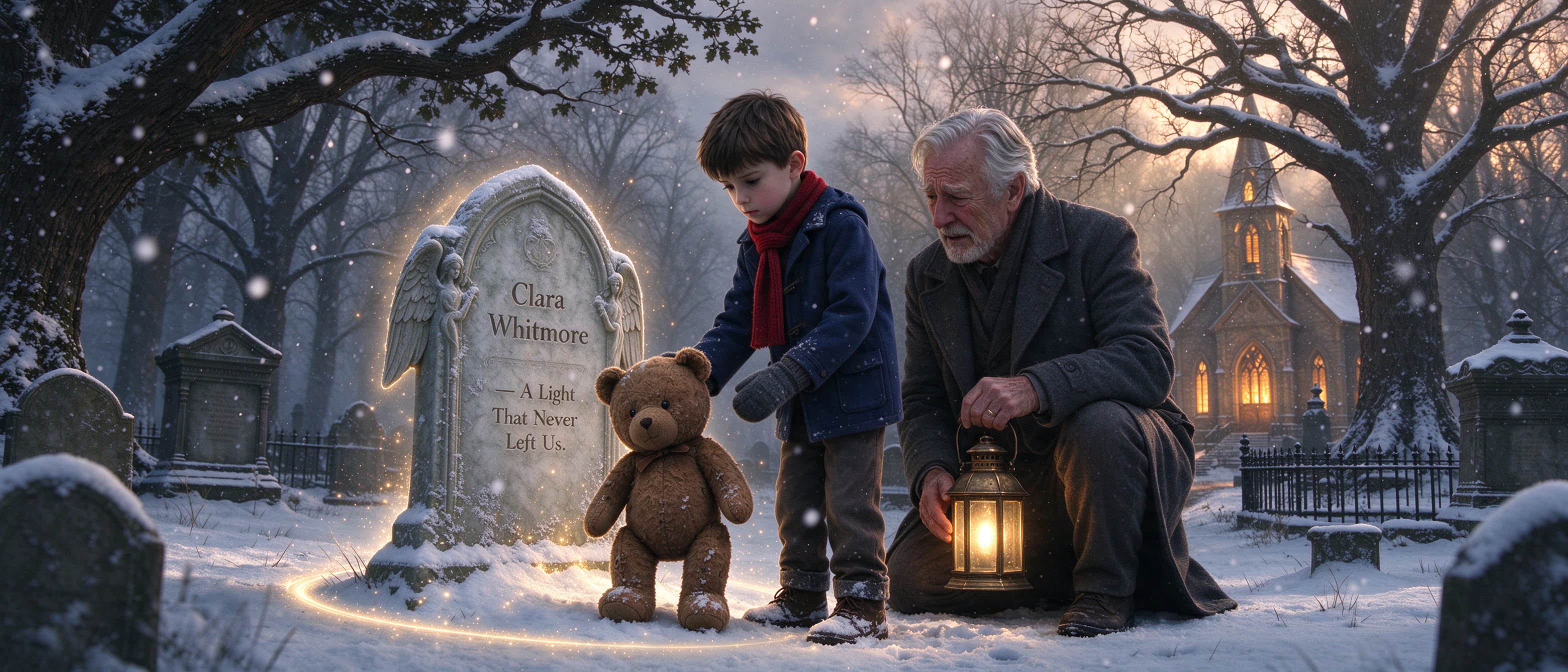
A cinematic winter afternoon beside an old cemetery gate. An elderly caretaker with kind, weathered features, silver hair, a charcoal wool coat, and an antique brass lantern kneels beside an eight-year-old boy wearing a navy winter coat and red scarf. They look toward an angel-carved gravestone beneath an ancient oak, where a worn brown teddy bear rests in a circle of luminous snow. The caretaker's expression holds both sorrow and wonder as he recognizes the bear. Snow falls gently through golden shafts of late-afternoon light. In the background, distant church windows glow warmly, creating a sense of memory, mystery, and hope. Ultra-realistic faces, cinematic lighting, intricate snow textures, emotionally rich composition, 8K photorealism.
That night, Noah could not sleep.
His arms felt strangely empty.
He reached for Captain Buttons, then remembered where he had left him.
He rolled onto his side and pulled the blankets beneath his chin.
Perhaps leaving the bear had been a mistake.
Perhaps Clara did not want him.
Perhaps his father would be angry when he discovered what Noah had done.
But whenever Noah closed his eyes, he remembered the strange light surrounding the grave.
And the sound of that single bell.
The next morning, he made a decision.
He would return to the cemetery.
Not to take Captain Buttons back.
Not yet.
He wanted to make sure the bear was safe.
At breakfast, Noah told his father that he wanted to visit Emily's grave again.
Daniel looked up from his coffee.
“Again?”
Noah nodded.
“Please?”
His father hesitated.
Then he glanced at his son's tired eyes.
“All right,” Daniel said softly. “We'll go after lunch.”
They arrived shortly before three.
The cemetery was quiet, and the sky hung low with gray clouds.
Daniel went to visit Emily's grave while Noah hurried beneath the old oak.
Captain Buttons was still there.
He sat upright against Clara's gravestone, his little blue ribbon resting against his chest.
A thin layer of snow covered his head.
Noah smiled with relief.
Then he noticed an elderly man standing nearby.
The man wore a long charcoal coat and held an old brass lantern.
He had silver hair, a neatly trimmed beard, and eyes that seemed to hold a lifetime of untold stories.
“You're the little fellow who left the bear,” the man said.
Noah looked up.
“Do you know Clara?”
The caretaker nodded.
“My name is Mr. Ellis. I've looked after this cemetery for forty-two years.”
He glanced toward the grave.
“And I've been wondering when someone would ask about her again.”
Noah stepped closer.
“Was she an angel?”
Mr. Ellis smiled, though his eyes became misty.
“That depends on what you mean by an angel.”
“Someone from heaven?”
“Some people believe angels have wings,” he answered. “Others believe they sometimes come into the world looking like ordinary people.”
Noah considered that.
“Like my mother?”
The caretaker's expression softened.
“Perhaps especially like your mother.”
Noah looked down at the teddy bear.
“Why doesn't the snow melt here?”
Mr. Ellis rested both hands on the handle of his lantern.
“People have asked that question for a very long time.”
“What do you think?”
“I think some mysteries aren't given to us so we can solve them. I think they're sometimes given to us so we'll remember what matters.”
Noah frowned.
“That doesn't really answer my question.”
Mr. Ellis laughed gently.
“No, I suppose it doesn't.”
He knelt beside the gravestone and brushed snow from its base.
“Clara Whitmore was a schoolteacher. She lived in Bellweather a long time ago. She never married, and she never had children of her own.”
“Was she sad?”
“Sometimes,” Mr. Ellis replied. “But she had a remarkable way of noticing when someone else was sad.”
He paused.
“During the Great Christmas Blizzard of 1947, a terrible storm trapped several families in their homes. Clara walked through the snow carrying blankets, soup, medicine, and toys for the children.”
“Wasn't she afraid?”
“I'm sure she was.”
“Then why did she go?”
Mr. Ellis looked at him.
“Because being afraid doesn't mean you stop caring.”
Noah thought about that for a long time.
The caretaker continued.
“Clara used to say that no child should have to feel forgotten at Christmas. Every year, she collected toys for children who had very little. She would leave them on doorsteps, in church halls, and beside hospital beds.”
“Did she have a teddy bear?”
Mr. Ellis glanced at Captain Buttons.
“Why do you ask?”
“Because I thought she might be lonely. I wanted her to have a friend.”
For a moment, the old caretaker said nothing.
Then he took a slow breath.
“You know,” he said, “Clara once gave away the only doll she had kept from her own childhood. She gave it to a little girl who had lost her mother.”
“What happened to the girl?”
Mr. Ellis looked toward the distant church.
“She grew up. She became a nurse. And every Christmas, she remembered the woman who had made her feel less alone.”
“Did she visit Clara?”
“Every year, until she was too old to travel.”
Noah looked back at the grave.
“Then someone remembered her.”
“Yes,” said Mr. Ellis. “Someone did.”
He gently touched the teddy bear's worn ear.
“And now, it seems, someone else does too.”
📷 Image Placement — The Box Beneath the Snow
🎨 Image Prompt
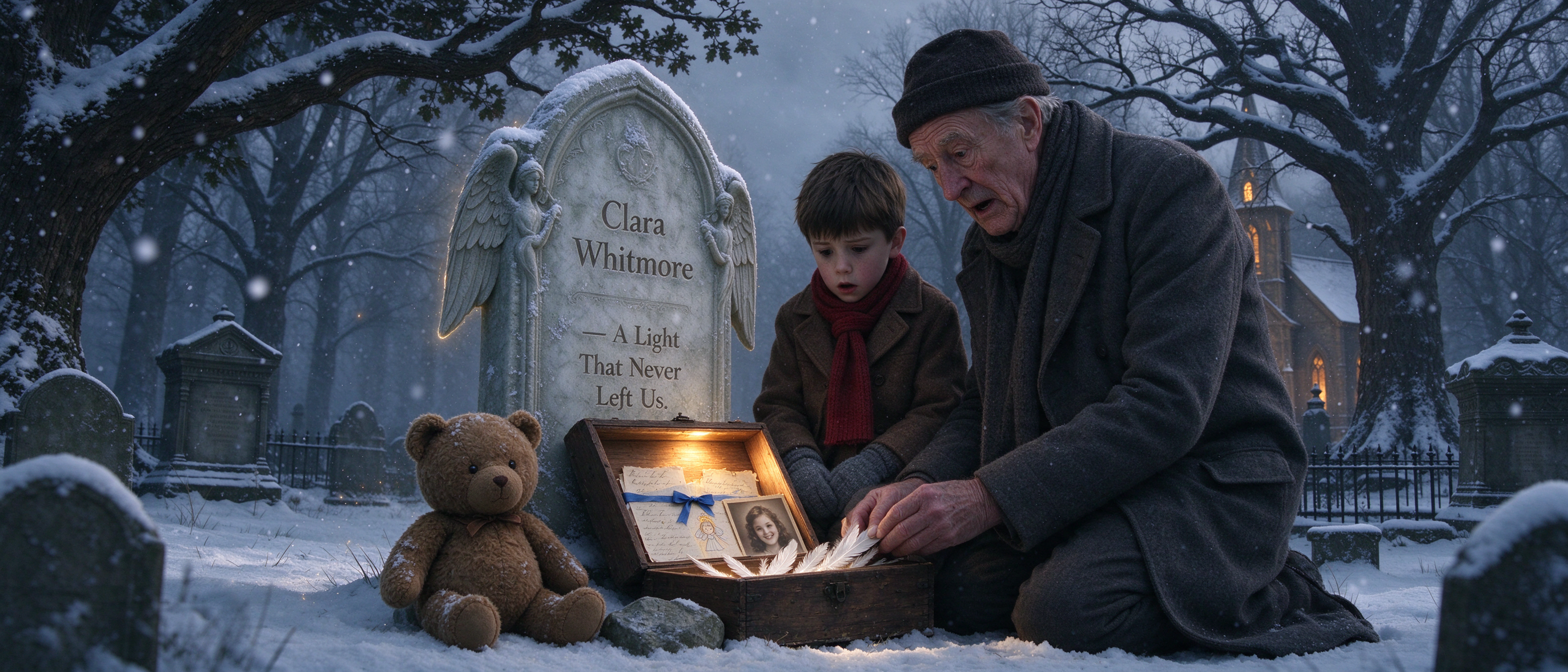
A mysterious, emotionally rich scene beneath an ancient snow-covered oak tree in a historic cemetery. An elderly caretaker and a small boy kneel beside the angel-carved gravestone as the caretaker gently opens a small weathered wooden box discovered beneath a loose stone. Inside lie faded handwritten letters tied with blue ribbon, a tiny child's drawing of an angel, a vintage photograph of a smiling young woman, and several delicate white feathers. The boy's well-loved brown teddy bear sits beside them in luminous snow. Warm golden light appears to glow from within the box, illuminating their astonished faces. Snowflakes drift through the branches, the world around them quiet and dreamlike. Cinematic realism, exquisite wood and paper textures, authentic emotional expressions, magical realism, 8K detail, no exaggerated fantasy effects.
Mr. Ellis was quiet for a while.
Then he stood and walked to the opposite side of the gravestone.
“There is something I've never told anyone who asked about the snow,” he said.
Noah followed him.
“What is it?”
The caretaker pressed his gloved hand against a small stone near the base of the monument.
It shifted slightly.
Beneath it was a shallow recess containing a little wooden box.
Noah's eyes widened.
“Treasure!”
Mr. Ellis smiled.
“Perhaps.”
He lifted the box carefully and placed it on the snow.
The wood was old and dark, its corners softened by time.
A narrow blue ribbon had been tied around it.
Mr. Ellis loosened the ribbon and opened the lid.
Inside were letters.
Dozens of them.
Some were written on yellowed paper.
Others were folded into tiny squares and tied with thread.
There were children's drawings, a faded photograph, and several small notes covered in handwriting.
Noah leaned forward.
“Who wrote them?”
“People Clara helped,” the caretaker answered. “They sent her letters over the years. After she died, someone placed them here.”
“Why?”
“Perhaps because they wanted her to know she hadn't been forgotten.”
Noah stared at the letters.
One drawing showed a woman with a smiling face and enormous white wings.
Another showed a house surrounded by snow.
A third depicted a little girl holding the hand of a woman beneath a Christmas star.
Noah touched the edge of the paper.
“Did Clara really help all these people?”
“As far as I know,” Mr. Ellis said. “And many more whose names were never written down.”
He carefully removed a photograph from the box.
It showed a young woman standing outside a small schoolhouse.
She wore a wool coat and a knitted scarf.
Her smile was gentle, and her eyes seemed to hold a quiet kind of courage.
“That was Clara,” Mr. Ellis explained.
Noah studied the picture.
“She looks like someone who would give you a hug.”
“I suspect she gave quite a few.”
Then Noah noticed a letter at the bottom of the box.
Unlike the others, it had never been opened.
His name was not on it.
Neither was the caretaker's.
The envelope simply read:
For the child who comes here carrying a broken heart.
Noah swallowed.
“Is that for me?”
Mr. Ellis looked at the envelope.
“I don't know, Noah.”
“Can we open it?”
The caretaker considered the words for a moment.
Then he nodded.
Noah carefully unfolded the paper inside.
The handwriting was delicate and slightly faded.
Mr. Ellis helped him read it aloud.
Dear Little One,
If you have found your way to this place, perhaps you are carrying a sadness that feels too large for your small hands.
I want you to know something.
You do not have to stop loving someone simply because you can no longer see them.
You do not have to pretend you are happy when your heart is hurting.
And you do not have to be brave every minute of every day.
If you miss someone, speak their name.
If you need to cry, let the tears come.
If you have something precious, share a little of its love with someone who needs it.
That is how love travels.
It moves from one heart to another, sometimes through a letter, sometimes through a kindness, sometimes through a worn-out teddy bear left beside a forgotten grave.
And when you believe you have nothing left to give, remember this:
Your very presence may be the gift someone else has been waiting for.
With all my love,
Clara.
Noah stood perfectly still.
The words seemed to reach a place inside him that he had not known how to explain.
He read the letter again.
Then he pressed it gently against his chest.
“I think she wrote that for me,” he whispered.
Mr. Ellis's eyes filled with tears.
“Perhaps she wrote it for every child who would ever need it.”
Noah looked toward Captain Buttons.
“I thought I was giving Clara a friend.”
He paused.
“But maybe she was helping me.”
Mr. Ellis rested a hand on the boy's shoulder.
“Sometimes, when we try to comfort someone else, we discover that our own hearts are being comforted too.”
Noah looked at the grave.
The snow around it sparkled beneath the gray sky.
For the first time in months, he felt something other than sadness.
He felt understood.
📷 Image Placement — The Story of the Snow That Never Melted
🎨 Image Prompt
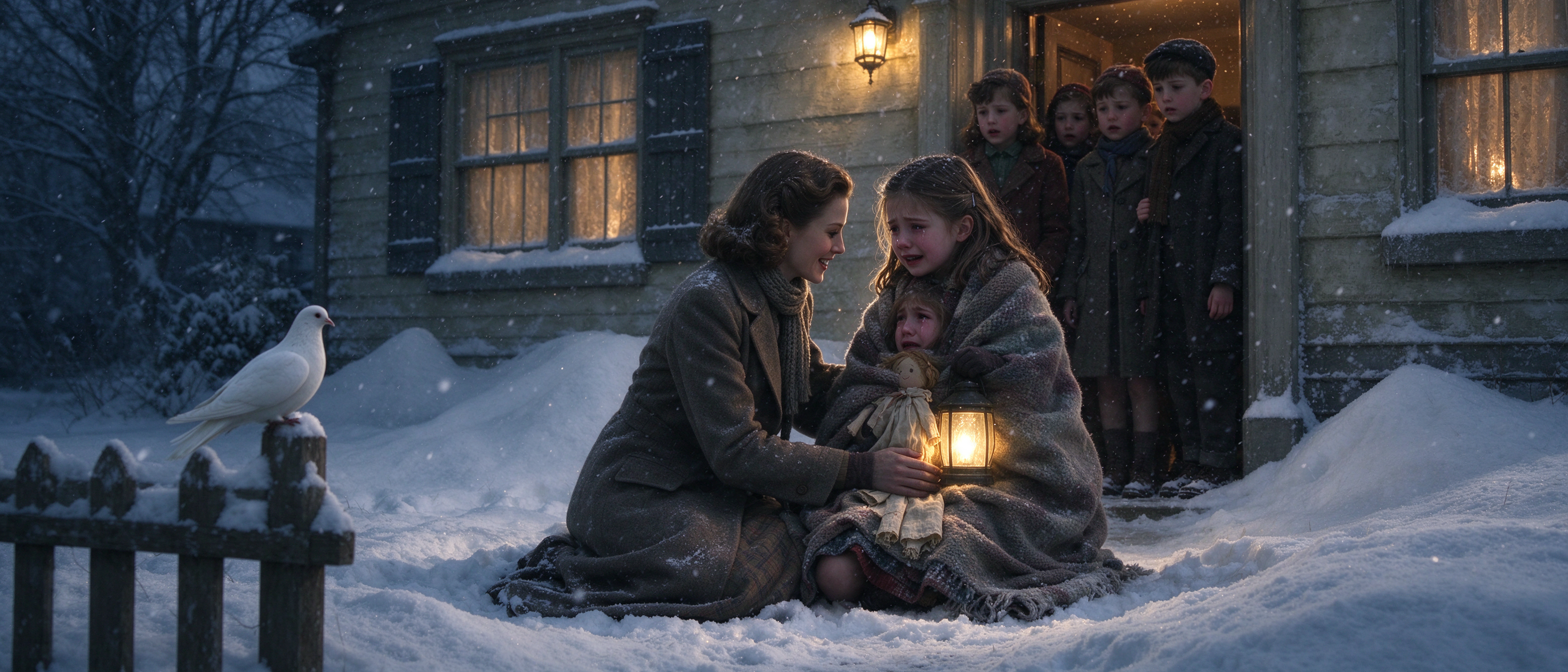
A nostalgic, cinematic flashback to a small village during the Great Christmas Blizzard of 1947. A compassionate young schoolteacher named Clara Whitmore, wearing a heavy wool coat and knitted scarf, kneels in the snow outside a modest cottage and gently wraps a frightened little girl in a warm blanket. Snowdrifts rise around the cottage, a lantern glows in Clara's hand, and warm light spills from the doorway. The little girl clutches a simple handmade doll while tears shine on her cheeks. Other children watch from the doorway as Clara smiles reassuringly. A white dove rests on a snow-covered fence, and delicate golden light illuminates the swirling snow. Historically inspired clothing and architecture, extraordinary emotional storytelling, photorealistic faces, cinematic composition, natural winter textures, 8K detail, soft nostalgic color grading, magical realism.
Mr. Ellis closed the box and returned it to its hiding place.
But Noah was not finished asking questions.
“Why did Clara die?”
The caretaker looked toward the trees.
“She became ill one winter. She had spent years caring for other people, and eventually her own body grew tired.”
“Was she scared?”
“I imagine she was sometimes.”
“Did she have a family?”
Mr. Ellis nodded.
“Not the kind you usually see in family photographs. But she had a great many people who loved her.”
He paused.
“There's one story about Clara that I've always remembered.”
Noah sat down in the snow.
Mr. Ellis sat beside him.
“Many years ago, during that terrible blizzard, a little girl named Rose lost her mother. Her father had gone away to find work and never returned.”
Noah's fingers tightened around the letter.
“The little girl lived with an elderly neighbor, but the neighbor became sick. When the storm came, Rose had nowhere warm to stay.”
“Was she all alone?”
“For a little while.”
Mr. Ellis looked at the gravestone.
“Clara found her sitting on the steps of an abandoned house. Rose was cold, frightened, and convinced that no one would ever come for her.”
“What did Clara do?”
“She carried her to the schoolhouse, wrapped her in blankets, and stayed beside her until the storm passed.”
“Did Rose get better?”
“Yes. Clara helped find her a safe home. She made sure the girl had warm clothes, enough food, and someone who would listen when she needed to talk.”
Noah's eyes lowered.
“Did Rose miss her mother?”
“Every day, I expect.”
“Did Clara tell her it was okay to cry?”
Mr. Ellis smiled sadly.
“I believe she did.”
The wind stirred the oak branches above them.
“When Rose grew older, she became a nurse. She spent her life caring for children who were sick, frightened, or alone. She never forgot Clara.”
“Is Rose still alive?”
“No,” Mr. Ellis replied gently. “She passed away many years ago.”
Noah looked at the gravestone.
“Then who remembers Clara now?”
The caretaker did not answer immediately.
He looked around the cemetery, at the weathered stones and the bare branches and the snow settling softly on the ground.
“People remember her in different ways,” he finally said. “Some remember the meals she brought. Some remember the blankets. Some remember a toy she left on their doorstep.”
He turned toward Noah.
“And some remember her because a little boy came here one Christmas and decided she shouldn't be lonely.”
Noah looked at Captain Buttons.
His teddy bear seemed very small against the enormous gravestone.
But he no longer thought his gift was silly.
He thought it might be exactly the sort of gift Clara would have understood.
Then he asked the question that had been waiting in his heart since his mother died.
“Mr. Ellis, if someone dies, does that mean they stop loving you?”
The old caretaker's face changed.
He did not rush to answer.
Instead, he looked at the boy with the kind of tenderness that comes from having lived long enough to understand that some questions cannot be answered with a simple sentence.
“Noah,” he said, “I cannot tell you exactly what happens beyond this life. But I can tell you what I've seen here.”
He gestured toward the cemetery.
“I've watched people return to these graves for fifty years. I've seen children become parents, and parents grow old. I've seen people bring flowers, letters, photographs, and Christmas ornaments.”
He paused.
“And I've seen love survive things that seemed impossible to survive.”
Noah listened carefully.
“Love changes shape,” Mr. Ellis continued. “Sometimes it becomes a memory. Sometimes it becomes a lesson. Sometimes it becomes the kindness you show another person because someone once showed kindness to you.”
He looked toward the teddy bear.
“Your mother may not be sitting beside you the way she once did. But the love she gave you is still part of who you are.”
Noah's eyes filled.
“So I haven't lost all of her?”
Mr. Ellis gently shook his head.
“No, my boy. You haven't lost all of her.”
A tear slipped down Noah's cheek.
He did not wipe it away.
For once, he did not feel that he had to hide it.
📷 Image Placement — A Father Finds His Son's Heart
🎨 Image Prompt
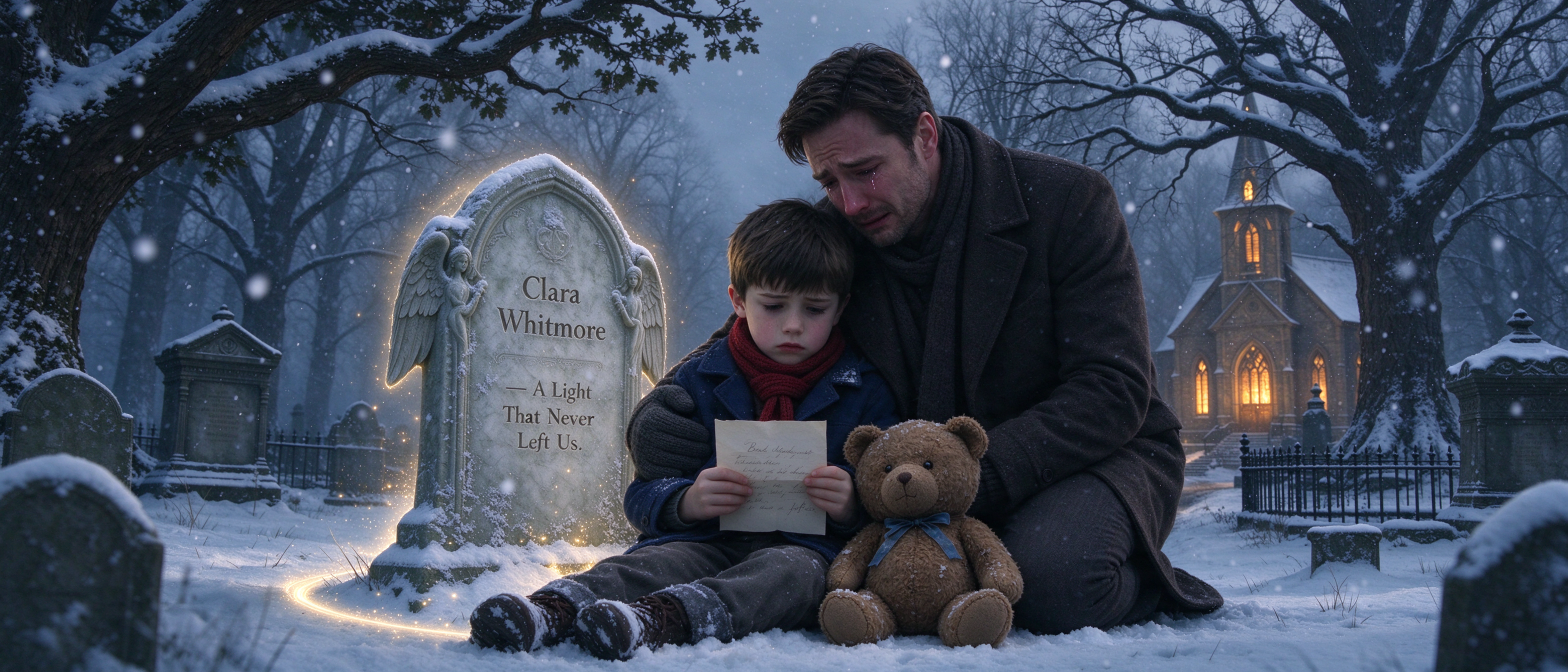
A moving cinematic winter scene in a historic cemetery at dusk. An eight-year-old boy sits in the snow beside an angel-carved gravestone, holding a handwritten letter against his chest. His father, a grieving man in his late thirties wearing a dark wool coat and knitted gloves, kneels beside him with tears in his eyes. Between them rests a worn brown teddy bear with a faded blue ribbon. The father gently wraps one arm around his son while the boy leans into his shoulder. An ancient oak tree arches overhead, and a small circle of luminous snow glows softly around the grave. In the background, the first Christmas lights of a nearby church shine through the snowy dusk. Natural emotional expressions, realistic tears, intimate framing, golden lantern light against cool blue snow, photorealistic cinematic realism, 8K detail, profound tenderness, no exaggerated expressions.
Daniel found them just before sunset.
He had finished visiting Emily's grave and noticed that Noah had not returned to the gate.
At first, he felt a familiar flash of worry.
Then irritation.
Then guilt for feeling irritated at all.
He followed the narrow path beneath the oak tree.
When he saw Noah sitting beside the gravestone, he slowed.
Mr. Ellis stood nearby, holding his lantern.
And Captain Buttons rested in the snow between the boy and the stone.
Daniel's expression softened.
“Noah?”
His son looked up.
“Dad.”
Daniel knelt beside him.
“Are you all right?”
Noah nodded, then shook his head.
“I don't know.”
It was an honest answer.
Perhaps the most honest answer he had given in months.
Daniel looked at the gravestone.
“Who is Clara?”
“She helped children who were lonely.”
Daniel glanced at Mr. Ellis, who gave a small nod.
Noah held out the letter.
“Can you read this?”
Daniel took it carefully.
As he read the words, his face grew still.
He reached the final lines and stopped.
For several seconds, he could not speak.
Then he folded the letter and returned it to Noah.
“Your mother would have loved this,” he whispered.
Noah stared at him.
“You think so?”
“I know so.”
Daniel's voice broke on the final word.
Noah looked down at the teddy bear.
“I left Captain Buttons here because I thought Clara might be lonely.”
Daniel swallowed.
“But I miss him,” Noah confessed. “And I miss Mom. And sometimes I think if I stop talking about her, everyone will forget she was here.”
His father's face crumpled.
“Oh, Noah.”
Daniel pulled his son into his arms.
“I haven't forgotten her.”
Noah clung to his coat.
“Then why don't we talk about her anymore?”
The question struck Daniel harder than anything else could have.
He closed his eyes.
Because he had been afraid.
Afraid that talking about Emily would make the pain unbearable.
Afraid that if he said her name, he would remember the hospital room, the final goodbye, and the terrible silence that followed.
Afraid that he would fall apart in front of his son.
So he had tried to be strong.
He had mistaken silence for strength.
And in doing so, he had left Noah to grieve alone.
Daniel held him tighter.
“I thought I was protecting you,” he whispered. “I thought if we didn't talk about how much we missed her, it might hurt a little less.”
Noah looked up.
“But it hurts anyway.”
Daniel's tears began to fall.
“I know, sweetheart. I'm so sorry.”
He pressed his cheek against Noah's hair.
“I miss her too.”
It was the first time Daniel had said those words aloud since the funeral.
The first time he had allowed himself to cry in front of his son.
And the first time in months that Noah had seen his father look less like a man trying to hold a broken world together and more like the father who used to make dinosaur pancakes.
Noah wrapped his arms around Daniel's neck.
“Can we talk about her at home?”
“Yes.”
“Can we put the ornaments on the tree?”
Daniel let out a trembling laugh.
“Yes, we can.”
“And can we make her favorite cookies?”
Daniel closed his eyes.
“Especially those.”
For a long time, father and son sat beneath the old oak tree.
They spoke about Emily's laugh.
They remembered the way she sang off-key while cooking.
They talked about her terrible dancing and her habit of putting too much cinnamon in the Christmas cookies.
They cried.
They laughed a little.
And for the first time since spring, the two of them were not trying to escape their grief.
They were carrying it together.
📷 Image Placement — The Snow Begins to Shine
🎨 Image Prompt
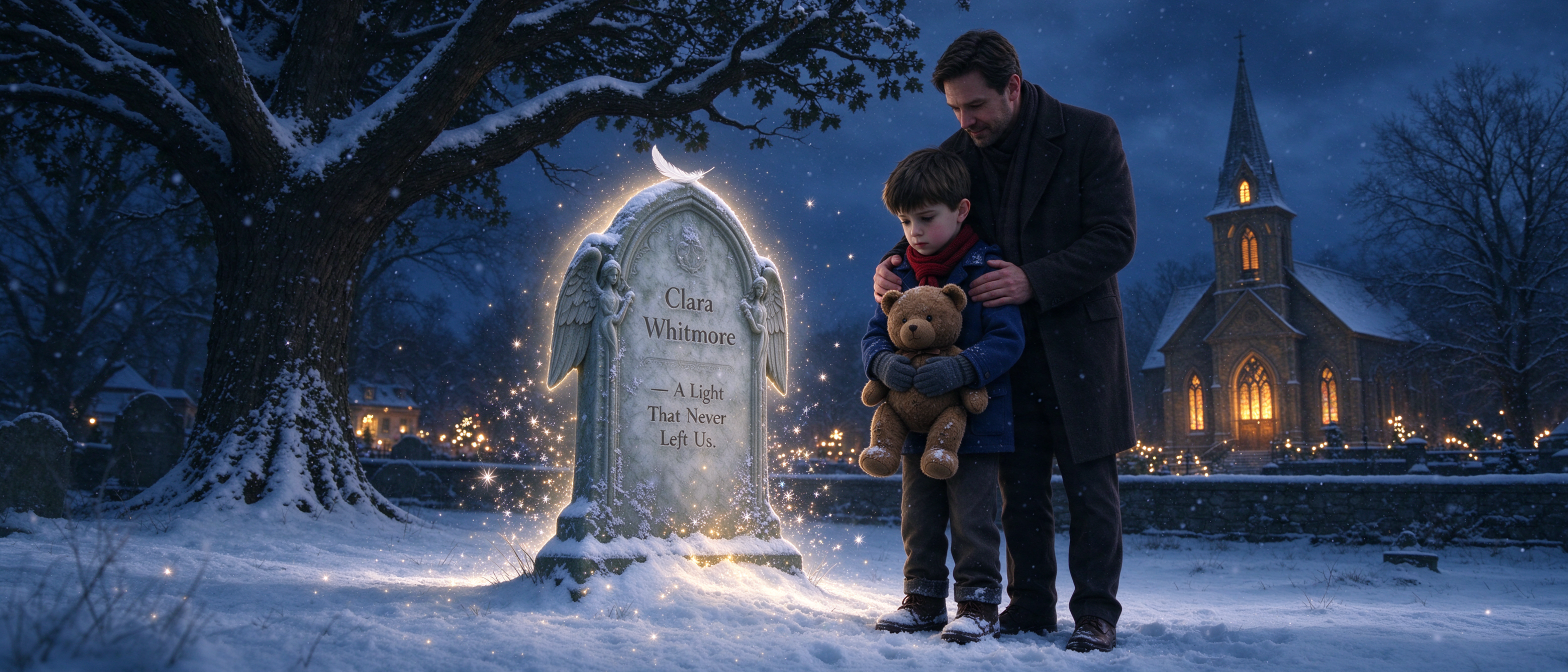
A spectacular, emotionally uplifting cinematic image of a father and young son standing together beside an old angel-carved gravestone beneath a towering snow-covered oak tree at blue hour on Christmas Eve. The boy holds a worn brown teddy bear while his father wraps a protective arm around his shoulders. Around the grave, delicate snowflakes begin to glow with subtle golden and silver light, swirling gently upward like tiny stars. A single white feather rests on the gravestone, and a distant church bell tower rises against a deep indigo sky. Warm Christmas lights sparkle in the town beyond the cemetery wall. Magical realism grounded in photorealism, luminous atmospheric lighting, breathtaking snow detail, realistic human emotion, wide cinematic composition, 8K masterpiece quality, peaceful heavenly mood, hope after grief.
On Christmas Eve, Noah returned to Clara's grave.
This time, he did not come alone.
His father walked beside him, carrying a small evergreen wreath decorated with red berries and a blue ribbon.
Noah carried Captain Buttons.
The teddy bear's fur had been brushed, and his little blue ribbon had been tied neatly around his neck.
Daniel glanced at the bear.
“Are you thinking of leaving him here again?”
Noah considered the question.
“I think Clara has enough friends now.”
His father smiled.
“Then perhaps Captain Buttons should come home.”
Noah nodded.
“But I want to leave her something else.”
He reached into his coat pocket and removed a small folded paper.
It was a drawing.
He had spent the previous evening making it at the kitchen table.
The picture showed Clara standing beneath an enormous oak tree, surrounded by children holding hands.
Above her head were two enormous wings.
At the bottom, Noah had written:
Thank you for keeping lonely people company.
He placed the drawing against the gravestone.
Then he stepped back.
The sky darkened.
Snow began to fall.
At first, the flakes drifted gently through the air.
Then something remarkable happened.
The snow surrounding Clara's grave began to shimmer.
Not brightly.
Not like a spotlight.
It glowed with a soft, silvery radiance, as though the moon had somehow found a way to shine from beneath the earth.
Noah stared.
“Dad?”
Daniel followed his gaze.
For a moment, neither of them spoke.
A single white feather drifted down and landed beside Noah's drawing.
Then came the sound of a bell.
One clear note.
The same delicate note Noah had heard on the day he left Captain Buttons.
Daniel looked toward the church.
Its bell tower stood silent.
He turned back toward the grave.
The glowing snow swirled gently around the gravestone, then settled.
Noah's eyes widened.
“Do you think Clara heard me?”
Daniel knelt beside him.
“I don't know, sweetheart.”
Noah thought about the letter.
He thought about the children Clara had helped.
He thought about the little girl who had grown up to become a nurse, and the countless people who had carried Clara's kindness into the world.
Then he looked at the drawing.
“Maybe the snow doesn't melt because people keep remembering her.”
Daniel followed his gaze.
“Maybe.”
Noah slipped his hand into his father's.
“And maybe we can do that for Mom too.”
Daniel squeezed his fingers.
“We can.”
They stood together until the snow grew heavy enough to settle on their shoulders.
Then they took Captain Buttons and walked home.
Behind them, Clara's grave rested beneath the old oak tree.
And the snow remained.
📷 Image Placement — The Christmas Promise
🎨 Image Prompt
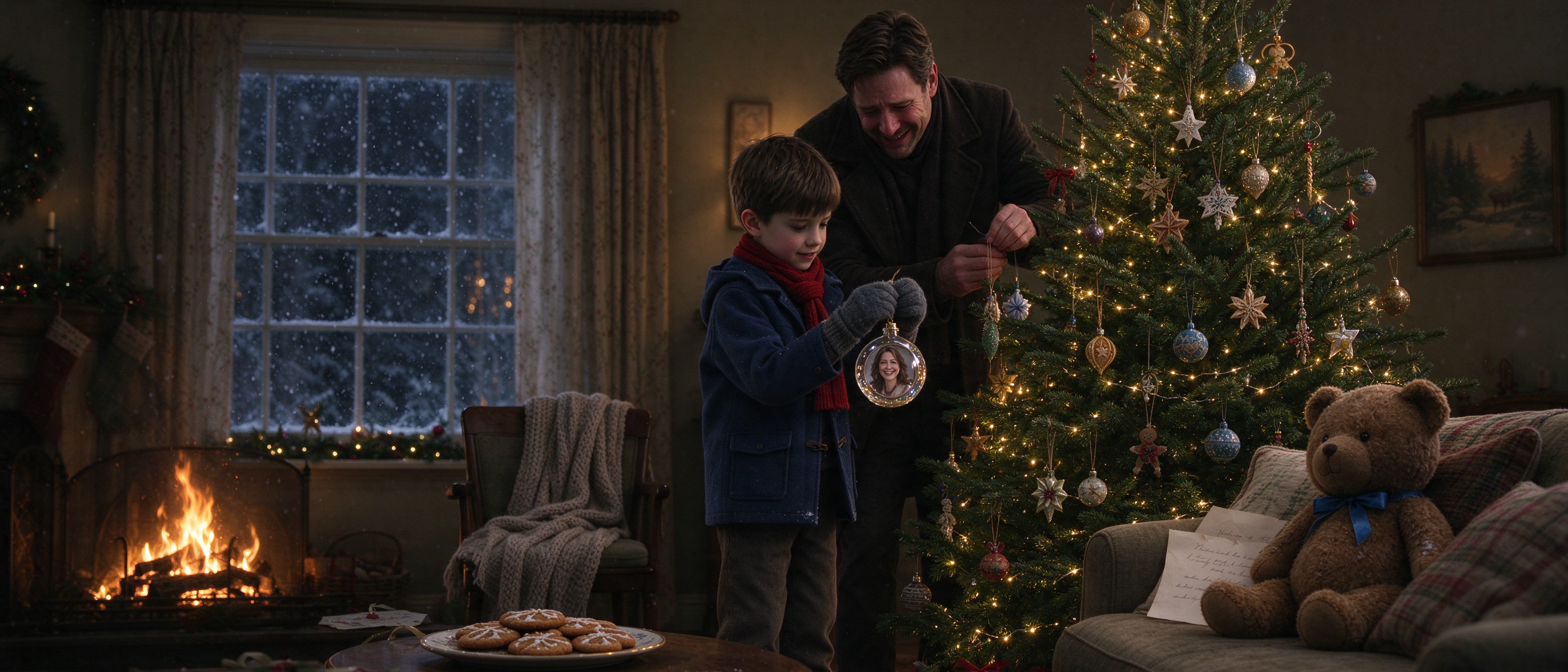
A heartwarming, photorealistic Christmas Eve interior in a cozy family living room. An eight-year-old boy and his father decorate a beautiful Christmas tree together, placing handmade ornaments and tiny golden lights among the branches. The boy holds a delicate glass ornament containing a photograph of his smiling mother, while his father watches with tears of love and a gentle smile. A well-loved brown teddy bear with a blue ribbon sits on the sofa beside a folded handwritten letter. Warm firelight illuminates a plate of homemade cinnamon cookies on the coffee table, and snow falls beyond the frosted window. An empty chair near the tree holds a soft knitted blanket, suggesting remembrance without despair. Cinematic warmth, authentic family emotion, intricate ornaments, natural skin textures, luminous golden light, 8K photorealism, nostalgic Christmas atmosphere, healing, hope, and enduring love.
When Noah and Daniel arrived home, the house felt different.
Not because the grief had disappeared.
It had not.
Emily was still gone.
Her voice did not suddenly fill the kitchen.
Her footsteps did not return to the hallway.
The ache in Daniel's heart had not vanished, and Noah still wished he could crawl into his mother's lap and tell her everything about his day.
But something had changed.
They were no longer afraid to say her name.
Daniel opened the cardboard box containing the Christmas ornaments.
Noah pulled out a wooden star, a tiny red mitten, and a crooked paper snowman he had made in kindergarten.
Then he found the ornament they had made together the year before Emily died.
It was a small glass ball with a photograph of the three of them inside.
Emily was laughing in the picture.
Daniel stared at it for a long time.
“She was so happy that day,” he whispered.
Noah smiled.
“She said you looked like a confused penguin because you couldn't figure out how to work the camera.”
Daniel laughed.
A real laugh.
It surprised both of them.
Then he laughed again.
Noah began laughing too.
For a few beautiful seconds, their living room filled with the sound they had both been missing.
Not because they had forgotten their sadness.
But because they had remembered that happiness and sadness could live in the same heart.
Together, they decorated the tree.
They placed the glass photograph ornament near the center, where its little picture could be seen whenever the lights glowed.
Then they baked Emily's favorite cinnamon cookies.
The first batch came out too dark.
The second batch was too soft.
The third batch was nearly perfect.
Daniel insisted that the imperfect ones were the best.
Noah told him that was because he had eaten most of them before they had cooled.
By evening, the house smelled like cinnamon and warm sugar.
The tree glowed.
The fire crackled.
And Captain Buttons sat beside Noah on the sofa, safely home.
Before bedtime, Noah took the letter from Clara's grave and placed it inside a small wooden frame.
Daniel helped him set it on the bedside table beside Emily's photograph.
“Dad?”
“Yes, sweetheart?”
“Do you think Mom knows we decorated the tree?”
Daniel sat beside him.
He considered his answer carefully.
“I can't prove what happens after someone dies,” he said. “But I know your mother loved you more than anything. And I know the love she gave you is still here.”
He gently touched Noah's chest.
“And here.”
Then he placed a hand over his own heart.
Noah leaned against him.
“I think she would have liked Clara.”
“I think she would have loved her.”
Noah smiled sleepily.
“Maybe they found each other.”
Daniel kissed the top of his head.
“Maybe.”
When Noah finally fell asleep, Daniel remained beside the bed for a few minutes.
He looked at the photograph of Emily.
For the first time in months, he spoke to her without feeling that the words might destroy him.
“Merry Christmas, sweetheart,” he whispered.
Then he turned off the lamp.
And as he stepped into the hallway, he heard the softest sound coming from Noah's room.
A tiny, delicate bell.
One clear note.
Daniel stopped.
He looked toward the window.
Outside, a single white feather drifted past the glass.
It caught the light from the Christmas tree, glimmered silver for a moment, and disappeared into the night.
Daniel did not try to explain it.
He simply smiled.
📷 Image Placement — The Little Girl Who Came to Remember
🎨 Image Prompt
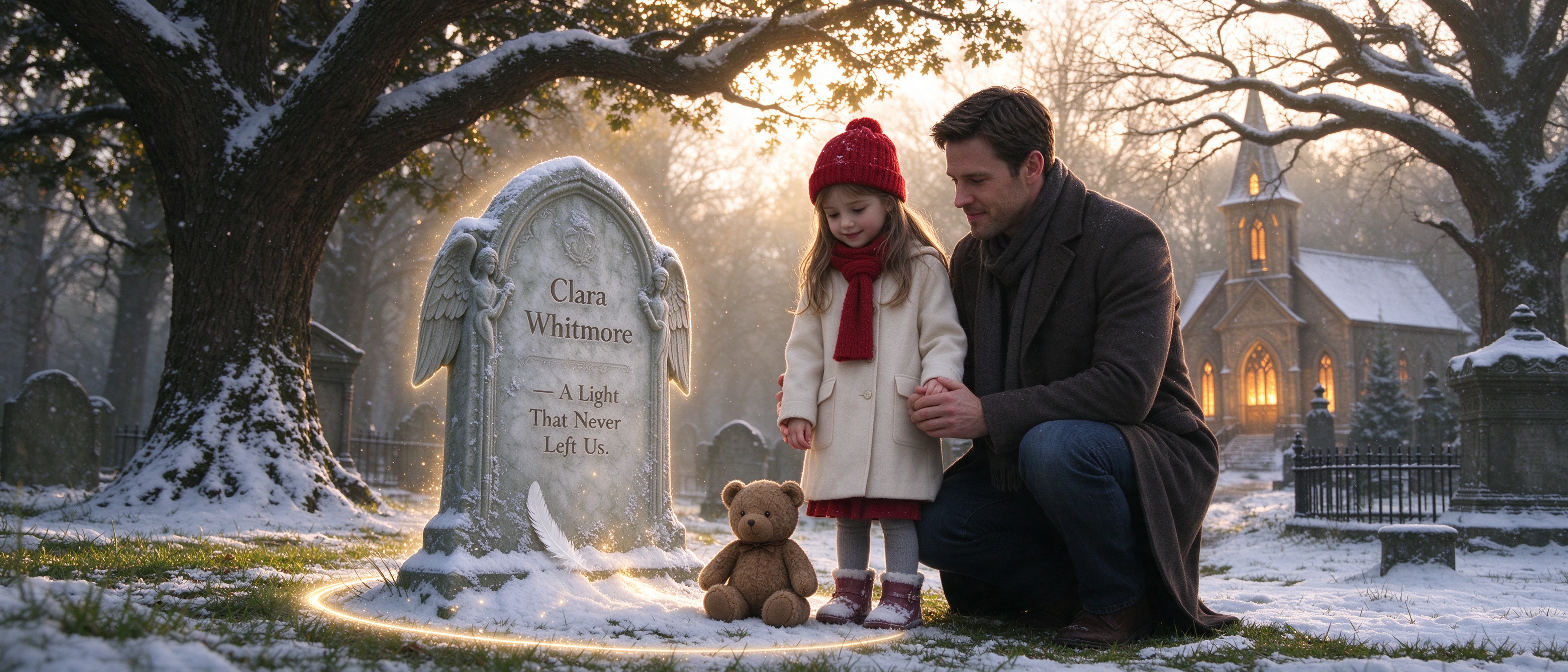
A breathtaking cinematic scene many years later on a peaceful Christmas morning. An adult man in his early thirties, with kind eyes and a thoughtful expression, kneels beside the same angel-carved gravestone beneath the ancient oak tree. Beside him stands his six-year-old daughter wearing a cream winter coat, a red knitted hat, and tiny snow boots. She places a small handmade teddy bear beside the grave, while her father gently holds her hand. The mysterious circle of snow glows softly around the stone, even though patches of green grass are visible elsewhere in the cemetery. A white feather rests on the gravestone, and golden sunlight filters through the snowy branches. The father resembles the little boy from earlier scenes, now older and peaceful. Deeply emotional multigenerational storytelling, photorealistic faces, exquisite snow and fabric detail, soft golden-hour light, cinematic composition, 8K masterpiece quality, heavenly but understated atmosphere, enduring kindness and love.
Twenty-four years passed.
Bellweather changed in a thousand little ways.
The bakery acquired a new owner.
The old schoolhouse became a community center.
The church replaced its wooden doors.
And the cemetery grew quieter as the people who had once filled its paths became memories themselves.
But beneath the ancient oak tree, Clara's grave remained.
And the snow still never melted.
Noah grew into a man who carried his mother's kindness into everything he did.
He became a schoolteacher.
He made a habit of learning the names of the children who sat quietly at the back of his classroom.
He kept extra mittens in his desk for students who arrived without them.
He placed books in the hands of children who thought they were not clever enough to read them.
And every December, he organized a collection of toys for families who were struggling.
He never forgot the woman whose letter had found him on the day he needed it most.
Nor did he forget the father who had finally sat beside him and allowed them both to cry.
Daniel grew older too.
He never stopped missing Emily.
But he learned that grief could become a companion rather than a prison.
He learned to laugh again.
He learned to make pancakes that were almost recognizable as dinosaurs.
And he learned that remembering someone did not mean spending every day in the past.
Sometimes, remembering meant living well in the present.
One Christmas morning, Noah returned to the cemetery with his young daughter, Lily.
She carried a small teddy bear made from soft cream-colored fabric.
Its nose was stitched crookedly.
Its ears were uneven.
And a little blue ribbon was tied around its neck.
“Daddy,” Lily asked, “who is Clara?”
Noah knelt beside the gravestone.
“She was a woman who helped people when they were lonely.”
“Was she an angel?”
Noah smiled.
“Some people thought so.”
“Did she have wings?”
“Maybe not the kind we can see.”
Lily considered that.
Then she looked at the bear in her hands.
“Do you think she needs a friend?”
Noah felt his breath catch.
For a moment, he was eight years old again.
He could almost feel the cold snow beneath his knees.
He could almost hear the single clear note of the mysterious bell.
And he could still remember the strange comfort that had filled his heart when he discovered Clara's letter.
He looked at his daughter.
“What do you think?”
Lily stepped forward.
“I think everybody should have somebody.”
Then she placed the little bear beside the grave.
Noah closed his eyes.
He remembered his mother.
He remembered Captain Buttons.
He remembered the father who had held him beneath the old oak tree and promised that they would talk about the people they loved.
And he remembered the words Clara had left behind.
That is how love travels.
A breeze moved through the branches.
Snowflakes drifted softly from the sky.
One settled on Lily's mitten.
She held it up to the light.
“Daddy, look!”
Noah smiled.
“A snowflake.”
“It looks like a star!”
“Yes,” he whispered. “It does.”
Then the snow surrounding Clara's grave began to shimmer.
Tiny silver lights appeared between the flakes.
A white feather floated down and landed beside Lily's teddy bear.
And from somewhere beyond the trees came the sound of a bell.
One clear note.
Lily looked up at her father.
“Did you hear that?”
Noah nodded.
“I did.”
“Was it an angel?”
He looked at the gravestone, at the little bear, and at the daughter who had inherited the same generous heart that had once made him leave his most precious possession beside a stranger's grave.
“I don't know, sweetheart,” he said.
Then he smiled.
“But I think someone heard you.”
They stood together beneath the oak tree for a little while longer.
Before they left, Noah brushed the snow from the gravestone.
He traced the words with his gloved fingertips.
Clara Whitmore.
A Light That Never Left Us.
Then he took Lily's hand.
And together, they walked toward the cemetery gates.
Behind them, the snow continued to fall.
It covered the old stone.
It covered the little teddy bear.
It covered the footprints of a father and daughter who had come to remember a woman whose kindness had outlived her by generations.
But the snow around Clara's grave never melted.
Not that winter.
Not the next.
Not in all the years that followed.
And in Bellweather, people eventually stopped asking whether the snow was a miracle.
They began telling a different story instead.
They told the story of a woman who had spent her life reminding lonely people that they mattered.
They told the story of a little boy who had given away his favorite teddy bear because he could not bear the thought of someone else being alone.
And they told the story of the letter that taught him a truth he carried for the rest of his life:
Sometimes, the people we think we are comforting are the ones who help us heal.
Sometimes, the smallest act of kindness becomes a light that guides generations.
And sometimes, love leaves something behind that even winter cannot take away.
❤️ Life Lesson
Grief can make the world feel cold.
It can turn familiar rooms into places of painful silence, transform holidays into reminders of absence, and make the simplest moments feel impossibly difficult.
When someone we love dies, we may fear that remembering them will hurt too much.
We may avoid their photographs, stop telling their stories, or hide our tears because we believe that being strong means keeping our sadness to ourselves.
But Noah discovered something important.
We do not honor the people we love by pretending we no longer miss them. We honor them by allowing their love to continue shaping the way we live.
His father had tried to protect him by avoiding painful conversations.
Yet healing began only when they finally spoke honestly about their loss.
They discovered that tears did not make them weaker.
Remembering Emily did not keep them trapped in the past.
And laughing at her old jokes did not mean they had forgotten how much they missed her.
Love and grief can exist together.
We can miss someone deeply and still find reasons to smile.
We can cry over an empty chair and still welcome new people into our lives.
We can treasure what we have lost while continuing to care for the people who remain.
Clara's story teaches us another lesson: kindness does not disappear when the person who offered it is gone.
It continues through the people who received it.
A teacher's encouragement may become a student's courage.
A stranger's generosity may inspire a lifetime of giving.
A parent's gentle words may become the foundation upon which a child builds a compassionate life.
And a little boy's decision to share his beloved teddy bear may become a story his daughter carries into the future.
We may never know how far our kindness travels.
We may never see the person who receives the comfort we once offered pass it along to someone else.
But that does not make our kindness any less meaningful.
Perhaps the greatest miracles are not always the ones that defy explanation.
Perhaps they are the quiet transformations that occur when a grieving father finally embraces his son, when a lonely child discovers that someone understands, or when a forgotten story inspires a new generation to care.
And perhaps the snow around Clara's grave never melted because the people of Bellweather needed a reminder that some things are too precious to be forgotten.
Love does not promise that we will never experience loss. It reminds us that loss does not have to be the end of love.
So, if you are missing someone this Christmas, speak their name.
Tell their favorite story.
Bake the cookies they loved.
Hang the ornament they gave you.
Let yourself cry when the memories hurt, and allow yourself to laugh when a beautiful memory finds its way into your heart.
Then take the love they gave you and share a little of it with someone who needs it.
You do not have to perform a grand miracle.
You might simply listen to someone who feels invisible.
You might offer a warm meal to a struggling neighbor.
You might sit beside a grieving friend without trying to fix their sadness.
Or you might remind a lonely child that they are seen, cherished, and never without worth.
You may never know how much that small kindness means.
But years from now, someone may remember it.
They may pass it on.
And somewhere, in a place you may never see, the light you left behind may still be shining.
Because the truest angels are not always the ones we imagine with wings.
Sometimes, they are the people who notice another person's loneliness and quietly choose to care.
And sometimes, they are the little children who remind the rest of us that nobody should have to face the cold alone.
❤️ Next Chapter
Chapter 125: The Christmas Star That Appeared Above an Abandoned Children's Home—and Led a Forgotten Mother Back to the Daughter She Had Never Stopped Loving ⭐🏚️🎄🪽❄️❤️✨
Topics
Writing one? Publish your story on the BudgetPixel blog.
 @pocahontas

 @EternaSky
 @faerierealm

 @germancowboy