
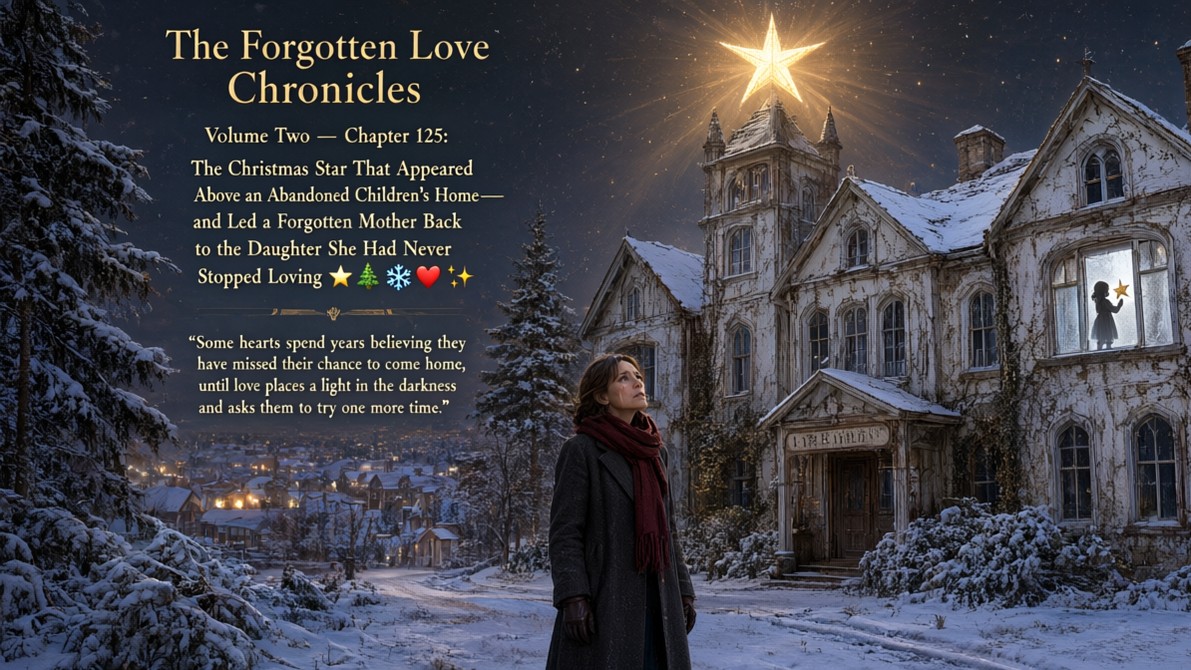
The Forgotten Love Chronicles Volume Two — Chapter 125: The Christmas Star That Appeared Above an Abandoned Children's Home—and Led a Forgotten Mother Back to the Daughter She Had Never Stopped Loving ⭐🏚️🎄🪽❄️❤️✨
 @archangeltara
The Forgotten Love Chronicles
Volume Two — Chapter 125: The Christmas Star That Appeared Above an Abandoned Children's Home—and Led a Forgotten Mother Back to the Daughter She Had Never Stopped Loving ⭐🏚️🎄🪽❄️❤️✨
📷 Image Placement
🎨 Image Prompt
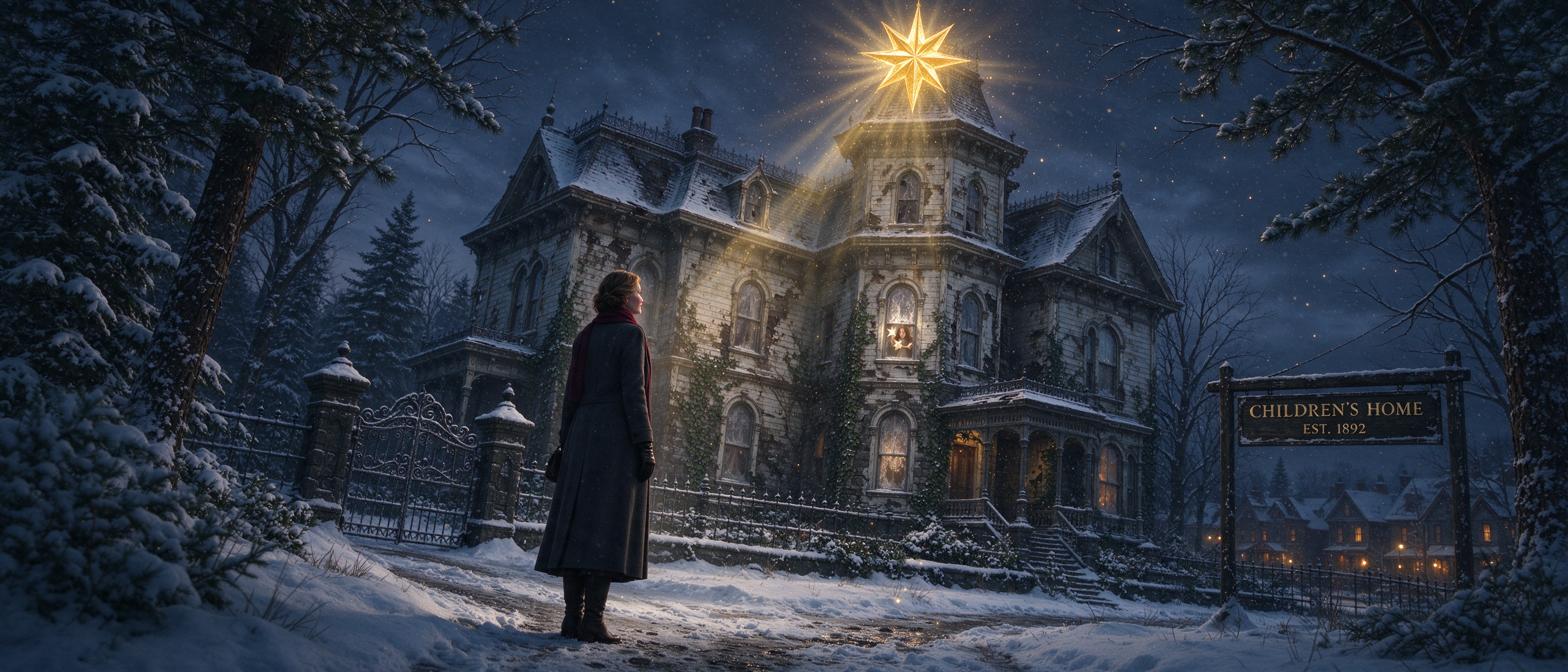
Create an extraordinary, ultra-photorealistic cinematic Christmas scene depicting an abandoned Victorian children's home on the edge of a small snow-covered town. The grand but weathered building has peeling white paint, ivy-covered stone walls, tall arched windows, and a faded wooden sign above its entrance. Snow blankets the roof and gardens. Above the central tower shines a magnificent golden Christmas star, suspended impossibly in the winter sky, radiating delicate beams of warm heavenly light through the falling snow. In the foreground, a middle-aged woman wearing a long charcoal coat, burgundy scarf, and leather gloves stands motionless on the snowy path, tears in her eyes as she looks toward the building she once called home. A faint silhouette of a little girl appears behind one frosted upstairs window, holding a small paper star. Snow-covered pine trees frame the scene, distant town lights shimmer in the background, and tiny golden particles drift through the air. Deep emotional storytelling, magical realism, photorealistic human features, exquisite Victorian architecture, cinematic lighting, breathtaking winter atmosphere, 8K detail, masterpiece quality, themes of forgiveness, motherhood, redemption, and hope.
“Some hearts spend years believing they have missed their chance to come home, until love places a light in the darkness and asks them to try one more time.”
The star appeared on Christmas Eve.
Nobody knew where it came from.
It shone above the abandoned children's home at the end of Willow Lane, a place the people of Bellweather had spent years trying to forget.
The building had once been beautiful.
Its tall windows had glowed with candlelight every December.
Its gardens had been filled with children running beneath the summer trees.
And its old wooden doors had opened to welcome little ones who had nowhere else to go.
But time had changed everything.
The paint had peeled.
The gardens had become overgrown.
The swing set stood crooked in the snow.
And the windows had grown dark.
For seventeen years, nobody had lived inside the old house.
Yet on that Christmas Eve, a golden star appeared above its highest tower.
It was brighter than any star in the winter sky.
It did not flicker.
It did not move with the wind.
And although the clouds thickened around it, the star continued to shine.
People stopped in the street to stare.
A baker stepped outside his shop.
A police officer pulled his car to the side of the road.
Children pressed their faces against their bedroom windows.
Some called it a Christmas miracle Star.
Others insisted it was a reflection from the church lights.
But those who knew the history of the old children's home felt something different.
They remembered the little ones who had once slept beneath its roof.
They remembered the woman who had devoted her life to caring for them.
And they remembered the final child who had left that house one winter morning, carrying a paper star in her pocket and a question in her heart.
Would her mother ever come back?
That child had been named Lily Hart.
And seventeen years later, the golden star was about to lead her mother home.
📷 Image Placement — The Woman Who Never Forgot
🎨 Image Prompt
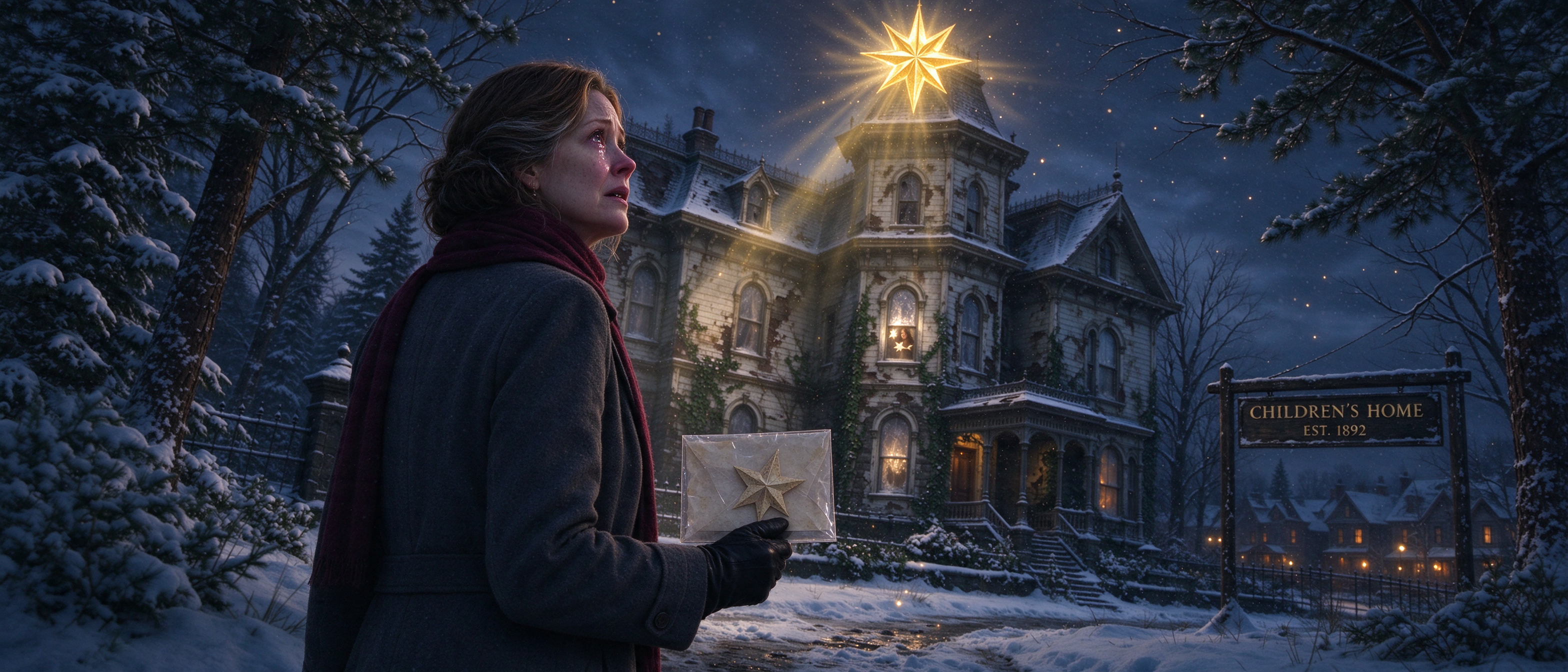
A deeply emotional cinematic portrait of a forty-two-year-old woman named Margaret Hart standing alone beside a snow-covered road at twilight. She wears a charcoal winter coat, burgundy scarf, leather gloves, and weathered boots. Her chestnut hair has a few silver strands, and her eyes reveal years of regret and sleepless nights. She holds a small, faded paper star protected inside a transparent envelope. Behind her, the abandoned Victorian children's home rises beneath falling snow, its upper tower illuminated by a mysterious golden star in the sky. Warm light from distant Christmas decorations reflects in her tear-filled eyes. Photorealistic skin textures, subtle facial emotion, cinematic depth of field, blue winter twilight contrasted with golden heavenly light, 8K detail, poignant atmosphere of longing, regret, and the possibility of forgiveness.
Margaret Hart had not intended to return to Bellweather.
For seventeen years, she had avoided the little town.
She had taken jobs in distant places.
She had lived in small apartments above busy streets.
She had worked long shifts in restaurants, cleaned hotel rooms, and cared for elderly patients who needed someone to sit beside them during the night.
She had learned to live quietly.
She had learned not to speak about the daughter she had left behind.
And she had learned to carry her sorrow in a place where nobody could see it.
But she had never learned how to stop loving Lily.
Every year, when December arrived, Margaret took a small paper star from the back of her dresser drawer.
It was creased at the edges.
One point had been torn and repaired with clear tape.
A child's handwriting crossed the center.
For Mommy. So she can always find me.
Lily had made it when she was five.
She had cut the star from yellow construction paper, decorated it with glitter, and presented it to Margaret on a snowy afternoon.
Margaret remembered the way her daughter had smiled.
She remembered the little hands holding out the gift.
She remembered Lily's soft voice saying, “If you ever get lost, Mommy, just look for my star.”
At the time, Margaret had laughed.
She had kissed the child's forehead and promised that she would never be lost.
But promises sometimes become painful reminders of the people we once hoped to be.
Margaret had been twenty-five when Lily was born.
She had loved her daughter fiercely.
But she had also been young, frightened, and trapped in a relationship that grew increasingly controlling.
Lily's father had left before the child's first birthday.
The bills accumulated.
The apartment grew colder.
And Margaret began working nights at a factory on the other side of town.
She tried to manage everything alone.
She told herself that if she worked harder, things would improve.
But exhaustion has a way of turning small difficulties into mountains.
When Margaret lost her job, the rent fell behind.
When the landlord gave her notice, she had nowhere safe to take Lily.
She spent weeks sleeping in a borrowed room and asking strangers for help.
Eventually, a social worker helped her find temporary shelter at Bellweather Children's Home.
Margaret had believed it would be for a few weeks.
She told Lily they were staying somewhere safe while Mommy made everything better.
But the weeks became months.
Her depression deepened.
Her fear grew heavier.
She began believing the cruel things she had once promised herself were not true.
That she was a failure.
That Lily deserved better.
That perhaps the kindest thing she could do was let someone else provide the stable home she could not offer.
The children's home helped arrange a permanent placement for Lily with a loving family.
Margaret signed the papers.
She told herself she was choosing her daughter's future.
But she left with a broken heart and a shame so deep that she could not bear to look back.
She did not understand that a mother could make a desperate decision and still spend the rest of her life longing to undo it.
She did not know how to ask for help.
She did not know how to forgive herself.
And she did not know that Lily had spent years wondering whether her mother had ever stopped loving her.
Now, at forty-two, Margaret stood outside the town where she had once lost everything.
She had come to Bellweather for a different reason.
A woman she had cared for in a nursing home had died, leaving Margaret a small envelope with instructions to deliver it to the local children's charity.
The woman had been born in Bellweather.
Her final request had been simple.
“Take this home,” she had told Margaret. “And if you happen to pass Willow Lane, look up.”
Margaret had promised she would.
She had not understood why.
Until she saw the star.
It shone above the abandoned children's home.
And as Margaret stared at it, she felt the familiar ache in her chest.
The same ache she had carried every Christmas since leaving Lily behind.
She reached into her coat pocket and touched the paper star.
For the first time in seventeen years, she whispered the words she had been too frightened to say aloud.
“Lily, my darling, I never stopped loving you.”
The golden star brightened.
Margaret took one trembling step toward the old house.
Then another.
And for the first time in nearly two decades, she allowed herself to hope that love might still have somewhere to go.
📷 Image Placement — The Girl Who Kept the Paper Star
🎨 Image Prompt
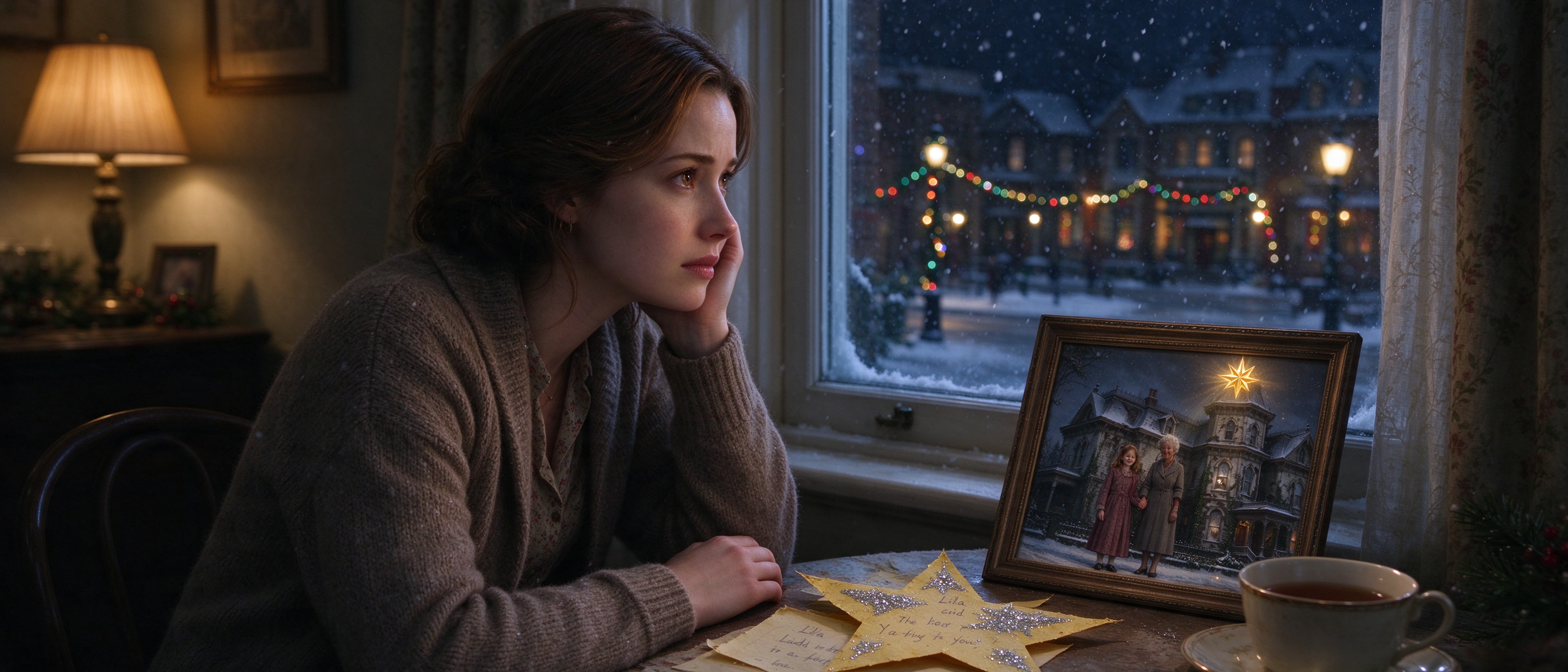
An intimate, photorealistic cinematic interior of a cozy apartment on a snowy December night. A twenty-two-year-old woman named Lily Hart sits beside a window overlooking a small town square decorated with Christmas lights. She has warm brown eyes, chestnut hair, and a thoughtful expression. On the table before her lies an old yellow paper star decorated with faded silver glitter and a child's handwritten message. Beside it rests a framed photograph of Lily as a little girl standing outside a Victorian children's home, holding hands with an older female caregiver. A mug of untouched tea sits nearby. Snowflakes drift past the window while warm lamplight illuminates the young woman's face. Her expression reflects quiet longing, unresolved questions, and a cautious hope she scarcely dares to acknowledge. Cinematic realism, realistic hands, exquisite paper textures, shallow depth of field, warm golden and cool blue lighting, 8K photorealism, emotional storytelling.
Lily Hart was twenty-two when the star appeared.
She lived in a small apartment above a flower shop.
She worked as a pediatric nurse at Bellweather Memorial Hospital.
She loved children.
She loved the way they asked questions adults had stopped asking.
She loved their honesty.
And she loved the way a frightened child could become brave simply because someone held their hand.
Somewhere inside her, she believed that if she could make the world gentler for a few children, perhaps the little girl she had once been would feel less alone.
Lily had been adopted at six.
Her adoptive parents, Thomas and Eleanor Reed, had welcomed her into their home with patience and tenderness.
They gave her a bedroom painted pale yellow.
They took her to the library every Saturday.
They attended every school concert, every birthday party, and every awkward childhood performance in which Lily sang too loudly or forgot the words.
They loved her without reservation.
And Lily loved them.
But there had always been a small, unanswered question inside her heart.
Why had her first mother let her go?
Thomas and Eleanor never tried to erase Lily's past.
They kept the papers from her adoption in a little blue folder.
They told her what they knew.
They answered her questions as honestly as they could.
They also reminded her that being given a loving home did not mean she had to stop wondering about the woman who had brought her into the world.
Lily appreciated that kindness.
But understanding a decision was not the same as understanding the heart behind it.
When she was little, she had imagined that her mother might return one day.
She imagined a knock at the door.
A familiar face.
An explanation that would make everything suddenly make sense.
As she grew older, those fantasies became embarrassing.
She stopped telling people about them.
She stopped asking whether anyone had heard from Margaret Hart.
Eventually, she learned to live with the unanswered question.
But every Christmas Eve, she took out the paper star.
It was the one thing she had been allowed to keep from the time before her adoption.
Her mother had given it back to her the morning they said goodbye.
Lily remembered standing in the doorway of the children's home, clutching the star in her mitten.
“Will you come back for me?” she had asked.
Margaret had knelt before her.
Her eyes were red.
Her hands trembled.
She had held Lily's face between her palms and kissed her forehead.
“I love you more than anything,” she had whispered.
Lily had waited.
She had watched her mother walk down the path.
She had waited for her to turn around.
But Margaret had kept walking.
For years, Lily believed that meant she had not been loved enough.
Even after she understood the circumstances, a small part of her still carried the question.
What if I had been easier to love?
What if I had been quieter?
What if I had been better?
Thomas and Eleanor spent years reminding her that a child's worth was never measured by the struggles of the adults around her.
Still, some wounds remain tender even after a person learns how they were made.
That Christmas Eve, Lily sat beside her window and turned the paper star between her fingers.
Outside, the snow began falling more heavily.
She glanced toward Willow Lane.
From her apartment, she could just make out the dark outline of the abandoned children's home.
Then she saw something that made her rise from her chair.
A golden star was shining above the old tower.
Lily pressed her hand against the window.
Her breath caught.
She had seen the building many times.
She had passed it on her way to school.
She had walked past it during summer evenings.
But she had never seen anything like this.
The star seemed to pulse gently against the winter sky.
And suddenly, Lily remembered her mother's voice.
If you ever get lost, Mommy, just look for my star.
She looked down at the paper star in her hand.
Then back at the window.
For the first time in years, she felt the strange, vulnerable sensation that perhaps a story she had thought was finished was not yet over.
📷 Image Placement — A Light in the Abandoned Home
🎨 Image Prompt
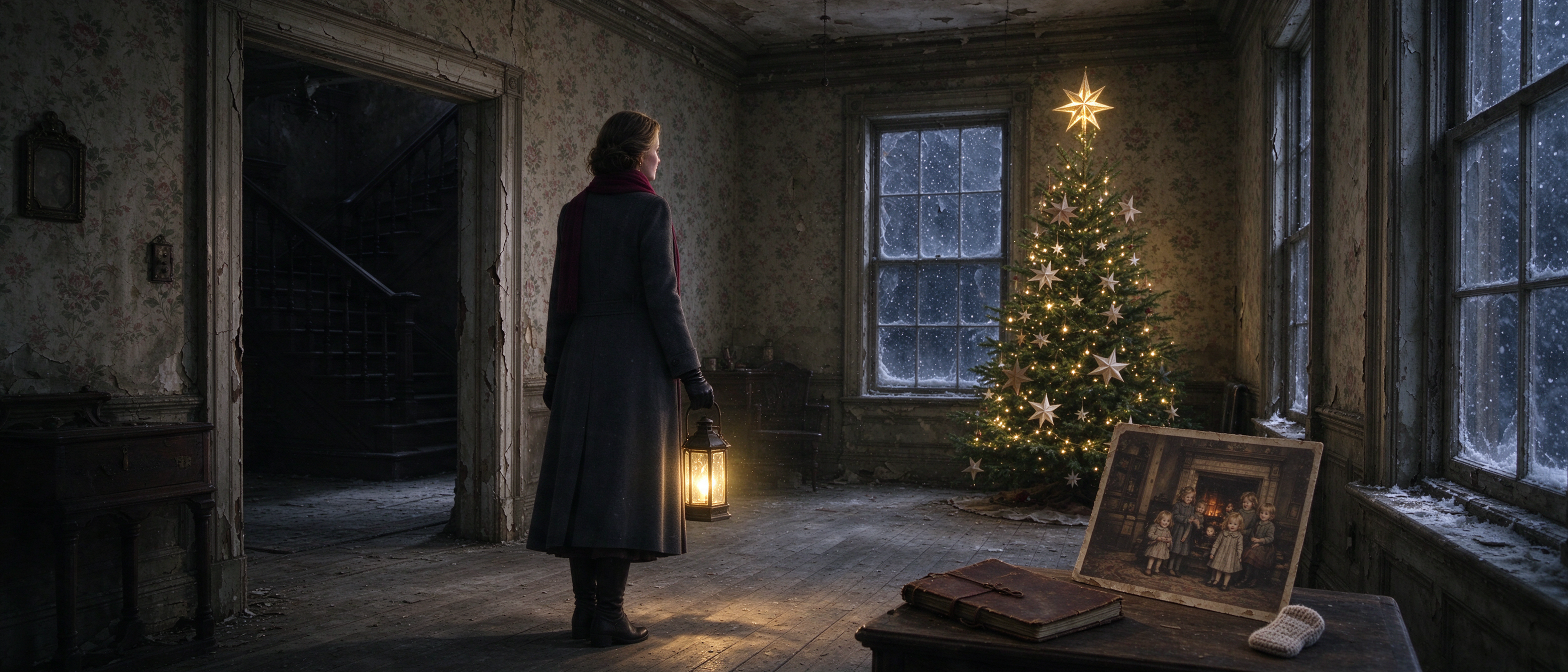
A cinematic, photorealistic interior of an abandoned Victorian children's home on Christmas Eve. A middle-aged woman in a charcoal coat and burgundy scarf stands inside the grand entrance hall, holding an antique lantern. Dusty wooden floors, faded wallpaper, and tall windows reveal years of neglect, yet a small Christmas tree glows in the far corner, decorated with handmade paper stars and delicate golden lights. On a narrow table rests an old guestbook, a faded photograph of children gathered around a fireplace, and a tiny knitted mitten. Moonlight and warm lantern light mingle across the walls. Through a cracked doorway, the staircase rises into shadow. The woman's expression reveals awe, sorrow, and recognition as she realizes the building has not been entirely forgotten. Ultra-photorealistic textures, exquisite Victorian details, cinematic lighting, atmospheric snowfall beyond the windows, 8K masterpiece quality, subtle magical realism.
Margaret reached the children's home shortly after seven.
The old gate stood open.
She pushed it gently, listening to the hinges creak in the cold.
Snow covered the path.
The garden had become wild, but someone had cleared a narrow walkway leading to the front door.
Margaret stopped.
Someone had been here.
She could see fresh footprints in the snow.
The door was not locked.
She pressed her hand against the handle and pushed.
It opened slowly.
The familiar smell of old wood and cold stone greeted her.
For a moment, she could not move.
She remembered the hallway.
The staircase.
The little room where Lily had once slept.
The kitchen where volunteers had prepared soup on winter evenings.
She remembered the sounds of children laughing.
She remembered their tears.
And she remembered the day she had walked out of the building without her daughter.
Margaret's knees weakened.
She reached for the wall.
“I am so sorry,” she whispered.
The words seemed to disappear into the empty house.
Then she noticed something at the far end of the hallway.
A Christmas tree.
It was small and slightly crooked.
Its branches were decorated with paper stars, wooden angels, and tiny handwritten notes.
A battery-powered candle glowed at its base.
Someone had taken the time to decorate a building everyone else had abandoned.
Margaret approached slowly.
The ornaments were handmade.
Some showed the names of children who had once lived here.
Others carried little messages.
You matter.
You are loved.
Your story is not over.
Margaret touched one of the paper stars.
It was yellow.
Its edges had been folded carefully.
A familiar feeling moved through her.
She had made hundreds of paper stars with Lily during their time at the home.
They had decorated the dining room windows.
They had hung them from the ceiling.
They had placed them on the beds of children who were frightened during their first nights away from home.
Lily had loved making stars.
She had believed each one could help someone find their way.
Margaret closed her eyes.
“I should have stayed,” she whispered.
The old house offered no answer.
Then she heard a sound from the room beyond the staircase.
A footstep.
Margaret turned.
An elderly woman stood in the doorway holding a candle.
She had silver hair gathered in a loose bun and wore a thick blue cardigan over a white blouse.
Her face was lined with age, but her eyes were kind.
Margaret recognized her immediately.
“Mrs. Bell?”
The woman stared at her.
Then the candle trembled in her hand.
“Margaret Hart?”
Margaret nodded.
For several seconds, neither woman spoke.
Mrs. Bell had been the director of the children's home when Lily was little.
She had been there on the morning Margaret left.
She had been the one who held Lily while the little girl cried.
She had been the one who sat beside her until she fell asleep.
And she had been the one who watched Margaret walk away.
Mrs. Bell approached slowly.
“I never thought I would see you again.”
Margaret lowered her eyes.
“Neither did I.”
Mrs. Bell studied her face.
“You've been carrying this a long time.”
Margaret's lips trembled.
“I don't know how to stop.”
The older woman looked toward the Christmas tree.
“Perhaps you don't have to stop carrying it,” she said. “Perhaps you only need to stop carrying it alone.”
Margaret began to cry.
Not quietly.
Not carefully.
She cried as though seventeen years of sorrow had finally found a door through which to escape.
Mrs. Bell wrapped her arms around her.
And for the first time since she had left Lily behind, Margaret allowed someone to comfort her without insisting she deserved to suffer.
📷 Image Placement — The Letter That Waited Seventeen Years
🎨 Image Prompt
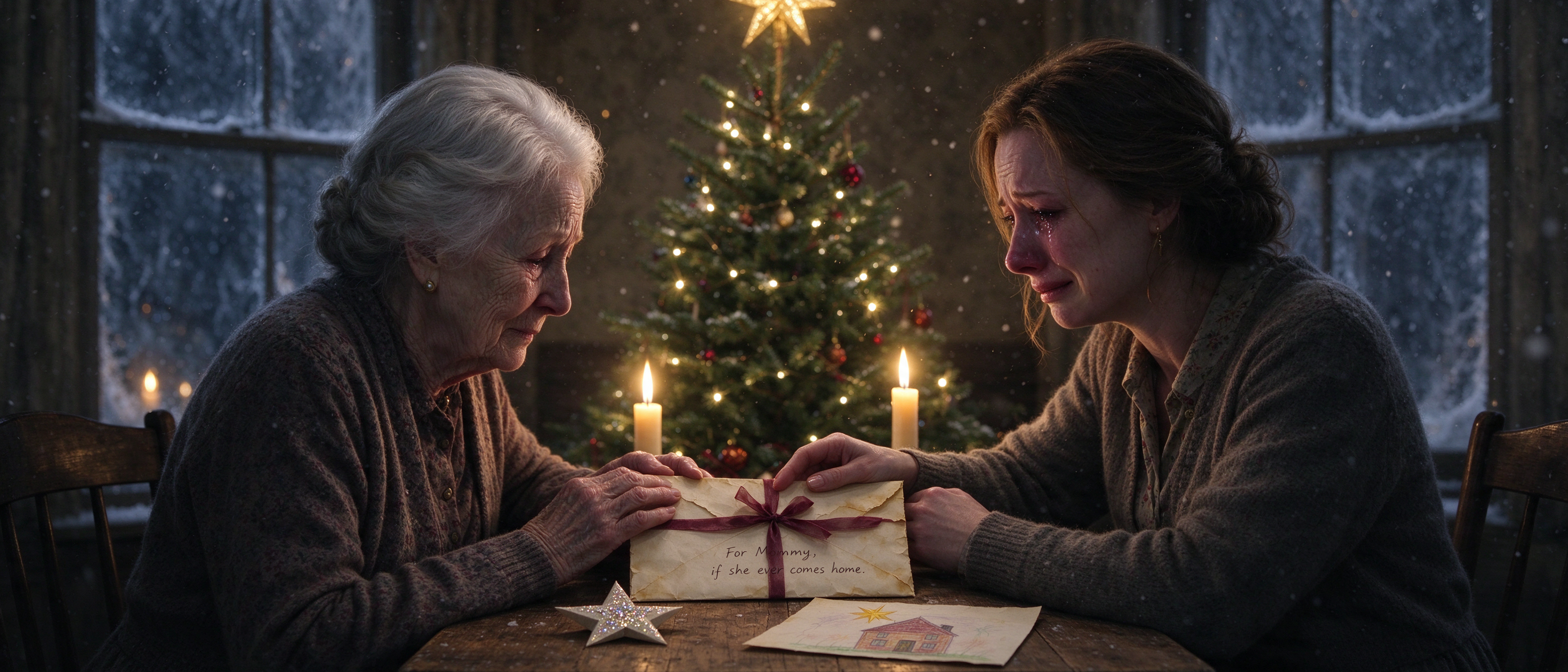
An emotionally powerful cinematic close-up inside the old children's home on Christmas Eve. An elderly woman with silver hair and a middle-aged woman with tearful eyes sit at a worn wooden table beneath a small Christmas tree. Between them lies a sealed envelope, yellowed with age, tied with a faded burgundy ribbon. The front bears the handwritten words “For Mommy, if she ever comes home.” Beside it rests a small paper star decorated with glitter and a child's drawing of a house beneath a shining star. Candlelight illuminates the women's hands as the mother hesitates before touching the letter. Dust motes drift through golden light, and snow falls outside tall frosted windows. Ultra-realistic paper fibers, natural hands, authentic tears, intimate cinematic composition, 8K photorealism, nostalgic warmth, atmosphere of forgiveness and long-awaited truth.
Mrs. Bell led Margaret into the old office.
It had once been filled with filing cabinets and children's drawings.
Now the room contained only a desk, two chairs, a bookshelf, and a small Christmas wreath hanging on the wall.
Mrs. Bell opened a drawer.
She removed a thin envelope tied with a faded burgundy ribbon.
Margaret stared at it.
“What is that?”
Mrs. Bell placed it on the desk.
“Something Lily left here.”
Margaret's breath caught.
“Lily?”
“She came back to the home a few times when she was older. Her adoptive parents brought her to visit. She wanted to see the place where she had lived before joining their family.”
Margaret covered her mouth.
“She came here?”
“Several times.”
The older woman nodded.
“She was always polite. Always kind. She asked about the children who lived here, and she wanted to know whether anyone remembered her.”
Margaret's eyes filled.
“Did she ask about me?”
Mrs. Bell paused.
“Yes.”
The answer seemed to break something open inside Margaret.
“What did she say?”
“She wanted to know whether we had ever heard from you.”
Margaret lowered her head.
“No one knew where I was.”
“I know.”
Mrs. Bell touched the envelope.
“On Lily's last visit, she brought this letter. She asked me to keep it here in case you ever returned.”
Margaret stared at the handwriting.
The letters were uneven.
The paper had softened at the folds.
She recognized the shape of the L.
She recognized the way Lily had always drawn the letter M with one extra line.
Her daughter had written this.
Her daughter had thought of her.
Her daughter had left a message for a mother who had been too ashamed to come home.
Margaret reached toward the envelope, then stopped.
“What if she hates me?”
Mrs. Bell sat beside her.
“Then you will have to respect her feelings.”
Margaret flinched.
“But what if she doesn't want to see me?”
“Then you must not force her.”
Tears slid down Margaret's face.
“I don't deserve to see her.”
Mrs. Bell's expression softened.
“Deserving is not the question, Margaret. Lily is an adult now. She has the right to decide whether she wants a relationship with you.”
She paused.
“But you are allowed to tell the truth. You are allowed to apologize. And you are allowed to hope.”
Margaret stared at the envelope.
For seventeen years, she had imagined that returning would require a miracle.
She had thought she would need to become a different person first.
Someone stronger.
Someone who had never been frightened.
Someone who had never made a decision she regretted.
But perhaps coming home did not require her to erase the past.
Perhaps it required her to face it.
She picked up the envelope.
Her fingers shook as she untied the ribbon.
Inside was a single sheet of paper.
Mrs. Bell moved her candle closer.
Margaret began to read.
Dear Mommy,
I am six years old now.
My new room is yellow, and I have a bookshelf with lots of stories. My new parents are kind to me. They tell me I can ask them anything.
I asked them whether you still think about me.
They said they believe you do.
I hope they are right.
Sometimes I remember the way you brushed my hair. Sometimes I remember you singing when you thought I was asleep.
I don't remember everything, but I remember that you held me when I was scared.
I used to think you left because I did something wrong.
Mrs. Bell says grown-ups sometimes have problems that children cannot understand.
I am trying to understand.
I still love you.
I am going to keep my paper star because I promised you could find me.
If you ever come back, I hope you will tell me what happened.
You don't have to bring me anything.
You don't have to be perfect.
I just want to know that you remember me.
Love,
Lily.
Margaret pressed the letter against her heart.
A sob escaped her.
“Oh, Lily.”
She bent forward, crying into her hands.
“I remembered you every day.”
Mrs. Bell sat beside her and held her shoulder.
Margaret read the letter again.
And again.
She could hardly bear the thought of her daughter believing that she had been forgotten.
But beneath the pain was something else.
A door.
Not a guarantee.
Not a promise that everything could be repaired.
Just a door that might still be open.
Margaret wiped her face.
“Where is she now?”
Mrs. Bell looked toward the window.
“She works at the hospital.”
Margaret's heart began to pound.
“Does she still live in Bellweather?”
“Yes.”
For the first time in seventeen years, Margaret knew where her daughter was.
And for the first time in seventeen years, she understood that finding Lily was only the beginning.
She would have to let Lily choose what happened next.
She would have to listen.
She would have to accept questions that might hurt.
She would have to tell the truth without asking her daughter to make the past easier for her.
She would have to offer an apology without demanding forgiveness in return.
Margaret folded the letter carefully.
Then she placed it inside her coat.
“Tomorrow,” she whispered. “I'll ask if she is willing to see me tomorrow.”
Mrs. Bell nodded.
“That's a good place to begin.”
📷 Image Placement — Two Women Beneath the Christmas Star
🎨 Image Prompt
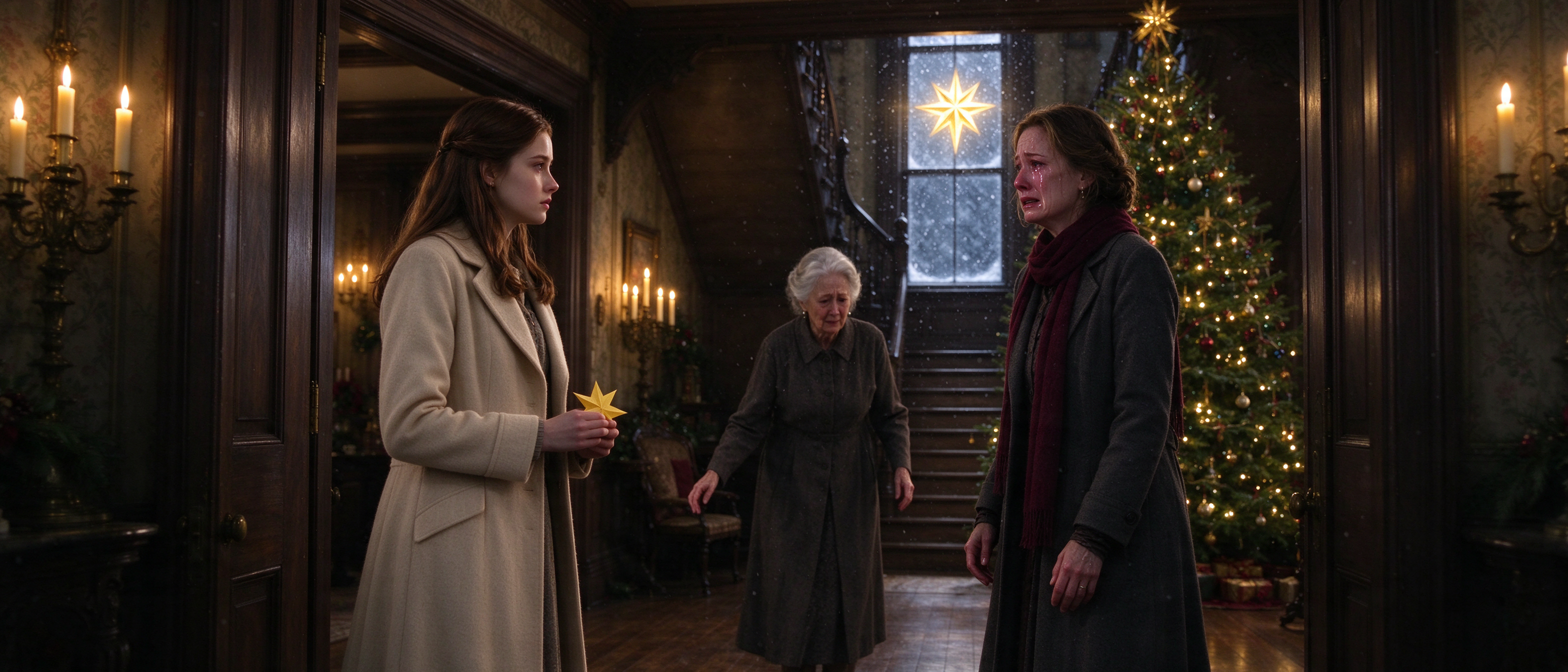
A breathtaking, emotionally intense cinematic Christmas Eve scene inside the entrance hall of an old Victorian children's home. A twenty-two-year-old woman with chestnut hair and warm brown eyes stands just inside the open doorway, wearing a cream wool coat and carrying a small yellow paper star. Across the room stands her forty-two-year-old mother, dressed in a charcoal coat and burgundy scarf, her face wet with tears and her hands trembling. They gaze at each other across several feet of wooden floor, neither certain whether to move closer. Between them stands an elderly woman with silver hair, gently stepping aside to give them privacy. A decorated Christmas tree glows behind the mother, while a golden star shines through the tall window above the staircase. Snow falls outside, and warm candlelight fills the room. Realistic age differences and facial features, powerful restrained emotion, cinematic composition, photorealistic detail, 8K quality, no exaggerated expressions, themes of reconciliation, courage, and the fragile first moment of reunion.
Lily saw the star from her apartment window.
She stood watching it for nearly ten minutes.
Then she called her father.
Thomas answered on the second ring.
“Lily? Is everything all right?”
“I don't know,” she said.
He heard something in her voice.
“What happened?”
She told him about the star.
She told him how it seemed to shine directly above the children's home.
And she told him about the memory that had returned so suddenly she could almost feel her mother's hands holding her paper star.
Thomas listened without interrupting.
When she finished, he asked, “Do you want to go there?”
Lily looked toward the window.
“Yes.”
“Then go.”
She hesitated.
“What if it's nothing?”
“Then it will be nothing, and you'll come home.”
His voice softened.
“But if it means something, you deserve to find out.”
Lily put on her coat.
She slipped the paper star into her pocket.
Then she walked toward Willow Lane.
Snow fell steadily around her.
The town was quiet, and the Christmas lights cast soft reflections across the wet pavement.
When she reached the children's home, the front door stood open.
Warm light spilled onto the snow.
Lily stepped inside.
She recognized the staircase.
The old wooden banister.
The narrow hallway where she had once learned to walk in shoes too big for her feet.
And the little Christmas tree decorated with paper stars.
Mrs. Bell emerged from the office.
For a moment, she simply stared.
Then she smiled through tears.
“Lily.”
Lily hurried forward and embraced her.
“Mrs. Bell!”
The older woman held her tightly.
“Oh, my darling. Look at you.”
Lily laughed shakily.
“It's been a long time.”
“It certainly has.”
Then Mrs. Bell's expression grew serious.
“There is someone here who has been hoping to see you.”
Lily went still.
She did not need to ask who.
Her hands began to tremble.
Mrs. Bell gently took one of them.
“You don't have to do anything you aren't ready to do.”
Lily looked toward the office doorway.
A woman stood inside.
She had chestnut hair threaded with silver.
She wore a charcoal coat and a burgundy scarf.
And in her hands, she held a faded paper star.
Lily stopped breathing for a moment.
The woman's face was older than the one in Lily's memories.
There were lines around her eyes.
Her shoulders were narrower.
Her hair was darker in the old photographs, and her cheeks had lost the fullness Lily remembered from childhood.
But the eyes were the same.
Lily knew those eyes.
She had spent years wondering whether she would ever see them again.
“Lily,” the woman whispered.
Lily could not move.
Margaret took one small step forward.
Then she stopped.
“I don't know what to say.”
Lily stared at her.
Seventeen years of questions crowded into a single moment.
Why didn't you come back?
Did you think about me?
Did you remember my birthday?
Did you ever want to find me?
Did you know I waited?
Did you know I thought I had done something wrong?
Lily's throat tightened.
Margaret looked down.
“I am so sorry.”
Her voice broke.
“I know that apology cannot give you back the years we lost. I know I cannot ask you to forgive me. And I know you may not want me in your life.”
She lifted her eyes.
“But I need you to know that I never stopped loving you.”
Lily's tears began to fall.
“Then why didn't you come back?”
Margaret closed her eyes.
It was the question she had feared for seventeen years.
And the question she knew her daughter deserved to ask.
“Because I was ashamed,” she whispered. “Because I believed I had failed you. Because I was afraid you would look at me and see someone who had abandoned you.”
She swallowed.
“And because every year I waited made it harder to imagine how I could explain the year before.”
Lily's face crumpled.
“I thought you forgot me.”
Margaret shook her head desperately.
“Never.”
“I thought maybe I wasn't worth coming back for.”
“No,” Margaret cried. “No, Lily. You were always worth coming back for.”
Lily pressed her hands against her face.
Margaret did not rush toward her.
She did not reach for her.
She stood still, allowing her daughter the space to feel whatever she needed to feel.
“I can't fix what happened,” Margaret whispered. “I can't ask you to make me feel better. I only wanted the chance to tell you the truth.”
Lily lowered her hands.
For a long moment, she looked at the woman who had given birth to her.
Then she took the paper star from her pocket.
It was old and faded.
One point had been repaired with tape.
She held it up.
“Do you remember this?”
Margaret began to sob.
“Yes.”
“You told me you would never get lost.”
Margaret nodded.
“I know.”
“You said I could always find you.”
“I know, sweetheart.”
Lily's voice trembled.
“I kept it.”
Margaret covered her mouth.
“You kept it?”
“Every Christmas.”
Margaret looked at her daughter with an expression that seemed to hold seventeen years of longing.
“I thought you would throw it away.”
Lily shook her head.
“I thought about it sometimes.”
She looked down at the star.
“But I couldn't.”
The room grew quiet.
Then Lily took one slow step forward.
Margaret remained still.
Lily took another.
And when she was close enough, she reached for her mother's hand.
It was not forgiveness.
Not yet.
It was not a promise that everything would be easy.
It was not the restoration of the years they had lost.
It was simply a hand reaching for another hand.
A beginning.
Margaret looked down at their joined fingers.
Then she looked into Lily's eyes.
“May I hug you?” she whispered.
Lily's lips trembled.
“Yes.”
Margaret wrapped her arms around her daughter.
And Lily, who had spent seventeen years wondering whether her mother had forgotten her, finally felt the warmth of the arms she had remembered from childhood.
They cried together beneath the Christmas star.
Neither woman tried to make the moment perfect.
Neither pretended that the past had disappeared.
They simply held on.
And for the first time in seventeen years, neither of them had to wonder whether the other still cared.
📷 Image Placement — The Christmas Morning of New Beginnings
🎨 Image Prompt
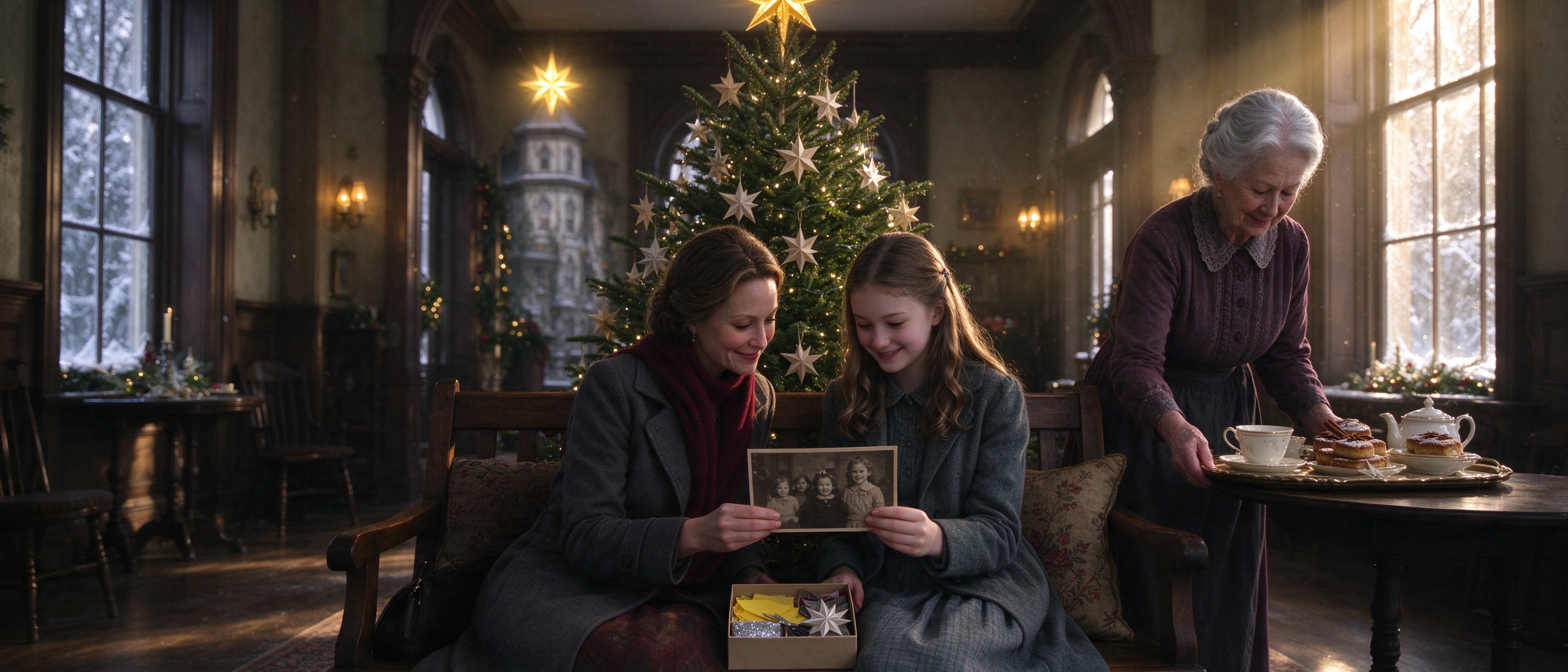
A warm, photorealistic Christmas morning inside the restored entrance hall of a Victorian children's home. A mother and her adult daughter sit side by side on a wooden bench beneath a small Christmas tree decorated with handmade paper stars. They are not embracing dramatically; instead, they share a quiet, genuine smile as they look at an old photograph from the daughter's childhood. Between them rests a small box of craft supplies, yellow paper, silver glitter, scissors, and a newly made paper star. An elderly woman with silver hair places a tray of tea and cinnamon pastries on a nearby table. Golden morning sunlight streams through tall windows, illuminating the snow outside. A luminous Christmas star glows faintly above the tower in the distance. Natural faces, understated emotion, realistic skin and fabric textures, cinematic warmth, 8K detail, themes of patience, reconciliation, hope, and love beginning again.
Lily did not go home with her mother that night.
She did not promise to call every day.
She did not tell Margaret that everything was forgiven.
And Margaret did not ask her to.
Instead, they sat in the old office for nearly two hours.
They talked about Lily's childhood.
They talked about Margaret's life after leaving Bellweather.
They spoke about the things they remembered and the things they could no longer recall.
There were painful silences.
There were questions that neither woman knew how to answer.
And there were moments when Lily had to look away because the emotions were too much.
Margaret listened.
She did not defend every decision.
She did not tell Lily that she should understand.
She did not ask her daughter to comfort her.
When Lily spoke about the years she had spent believing she was somehow unworthy of being chosen, Margaret cried.
But she did not interrupt.
She let Lily finish.
Then she said, “You were never the reason I struggled. You were never the reason I left. You were a child who deserved to be cared for, and I am sorry that my pain made you question your worth.”
Lily looked down at her hands.
“I don't know how to feel about you yet.”
Margaret nodded.
“You don't have to know tonight.”
“What if I get angry?”
“You can be angry.”
“What if I don't want to see you for a while?”
“I will respect that.”
Lily looked at her mother.
“What if I do want to see you?”
Margaret's eyes filled again.
“Then I will be grateful for every moment you're willing to share.”
That answer mattered.
It was the first time Lily felt that she could choose the shape of their relationship without being responsible for Margaret's happiness.
She could love her mother.
She could be angry with her.
She could ask questions.
She could need time.
She could decide what came next.
And she could do all those things without losing the family who had raised her.
Before Lily left, Margaret handed her the old letter.
“I thought you should have it.”
Lily held the paper carefully.
“You kept it all these years?”
“I found it tonight.”
Lily looked at Mrs. Bell.
The older woman smiled.
“I kept it safe for the day it might be needed.”
Lily hugged her again.
Then she turned toward Margaret.
“Would you like to have breakfast with me tomorrow?”
Margaret's face went still.
For a moment, she seemed unable to understand the words.
“Breakfast?”
Lily nodded.
“Somewhere public. Just coffee and something to eat.”
Margaret smiled through her tears.
“I would love that.”
Lily paused.
“And Mom?”
Margaret's breath caught.
It was the first time Lily had called her that since they had been reunited.
“Yes, sweetheart?”
Lily glanced at the paper star in her hand.
“Don't disappear again.”
Margaret shook her head.
“I won't disappear because I'm ashamed. If you need space, I'll give it to you. If we have difficult days, I'll face them with you. And if I don't know what to say, I'll tell you the truth.”
Lily nodded slowly.
“That would be a start.”
“Yes,” Margaret whispered. “It would.”
The following morning, they met at a small café beside the town square.
They talked over coffee and cinnamon toast.
At first, their conversation was awkward.
They had seventeen years of ordinary life to catch up on.
Seventeen birthdays.
Seventeen Christmases.
Seventeen years of favorite books, new friends, difficult days, and small victories.
They could not recover those years.
But they could begin learning who they were to each other now.
Lily told Margaret about nursing school.
Margaret told Lily about the elderly woman who had sent her back to Bellweather.
They exchanged photographs.
They laughed when they discovered that they both disliked raisins in cookies.
And when the conversation became difficult, they allowed the silence to remain without treating it as a failure.
Over the following months, they met again.
Sometimes for lunch.
Sometimes for a walk.
Sometimes simply to sit together and talk.
Lily continued to ask questions.
Margaret continued to answer honestly.
Trust did not arrive all at once.
It grew slowly.
It grew through kept promises.
Through phone calls returned.
Through apologies that did not come with excuses.
Through a mother who learned that love meant respecting her daughter's boundaries.
And through a daughter who gradually discovered that acknowledging her mother's humanity did not require her to deny her own pain.
They were not returning to the relationship they might have had.
They were building a different one.
One honest conversation at a time.
📷 Image Placement — The Star That Led Them Home
🎨 Image Prompt
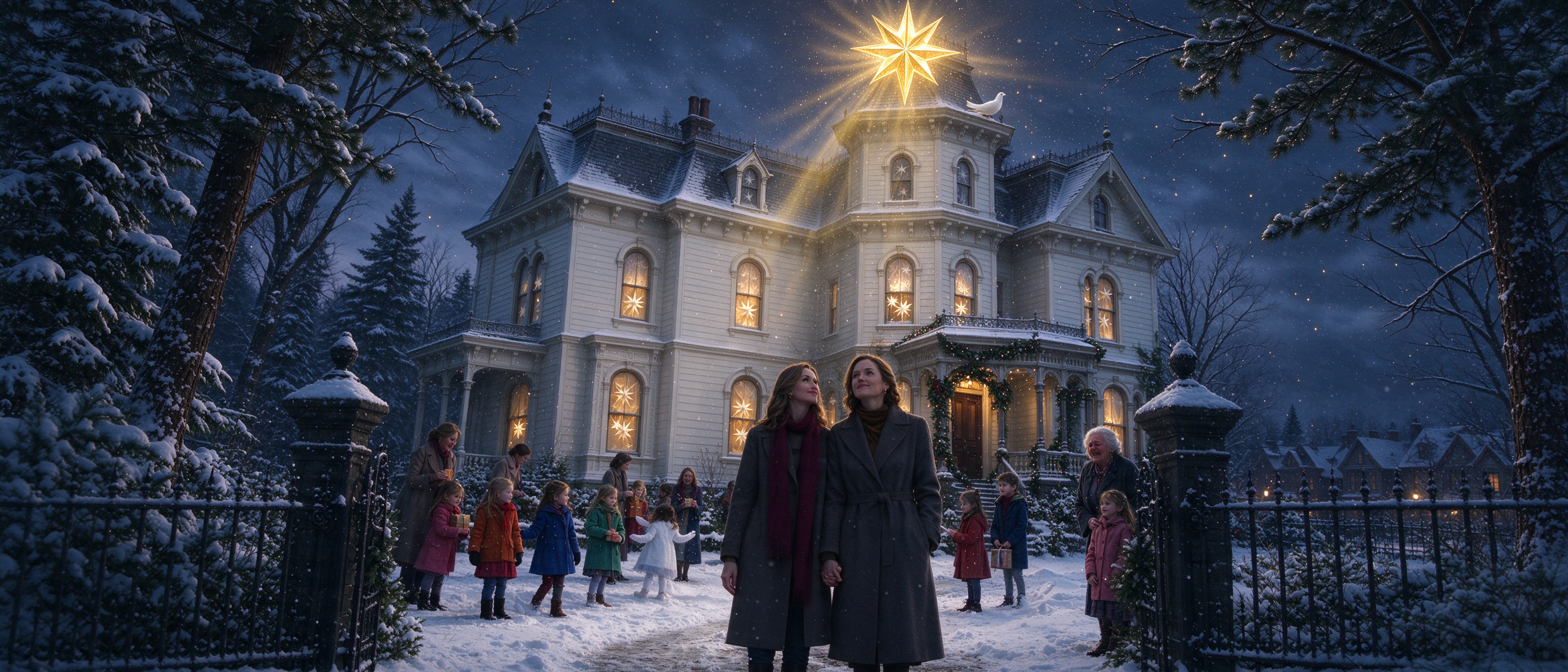
Create a breathtaking, ultra-photorealistic cinematic Christmas scene one year later at the restored Victorian children's home on Willow Lane. The building now shines with renewed warmth, its freshly painted white walls, restored wooden doors, and tall windows glowing with golden light. Evergreen wreaths decorate the entrance, and handmade paper stars hang in every window. A group of children in colorful winter coats gather in the snow-covered garden with volunteers, making snow angels and carrying small wrapped gifts. In the foreground, a mother and her adult daughter stand together beneath the entrance arch, holding hands while looking toward a magnificent golden Christmas star shining above the tower. Their expressions are peaceful and hopeful, with the quiet tenderness of a relationship slowly rebuilt. An elderly woman watches from the doorway, smiling through tears. Snowflakes drift through the air, reflecting warm light, while a white dove rests on the roofline. Cinematic realism, extraordinary Victorian architectural detail, lifelike human expressions, warm golden light against cool winter blues, heavenly magical realism, 8K masterpiece quality, profound themes of forgiveness, belonging, second chances, and enduring love.
One year later, the old children's home opened its doors again.
It was no longer a residential home.
Instead, it became a community center for families facing difficult times.
There was a warm kitchen where volunteers prepared meals.
There was a room filled with donated winter coats and boots.
There was a little library with shelves of children's books.
And there was a craft room where children could make paper stars, Christmas cards, and ornaments to hang in the windows.
Margaret volunteered there twice a week.
She helped prepare meals.
She sorted donations.
She listened when frightened parents needed someone to hear their stories without judgment.
She never pretended that her own past gave her all the answers.
Instead, she tried to remember what it had felt like to need help and be too ashamed to ask.
Lily visited when her hospital schedule allowed.
Sometimes she brought books for the children.
Sometimes she helped with first-aid classes.
And sometimes she simply sat beside a little one who was missing someone and reminded them that their feelings mattered.
Their relationship continued to grow.
It was not always easy.
There were days when old wounds returned unexpectedly.
There were conversations that had to be revisited.
There were moments when Lily needed distance and moments when Margaret had to learn not to mistake that distance for rejection.
But they kept showing up.
And slowly, they learned that love could be rebuilt without pretending the broken parts had never existed.
On Christmas Eve, they gathered with the volunteers and children outside the restored home.
Paper stars decorated the windows.
A large evergreen wreath hung above the entrance.
Children laughed as they carried boxes of gifts into the building.
And above the tower, the golden star appeared once more.
It shone with a soft, steady light.
Lily stood beside her mother, watching the children play in the snow.
“Do you think it was really a miracle?” she asked.
Margaret looked up at the star.
“I don't know.”
Lily smiled.
“I used to think a miracle would be you coming back and making everything the way it was before.”
Margaret lowered her eyes.
“I wish I could have given you that.”
“I know.”
Lily took her mother's hand.
“But maybe the miracle was that we found a way to tell the truth.”
Margaret looked at her daughter.
“And that we kept choosing to come back.”
Lily nodded.
“Even when it was hard.”
They stood together beneath the glowing star.
Then a little girl came running toward them.
She was six years old, with dark curls, rosy cheeks, and a paper star clutched in her mitten.
“Lily!” she called. “Look what I made!”
Lily crouched to see it.
The star was bright yellow, decorated with silver glitter.
One of its points had been folded.
The child held it proudly.
“I'm going to give it to my grandma. She lives far away, and I want her to know I miss her.”
Lily smiled.
“That's a beautiful idea.”
The girl looked up at Margaret.
“Do you think stars help people find their way?”
Margaret felt tears gather in her eyes.
She looked at the paper star.
Then she looked at her daughter.
“I think love can help people find their way,” she answered. “And sometimes a little star reminds us where to begin looking.”
The child considered this.
Then she ran back toward the other children.
Lily leaned against her mother's shoulder.
For a moment, neither of them spoke.
They did not need to.
Above them, the golden star shone against the winter sky.
Its light spilled across the old building, the snow-covered garden, and the faces of the people gathered beneath it.
Perhaps it was a miracle.
Perhaps it was a mystery.
Perhaps it was simply the reflection of the Christmas lights on a cloud of falling snow.
Nobody ever discovered the explanation.
But every year, the star returned.
And every year, someone who had been feeling lost found their way to Willow Lane.
A father who had lost his job and feared he could no longer provide for his children.
A mother who needed help but was afraid to ask.
A teenager who believed no one would ever understand.
A child who wondered whether they mattered.
They came carrying different kinds of sorrow.
And they found warm rooms, patient listeners, and people who understood that asking for help was not a failure.
They found a place where no one was required to be perfect before receiving kindness.
They found a place where the past could be spoken of honestly and the future could still be approached with hope.
And above the tower, the Christmas star continued to shine.
Not as a promise that every broken relationship would be restored.
Not as a guarantee that every apology would be accepted.
But as a gentle reminder that even after years of darkness, a person can choose to take one small step toward the light.
Margaret could never give Lily back the seventeen years they had lost.
Lily could never return to the childhood in which she had waited for her mother to come through the door.
They could not rewrite their history.
But they could decide what to do with the time that remained.
They could speak honestly.
They could respect each other's pain.
They could keep their promises.
They could create new memories without demanding that those memories erase the old ones.
And they could pass their hard-won understanding to children who were still learning what love meant.
On that Christmas Eve, as snow settled softly across Willow Lane, Lily slipped her hand into her mother's.
“I'm glad you came home,” she whispered.
Margaret closed her fingers around hers.
“So am I.”
Above them, the golden star shone.
And for the first time in seventeen years, the woman who had once believed she could never come home understood something she had spent a lifetime trying to learn.
Home was not always the place where nothing had gone wrong.
Sometimes, home was the place where the truth could finally be told.
Sometimes, it was the place where forgiveness was allowed to take its time.
And sometimes, it was the place where two people who had lost years they could never recover chose, at last, to begin again.
❤️ Life Lesson
There are decisions in life whose consequences cannot be undone.
There are years we cannot recover, words we cannot take back, and moments we wish we had handled differently.
Some people spend so long regretting their mistakes that they begin to believe they no longer deserve happiness.
They tell themselves they have waited too long.
They have hurt too many people.
They have made too many wrong choices.
And they convince themselves that staying away is kinder than risking rejection.
But Margaret's story reminds us that shame may explain why we hide, but it does not have to decide how the rest of our lives will unfold.
Margaret made a painful decision during a time when she felt overwhelmed and alone.
Her choice left a wound in her daughter's life.
Her love did not erase that wound, and her suffering did not undo the consequences.
But when she finally returned, she stopped asking shame to make her decisions for her.
She accepted that Lily had a right to ask difficult questions.
She understood that an apology was not a demand for forgiveness.
And she learned that loving someone sometimes means allowing them to choose the distance they need.
Lily's journey teaches us something equally important.
We can acknowledge another person's struggles without pretending their choices did not hurt us.
We can understand why someone failed us without declaring that the failure did not matter.
We can offer forgiveness without rushing ourselves.
And we can decide to build a relationship differently from the way it existed before.
Forgiveness is not the same as forgetting, and reconciliation is not something one person can demand from another.
Sometimes, reconciliation is possible.
Sometimes, it takes years.
Sometimes, a person can offer a sincere apology and still be unable to restore the relationship they lost.
But even then, honesty, accountability, and compassion can help people move toward a healthier future.
The most important thing is not to force a particular ending.
It is to create the possibility of a better beginning.
If you are carrying regret, remember that you do not have to become a perfect person before you take responsibility for your past.
You can begin by telling the truth.
You can apologize without making excuses.
You can seek help when you need it.
You can respect the boundaries of the people you have hurt.
And you can begin doing good today, even if yesterday was painful.
If someone has hurt you, remember that you are not obligated to forgive before you are ready.
You are not required to reopen a door that does not feel safe.
You may take your time, ask questions, and decide what kind of relationship, if any, you want to have.
Your healing matters too.
And if you have spent years wondering whether you were worth loving, please remember this:
Someone else's inability to care for you in the way you needed was never a measurement of your worth.
Lily was worthy of love when she was six years old.
She was worthy of love while she waited.
She was worthy of love when she felt angry, confused, and hurt.
And she was worthy of love when she finally met the mother she had spent seventeen years missing.
Nothing about her mother's struggles changed that.
You do not have to earn your right to be treated with dignity.
You do not have to be easier to love.
You do not have to carry responsibility for every broken thing that happened around you.
And you do not have to let the unanswered questions of your past determine every possibility in your future.
Sometimes, a second chance begins with a grand gesture.
But more often, it begins with something much smaller.
A phone call.
A truthful conversation.
An apology.
A willingness to listen.
A promise kept.
Or a single step toward a door you have been afraid to open.
The Christmas star above Willow Lane did not erase Margaret and Lily's history.
It simply helped them find the courage to face it together.
And perhaps that is what hope really is.
Not the belief that everything can be made exactly as it was before.
But the understanding that, even after heartbreak, there may still be something meaningful left to build.
You cannot always change how your story began. But with honesty, courage, and compassion, you may still help shape what happens next.
And sometimes, the first step toward home is simply believing you are allowed to try.
❤️ Next Chapter
Chapter 126: The Forgotten Christmas Violin That Played by Itself in an Empty Train Station—and Reunited Two Souls Who Had Waited Forty Years to Say Goodbye 🎻🚂❄️🎄🪽❤️✨
Topics
Writing one? Publish your story on the BudgetPixel blog.
 @pocahontas


 @faerierealm

 @EternaSky

 @germancowboy