
The Story Behind 朝焼けまで待てない
 @germancowboy
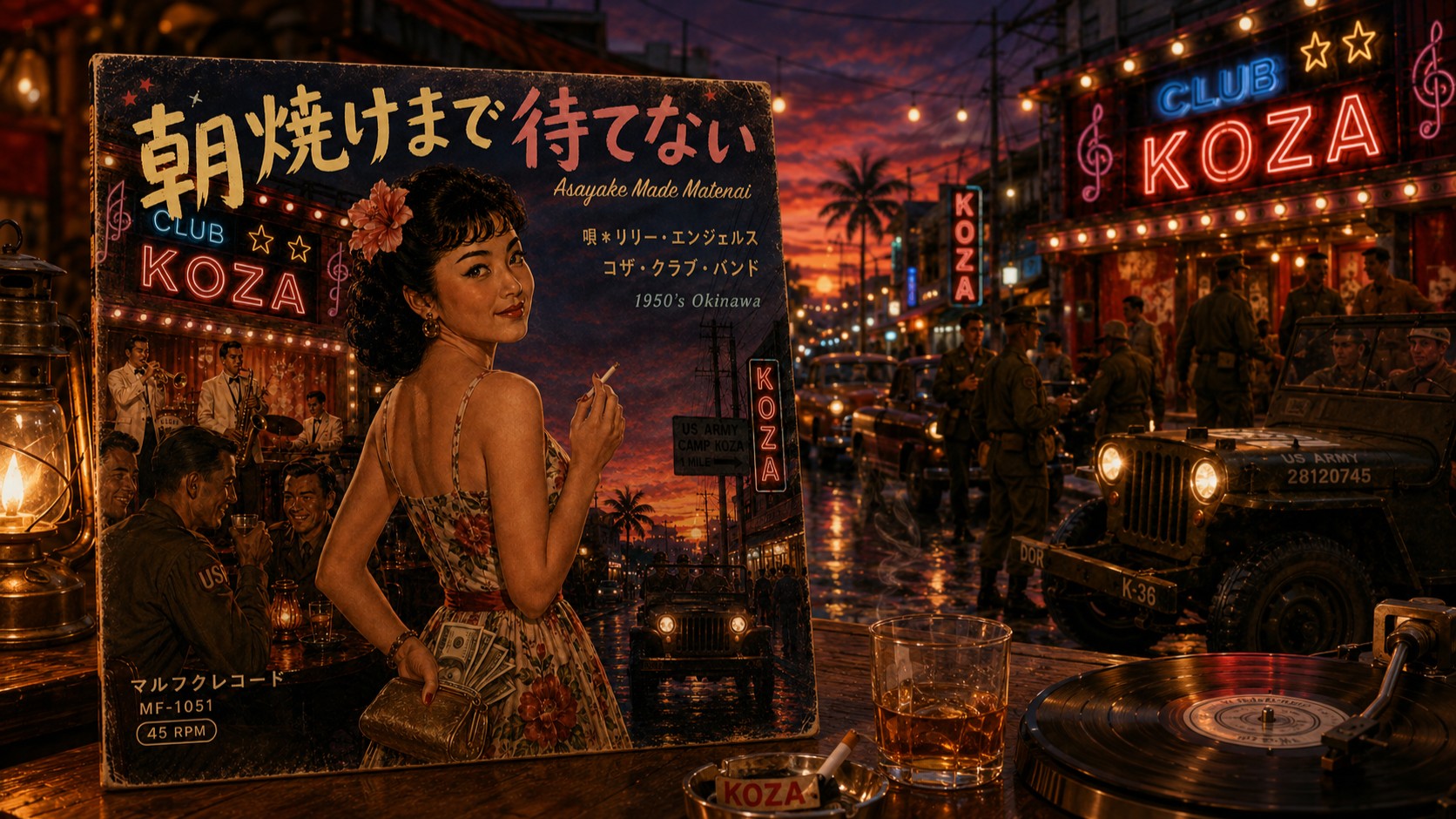
Listen to the song here: 朝焼けまで待てない
There are songs that tell you exactly what happened, and there are songs that leave an entire life hiding between the lines.
朝焼けまで待てない — “I Can’t Wait Until the Morning Glow” — belongs to the second kind.
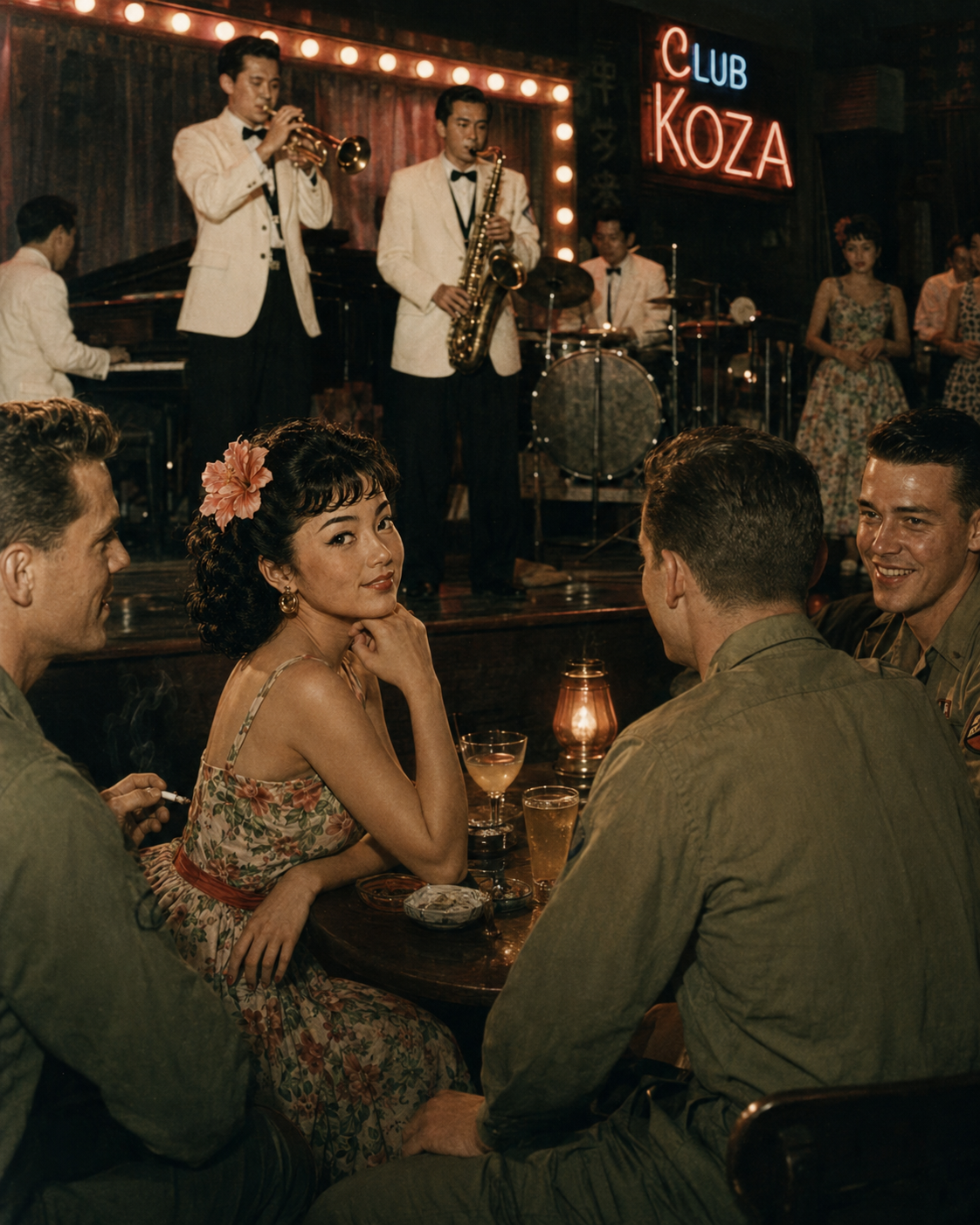
Set against the American-influenced nightlife of early-1950s Okinawa, the song follows a young woman whose nights belong to the crowded clubs and bars around Koza, but whose mornings belong entirely to someone else.
Her name was Aiko.
At least, that is the name we give her here.
This is her imagined story.
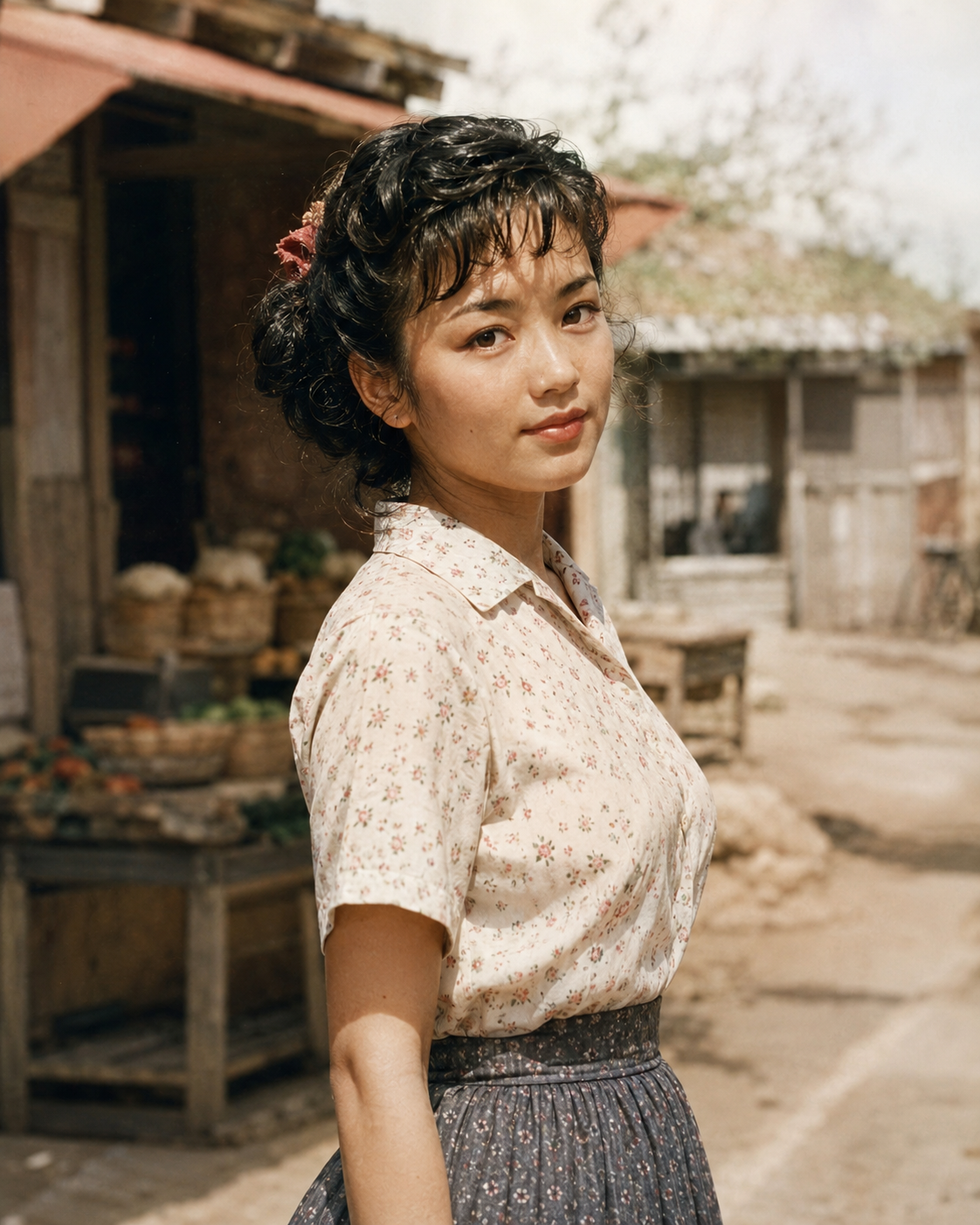
Aiko before Koza, photographed near a neighborhood market.
Aiko was twenty-two when she first came to Koza.
The war had ended only a few years earlier, but its absence did not mean that life had become easy. Okinawa was still rebuilding. Families were scattered, houses had disappeared, and the American military presence had created a new economy almost overnight.
Where soldiers went, businesses followed.
Bars appeared. Dance halls opened. Small restaurants stayed awake until morning. Tailors altered dresses in American styles. Musicians learned jazz standards. Women learned enough English to greet customers, take drink orders, make jokes and understand when someone was asking them to dance.
Aiko had grown up outside the busiest districts and had never imagined herself working in one of them.
She had imagined something quieter.
By the time she reached Koza, quiet had become a luxury.
What she needed was money.
Not a fortune.
Enough for rice.
Enough for rent.
Enough to replace a pair of shoes before the soles wore completely through.
And, most importantly, enough for two people to live together.
The second person was Keiko.
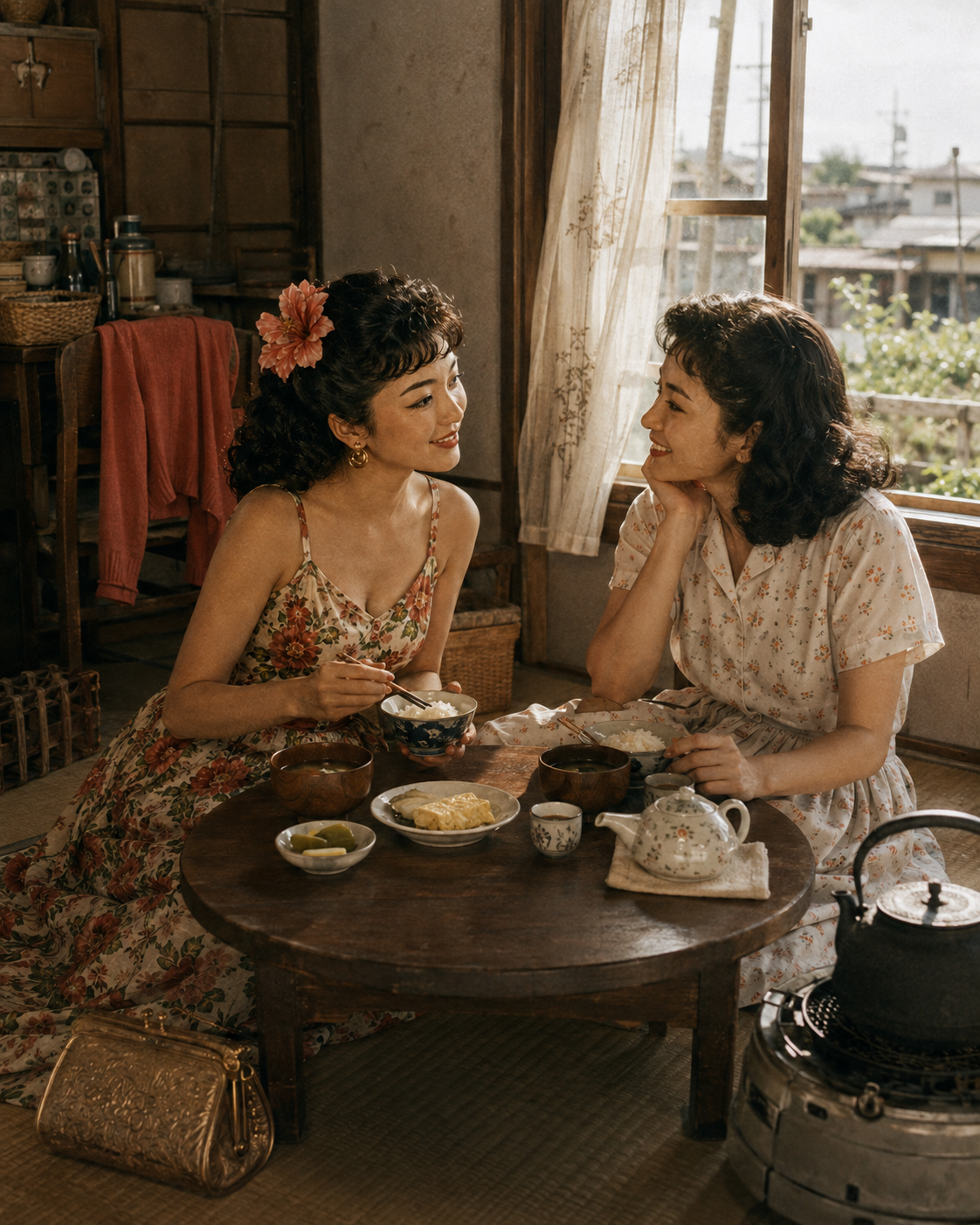
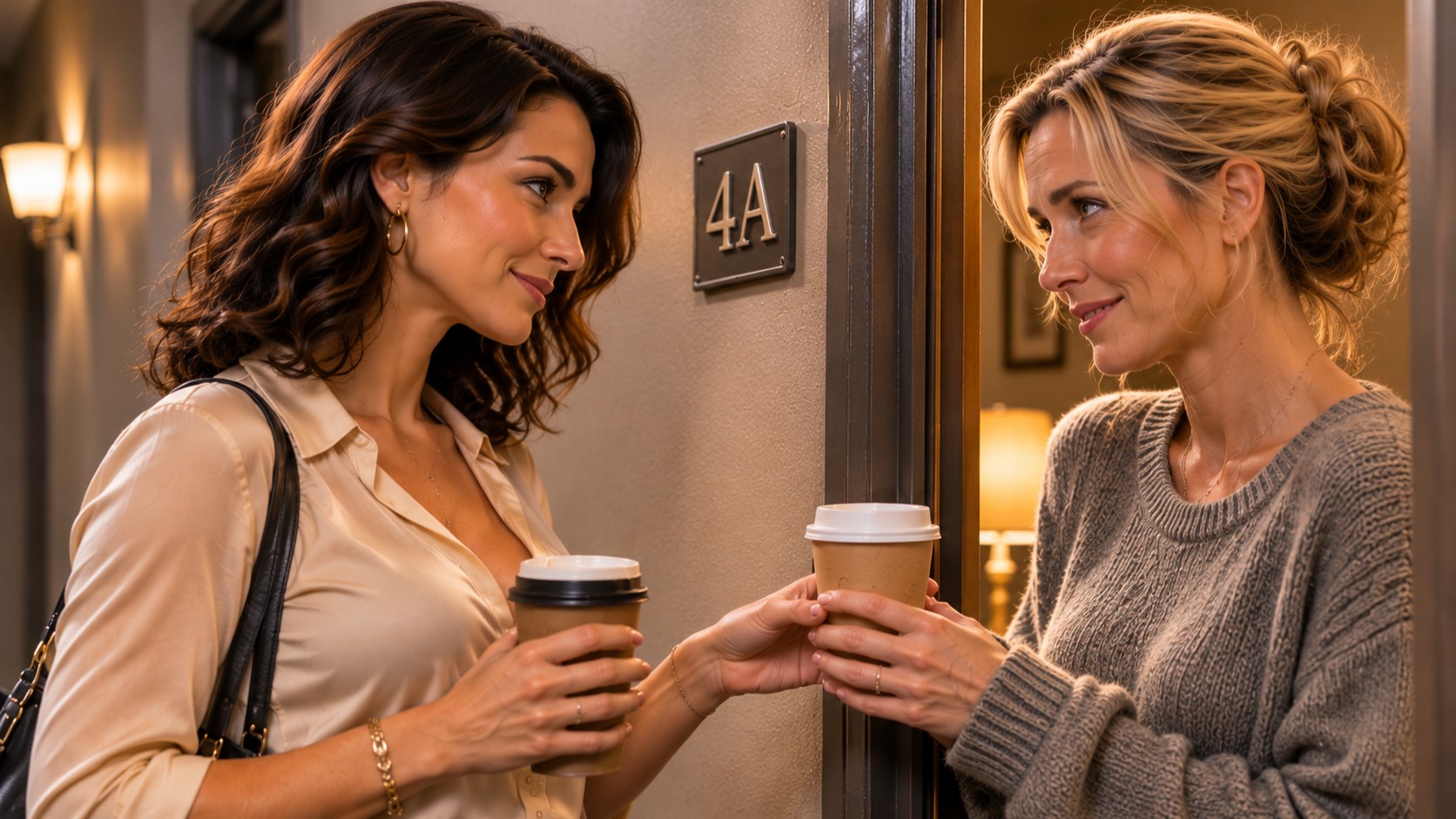
Aiko and Keiko sharing breakfast after one of Aiko’s night shifts.
They had met several years earlier.
To neighbors, they were simply two women sharing expenses.
That explanation required very little imagination in postwar Okinawa. Housing was scarce, wages were low, and women frequently shared rooms.
The truth was equally simple.
They loved each other.
Their home consisted of one main room, a tiny cooking area, a low table, two futons, a few dishes and whatever possessions they had managed to gather.
There was nothing glamorous about it.
To Aiko, it was the most valuable place in the world.
Keiko worked during the day. Aiko increasingly worked at night.
Their lives met in the morning.
That became their ritual.
Keiko would wake early, prepare rice, tea and whatever else they could afford. Sometimes there was egg. Sometimes pickled vegetables. On better mornings there might be fish.
Then she would listen for Aiko coming home.
Some mornings she heard the bicycle before she heard the door.
That moment eventually became the emotional center of 朝焼けまで待てない.
The song is ostensibly about nightlife, but almost every nightclub image points toward home.
The lipstick is temporary.
The borrowed dress is temporary.
The English jokes are temporary.
Even the smile is temporary.
The morning is real.
Aiko and Keiko sharing breakfast after one of Aiko’s night shifts.
By 1952, Aiko was working regularly in a club near Koza.
Her job existed somewhere between hostess, drinking companion, dancer and entertainer.
The exact arrangements changed depending on the customer and the evening.
Women working around the military districts occupied many different positions, and the distinctions could be deliberately vague. Some simply encouraged men to buy drinks. Some danced. Some accompanied customers elsewhere. Some relied on private arrangements to make enough money.
Aiko learned quickly that the easiest way to survive was to treat the night as a performance.
Red lipstick.
A flower in her hair.
A bright dress.
“Hello!”
“Good evening!”
“You dance?”
A laugh at the right moment.
A hand on somebody's shoulder.
A compliment she had already used three times that evening.
The soldiers often believed that Aiko enjoyed their attention more than she actually did.
She did not resent them.
Most were young men far from home themselves.
Some were polite. Some were funny. Some were lonely. Some were foolish. Some drank too much.
But they belonged to the night.
Keiko belonged to everything after it.
That distinction appears in one of the most revealing lines of the song:
Watashi no sumairu wa hanbun dake
Nokori hanbun shimatte aru no
Anata ni miseru asa no tame
Only half of my smile is here.
I keep the other half tucked away,
for the morning when I can show it to you.
That was not sadness.
It was compartmentalization.
Aiko knew exactly which part of herself she was selling.
She also knew which part was not for sale.
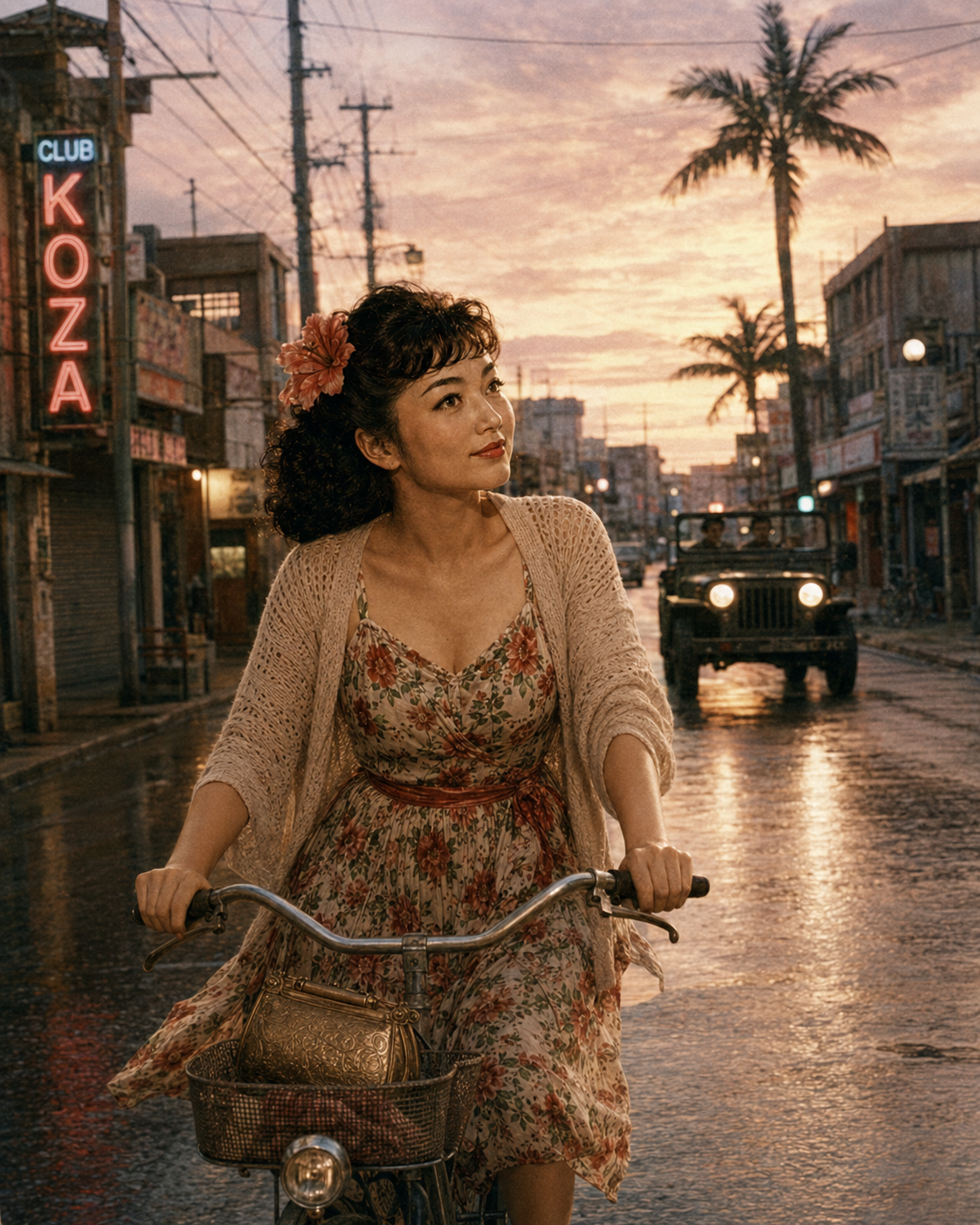
Riding home through Koza at dawn, as the nightlife district begins to close.
The best part of Aiko's night began when everybody else's ended.
The musicians packed their instruments.
Glasses disappeared from tables.
The last jeeps rolled away.
Neon signs were switched off one by one.
Aiko would wash away most of her makeup, tie her hair differently, pull a cardigan over her dress and count the money in her handbag.
Some nights were good.
Some were disappointing.
A good night meant rice for several days.
A very good night meant rent without anxiety.
On those mornings, Aiko felt almost triumphant.
She rode home while Koza changed around her.
At four in the morning it belonged to soldiers, bartenders and musicians.
At six it belonged to delivery bicycles, shopkeepers and women sweeping the pavement.
She preferred six.
The title, 朝焼けまで待てない, literally expresses that impatience.
She cannot wait for the morning glow because dawn means that the performance is finished.
She can go home.
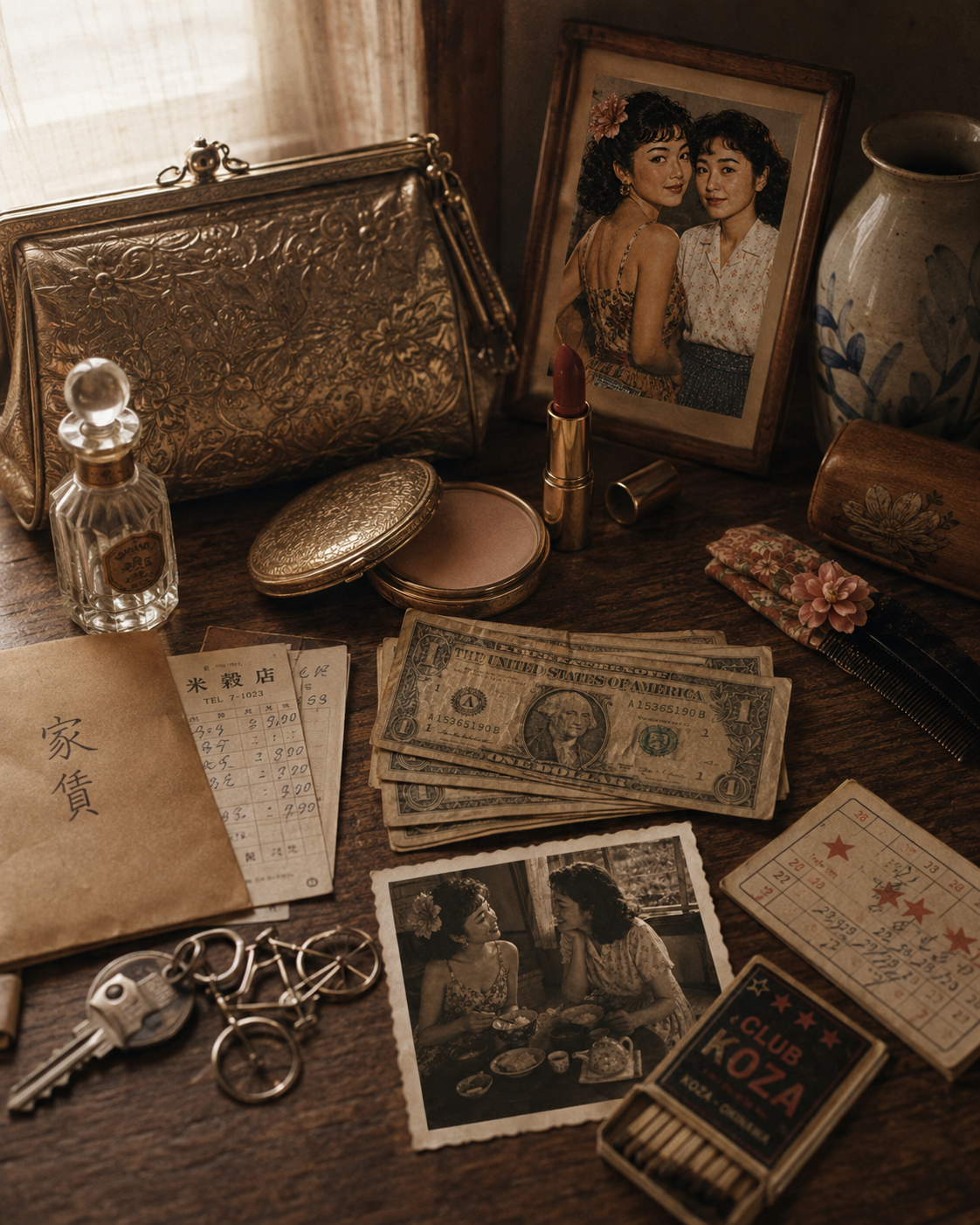
Aiko’s personal effects: handbag, lipstick, rent money, bicycle key, and a photograph of the couple.
Money appears several times in the song, but never as greed.
It is almost domestic.
The dollars in Aiko's handbag become groceries.
They become rent.
They become the possibility of continuing the same life for another month.
This mattered because Aiko and Keiko possessed very little security beyond what they could create themselves.
There was no public language available for what they were to one another.
No marriage.
No official recognition.
No easy explanation.
Their relationship existed in ordinary things.
A second bowl placed on the table.
Two futons folded against the wall.
A blouse borrowed without asking.
A bicycle key left beside the door.
A woman waiting for another woman to come home.
That is why the line about rent is perhaps more romantic than it initially sounds:
Kyō no yachin mo haraeru shi
Futari no kurashi wa tsuzuku no yo
I can pay the rent today too.
Our life together can continue.
For Aiko, love was not abstract.
Love was making sure there would still be a room for both of them next month.
[IMAGE 6 — FINAL MORNING: A quiet photograph-like scene of Aiko and Keiko together after breakfast, sunlight entering the room, Aiko finally relaxed after the night shift.]
There was another small ritual.
Before sleeping, Aiko would empty her handbag.
Lipstick.
Compact.
A few coins.
Crumpled bills.
Sometimes a matchbook from the club.
Sometimes a scrap of paper with English words she wanted to remember.
Keiko would occasionally tease her about the glamorous woman she became at night.
Aiko would answer that the glamorous woman paid the rent.
Then she would remove the flower from her hair.
That gesture might be the simplest way to understand 朝焼けまで待てない.
The woman in the club and the woman eating breakfast are not different people.
But only one of them is completely hers.
The song remains upbeat because Aiko does not view herself as defeated.
Her circumstances are complicated, and her work demands things from her, but she has something waiting beyond it.
Every night ends.
Every sunrise brings her bicycle back down the same road.
Every morning Keiko is there.
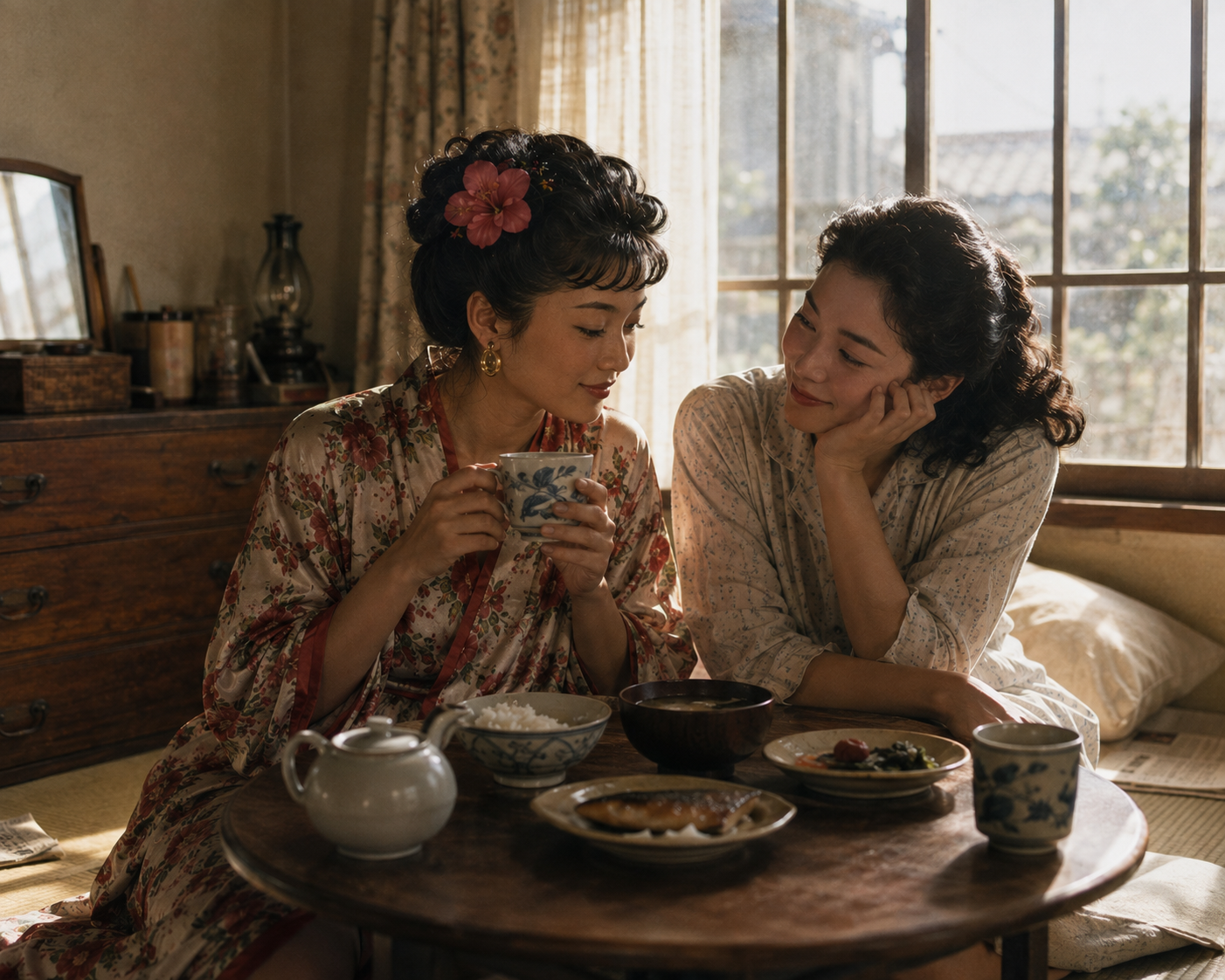
A quiet morning at home with Keiko, after the night’s work is finished.
And after an entire night of saying whatever strangers want to hear, the most important words Aiko hears are also the simplest:
“Okaerinasai.”
Welcome home.
That is the real story behind 朝焼けまで待てない.
Listen to the song here: 朝焼けまで待てない
Literal English Translation
Below is a literal translation of the song rather than a singable English adaptation.
Pa-para, pa-para, trumpet
Play it with a quick cha-cha sound, and night comes
Koza’s neon lights wink
Tonight too, work begins
Red lipstick and white shoes
The borrowed dress fluttering
Every time the lights of a jeep pass by
I wave my hand, saying “hello, hello”
Putting dollar bills into my bag
If I smile and dance, the night passes
But every time I look at the clock
Your face comes to mind
I can’t wait until the morning glow
I want to go back to where you are
Coral wind, please blow
Hurry me along the road at dawn
I can’t wait until the morning glow
In the little room, you are there
Because I was able to buy today’s rice too
I can smile and say, “I’m home”
Swaying my shoulders to the jazz rhythm
Making one joke mixed with English
Making an unfamiliar soldier laugh
The ice in the glass makes a clinking sound
Even when I’m told, “Baby, smile”
Only half of my smile is here
I keep the other half tucked away
For the morning when I will show it to you
I can’t wait until the morning glow
I want to go back to where you are
Passing the rows of banyan trees
I want to pedal my bicycle home
I can’t wait until the morning glow
Because I want to see your sleeping face
I can pay the rent today too
Our life together can continue
Tooruru, tooruru, the saxophone plays
It is about time for the stars to sleep too
When I see off the last jeep
My night is already over
Removing the perfume and wiping away the lipstick
I tie up my hair and go outside
When the morning wind blows from the sea
I return to the real me
I can’t wait until the morning glow
I want to go back to where you are
My pockets full of today’s dreams
Both hands full of love for you
I can’t wait until the morning glow
Even the eastern sky is peach-colored
When I open the front door, I hear your voice
Your “welcome home” is my treasure
Pa-para, pa-para, morning comes
Goodbye to last night
Tonight too, I will surely work
But in the morning, I return to you
Cha-cha, cha-cha
The sun sparkles
Breakfast that I eat with you
That is my
Happiness
Writing one? Publish your story on the BudgetPixel blog.





 @EternaSky

 @charlypalermo

 @CaylaCatz

 @crabmouse

 @DavidP

Comments (1)
beautiful and relaxing atmosphere.
Sign in to join the conversation.