
The Female Pasha of Cairo
 @germancowboy
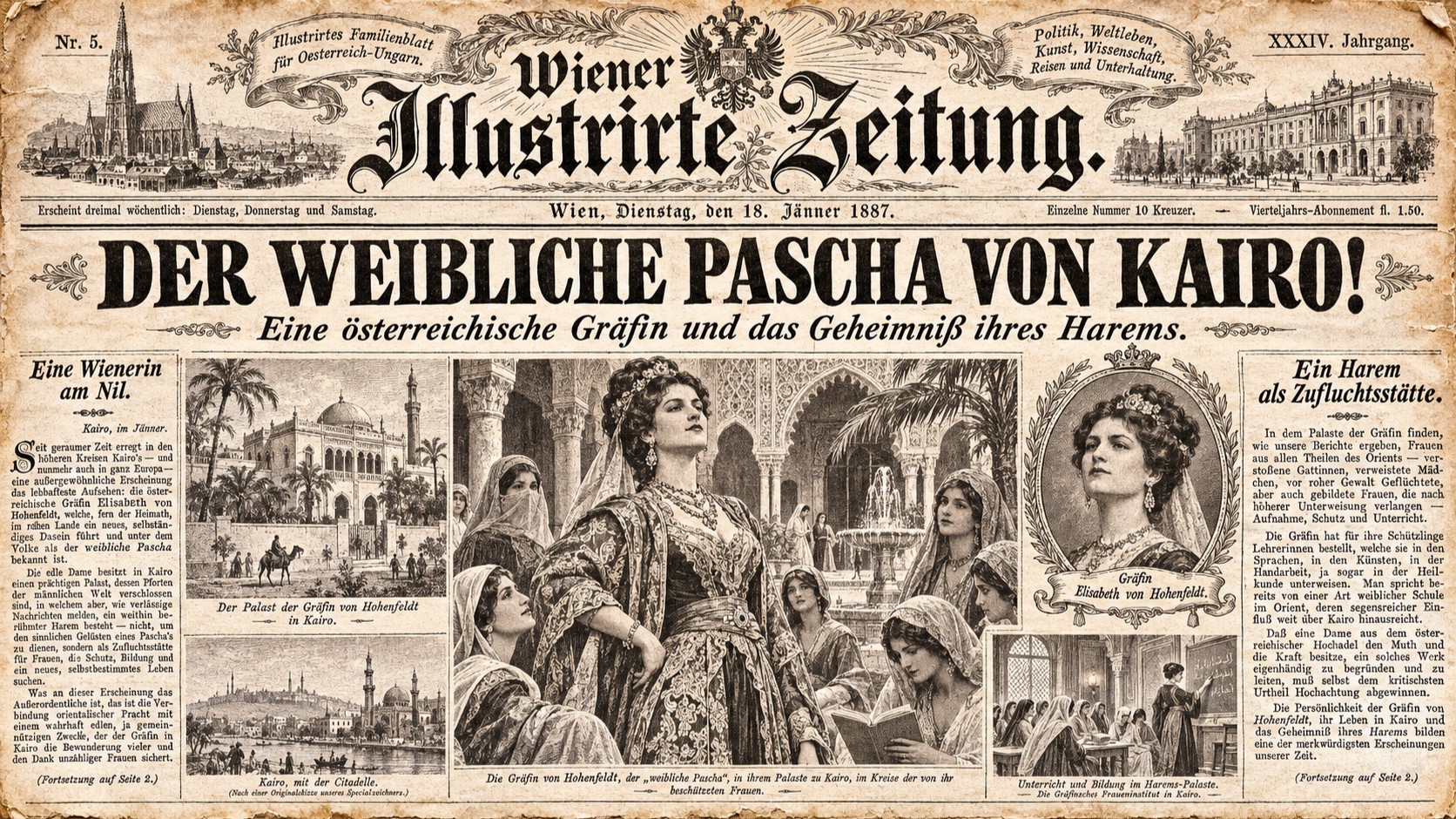
THE EXTRAORDINARY LIFE OF GRÄFIN ELISABETH VON HOHENFELDT · JANUARY 18, 1887
DER WEIBLICHE PASCHA VON KAIRO!
Eine österreichische Gräfin und das Geheimniß ihres Harems
THE FEMALE PASHA OF CAIRO!
An Austrian Countess, Forty-Seven Women, and the Extraordinary Secret Behind the Gates of a Cairo Palace — A Scandal That Has Astonished Two Continents.
VIENNA, January 18, 1887. — Few stories reaching the European capitals from the Orient have occasioned such lively speculation as the remarkable affair of Gräfin Elisabeth von Hohenfeldt, an Austrian lady of distinguished birth who has established herself in Cairo under circumstances so extraordinary that the inhabitants of that ancient city have bestowed upon her the singular appellation of the Female Pasha.
For nearly nine years, the Countess has occupied a magnificent residence overlooking the Nile, surrounded by high walls, guarded entrances, and extensive gardens.
Within these walls resides an establishment of forty-seven women of various nationalities, whose presence has given rise to the most extravagant rumors.
Some have described the residence as a private harem maintained in defiance of European convention. Others have suggested that the Countess exercises an influence extending far beyond the boundaries of her estate.
The truth, as recently revealed following an extraordinary dispute with a wealthy merchant, is more remarkable than any of these conjectures.
For the supposed harem is, in reality, a sanctuary in which dozens of women have found protection, education, employment, and freedom.
And the Austrian lady who governs this extraordinary establishment has accomplished her work while successfully concealing its true purpose from much of Cairo society.
A lady of uncommon accomplishments
Gräfin Elisabeth von Hohenfeldt was born in Vienna in 1842, the daughter of Count Friedrich von Hohenfeldt, a diplomat attached to the Austrian service.
Her childhood was divided between Vienna, Constantinople, and several European capitals, an upbringing which afforded her opportunities of education rarely enjoyed by young ladies of her station.
She acquired an excellent command of French, Italian, and English, subsequently adding Turkish and Arabic to her accomplishments.
Her interests extended to history, law, mathematics, and the administration of estates.
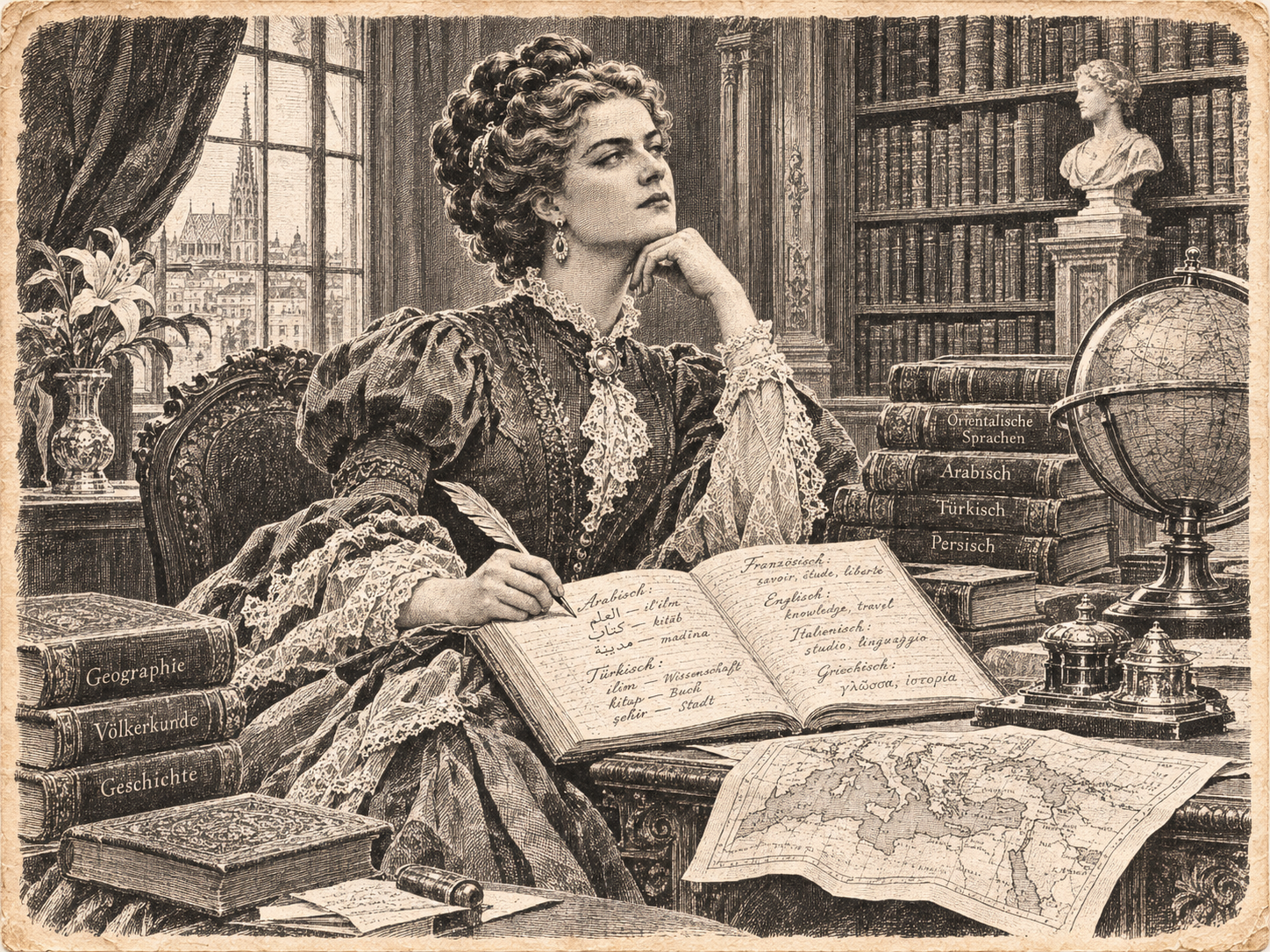
The young Gräfin Elisabeth von Hohenfeldt at her studies in Vienna, where she acquired the languages and knowledge that would later prove indispensable in the Orient.
By her twenty-fifth year she had traveled extensively throughout the Ottoman dominions and developed a familiarity with their customs which astonished even experienced diplomats.
Contemporary acquaintances describe her as a striking woman, possessing considerable beauty, a commanding presence, and an independence of character which did not invariably endear her to the more conventional members of Viennese society.
She never married.
A substantial inheritance following the death of her father in 1872 placed her in possession of considerable independent means.
In 1877, at the age of thirty-five, she traveled to Egypt, ostensibly for reasons of health.
She has remained there ever since.
The woman who changed everything
It was shortly after her arrival in Cairo that the Countess made the acquaintance of a young Circassian woman named Safiye, whose circumstances were to alter the entire direction of her life.
Safiye, then twenty-three, had spent much of her youth in an affluent household, where she had received an excellent education but possessed little control over her own future.
Her situation had become increasingly precarious following the death of her former protector.
The Countess first encountered her through a mutual acquaintance.
What passed between the two women during their earliest meetings has never been fully disclosed.
It is known, however, that Elisabeth assisted Safiye in obtaining her legal freedom and subsequently offered her employment as a companion and interpreter.
The arrangement, originally intended to be temporary, developed into a partnership of unusual permanence.
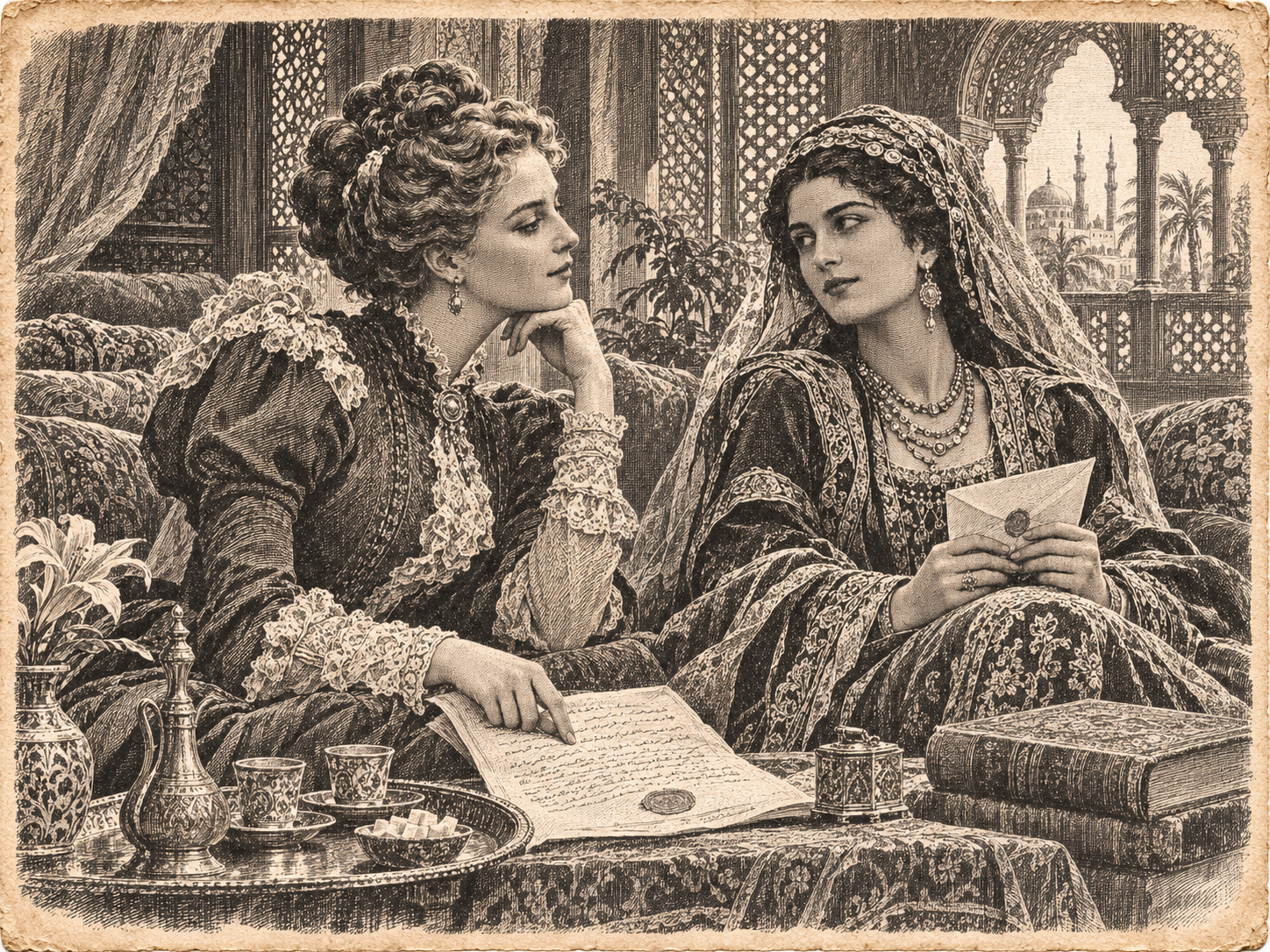
The Austrian Countess and Safiye Hanım, whose remarkable friendship was to inspire the establishment of a sanctuary for women in Cairo.
Safiye, who possessed a remarkable aptitude for languages and commercial affairs, soon became indispensable to the Countess.
When Elisabeth acquired her Cairo residence in 1878, it was Safiye who supervised much of the household's establishment.
And it was Safiye who first suggested that their home might provide shelter for other women in desperate circumstances.
"One woman cannot change the world," Elisabeth is reported to have observed.
"Then we must find several," Safiye replied.
The Countess has never forgotten the answer.
The palace behind the high walls
The residence subsequently acquired by Gräfin von Hohenfeldt was formerly the property of a wealthy official and contained all the appointments expected of an important Egyptian household.
Its spacious apartments overlooked shaded courtyards, ornamental fountains, and gardens planted with palms and flowering shrubs.
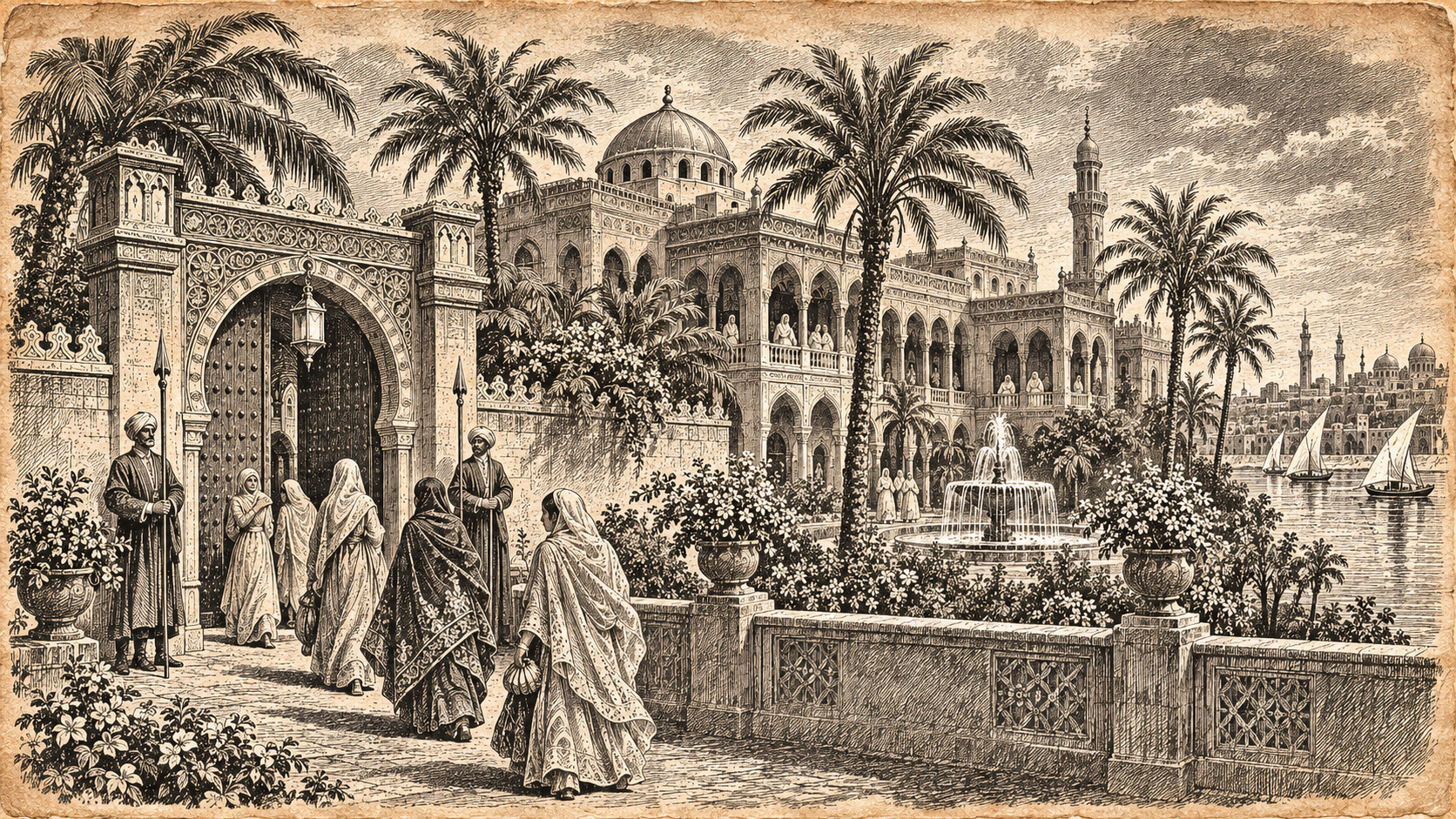
The magnificent Cairo residence of Gräfin Elisabeth von Hohenfeldt, whose secluded gardens and guarded gates concealed one of the most extraordinary establishments in Egypt.
A separate wing, originally intended for the women of the former owner's household, was particularly extensive.
The Countess preserved this arrangement.
Indeed, she enlarged it.
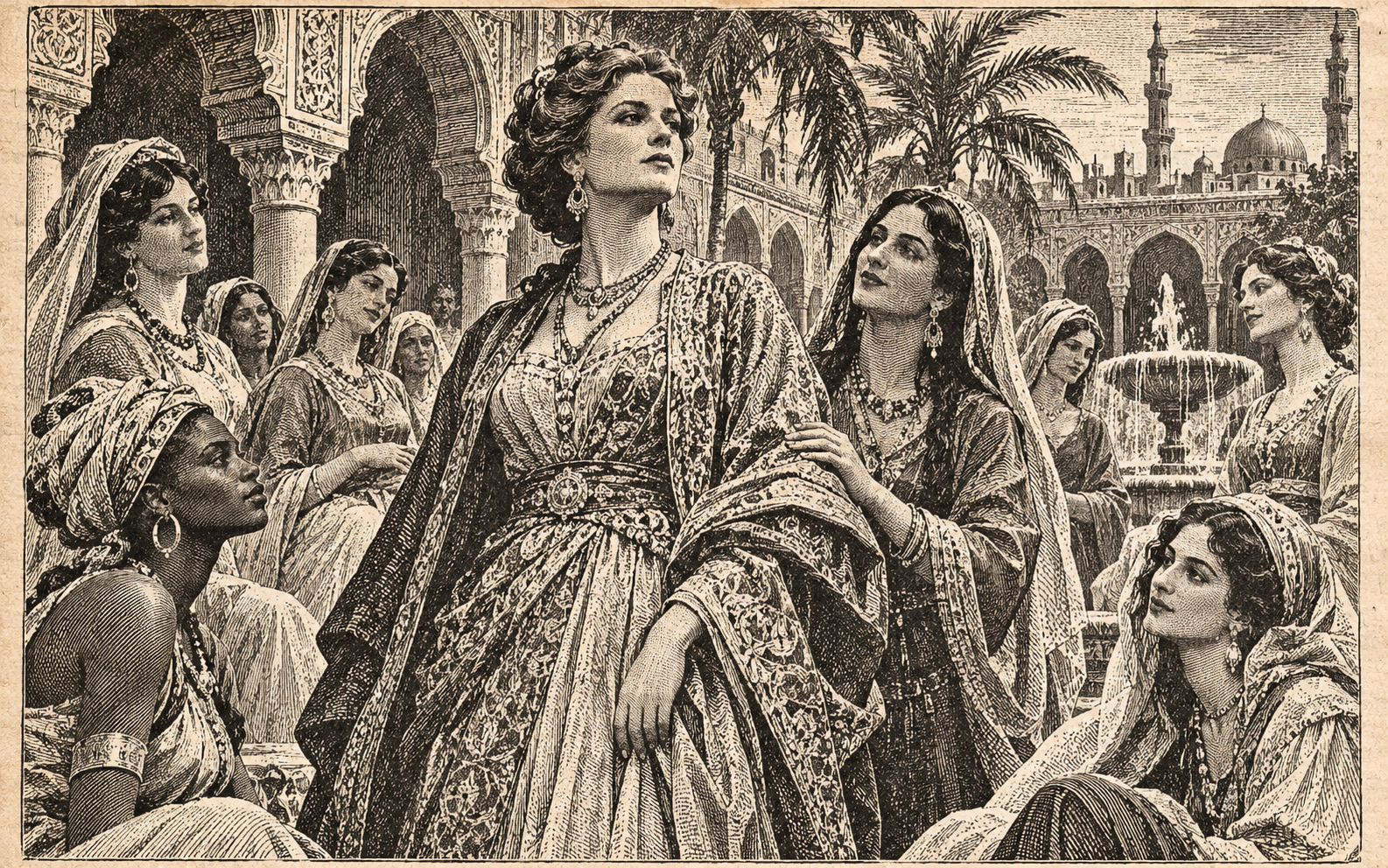
Gräfin von Hohenfeldt among the women of her household, an establishment whose true purpose remained concealed from much of Cairo society.
Additional rooms were furnished, a small infirmary established, and several chambers converted into classrooms and workshops.
In time, the establishment came to accommodate women from Egypt, Sudan, Ethiopia, the Caucasus, Greece, Armenia, and other parts of the Ottoman world.
Some had formerly been enslaved. Others had fled violent households or arrangements in which they feared they would be compelled to marry against their wishes.
Still others were widows or abandoned wives left without adequate means of support.
Those who arrived without legal proof of freedom were assisted in obtaining the appropriate documents through the authorities.
The Countess also employed advocates and intermediaries to negotiate settlements in difficult domestic cases.
Such activities were conducted with the greatest discretion.
The outside world saw only a wealthy European lady maintaining a secluded household of unusual dimensions.
And thus arose the rumors concerning her harem.
A harem without a master
Our correspondent, having obtained the privilege of visiting the residence, found little resemblance between its actual organization and the extravagant descriptions circulating in Cairo.
There were, certainly, richly furnished chambers, carpets, silken cushions, and women wearing the picturesque garments of several nations.
But there were also classrooms.
There were books, sewing machines, account ledgers, medicinal supplies, and workshops in which women practiced trades intended to secure their future independence.
In one apartment, a teacher instructed eight young women in reading and arithmetic.
In another, several women prepared embroidered articles for sale through merchants in Cairo and Alexandria.
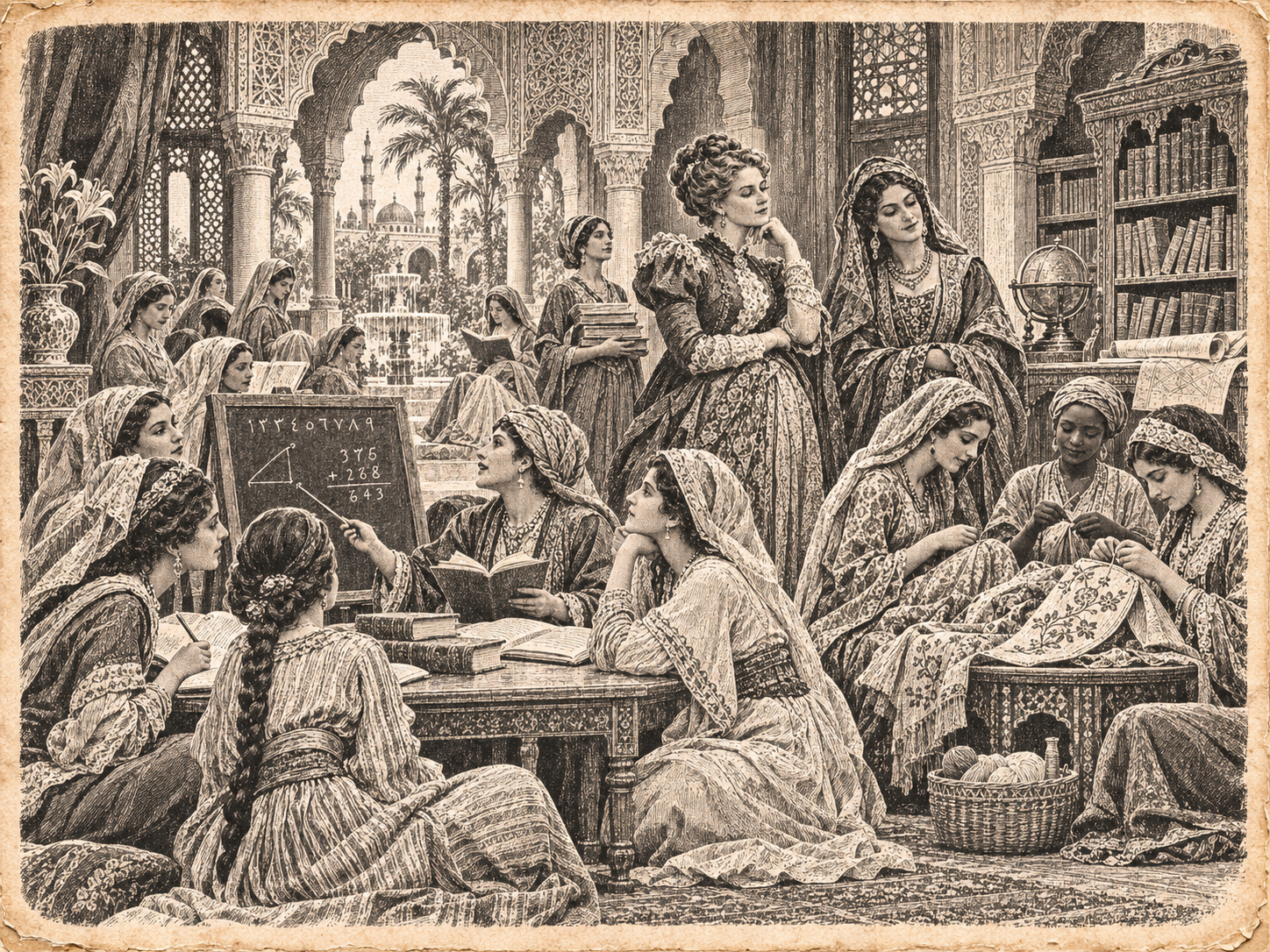
Within the supposed harem, women received instruction in reading, arithmetic, and practical trades intended to secure their independence.
A small dispensary provided assistance to residents and, on certain days, to women from neighboring households.
The establishment was neither a convent nor a charitable institution in the ordinary European sense.
Its residents received allowances or wages according to their circumstances and duties. Many were accumulating savings of their own.
Nor were they prisoners.
Women possessing independent means departed whenever they wished, while those requiring assistance received help in securing employment, lodging, or travel.
Several former residents had married, established businesses, or returned to relatives elsewhere.
Others preferred to remain.
"I have no wish to replace one master with another," the Countess explained. "A woman who must ask permission to be free has merely exchanged her prison."
The council of seven
Perhaps the most remarkable feature of the establishment is its government.
Although the Countess remains its principal benefactor and legal proprietor, its daily affairs are directed by a council of seven women.
Safiye presides over this body.
The remaining members are chosen from among the senior residents and are responsible for various departments of the household.
One supervises the finances, another the kitchens and stores, a third the schools, and another the arrangements necessary for admitting and protecting new arrivals.
The council meets twice weekly.
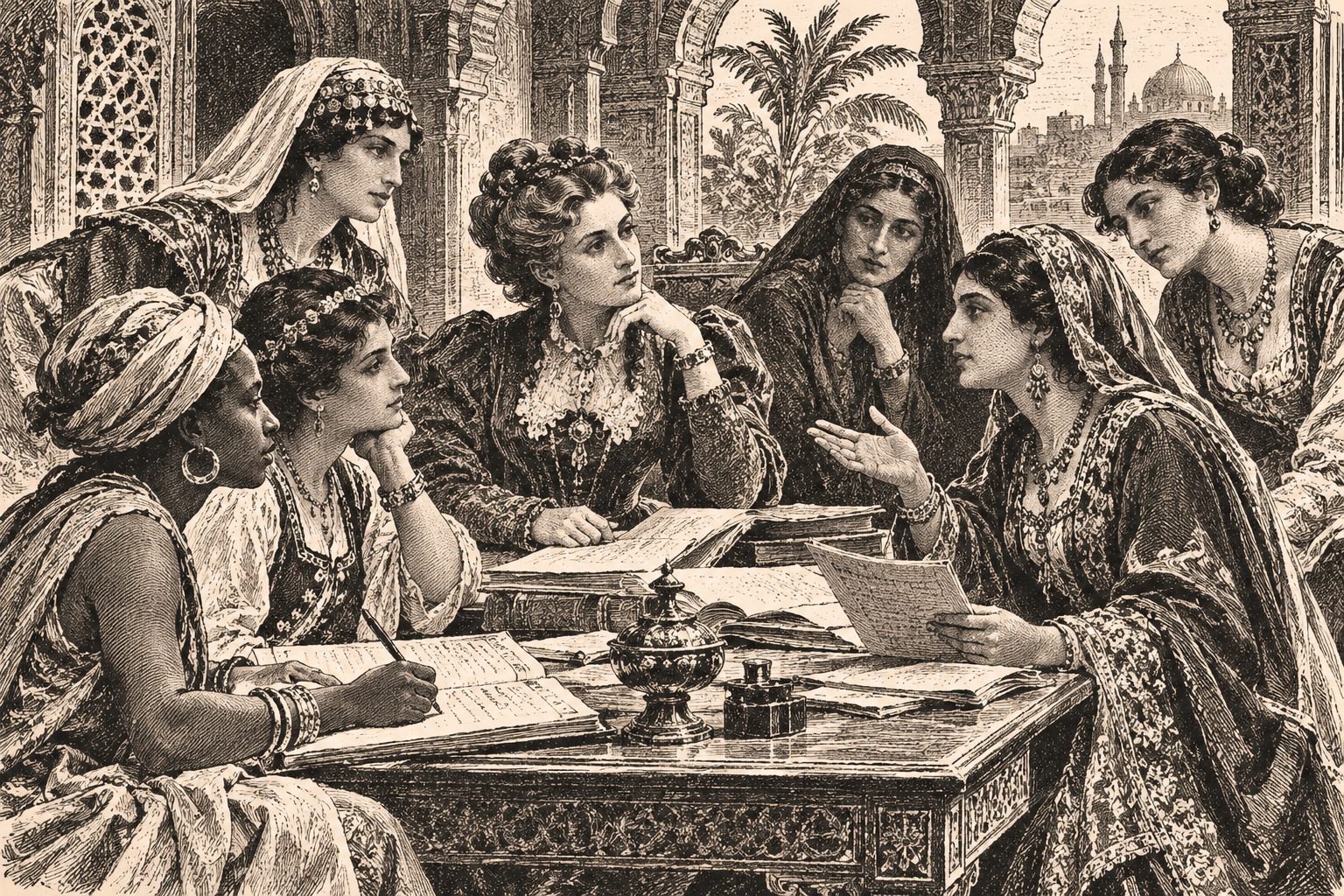
Safiye Hanım presiding over the Council of Seven, whose members directed the finances, education, and daily affairs of the Countess's extraordinary household.
During these gatherings the Countess herself occupies no more prominent place than the other participants, although her advice is naturally regarded with particular respect.
The financial accounts examined by our correspondent indicate a substantial expenditure upon food, clothing, medical attention, legal services, and instruction.
These expenses are supported partly by the Countess's private fortune and partly by the proceeds of the establishment's commercial activities.
The household employs men as gardeners, drivers, and guards, but none exercises authority over the women residing within.
It is this extraordinary arrangement which has given rise to the name Female Pasha.
The Countess herself professes to dislike the title.
Safiye, however, appears greatly amused by it.
"A Pasha commands men," she remarked. "Our lady has the greater difficulty. She must persuade women who are perfectly capable of disagreeing with her."
The night of the three carriages
The true purpose of the palace might have remained concealed for many years had it not been for the events of November last.
Shortly after midnight, three closed carriages arrived at the gates of the Countess's residence.
Within them were five women, accompanied by two female servants and an elderly gentleman who had assisted in arranging their escape.
Among the arrivals was a nineteen-year-old Egyptian woman named Nadia, whose proposed marriage to a considerably older merchant had become the subject of bitter disagreement.
Nadia maintained that she had refused the arrangement and feared violence if compelled to return.
The other women had grievances of varying character, including disputes involving employment, family obligations, and property.
The Countess admitted them.
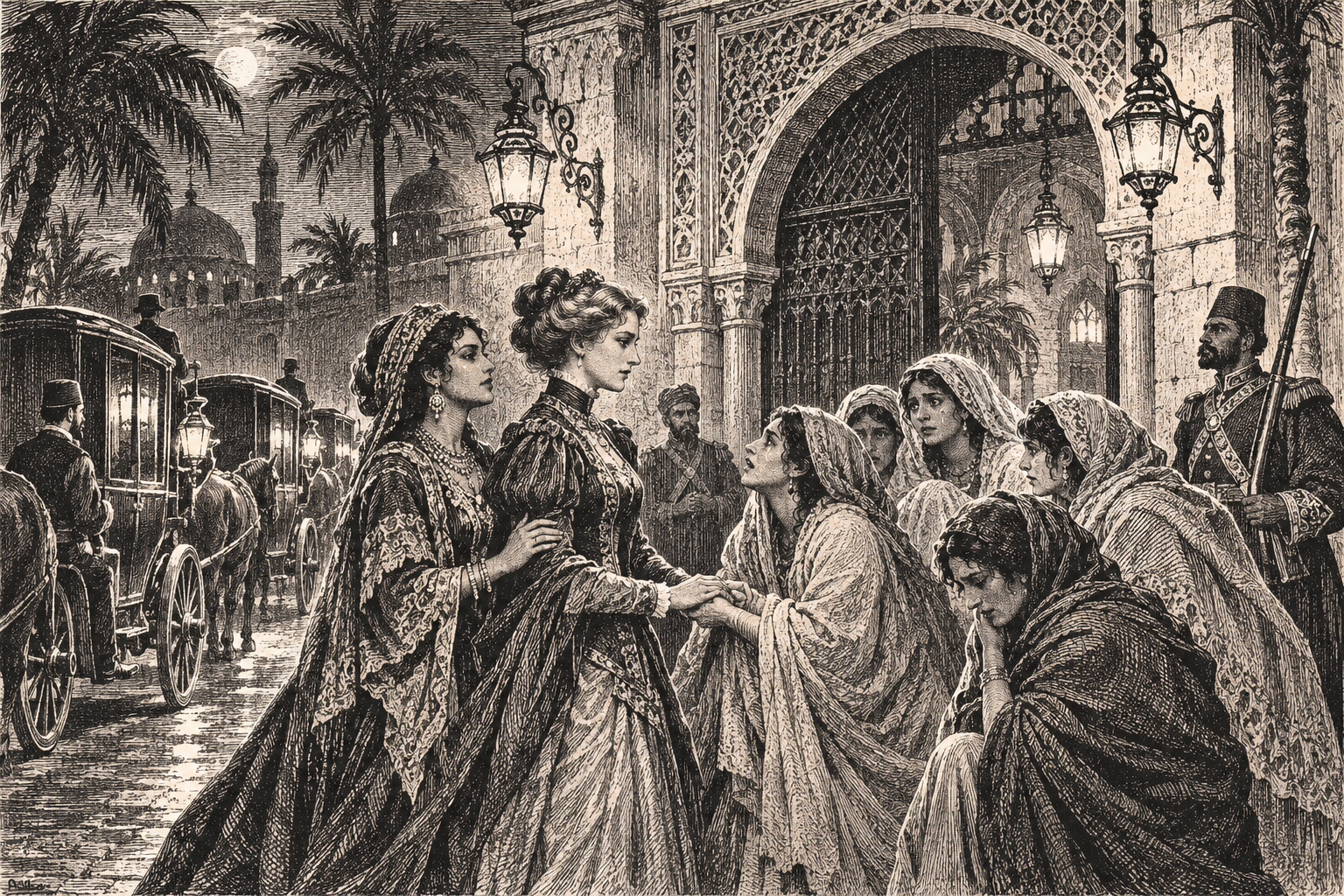
Under cover of darkness, five women seeking protection are welcomed into the palace by Gräfin von Hohenfeldt and Safiye Hanım.
Within forty-eight hours, a man claiming authority over Nadia appeared at the gates and demanded her immediate surrender.
His request was refused.
He returned accompanied by two associates and threatened proceedings against the Countess.
Again she refused.
When the matter was subsequently brought before the authorities, it became apparent that the merchant had little legal justification for the sweeping claims he asserted.
But by then the affair had attracted considerable attention.
It was alleged that the Austrian lady was harboring women against the wishes of their families, interfering in domestic arrangements, and encouraging resistance to established customs.
The Countess responded by declaring that no woman in her establishment was being forcibly detained and that any person asserting a lawful claim should present it before the appropriate authority.
She then produced an extensive collection of papers.
The forty-seven signatures
The documents included certificates of manumission, employment agreements, correspondence with advocates, records of financial assistance, and signed declarations from residents.
Most remarkable was a register containing the names of forty-seven women then living within the establishment.
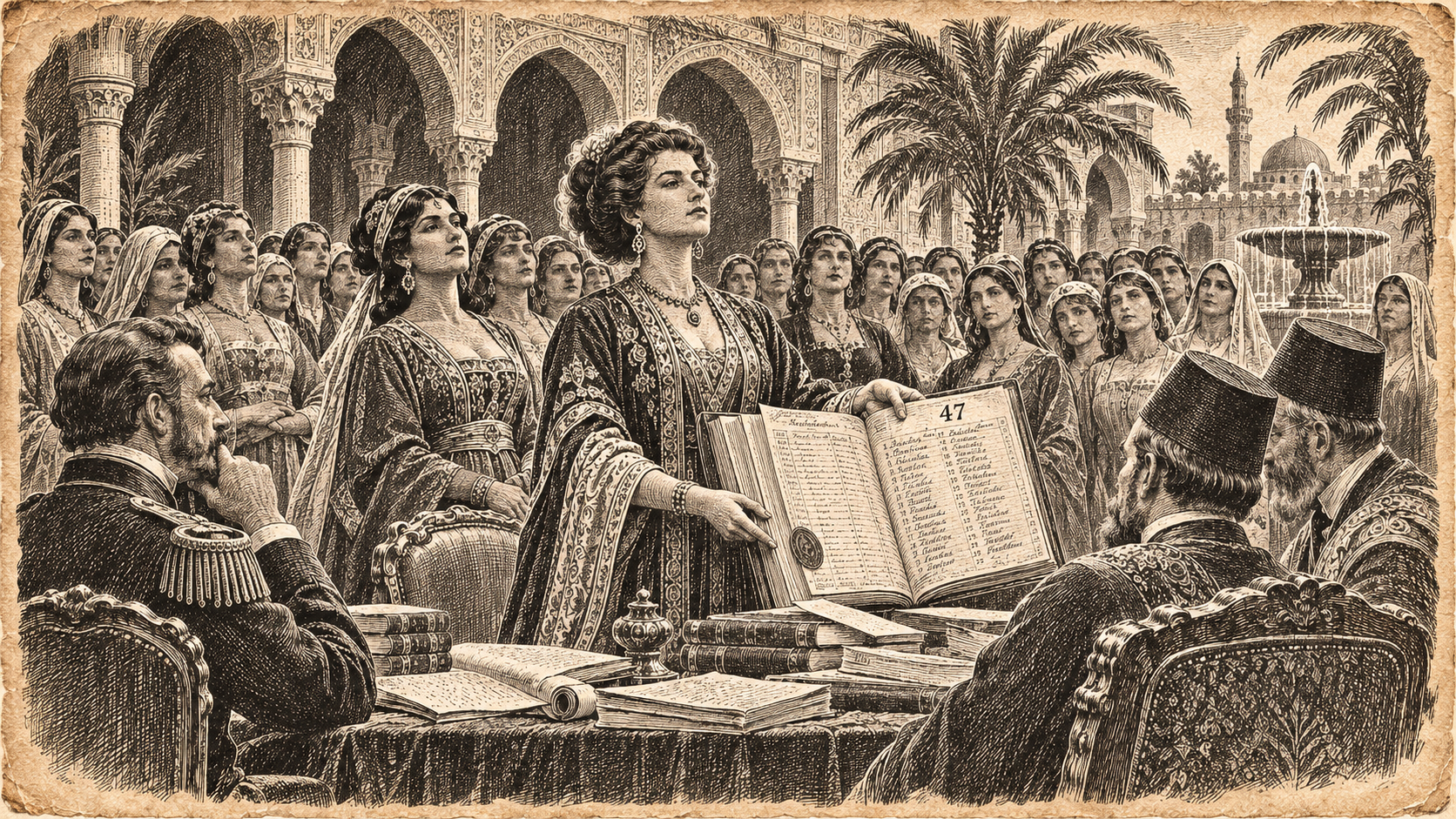
Gräfin von Hohenfeldt presents the register of forty-seven women to the investigating authorities, while the residents of her remarkable household stand united behind her.
Each had been interviewed regarding her circumstances.
Each had declared her wish to remain.
And each, according to the Countess, possessed the freedom to depart.
Some had signed the register themselves.
Others, being unable to write, had made a mark witnessed by persons familiar with their situation.
These papers were accompanied by an account of the establishment's activities extending over nearly nine years.
The documents indicated that more than eighty women had received assistance during that period.
Some had remained only weeks.
Others had resided there for several years.
Several had been reunited with relatives, while others had been established in independent employment.
The Countess refused to disclose the addresses of certain former residents, explaining that such information might expose them to renewed danger.
The investigating officials are understood to have found no sufficient grounds for the accusations concerning unlawful detention.
The dispute involving Nadia remains a matter of legal discussion, but the young woman has not been compelled to leave the palace.
The proceedings have consequently produced precisely the result the Countess had spent years attempting to avoid.
The secret of the Female Pasha is now known throughout Cairo.
An Austrian countess before the world
The revelations have caused considerable excitement in European circles.
Several charitable organizations have expressed interest in the Countess's work, while others have questioned whether a private individual should exercise such extensive influence in matters involving domestic disputes and the legal status of women.
The Countess rejects the suggestion that her establishment constitutes an attempt to impose European customs upon Egyptian society.
"Most of the women who direct this house were born in the East," she observed. "They understand its families, its languages, and its laws far better than I ever shall."
Indeed, much of the work appears to have been organized by Safiye and the other senior members of the household.
The Countess has supplied the means.
They have supplied the knowledge.
And together they have established an institution for which few parallels can be found.
The extraordinary attachment
No account of the Female Pasha would be complete without reference to the singular devotion existing between the Countess and Safiye Hanım.
For almost ten years the two women have been inseparable.
They occupy adjoining apartments overlooking the inner garden, dine together, travel together, and receive their closest acquaintances in a private salon from which most visitors are excluded.
The Countess entrusts Safiye with the keys to her private papers and has reportedly made substantial provisions for her in her testament.
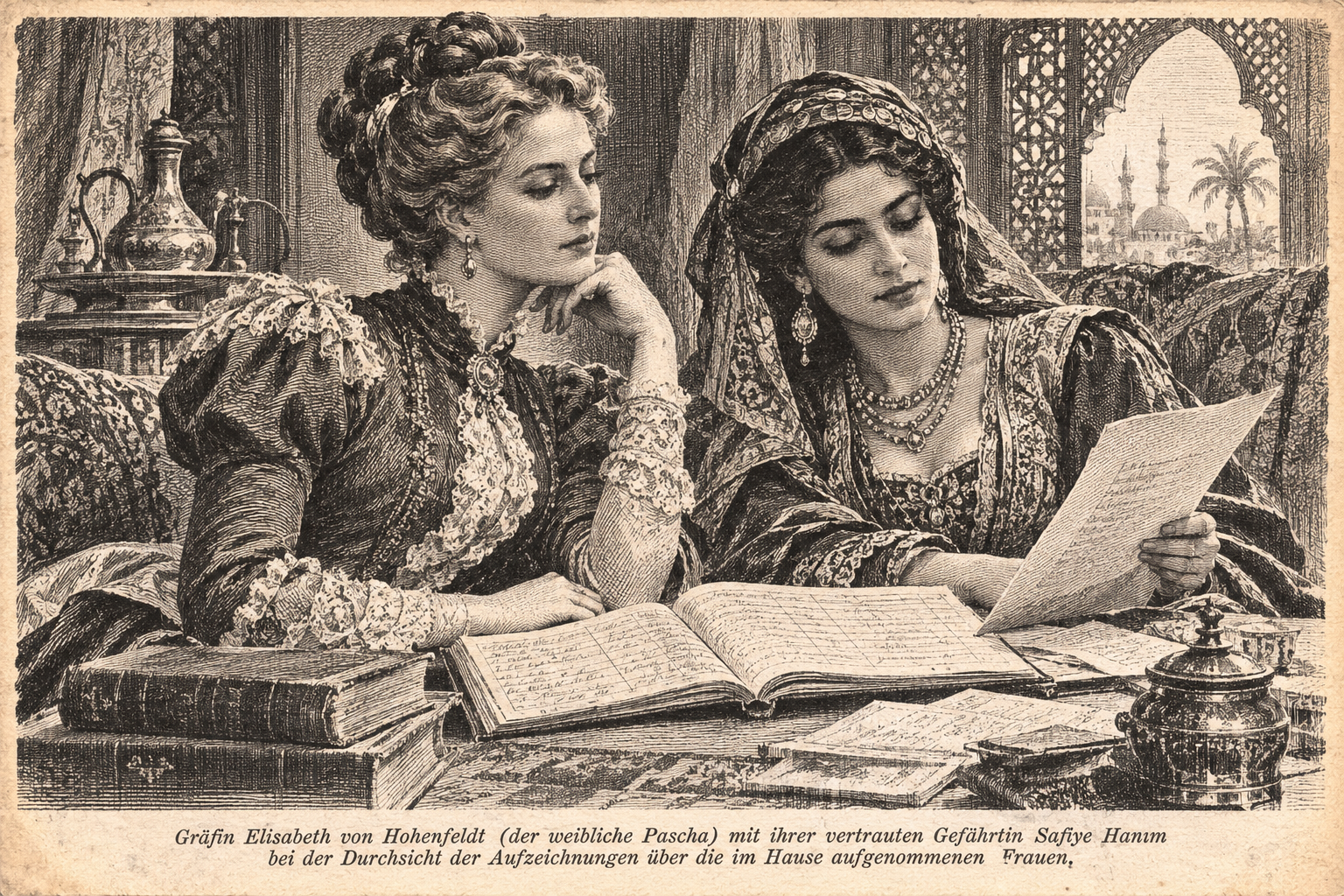
The Countess and her trusted companion Safiye Hanım reviewing the records of the women who had found refuge within their household.
When our correspondent ventured to ask why a woman of Elisabeth's considerable fortune and social position had never married, the Countess answered with some amusement.
"I have never found a gentleman whose company I preferred to that of the ladies already in my household."
Safiye, seated beside her, laughed.
The Countess then added:
"Besides, I have been fortunate enough to find someone who understands precisely what I wish to accomplish, even when I have not the slightest idea how it is to be done."
At this, Safiye placed her hand upon the Countess's.
Neither woman offered any further explanation.
The future of the palace
The attention now directed toward the establishment has produced unexpected consequences.
Several wealthy women of Cairo have offered financial assistance.
An Alexandrian merchant has undertaken to purchase articles produced by the workshops, while an Egyptian lady of distinguished family has proposed the establishment of a similar refuge under local administration.
The Countess is considering the acquisition of a second property in Alexandria.
She has also expressed the hope that a permanent fund may eventually secure the institution's existence beyond her lifetime.
But there are difficulties.
Not every rescued woman is easily reconciled with her family.
Not every legal proceeding ends favorably.
The maintenance of so large a household imposes considerable expense, and those who oppose the Countess's activities are unlikely to abandon their objections merely because the recent investigation has proved unsuccessful.
Nevertheless, she appears determined to continue.
A remarkable answer
Before departing, our correspondent was permitted to observe the Countess during her customary evening walk in the gardens.
The sun had descended behind the distant roofs of Cairo, and the fountains were beginning to catch the first light of the courtyard lamps.
Several women sat beneath the palms, conversing quietly.
Others crossed the garden carrying books or returning from the workshops.
A young woman approached the Countess and presented a letter received from her sister in Alexandria.
Elisabeth read it, smiled, and handed it to Safiye.
The two exchanged a few words in Turkish.
Then the Countess turned once more to our correspondent.
"Tell me, Gräfin," he asked, "what would you say to those gentlemen who insist that a household such as yours must have a master?"
She considered the question.
Then she looked toward the women gathered around the fountain.
"Let them believe there is one," she answered. "It seems to make them more comfortable."
"And who, Madame, is that master?"
The Countess smiled.
"Why, the women themselves, of course."
Safiye laughed so heartily that several of the others turned to inquire what had been said.
The Countess explained it to them in Arabic.
Within moments the entire courtyard was filled with laughter.
It was a most unusual conclusion to a most extraordinary interview.
And perhaps the best explanation of why the inhabitants of Cairo have bestowed upon this remarkable Austrian lady a title formerly reserved for the most powerful of men.
For behind the gates of the Female Pasha's palace, the women have discovered something more valuable than gold, jewels, or silks.
They have discovered the right to govern their own lives.
Editor's Note: This article is a work of historical fiction written in the style of an Austrian newspaper report from 1887. Gräfin Elisabeth von Hohenfeldt, Safiye Hanım, the palace, and the events described are fictional. The historical setting draws upon the social structure of nineteenth-century Egyptian households, the influence exercised by wealthy women, and the gradual suppression of slavery and the slave trade during this period.
Writing one? Publish your story on the BudgetPixel blog.






 @panos

 @archminalabib

 @EternaSky

 @Sealine

 @suga2309

 @crabmouse