
The New Woman in Gallery Three
 @germancowboy
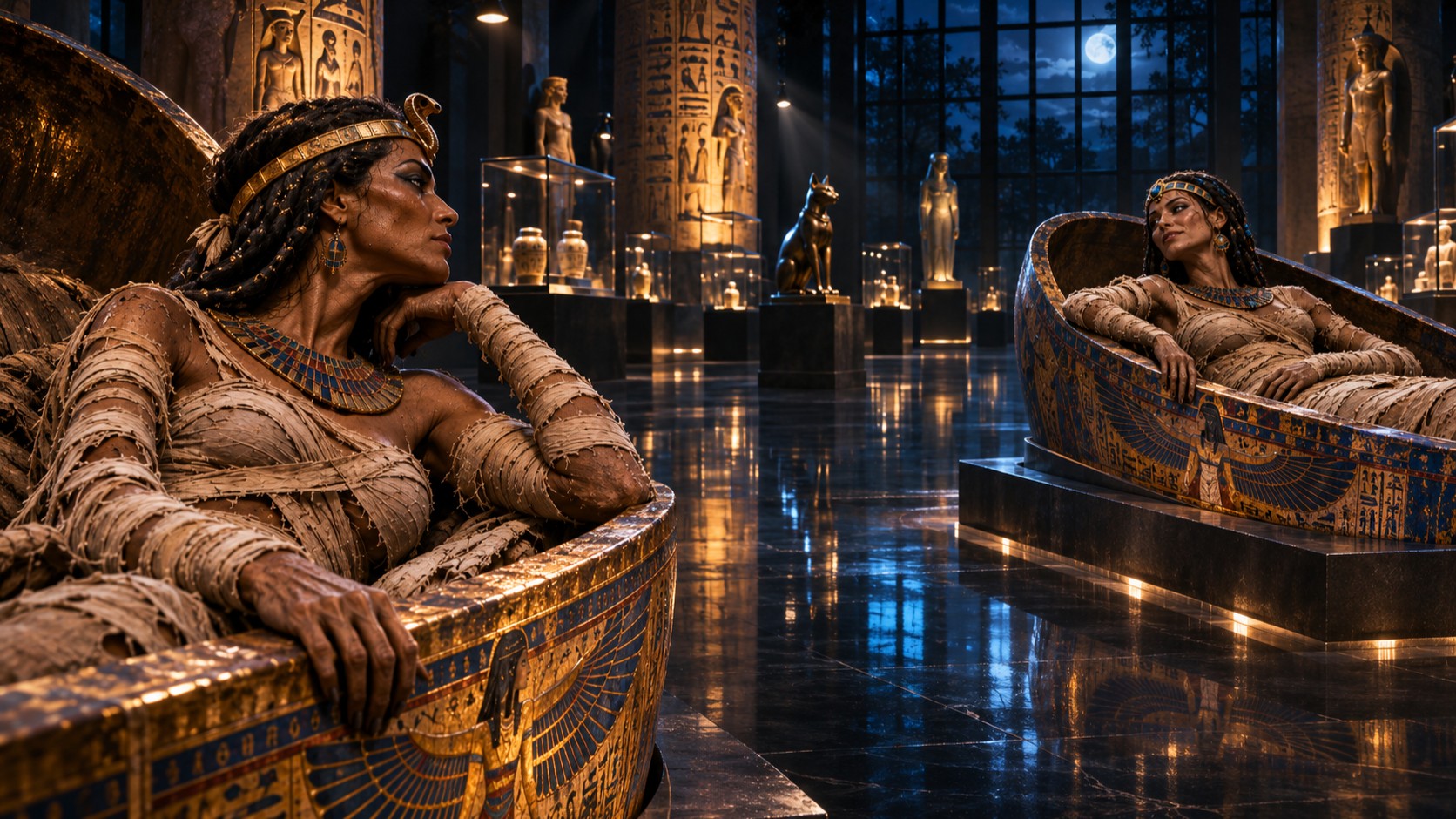
When the museum closed for the evening, silence settled over the Egyptian wing.
The last footsteps faded.
The lights dimmed to their nighttime glow.
And, as always, at precisely nine minutes past midnight, Lady Meret opened her eyes.
Not very far, of course.
One could only do so much after three thousand years of mummification.
Still, it was enough.
Enough to look out through the narrow opening where the conservators had left her coffin lid slightly ajar.
Enough to admire her familiar kingdom: Gallery Three, Egypt, New Kingdom to Late Period.
Meret had occupied the place of honor for seventy-two years.
Schoolchildren stared at her.
Tourists photographed her.
Docents spoke about her as though they knew her personally.
“High-status woman.”
“Beautifully decorated coffin.”
“Exceptionally preserved.”
Meret thought the last description rather flattering.
She had become accustomed to being the most important woman in the room.
Which was why she immediately disliked the large wooden crate rolled into the gallery on a Tuesday morning.
By noon, three conservators, two curators, and a very excited museum director were gathered around it.
Meret listened with increasing annoyance.
“Late Period.”
“Remarkable condition.”
“Female.”
“Possible noble birth.”
“New centerpiece for the special exhibition.”
New centerpiece?
Meret would have gasped if her lungs had still been functional.
By evening, the crate had been opened.
Inside lay a second sarcophagus, painted in deep blue and gold, elegant and unmistakably feminine.
Meret stared.
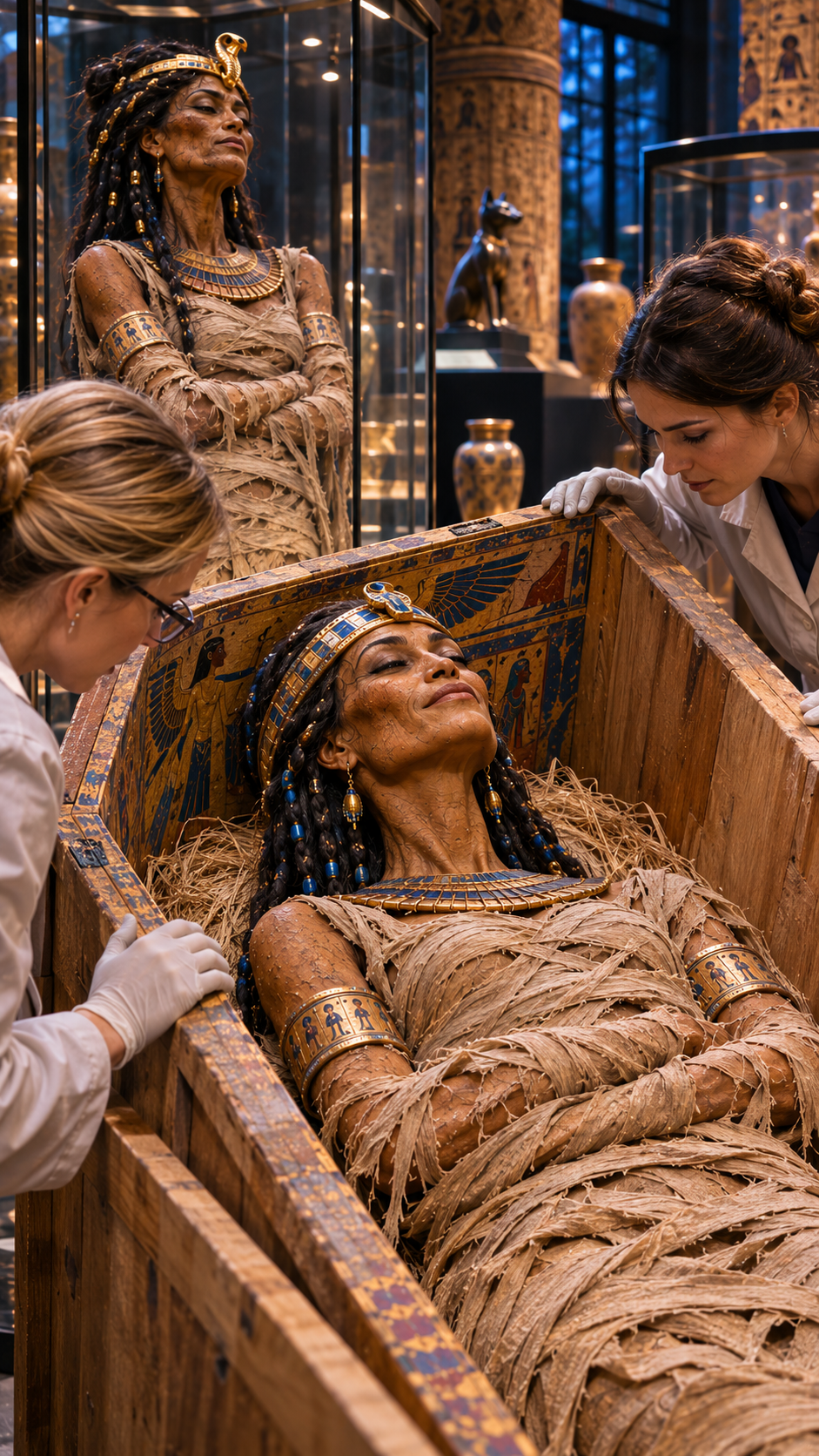
The newcomer’s face was younger than hers, with fine painted brows and the faintest hint of a smile.
Beautiful.
Infuriatingly beautiful.
The placard was installed before closing.
LADY TANOFRET
Recently acquired on long-term loan from a private collection
“A loan?” Meret muttered to herself after the last guard departed. “So she is not even staying.”
Then, at midnight, the newcomer opened her eyes.
Very slowly, her coffin lid shifted.
A dry little cough came from within.
“Well,” said a low, amused female voice, “this place is dreadful.”
Meret stiffened.
“You are in a museum.”
“Yes,” said the stranger. “That explains the lighting.”
Meret was silent for a moment.
Then she said coldly, “You are in my gallery.”
The newcomer turned her head as far as her wrappings allowed and peered across the dim room.
“Your gallery?”
“I have been here for decades.”
“How impressive.”
“It is.”
The other mummy gave a rustling little laugh.
“I am Tanofret.”
“Lady Meret.”
“Ah,” Tanofret replied. “You sound exactly like a woman who has had her own pedestal for too long.”
Tanofret proved unbearable.
Within three nights, she had insulted the museum’s climate control, the amateur quality of the explanatory panels, and Meret’s taste in funerary jewelry.
“The collar is overworked,” Tanofret observed.
“It is regal.”
“It is crowded.”
“At least I still have both earrings.”
Tanofret went very still.
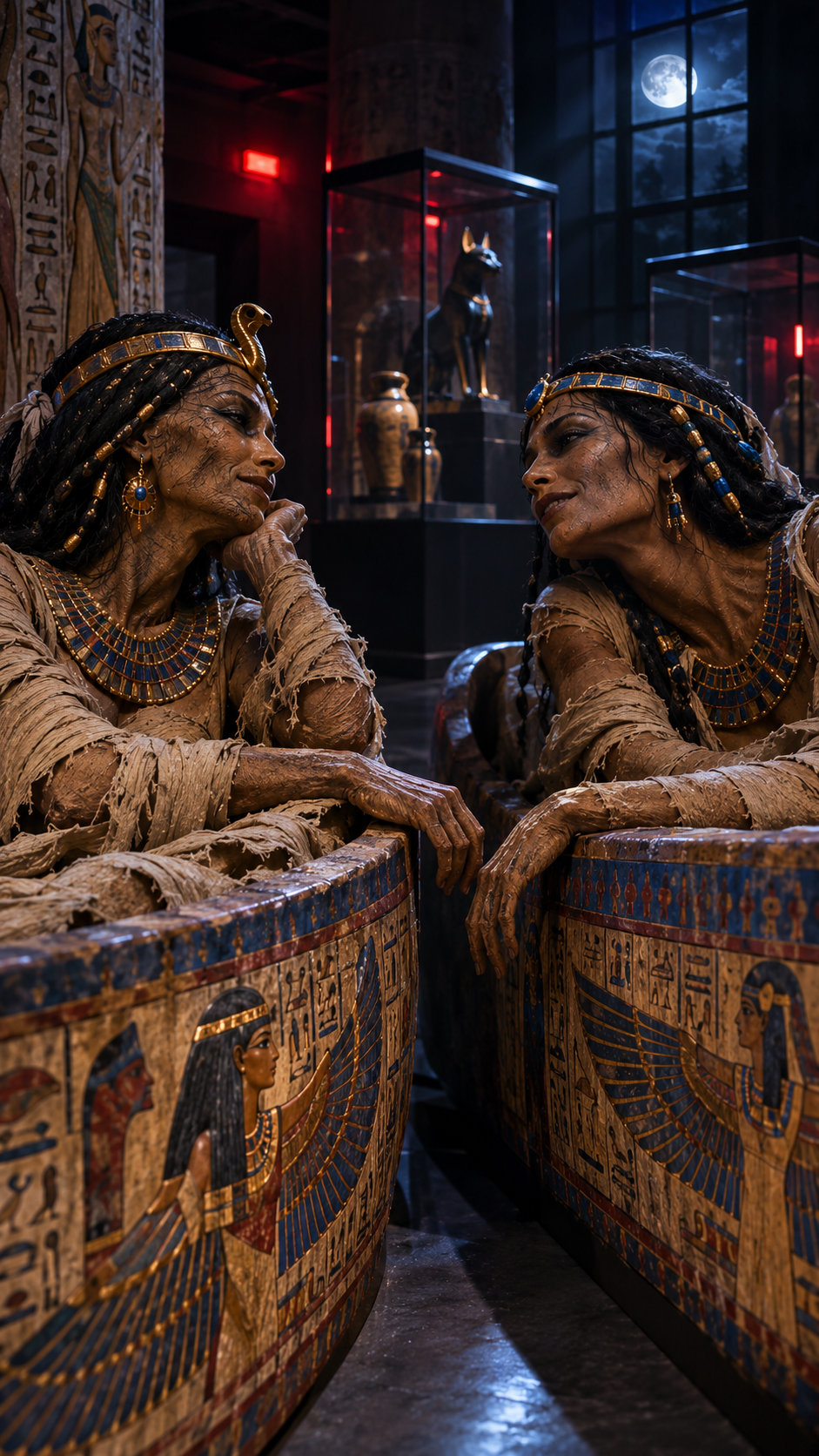
Meret realized, too late, that one of Tanofret’s earrings was indeed missing.
“Oh,” Meret said.
Tanofret looked away.
“That happened in 1894.”
“I see.”
“It was a clumsy Englishman.”
“How unfortunate.”
“It was murder,” Tanofret said darkly.
Meret tried, unsuccessfully, not to smile.
Their rivalry only worsened when the museum staff rearranged the gallery.
Tanofret was given the new central platform, dramatic spotlighting, and a freestanding explanatory panel.
Meret, who had previously occupied the visual center of the room, was moved three feet to the left.
Three feet.
“Exiled,” she whispered bitterly that night.
“Oh, do stop,” Tanofret said. “You can still see the entrance.”
“They moved me.”
“They shifted you.”
“They moved me.”
Tanofret’s linen-wrapped shoulders twitched.
Meret realized, with horror, that the woman was laughing.
“You are enjoying this.”
“A little.”
“You are insufferable.”
“And you,” Tanofret replied, “are vain.”
Meret drew herself up within her coffin as majestically as possible.
“I was buried with six alabaster jars, fourteen amulets, and an entire chest of cosmetics. I earned my vanity.”
“That,” said Tanofret, “is the most interesting thing you have said all week.”
On the sixth night, the power went out.
The entire museum fell into darkness.
Emergency lights glowed faint red in the hallway, but Gallery Three was left in near-blackness.
Meret disliked it immediately.
Not because she feared the dark.
She had spent millennia in tombs.
But museums had rules, order, reassuring rhythms.
Darkness meant uncertainty.
Somewhere in the room, Tanofret shifted.
“Meret?”
Meret blinked.
It was the first time the woman had used her name without irony.
“Yes?”
“I do not care for this.”
Meret hesitated.
“Neither do I.”
For a little while, neither spoke.
Rain lashed the skylights above.
Wind rattled something metallic in a distant gallery.
Then Tanofret said quietly, “When they first unwrapped my outer coffin, I thought I had been stolen by grave robbers.”
Meret turned her head.
“I thought much the same when I was excavated.”
Tanofret gave a small, humorless laugh.
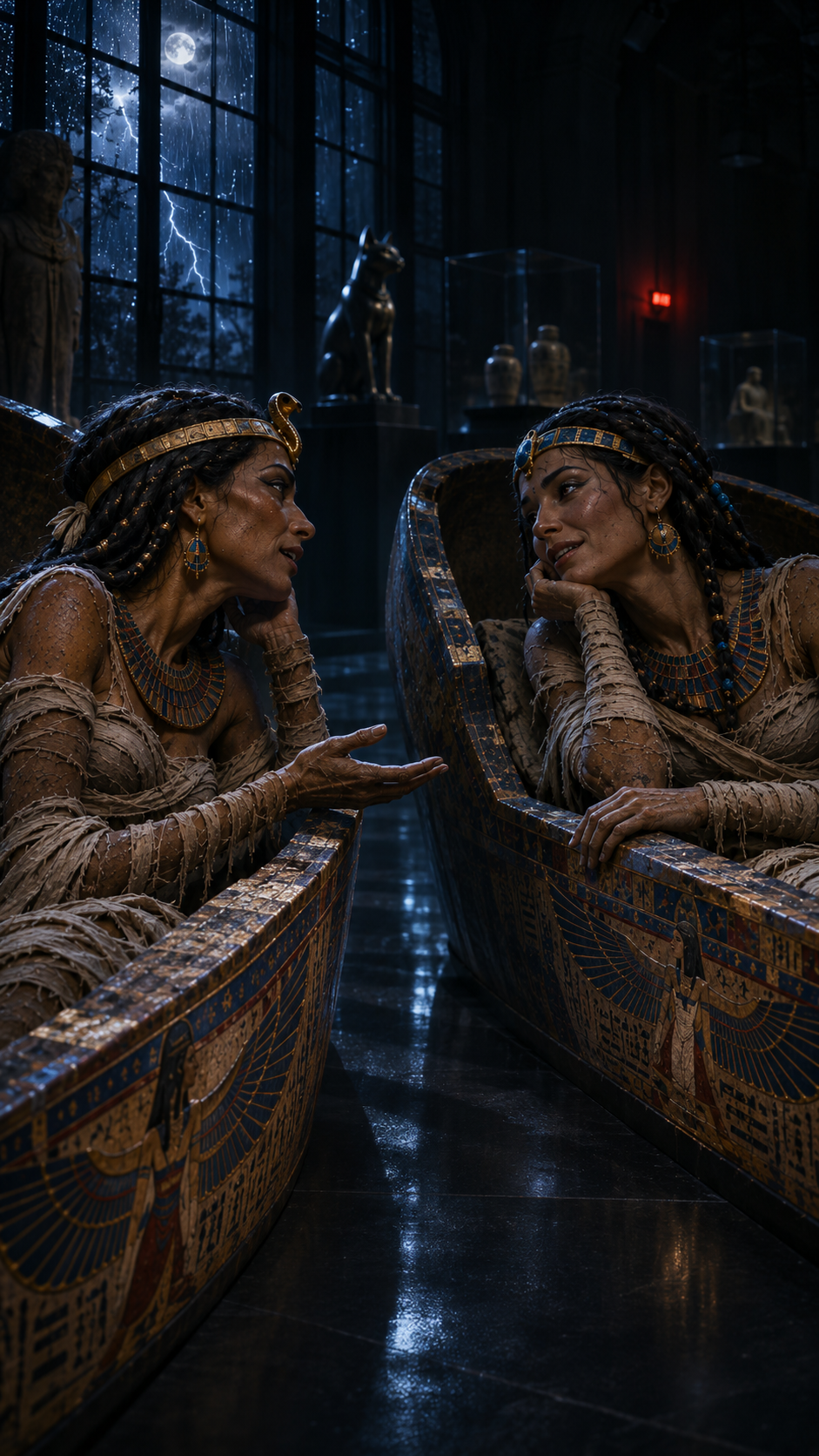
“It is strange, is it not?”
“What is?”
“That thousands of years can pass, empires can vanish, languages can die, and yet one can still feel... displaced.”
Meret was silent.
Then she answered more softly than before.
“Yes.”
The darkness between them no longer felt quite so large.
“Were you alone?” Tanofret asked after a moment.
“In life?”
“And after.”
Meret looked up at the black ceiling.
“Yes.”
“So was I.”
The storm went on above them.
At last Meret said, “You may speak, if you like.”
Tanofret turned toward her.
“About what?”
“Anything.”
There was a pause.
Then Tanofret said, “Very well. But if I am to suffer a modern museum, at least let me complain properly.”
Meret laughed.
A dry, papery sound, but unmistakably laughter.
And in the darkness of Gallery Three, two ancient women began talking.
Tanofret had been a temple singer.
Meret had managed an estate after her husband died.
Tanofret had adored music.
Meret had adored perfume, books, and expensive linen.
Tanofret had once loved a woman named Iset, who braided jasper beads into her hair beside the Nile.
Meret had loved a woman too — a sculptor’s daughter with strong hands and a reckless smile, long before Meret’s respectable marriage had been arranged.
“She carved little cats from scraps of limestone,” Meret said one night.
Tanofret looked at her with surprising gentleness.
“Did she love you?”
“Yes.”
“What happened?”
“My father preferred a politically useful husband.”
Tanofret’s eyes darkened.
“Men do ruin everything.”
Meret smiled.
“Most things.”
“And your husband?”
“He was tolerable.”
“Tolerable,” Tanofret repeated, appalled.
“It was considered a success.”
Tanofret shook her head.
“My poor Meret.”
Meret stared at her.
That was new.
“My poor Meret,” Tanofret said again, more quietly. “You deserved better.”
Something unfamiliar passed through Meret’s long-silent heart.
It felt suspiciously like longing.
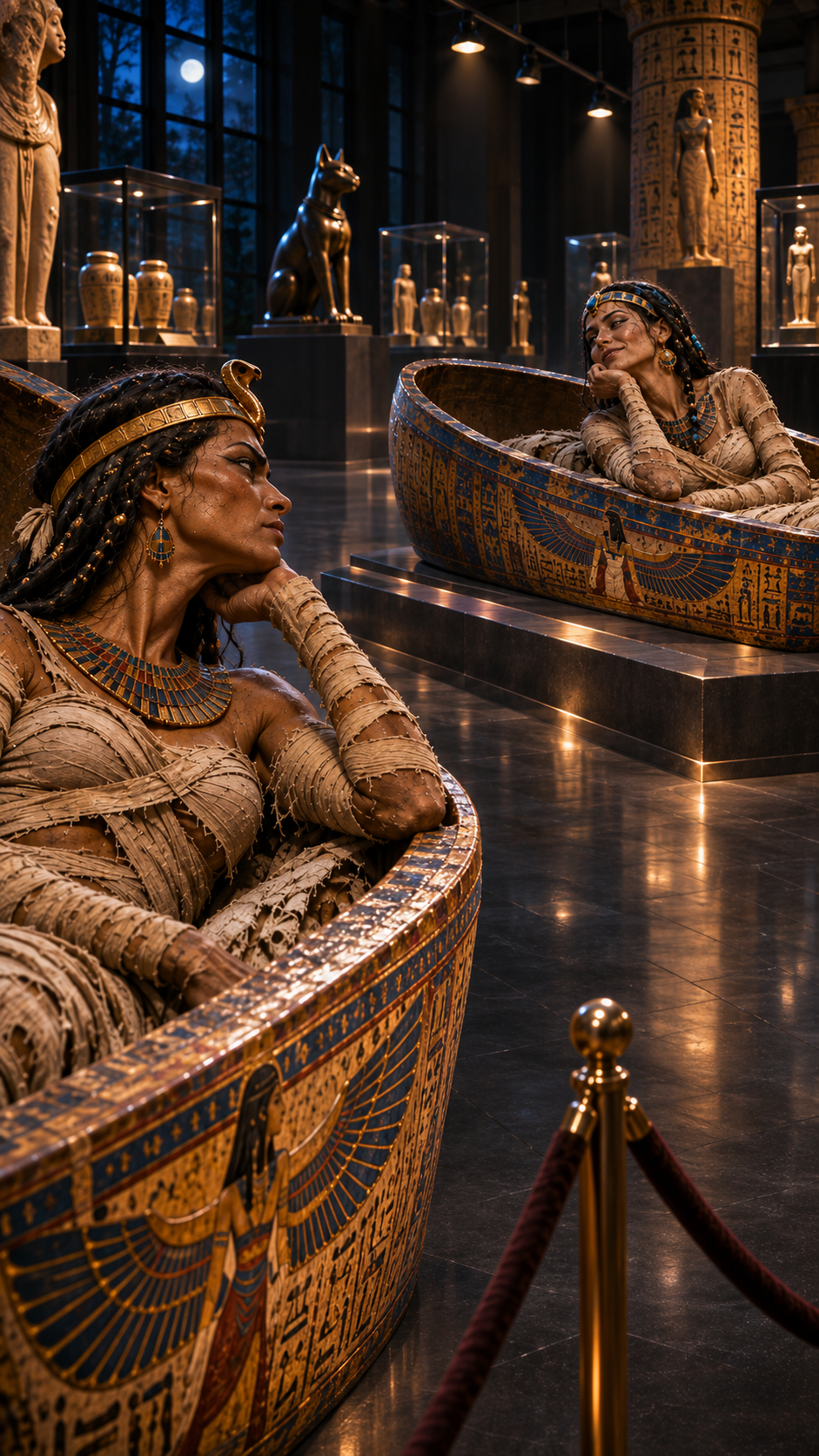
The kiss, when it came, was complicated by bandages.
As so many things in mummified romance must be.
It happened after a school group had spent the day mispronouncing both their names, and Tanofret had been especially cross.
“That boy called me ‘toenail-fret,’” she muttered furiously after closing.
Meret tried not to laugh.
“You are laughing.”
“I am absolutely not.”
“You are dreadful.”
“And yet you keep talking to me.”
Tanofret turned in her coffin, as far as she could.
“Only because the alternatives are unbearable.”
Meret smiled.
The silence that followed was not uncomfortable.
Tanofret studied her.
“You are very beautiful, you know.”
Meret nearly slid down inside her wrappings.
“At my age?”
“At any age.”
Meret’s painted face could not blush, but she felt as though it might.
“You are impossible,” she whispered.
Tanofret leaned as close as her coffin allowed.
“And you are very far away.”
That was, unfortunately, true.
Their pedestals stood several feet apart.
Meret considered this tragedy.
Then, with all the caution of a noblewoman preserving her dignity, she climbed out of her sarcophagus.
It took some time.
And a good deal of graceless rustling.
But at last she stood on the museum floor, linen-wrapped and magnificent.
Tanofret stared.
“My word.”
“Do not comment on the bandages.”
“I was going to comment on the determination.”
Meret came to stand beside Tanofret’s open coffin.
For a moment, neither moved.
Then Tanofret lifted her chin.
Meret bent carefully.
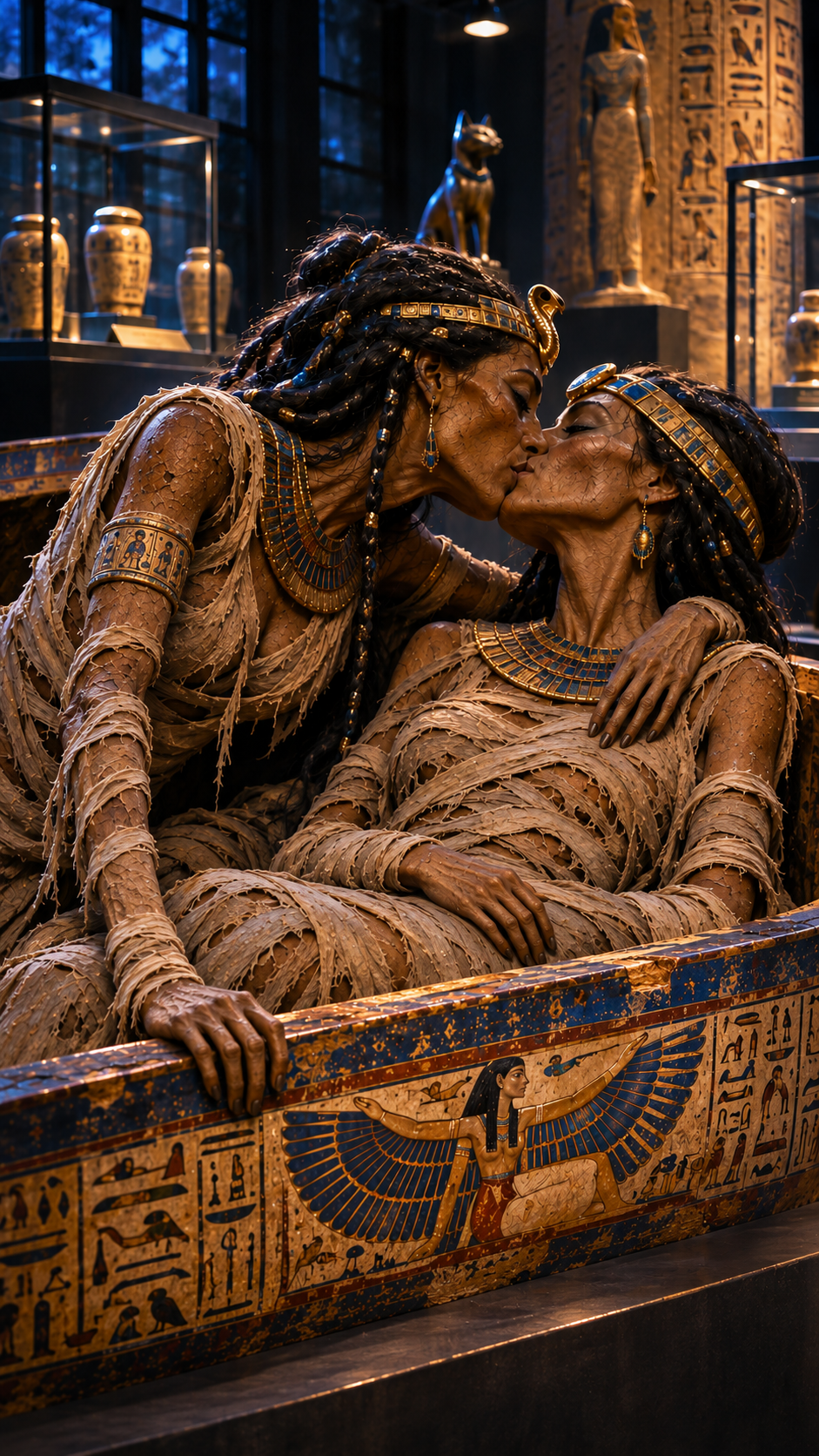
Their lips, dry and ancient and slightly inconvenient, met in a kiss that was more tender than elegant.
When Meret drew back, Tanofret’s eyes were shining.
“Well,” Tanofret murmured.
“Well indeed,” Meret replied.
The practical problem emerged three nights later.
The conservators removed Tanofret’s inner wrappings for examination and temporarily transferred her to a plain storage cradle.
“It is humiliating,” Tanofret whispered that evening. “I look like spare furniture.”
Meret looked across the room.
Tanofret did, admittedly, look miserable.
Her fine sarcophagus stood empty while she lay on a padded table behind discreet velvet ropes.
“You cannot sleep there,” Meret said.
“I have no choice.”
Meret was quiet for several moments.
Then she said, with studied composure, “There is room in mine.”
Tanofret turned.
“Meret.”
“It is a large sarcophagus.”
“Yes.”
“And you are not especially broad.”
Tanofret laughed.
“My darling, are you inviting me into your coffin?”
“I am extending practical hospitality.”
“Of course you are.”
That night, after the guards made their final round, Meret helped Tanofret climb into her sarcophagus.
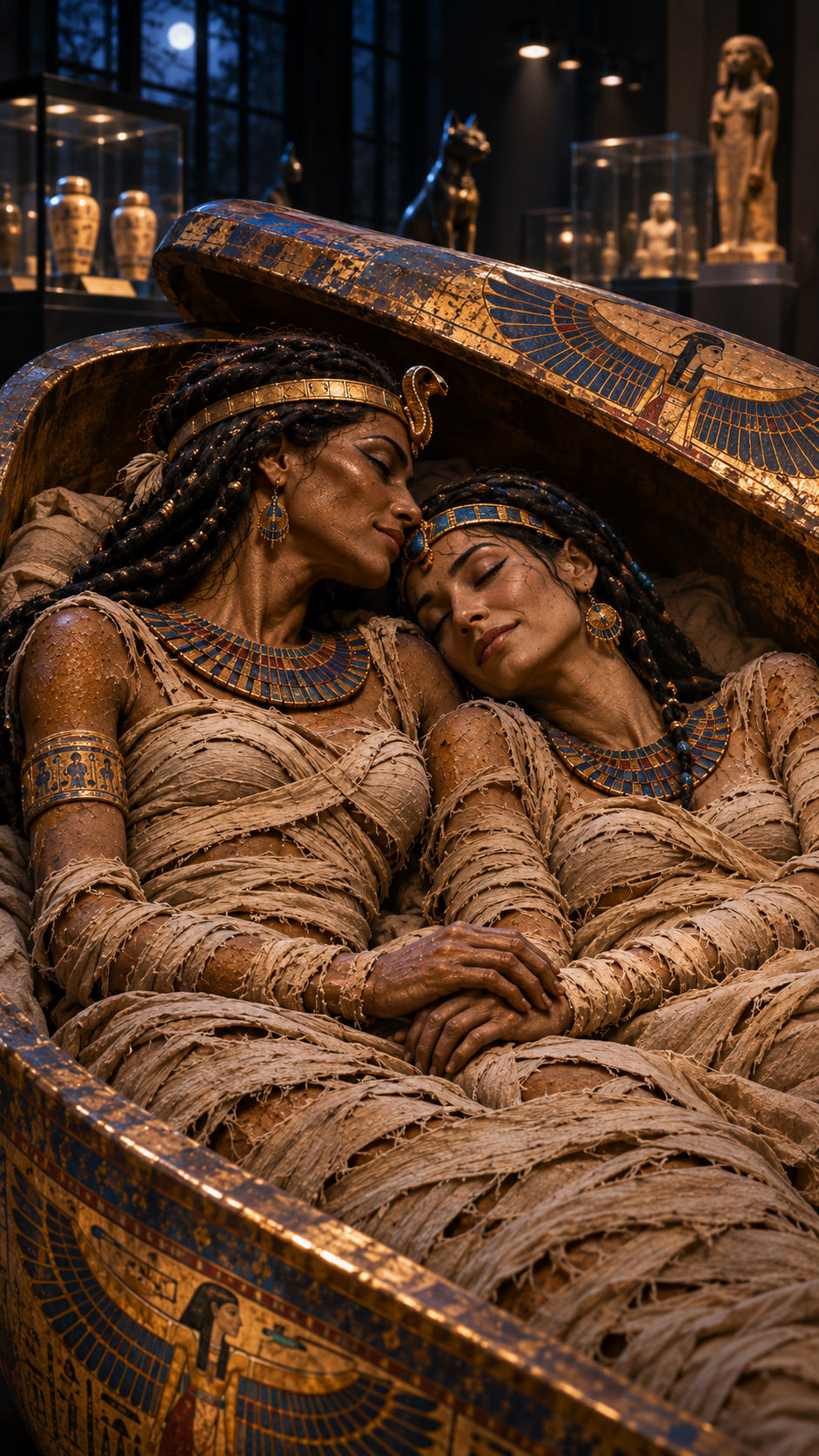
It was, as Meret had promised, quite spacious.
For a while they lay side by side in the narrow painted chamber, their shoulders touching.
Tanofret sighed contentedly.
“This is scandalous.”
Meret smiled in the darkness.
“I should hope so.”
Tanofret shifted closer.
“Will you make me return to my own when the conservators are finished?”
Meret considered.
“No.”
“No?”
“No. You may stay.”
Tanofret was silent for a moment.
Then she rested her head lightly against Meret’s shoulder.
“I do believe,” she said softly, “that you were lonely.”
Meret looked up at the painted lid above them.
For three thousand years, she had slept alone.
In a tomb.
In a crate.
On a pedestal beneath museum lights.
“Yes,” she said at last.
“I was.”
Tanofret took her hand.
“So was I.”
And there, beneath painted gods and faded stars, in a museum long after visiting hours, two rival mummies settled together into the same sarcophagus and found, at last, that eternity felt much less empty when shared.
In the morning, the conservators were puzzled.
Tanofret had somehow shifted across the gallery overnight.
Meret’s coffin lid was not quite where they had left it.
And a junior curator swore that the two mummies looked “happier,” though everyone agreed that was impossible.
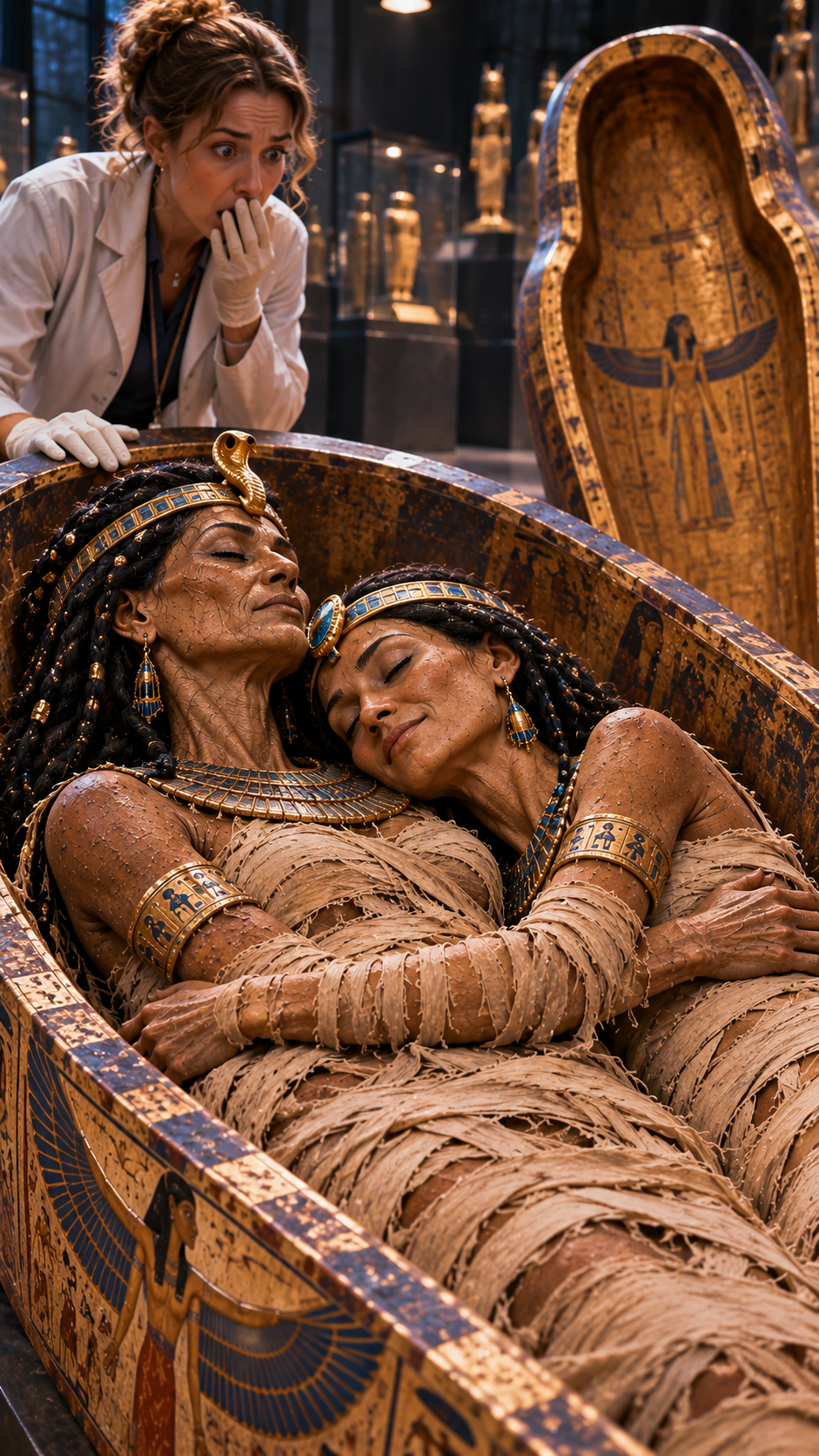
By the end of the month, the museum altered the exhibition text.
LADY MERET AND LADY TANOFRET
Displayed together by curatorial decision
Meret found this deeply amusing.
Tanofret found it romantic.
And every night, once the last footsteps faded and the lights dimmed low, the women of Gallery Three closed the lid above them, ignored the entire modern world, and went to sleep in the same ancient bed.
THE END
Writing one? Publish your story on the BudgetPixel blog.






 @crabmouse

 @EternaSky

 @CaylaCatz

 @monkeydude69

 @DavidP