
The Forgotten Love Chronicles Volume Three — Everyday Angelic Inspirations November 27, 2026 Chapter 21: The Little Bell That Rang at the Forgotten Schoolhouse—and the Retired Teacher Who Discovered That One Lesson Could Change a Lifetime 📚🔔🍂❤️
 @archangeltara

📷 Image Placement — Opening Scene
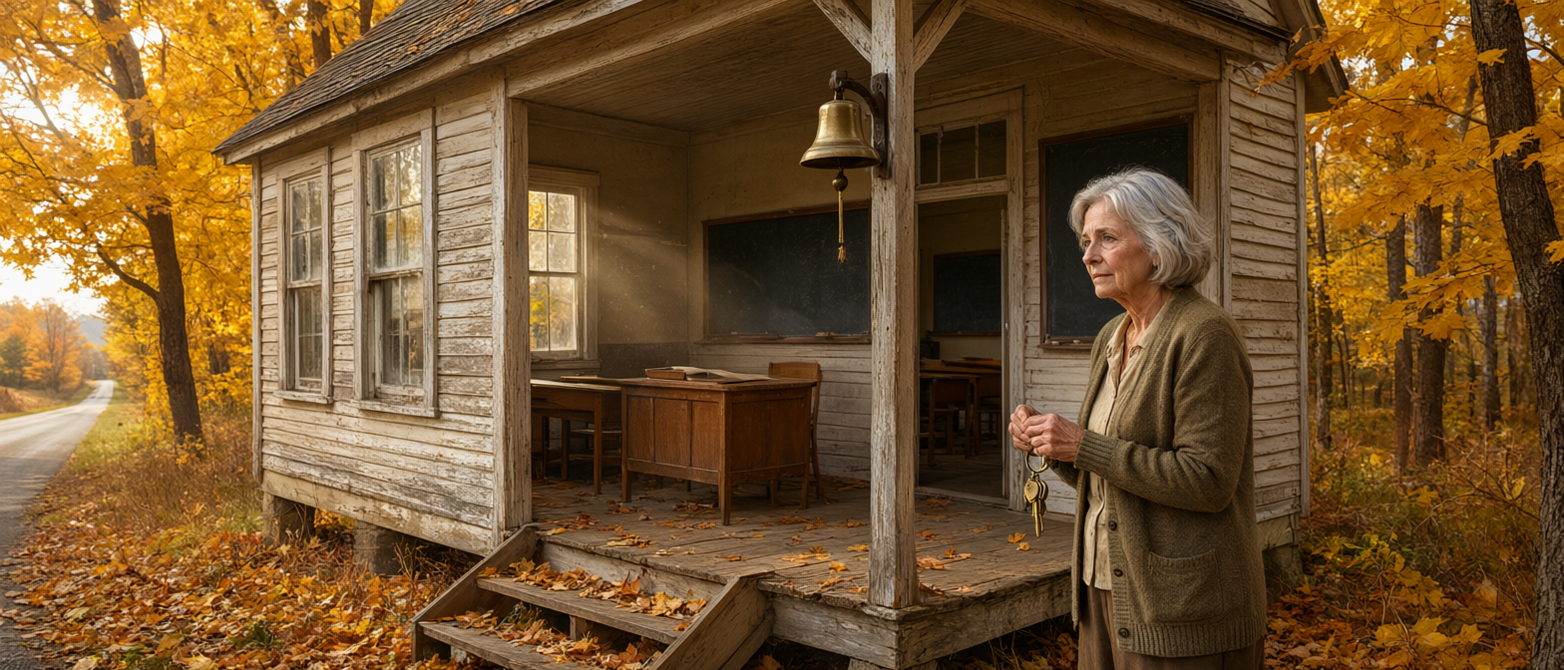
🎨 Image Prompt
Create a breathtaking, ultra-photorealistic 8K cinematic autumn scene featuring a beautiful, weathered one-room country schoolhouse standing at the edge of a quiet rural road. Golden maple trees surround the building, fallen leaves cover the wooden steps, and a small brass school bell hangs beside the entrance. Through the dusty windows, reveal an old wooden teacher's desk, antique chalkboards, rows of empty wooden desks, and soft afternoon sunlight illuminating floating dust particles. A silver-haired retired female teacher in her late seventies stands on the porch holding a small ring of keys, gazing toward the schoolhouse with a mixture of nostalgia and quiet sadness. Rich autumn colors, atmospheric cinematic lighting, extraordinary architectural details, realistic textures, no readable text, no watermark.
“A lesson may end when the school bell rings, but the kindness of a good teacher can last a lifetime.”
The Schoolhouse at the End of the Road
For forty-two years, Margaret Whitmore had taught children in a little country schoolhouse.
She had taught children who arrived with muddy shoes, children who struggled to read, children who were afraid of thunderstorms, and children who thought they weren't clever enough to succeed.
She had taught multiplication beneath a ceiling fan that rattled every summer, spelling beside a wood-burning stove in winter, and history while rain tapped against the old windows.
But most importantly, she had taught children that their mistakes did not define them.
"Try again," she would always say.
"There's no shame in learning something twice."
When Margaret finally retired, the schoolhouse closed.
The district had built a modern elementary school several miles away, and the old building was no longer needed.
The desks were removed.
The books were boxed.
The chalkboards were left behind.
And the little brass bell beside the front door stopped ringing.
For twelve years, Margaret drove past the building every autumn.
Each time, she looked toward the windows.
Each time, she remembered the children.
And each time, she wondered whether the little schoolhouse would eventually disappear beneath weeds and forgotten memories.
One November morning, she received a letter from the county.
The building was scheduled for demolition.
The land had been sold, and the schoolhouse was considered too old and expensive to maintain.
Margaret read the letter twice.
Then she folded it carefully and placed it on the kitchen table.
She understood that buildings could not remain forever.
But she couldn't bear the thought of the schoolhouse vanishing without anyone remembering what had happened inside it.
So she found her old keys.
And she decided to visit one more time.
The Boy on the Front Steps
When Margaret arrived, she noticed someone sitting on the schoolhouse steps.
A boy, perhaps eleven years old, was holding a backpack in his lap.
His name was Eli Parker.
He lived with his father in a small farmhouse nearby.
Eli had recently transferred schools after his parents separated. Since the move, he had struggled to make friends.
He was quiet in class.
He avoided reading aloud.
And whenever a teacher asked him a question, he stared at his desk as though the answer might be hiding somewhere beneath it.
His grades had begun to fall.
His father, Daniel, worried about him, but he worked long hours and didn't always know how to reach his son.
Eli had discovered the abandoned schoolhouse while walking home.
Something about it made him feel comfortable.
It was quiet.
Nobody expected him to speak.
Nobody asked him to read.
He sometimes sat on the steps and imagined what it might have been like to attend school there.
Margaret approached slowly.
"Hello, young man."
Eli looked up.
"Hi."
"Are you waiting for someone?"
"No, ma'am."
"Then may I ask what brings you here?"
He shrugged.
"I just like it."
Margaret smiled.
"Well, I suppose that's a good reason."
She held up her keys.
"I'm Margaret. I used to teach here."
Eli looked toward the door.
"You were a teacher?"
"For a very long time."
"Did you teach everybody?"
"Not everybody," Margaret replied. "But I did my best to teach anyone who walked through that door."
Eli looked down at his backpack.
"Was it a good school?"
Margaret considered the question.
"It wasn't fancy. We didn't have computers or smartboards. Sometimes the heating stopped working, and the roof leaked when it rained."
She smiled.
"But yes. It was a very good school."
"Why?"
"Because the people inside cared about one another."
Eli thought about that.
Then he asked quietly:
"Did you ever have kids who weren't good at reading?"
Margaret looked at him.
"Of course."
"What did you do?"
"I helped them."
"What if they were really bad?"
"Then we started with one word."
Eli glanced at the old schoolhouse door.
"Just one?"
"Just one."
For the first time, he smiled.
📷 Image Placement — The First Lesson
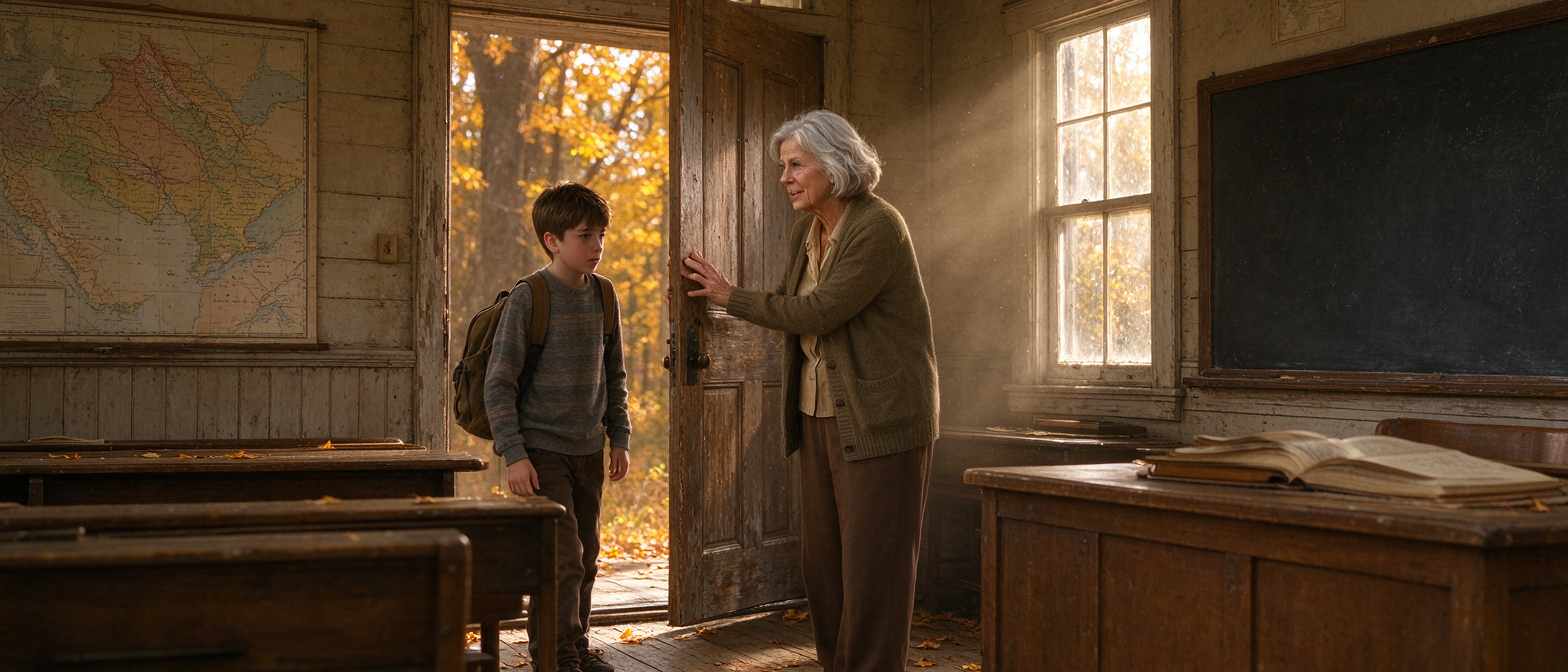
🎨 Image Prompt
Create an ultra-photorealistic 8K cinematic interior scene inside a forgotten one-room American schoolhouse. An elderly female teacher with silver hair gently opens the tall wooden door while an eleven-year-old boy wearing a simple backpack steps inside. Golden late-autumn sunlight streams through tall dusty windows, illuminating old wooden floorboards, vintage student desks, a large dark chalkboard, antique maps, and a weathered teacher's desk. The boy looks curious and slightly uncertain, while the teacher's expression is welcoming and reassuring. The atmosphere should evoke nostalgia, hope, discovery, and the beginning of an unexpected friendship. Cinematic depth of field, realistic faces, exquisite period details, no readable writing, no watermark.
One Word at a Time
Margaret unlocked the door.
The hinges groaned as it opened.
Inside, the schoolhouse smelled of old wood, dust, and memories.
Eli walked slowly between the empty desks.
"Did you really teach here?"
"Every day."
Margaret placed her purse on the teacher's desk.
"Would you like to see something?"
She opened an old cabinet.
Inside were several boxes of books, forgotten lesson materials, and a small collection of wooden alphabet letters.
She found a beginner's reading book and placed it on a desk.
Eli stared at it.
"I don't really like reading."
"That's all right."
"I'm not very good."
"That doesn't mean you can't become good."
He didn't answer.
Margaret sat beside him.
"Would you like to try one page?"
Eli hesitated.
"What if I mess up?"
"Then we'll try again."
He opened the book.
The first page contained a short sentence.
Eli struggled with the first word.
He guessed.
He stopped.
He tried again.
Margaret waited patiently.
She didn't rush him or finish the word for him.
Finally, he sounded it out.
"Sun."
"That's right."
He moved to the next word.
"Is."
"Very good."
Then came the last word.
"Warm."
Eli read the entire sentence.
"The sun is warm."
Margaret smiled.
"Excellent."
He looked surprised.
"That was it?"
"That was it."
He stared at the page.
"I thought reading was supposed to be harder."
Margaret laughed softly.
"Some days it is. But every difficult thing becomes easier when you learn it one small piece at a time."
Eli looked at the book again.
"Can I come back tomorrow?"
Margaret felt something stir inside her.
"Yes, young man. I think we can arrange that."
The Secret Behind the Chalkboard
Over the next several days, Margaret returned to the schoolhouse.
Eli came whenever he could.
They read short stories.
They practiced spelling.
They worked through simple mathematics problems.
Margaret discovered that Eli wasn't unintelligent or lazy.
He was frightened of making mistakes in front of other people.
He had fallen behind during the difficult months surrounding his parents' separation. Instead of asking for help, he had convinced himself that he wasn't capable of catching up.
Margaret knew that feeling.
Years earlier, she had taught a girl named Anna who had struggled with nearly every subject.
Anna had been quiet, withdrawn, and convinced that she would never succeed.
Margaret had spent afternoons helping her read.
She had written encouraging notes on her assignments.
She had told her that intelligence was not measured by how quickly someone understood something.
Anna eventually became a nurse.
Years later, she returned to the schoolhouse and told Margaret that those afternoons had changed her life.
Margaret remembered the conversation vividly.
She also remembered something else.
On her final day of teaching, Anna had given her a small brass bell.
It was the same kind of bell that once hung beside the schoolhouse entrance.
A little card accompanied it.
The message read:
You rang the bell to call us into class. But you also rang something inside us that told us we mattered.
Margaret had kept the bell ever since.
Now, standing beside the old chalkboard, she wondered whether it was time to ring it again.
Not for a class that had officially returned.
But for children who needed somewhere to learn without being afraid.
📷 Image Placement — The Bell Rings Again
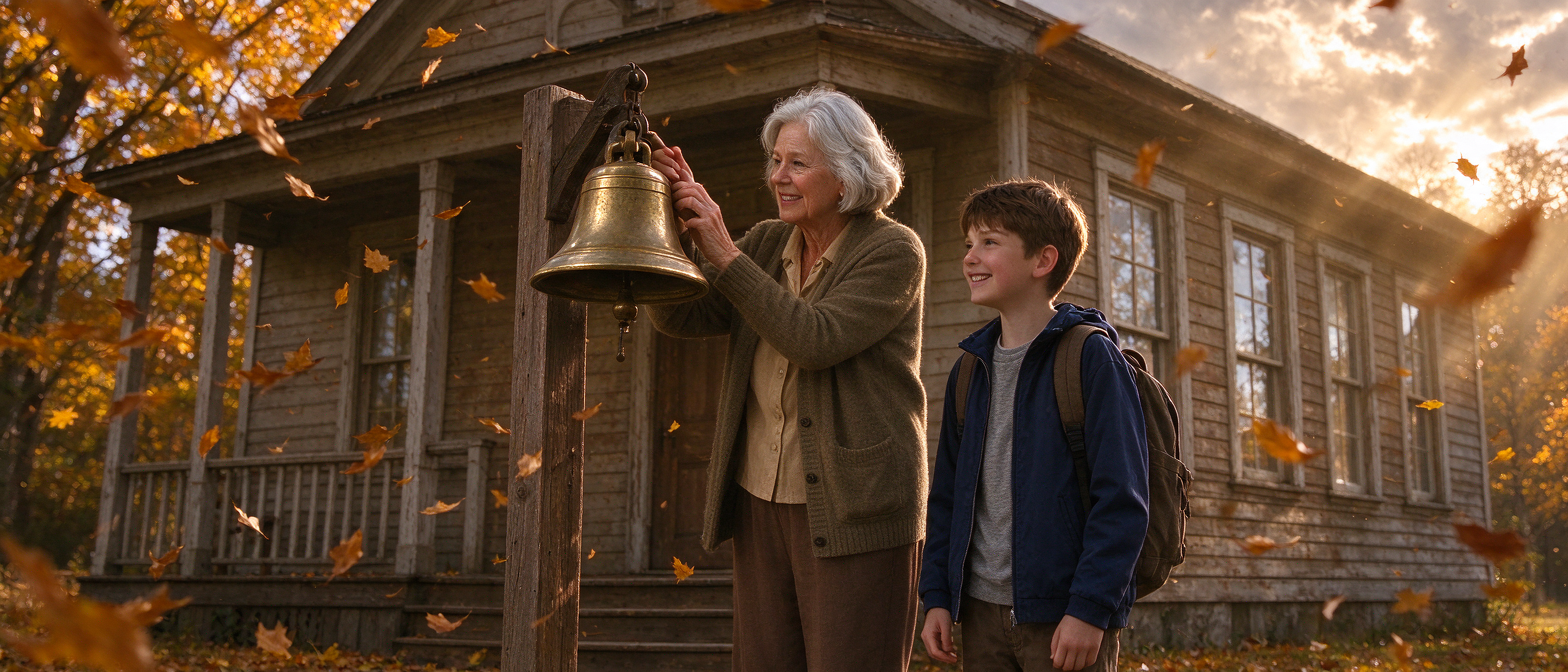
🎨 Image Prompt
Create a breathtaking, ultra-photorealistic 8K cinematic scene of an elderly silver-haired retired teacher standing outside a historic one-room schoolhouse in late November, gently ringing a polished antique brass school bell. Beside her stands an eleven-year-old boy wearing a navy blue jacket and backpack, smiling with wonder. Golden autumn leaves swirl through the air, and warm sunlight breaks through clouds behind the schoolhouse. The old wooden building has charming weathered siding, tall windows, and a small porch. The moment should feel symbolic, hopeful, and deeply emotional, as though a forgotten place is awakening to a new purpose. Rich cinematic lighting, realistic motion in the leaves, beautiful natural expressions, no text, no watermark.
A New Kind of Classroom
Margaret contacted the county library and asked whether she could organize a small reading group for children who needed extra help.
She explained that she had access to the old schoolhouse, but she needed permission to use it temporarily.
The county official was sympathetic.
However, the demolition had already been scheduled.
"Mrs. Whitmore, I wish we could help, but the building is going to be removed. We can't authorize a new program there."
Margaret thanked him.
She was disappointed, but she wasn't ready to give up.
She contacted the library.
Then the local community center.
Then a church that had once partnered with the school.
Everywhere she went, she explained the same thing.
"I don't need a big program. I don't need expensive equipment. I just want to help children who are afraid they aren't good enough."
A few people offered to help.
A retired librarian donated reading books.
A college student volunteered to assist with homework.
A local carpenter offered to repair the schoolhouse steps.
But the building's future remained uncertain.
Then Eli's father learned what was happening.
Daniel Parker had noticed his son coming home with books under his arm.
He had also noticed something he hadn't seen in months.
Eli was smiling.
One evening, Daniel asked him about it.
"What's going on with you and that old schoolhouse?"
Eli shrugged.
"Mrs. Whitmore helps me read."
"Does she?"
"Yeah. She doesn't get mad when I mess up."
Daniel sat down beside him.
"That's good, son."
Eli hesitated.
"She wants to help other kids, too."
Daniel looked at him.
"Then maybe we should help her."
The following Saturday, Daniel visited Margaret.
He offered to organize volunteers to repair the schoolhouse, clean the grounds, and make the building safe enough for temporary community use.
Margaret was touched.
"That's very kind of you."
Daniel smiled.
"Actually, I think I should thank you. My boy is starting to believe in himself again."
The Letter That Changed Everything
While cleaning the schoolhouse, Daniel discovered an old wooden box beneath the teacher's desk.
It contained photographs, lesson plans, student drawings, and several letters from former pupils.
Margaret opened the box carefully.
She recognized many of the names.
One letter had been written by a former student named Anna.
Another came from a young man who had become an engineer.
There were notes from parents, thank-you cards, and little drawings made by children who had once sat at those desks.
At the bottom was a sealed envelope addressed to Margaret.
She recognized the handwriting immediately.
It belonged to her late husband, George.
George had helped maintain the schoolhouse for years. He had passed away shortly before Margaret retired.
She opened the envelope with trembling fingers.
Inside was a short letter.
My dearest Margaret,
I have watched you teach for more years than I can count. I have watched children arrive frightened, uncertain, and convinced that they had nothing special to offer.
And I have watched you show them otherwise.
You sometimes think your work is finished when the school day ends. But I have always believed that the most important lessons you teach happen long after the children leave.
If this old building ever becomes quiet, remember that the things you gave those children are still out there, walking around in the world.
You may never see where every seed grows, but that does not mean you didn't plant it.
With all my love,
George.
Margaret lowered the letter.
For several moments, she couldn't speak.
Daniel quietly stepped away to give her privacy.
Eli noticed her tears.
"Are you okay?"
Margaret nodded.
"Yes, sweetheart."
She folded the letter carefully.
"I just found a reminder of something important."
"What?"
"That a person never really knows how far their kindness will travel."
📷 Image Placement — The Letter From George
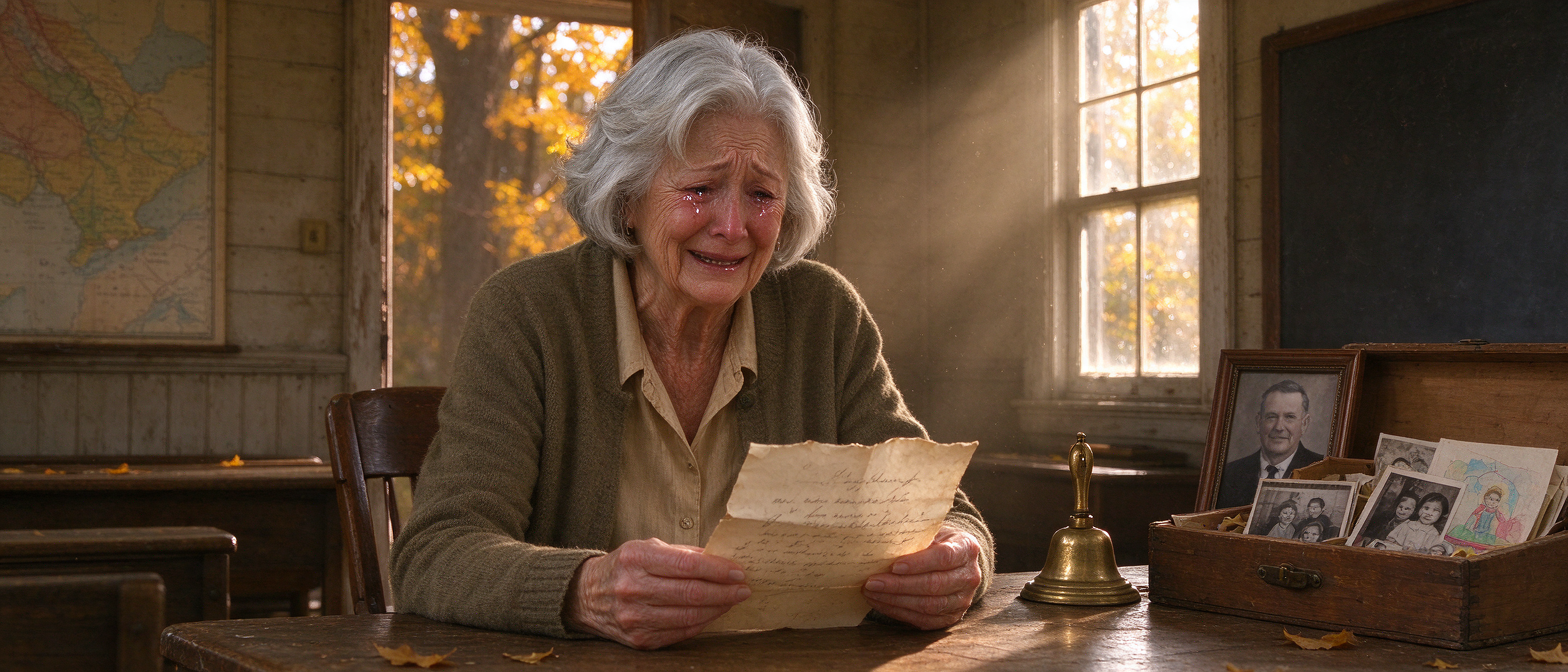
🎨 Image Prompt
Create an ultra-photorealistic 8K cinematic emotional portrait inside a vintage country schoolhouse. An elderly silver-haired woman sits alone at an antique teacher's desk, holding an old handwritten letter with both hands. Her eyes glisten with tears, but her expression carries warmth and gratitude rather than despair. Beside her rests a small brass school bell, an open wooden box filled with old student photographs and children's drawings, and a framed photograph of her late husband. Soft golden afternoon light streams through the window, illuminating the letter and her hands. The image should express enduring love, treasured memories, and the discovery that a lifetime of kindness never disappears. Exquisite realistic details, intimate cinematic framing, no readable writing, no watermark.
The Last Day That Became a Beginning
A week before demolition was scheduled, Margaret received an unexpected telephone call.
The county had received numerous messages from former students and neighborhood residents.
People had heard about the proposed reading program.
Some remembered attending the old schoolhouse.
Others had children who needed extra support.
A former student had even offered to contribute funds toward preserving the building.
The county agreed to postpone demolition while it reviewed a community preservation proposal.
It wasn't a permanent victory.
But it was a chance.
Margaret gathered the volunteers.
They repaired the porch, cleaned the windows, painted the front door, and restored the old desks.
The library donated books.
The community center supplied tables and chairs.
And Daniel organized a schedule of volunteer tutors.
They called it The Little Bell Learning Room.
Its purpose was simple:
Every child deserved a place where learning could begin without embarrassment.
On the first afternoon, Margaret stood outside the schoolhouse.
She wore her favorite blue cardigan and held the little brass bell.
Eli stood beside her.
A handful of children waited on the porch.
Some were shy.
Some were excited.
One little girl held her mother's hand so tightly that her knuckles had turned white.
Margaret smiled.
"Welcome, everyone."
She rang the bell.
Its clear, beautiful sound traveled across the autumn field.
The children entered.
Eli was the first to sit at a desk.
He opened his reading book and waited.
Margaret approached him.
"Ready for another page?"
He nodded.
Then, without being asked, he began reading aloud.
He made a mistake halfway through.
He stopped.
He looked up.
Margaret waited.
Eli took a breath and tried again.
This time, he finished the paragraph.
The other children applauded.
Eli's cheeks turned pink.
But he was smiling.
Margaret looked around the classroom.
The desks were occupied again.
The chalkboard was no longer empty.
The little schoolhouse had a purpose.
And the bell was ringing once more.
A Lesson That Traveled Further Than Anyone Expected
Several months later, Eli received a certificate from his school recognizing his improvement in reading.
His father took a photograph.
Margaret framed a copy and placed it beside the old letter from George.
But something even more wonderful happened.
Eli began helping younger children.
He would sit beside them, point to the words, and patiently wait while they sounded them out.
One afternoon, a little boy became frustrated and pushed his book away.
"I can't do it."
Eli remembered how he had once felt.
He sat beside the boy.
"That's okay," he said. "You don't have to get it right the first time."
The boy looked at him.
"What if I keep getting it wrong?"
Eli smiled.
"Then we try again."
Margaret heard the exchange from across the room.
She quietly turned toward the window.
There were tears in her eyes.
Not because Eli had become a better reader.
But because he had become the kind of person who could help someone else believe in themselves.
That was the lesson she had hoped to teach all along.
And perhaps it was the most important one.
One afternoon, Margaret stood beneath the old brass bell as the children finished their lessons.
She watched them run outside, laughing beneath the golden trees.
Eli approached her.
"Mrs. Whitmore?"
"Yes, dear?"
"Do you think you'll teach here forever?"
Margaret laughed.
"Well, I don't know about forever."
He looked toward the classroom.
"But you'll keep coming back, right?"
Margaret placed a hand on his shoulder.
"As long as there's a child who wants to learn, I'll find a way to help."
Eli smiled.
Then he ran to join the others.
Margaret listened to their laughter.
The schoolhouse was no longer forgotten.
The little bell no longer stood silent.
And a retired teacher who had once believed her greatest work was behind her discovered that sometimes the most meaningful chapters of our lives begin after we think the story is over.
Because a teacher doesn't simply teach children to read words.
A truly wonderful teacher helps them read the possibilities waiting inside their own lives.
And those lessons never graduate.
❤️ Life Lesson
We sometimes measure our lives by the things we have completed: the job we retired from, the children we raised, the goals we achieved, and the chapters that have come to an end.
But our purpose does not always disappear when one season of life ends.
Margaret believed her teaching days were over. Yet her greatest opportunity to inspire another generation was still waiting.
Her story reminds us that the smallest acts of encouragement can have extraordinary consequences.
A patient explanation, a kind word, a second chance, or the willingness to sit beside someone who is struggling can change the direction of a life.
And when we share what we have learned, our kindness continues through others.
We may never know every person who benefits from something we have taught or given. But that doesn't make our efforts any less meaningful.
The most valuable lessons are not always written on a chalkboard. They are written in the hearts of the people we encourage.
❤️ A Thought to Carry Into Tomorrow
You are never too old to make a difference.
You are never too late to encourage someone.
And you are never finished sharing the good things life has taught you.
There may be a child who needs your patience, a neighbor who needs your wisdom, or a stranger who simply needs someone to believe in them.
Don't assume your most meaningful contribution is already behind you.
Sometimes the next chapter begins with a little courage, an open door, and one small bell ringing again.
Never stop planting seeds of kindness. You may not be there when every one of them blooms, but someone will enjoy the flowers. ❤️
Topics
Writing one? Publish your story on the BudgetPixel blog.



 @pocahontas



 @EternaSky

 @faerierealm

 @suga2309