
Part 19 of The Forgotten Love Chronicles Volume Three — Everyday Angelic Inspirations
The Forgotten Love Chronicles Volume Three — Everyday Angelic Inspirations November 25, 2026 Chapter 19: The Little Wooden Bench Beneath the Old Oak Tree—and the Stranger Who Discovered That Listening Could Save a Life 🌳🍂🪑❤️🪽
 @archangeltara
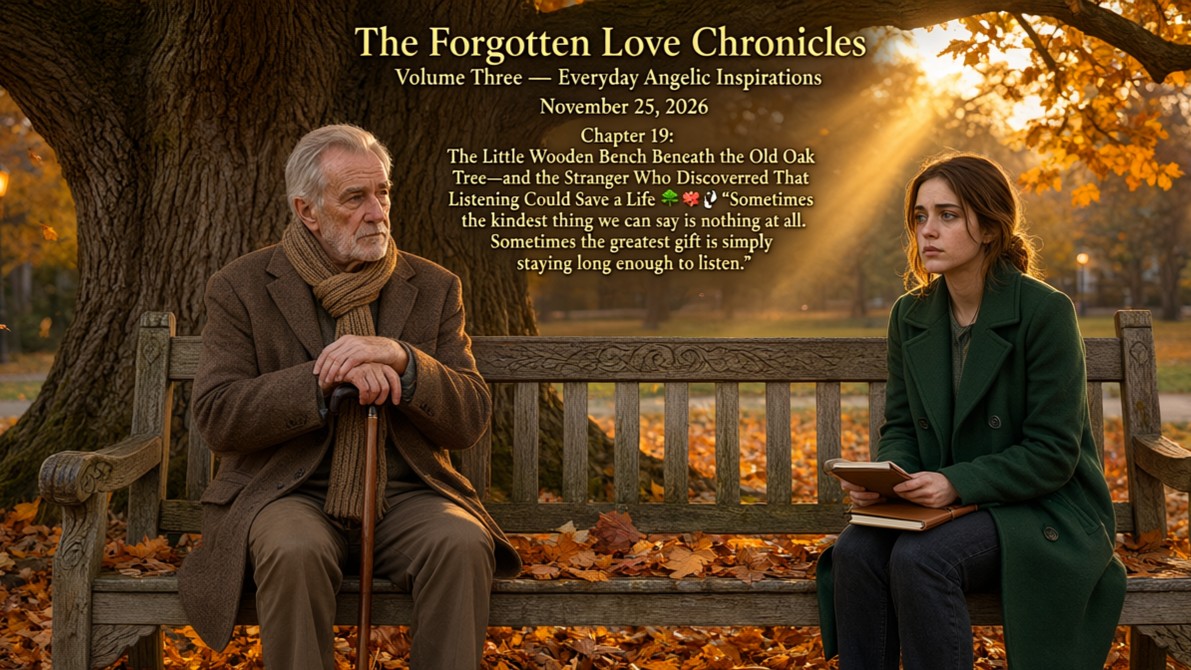
📷 Image Placement — Opening Scene
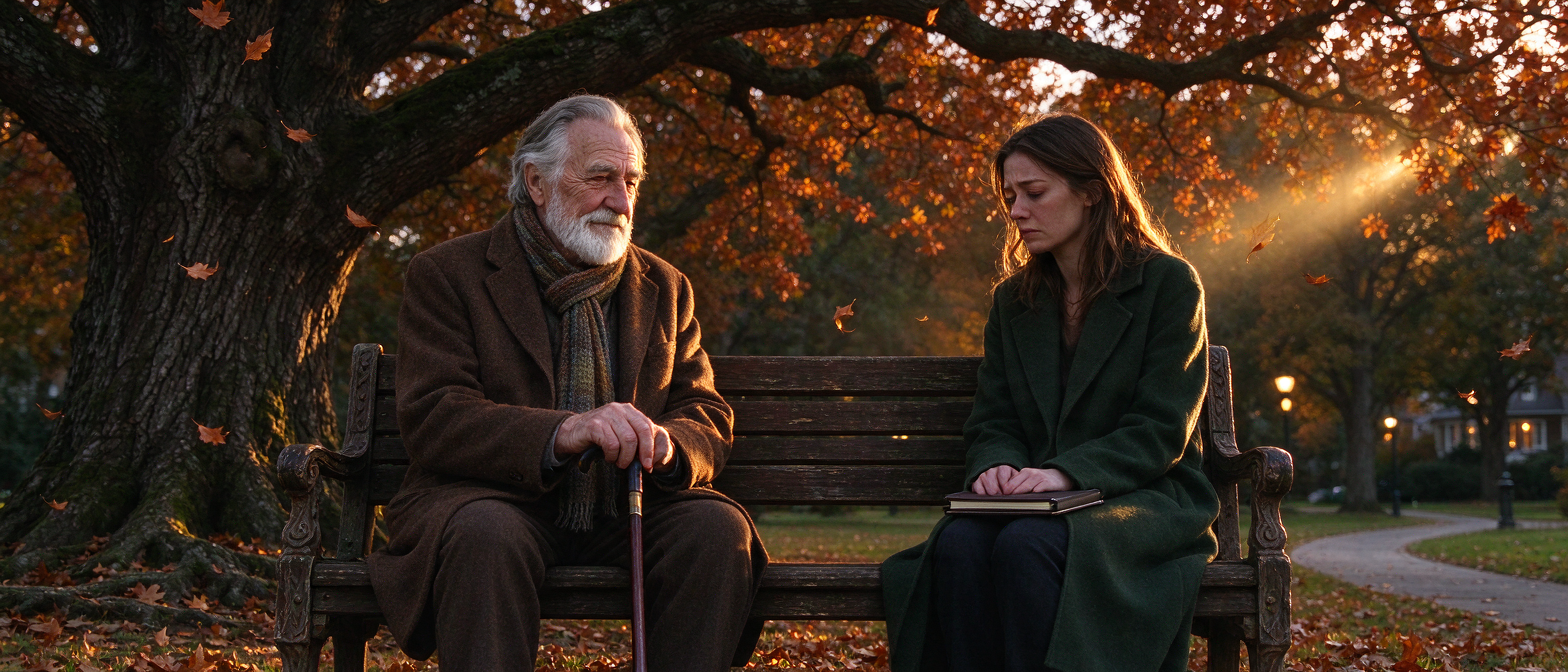
🎨 Image Prompt
Create a breathtaking, ultra-photorealistic 8K cinematic autumn scene in a peaceful neighborhood park just before sunset. Beneath an enormous ancient oak tree stands a weathered wooden bench with beautifully carved armrests and fallen copper, amber, and golden leaves scattered around its legs. An elderly gentleman in his early seventies sits quietly at one end of the bench, wearing a brown wool coat and a knitted scarf. His hands rest gently on a walking cane, and his expression is thoughtful and compassionate. At the other end sits a young woman in her late twenties, wearing a dark green coat, holding a closed notebook in her lap, her eyes showing exhaustion and uncertainty. A golden shaft of sunlight passes through the oak branches, illuminating the space between them. A few distant park lamps begin to glow, and delicate leaves drift through the air. Emotionally powerful, realistic human expressions, rich autumn textures, cinematic lighting, no text, no lettering, no watermark.
“Sometimes the kindest thing we can say is nothing at all. Sometimes the greatest gift is simply staying long enough to listen.”
The Bench Nobody Noticed
In the center of Willowbrook Park stood an enormous oak tree.
Its branches stretched across the walking path, providing shade in summer and shelter for birds throughout the year.
Beneath it sat a wooden bench.
The bench had been there for nearly sixty years.
Its paint had faded, one armrest had a small crack, and the wooden slats had been polished smooth by generations of people who had sat there to rest.
Children had eaten sandwiches on it.
Couples had held hands beside it.
Older neighbors had watched the seasons change from its familiar seat.
But most people simply walked past.
They rarely noticed the bench.
They certainly did not know that, for nearly twenty years, a man named Samuel Brooks had visited it every afternoon.
Samuel was seventy-two.
He had retired from his work as a high school counselor and lived in a small house on the edge of town.
He had been married to his wife, Helen, for forty-five years before she passed away.
Helen had loved the old oak tree.
She used to bring a thermos of tea and a little container of biscuits, then sit beside Samuel while they watched the children play.
After she died, Samuel continued visiting the bench.
At first, he came because the house was too quiet.
Later, he came because he realized something.
People often sat on that bench when they needed a moment away from the world.
Some were simply tired.
Some were worried.
Some were grieving.
And some appeared to be carrying burdens too heavy to explain.
Samuel never considered himself particularly wise.
He had made mistakes as a husband, a father, and a counselor.
But after forty years of listening to young people, he had learned one important thing.
Not everyone who needs help knows how to ask for it.
Sometimes they begin by sitting down.
The Woman With the Closed Notebook
One chilly afternoon in November, Samuel noticed a young woman standing near the oak tree.
She wore a dark green coat and held a notebook against her chest.
She looked around the park as though she were searching for somewhere to go.
Then she sat at the far end of the bench.
Samuel offered a polite smile.
“Beautiful afternoon.”
The woman nodded.
“It's getting cold.”
“That it is.”
Silence settled between them.
Samuel returned his attention to the trees.
After several minutes, the woman opened her notebook, stared at the first page, and closed it again.
Samuel noticed her hands trembling slightly.
He did not ask what was wrong.
He simply said, “Sometimes the hardest part of writing is knowing where to begin.”
The woman looked at him.
“You're a writer?”
“Not particularly. But my wife was.”
The young woman glanced at the notebook.
“I used to write.”
“What happened?”
She hesitated.
“Life, I suppose.”
Samuel nodded.
“Life has a way of interrupting things.”
The woman gave a small, humorless laugh.
“My name is Claire.”
“Samuel.”
They shook hands.
Then Claire looked down at her notebook.
“I don't know why I brought this.”
“Perhaps some part of you wanted to remember what it felt like.”
Claire said nothing.
Samuel did not push.
After a while, she stood.
“Have a nice day, Mr. Samuel.”
“You too, Claire.”
She walked away.
Samuel watched her disappear beneath the trees.
He had no idea what had brought her to the bench.
But he hoped she would return.
A Conversation Without Questions
Claire returned two days later.
She sat in the same place.
Samuel was already there.
“Hello again,” he said.
“Hello.”
They sat quietly.
This time, Claire opened her notebook and began writing.
Samuel watched a squirrel carry an acorn across the path.
After ten minutes, Claire spoke.
“Do you ever feel like everyone else is moving forward while you're standing still?”
Samuel looked at her.
“Yes.”
She seemed surprised.
“You do?”
“Of course.”
“Even at your age?”
Samuel smiled.
“Especially at my age. I've had more time to make mistakes.”
Claire laughed softly.
Then her expression changed.
“I lost my job last month.”
Samuel listened.
“My mother is sick. My relationship ended. I moved back into my parents' house, and I feel like I've failed at everything.”
Samuel did not interrupt.
Claire continued.
“I used to have plans. I wanted to write books. I wanted to travel. I wanted to build a life that felt like mine.”
She swallowed.
“Now I don't even know what tomorrow is supposed to look like.”
Samuel nodded slowly.
“That sounds like an awful lot to carry.”
Claire's eyes filled.
“Everyone keeps telling me to stay positive.”
Samuel looked at her gently.
“Do you want me to tell you to stay positive?”
She shook her head.
“No.”
“Then I won't.”
For the first time, Claire began to cry.
Not loudly.
Not dramatically.
She simply lowered her face and let the tears come.
Samuel stayed where he was.
He did not tell her everything would be fine.
He did not offer a list of solutions.
He did not tell her that other people had it worse.
He simply sat beside her.
And when she finally looked up, he handed her a clean handkerchief.
“Thank you,” she whispered.
Samuel smiled.
“You're welcome.”
📷 Image Placement — The First Honest Conversation
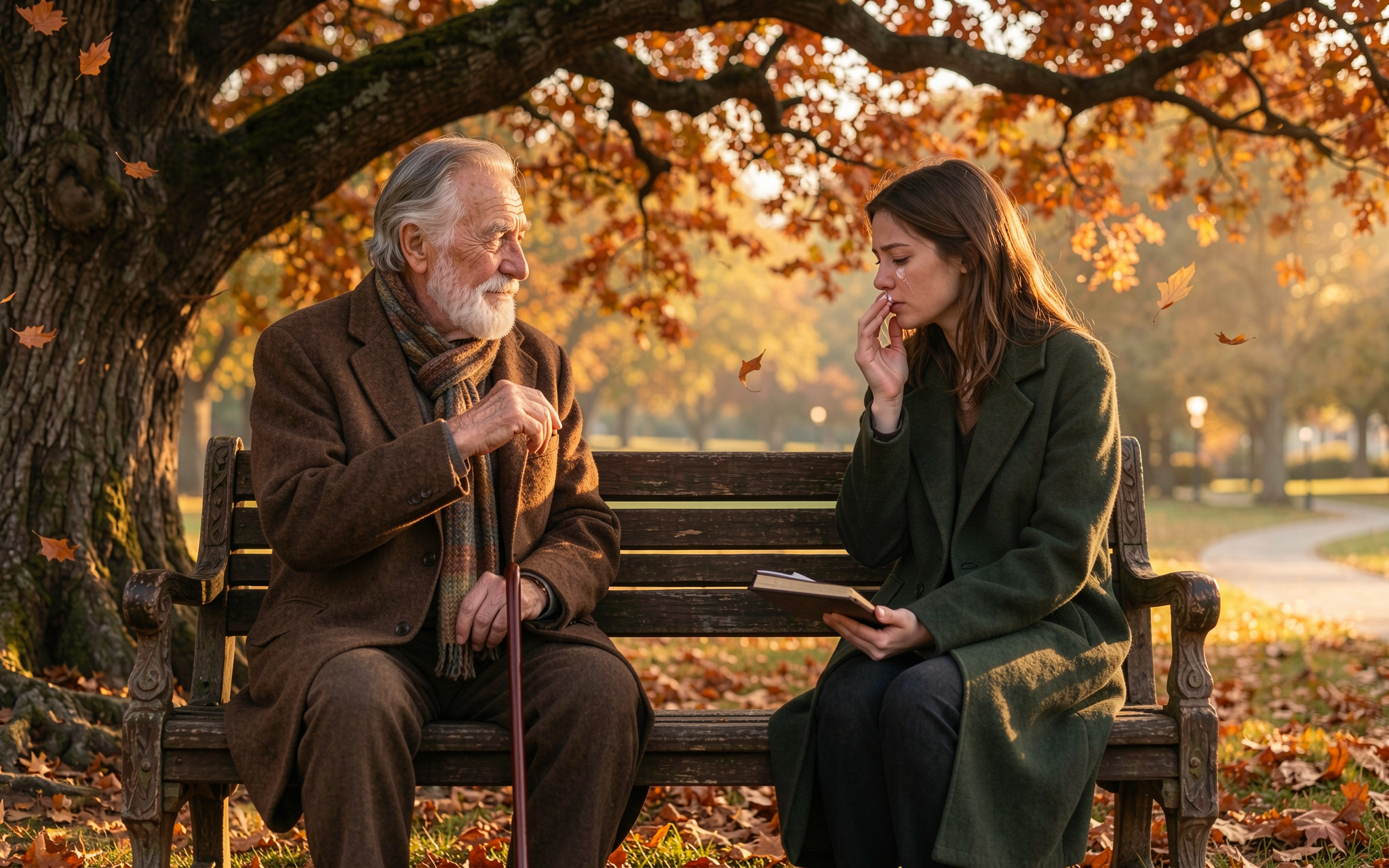
🎨 Image Prompt
Create an emotionally moving, ultra-photorealistic 8K cinematic autumn park scene beneath an enormous oak tree. A seventy-two-year-old gentleman with silver hair and kind eyes sits on a weathered wooden bench beside a young woman in her late twenties. The woman holds a small notebook and gently wipes tears from her cheek while the elderly man listens with quiet compassion. He is not touching her or trying to interrupt; his posture communicates patience, respect, and warmth. Fallen autumn leaves cover the ground, a few drift through the golden afternoon sunlight, and the background shows a softly blurred park path with distant trees. The composition emphasizes the emotional space between two strangers slowly becoming comfortable with one another. Authentic human expressions, cinematic natural lighting, realistic textures, no text, no watermark.
The Things People Don't Say
Over the next two weeks, Claire returned to the bench several times.
Sometimes she spoke.
Sometimes she wrote.
Sometimes she simply sat beside Samuel while they watched the leaves fall.
Samuel learned that Claire had once worked for a small publishing company.
She had loved editing stories and dreamed of writing a novel.
But after her mother became ill, she had moved home to help.
Her relationship had ended shortly afterward.
Then the publishing company had reduced its staff.
Everything seemed to have happened at once.
“I feel guilty for being unhappy,” Claire admitted one afternoon. “My mother needs me. I should be grateful I can help her.”
Samuel considered her words.
“Can you love your mother and still feel exhausted?”
Claire nodded.
“Can you be grateful for your family and still wish your life had turned out differently?”
She nodded again.
“Then perhaps you don't need to feel guilty for having more than one feeling.”
Claire looked at him.
“No one has ever put it that way.”
Samuel smiled.
“People are complicated. We can be grateful and disappointed, hopeful and frightened, loving and tired, all at the same time.”
Claire wrote something in her notebook.
“What did you write?” Samuel asked.
She turned the page toward him.
I am allowed to be human.
Samuel smiled.
“That is worth remembering.”
The Secret Samuel Had Kept
One afternoon, Claire arrived at the bench and found Samuel staring at a small photograph.
It showed a smiling woman standing beside the oak tree.
“Your wife?”
Samuel nodded.
“Helen.”
“She looks lovely.”
“She was.”
Claire sat beside him.
“Did she ever feel like I do?”
Samuel looked at the photograph.
“Yes.”
Claire waited.
“When Helen was forty, she lost her younger sister. Not long afterward, she struggled with depression. She stopped painting, stopped visiting friends, and began believing that the world had moved on without her.”
“What helped?”
Samuel looked toward the oak branches.
“Not one thing. And certainly not one conversation.”
He paused.
“I tried to fix everything. I offered advice. I told her to take walks, find hobbies, and keep busy.”
“Did it help?”
“Not very much.”
He smiled sadly.
“Eventually, she told me she didn't need a handyman for her heart. She needed her husband.”
Claire laughed softly.
Samuel continued.
“So I learned to listen. I learned that being beside someone is sometimes more useful than having an answer.”
He looked at the photograph again.
“Helen got help. She slowly found her way back to painting and to the people she loved. She taught me that love doesn't mean carrying another person's whole burden. It means helping them remember they don't have to carry it alone.”
Claire looked down at her notebook.
“I'm glad she had you.”
Samuel smiled.
“I was the lucky one.”
The Note Beneath the Bench
One afternoon, Samuel arrived early and discovered a small envelope tucked beneath the wooden bench.
His name was written on the front.
Inside was a note from Claire.
Dear Samuel,
I don't know whether you realize how much these afternoons have meant to me.
I used to think I had to explain everything perfectly before anyone could understand me.
But you never made me feel as though I had to perform happiness or pretend I was doing better than I was.
You listened.
I have started seeing a counselor, and I'm taking things one step at a time. I am also writing again.
I don't know what the future will look like. But I no longer feel that I have to figure it all out in one afternoon.
Thank you for reminding me that I am still a person with dreams, even when life becomes difficult.
Claire.
Samuel folded the note carefully.
He was proud of her.
Not because she had suddenly solved every problem.
But because she had reached out for help.
That afternoon, he placed the note inside his coat pocket.
Then he looked toward the far end of the park.
And he remembered something Helen had once told him.
If you can make one person feel less alone, you have done something worthwhile with your day.
The Bench Gets a New Beginning
A week later, Samuel noticed a young man sitting beneath the oak tree.
He was perhaps twenty years old.
His hood was pulled over his head, and he stared at the ground.
Samuel recognized the posture.
The shoulders.
The stillness.
The expression of someone who had come to a place where nobody expected him to explain himself.
Samuel approached slowly.
“Mind if I sit?”
The young man shrugged.
Samuel sat at the other end of the bench.
For several minutes, neither spoke.
Then the young man said, “I think I messed everything up.”
Samuel looked toward the trees.
“Would you like to tell me about it?”
The young man hesitated.
“My name is Jordan. I dropped out of college.”
Samuel nodded.
“That's a difficult thing to go through.”
“My parents are furious.”
“Are you disappointed too?”
Jordan looked at him.
“Yes.”
Samuel nodded.
“Then perhaps you have something important to talk about.”
Jordan began explaining.
He had struggled with classes, felt overwhelmed by expectations, and had hidden his difficulties from his family.
Eventually, he stopped attending.
Now he was afraid to go home.
Samuel listened.
He did not promise to solve Jordan's academic problems.
He encouraged him to contact a trusted family member, explore the college's counseling and advising services, and consider what kind of support might help him decide his next step.
Before Jordan left, Samuel said, “One difficult chapter does not have to become your entire story.”
Jordan looked at him.
“Did you make that up?”
Samuel smiled.
“No. I borrowed it from someone much wiser.”
“Who?”
“My wife.”
Jordan nodded.
Then he stood.
“Thanks, Mr. Brooks.”
Samuel watched him walk away.
The old bench seemed to have become something more than a place to sit.
It had become a place where people could begin again.
📷 Image Placement — A New Stranger Finds the Bench
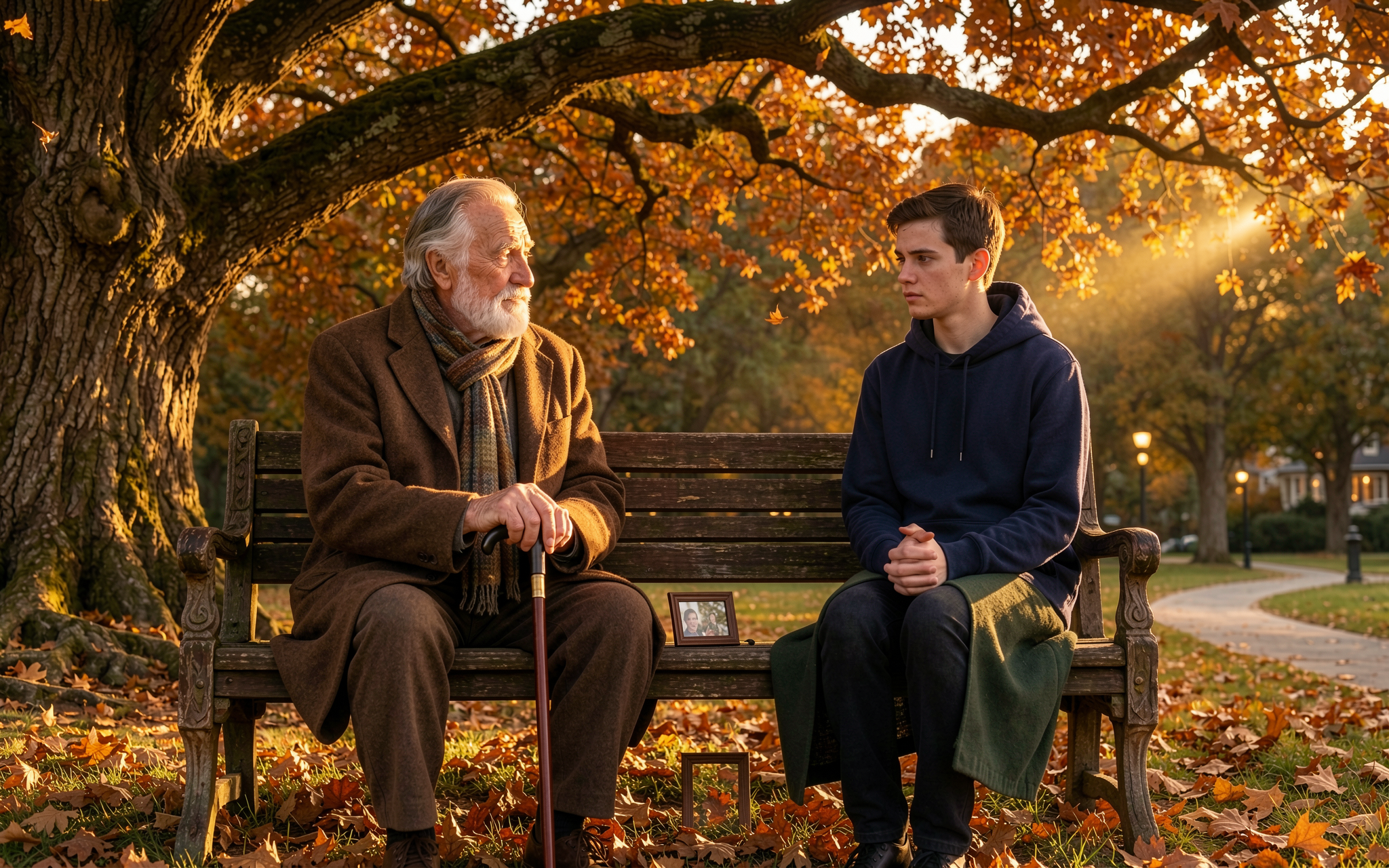
🎨 Image Prompt
Create an ultra-photorealistic 8K cinematic autumn image beneath the enormous oak tree in Willowbrook Park. An elderly silver-haired man in a warm brown coat sits at one end of a weathered wooden bench, listening attentively to a young adult man wearing a navy hoodie. The young man looks thoughtful and vulnerable, his hands clasped together, while the older man maintains a calm, reassuring expression. Golden leaves cover the ground, and the afternoon sun filters through the oak branches. A small framed photograph rests discreetly beside the elderly man's walking cane. The scene communicates dignity, patience, and the quiet importance of being heard. Realistic expressions, detailed clothing textures, cinematic golden-hour lighting, no text, no watermark.
The Little Sign
By early December, the park had become colder.
The leaves were almost gone.
The oak tree stood with its bare branches stretching toward the winter sky.
Samuel noticed that more people were using the bench.
An older woman sat there every morning with her dog.
A father rested beside it while his young daughter practiced riding her bicycle.
A teenager sometimes stopped after school to write in a journal.
And Claire continued to visit.
One afternoon, she arrived carrying a small wooden sign.
“I made something.”
Samuel examined it.
The sign was simple.
It read:
YOU DON'T HAVE TO HAVE THE RIGHT WORDS. YOU CAN JUST SIT HERE.
Samuel smiled.
“That's wonderful.”
Claire had painted the letters dark blue and added a little golden heart in the corner.
“I thought the bench could use a reminder.”
Samuel looked at the sign.
“Where shall we put it?”
They attached it to the tree beside the bench, making sure not to damage the bark.
When they finished, Claire stepped back.
“There.”
Samuel nodded.
“Now people will know.”
Claire smiled.
“Know what?”
“That they don't have to pretend.”
The Afternoon That Changed Everything
A few days before Christmas, Samuel received a telephone call from Claire.
Her mother had been taken to the hospital.
Claire was frightened.
She asked whether he could meet her at the park for a few minutes before she went to see her.
Samuel agreed.
When she arrived, he could see how worried she was.
“My mother has an infection,” she said. “The doctors are treating it, but I'm scared.”
Samuel nodded.
“Of course you are.”
“I thought I was doing better. I thought I had learned how to handle difficult things.”
He looked at her.
“Being stronger doesn't mean you stop being frightened.”
Claire began to cry.
“I don't know what I'd do without her.”
Samuel listened.
Then he said, “You don't have to decide everything today. Go be with your mother. Ask the doctors your questions. Let people help you.”
Claire nodded.
Samuel continued.
“And remember to take care of yourself, too.”
She wiped her eyes.
“Thank you.”
He reached into his coat and handed her a folded piece of paper.
It was a note Helen had written years earlier.
Samuel had carried it in his wallet for a long time.
You cannot control every storm, but you can make sure the people you love know they don't have to stand in the rain alone.
Claire read it.
Then she folded it carefully.
“I'll keep this.”
Samuel smiled.
“I think Helen would like that.”
Claire hugged him.
And then she hurried toward the hospital.
A Different Kind of Christmas Gift
On Christmas Eve, Samuel arrived at the park carrying a small package.
He placed it beneath the oak tree, beside the bench.
Inside was a framed photograph of Helen sitting on the wooden bench years earlier.
Beside it was a new little plaque.
It read:
THE HELEN BROOKS LISTENING BENCH
For anyone who needs a quiet moment, a kind ear, or a place to begin again.
Samuel stepped back.
He had arranged for the park department to dedicate the bench in Helen's memory.
Claire had helped organize it.
A few neighbors arrived with thermoses of hot chocolate and small paper lanterns.
Jordan came too.
He had contacted his family and was exploring a new educational path.
He was not certain what he wanted to do yet, but he had started talking honestly with his parents.
Claire arrived last.
Her mother was recovering, and she had been able to spend Christmas Eve with her family.
She walked toward Samuel and hugged him.
“She's doing better.”
Samuel smiled.
“I'm glad.”
Claire looked at the bench.
“Do you think Helen would have liked this?”
Samuel looked at the photograph.
“I think she would have loved it.”
A little girl approached with her father.
She read the sign aloud.
“You don't have to have the right words. You can just sit here.”
Then she looked at Samuel.
“Can I sit?”
“Of course, sweetheart.”
She climbed onto the bench.
Her father sat beside her.
And for a moment, everyone stood quietly beneath the oak tree.
The park lights began to glow.
A few snowflakes drifted down.
Samuel looked at the little sign and felt a deep sense of gratitude.
Helen had been gone for years.
But her kindness was still finding its way into other people's lives.
And he understood that this was one of the most beautiful things love could do.
It could continue long after the person who first gave it was gone.
📷 Image Placement — The Listening Bench at Christmas
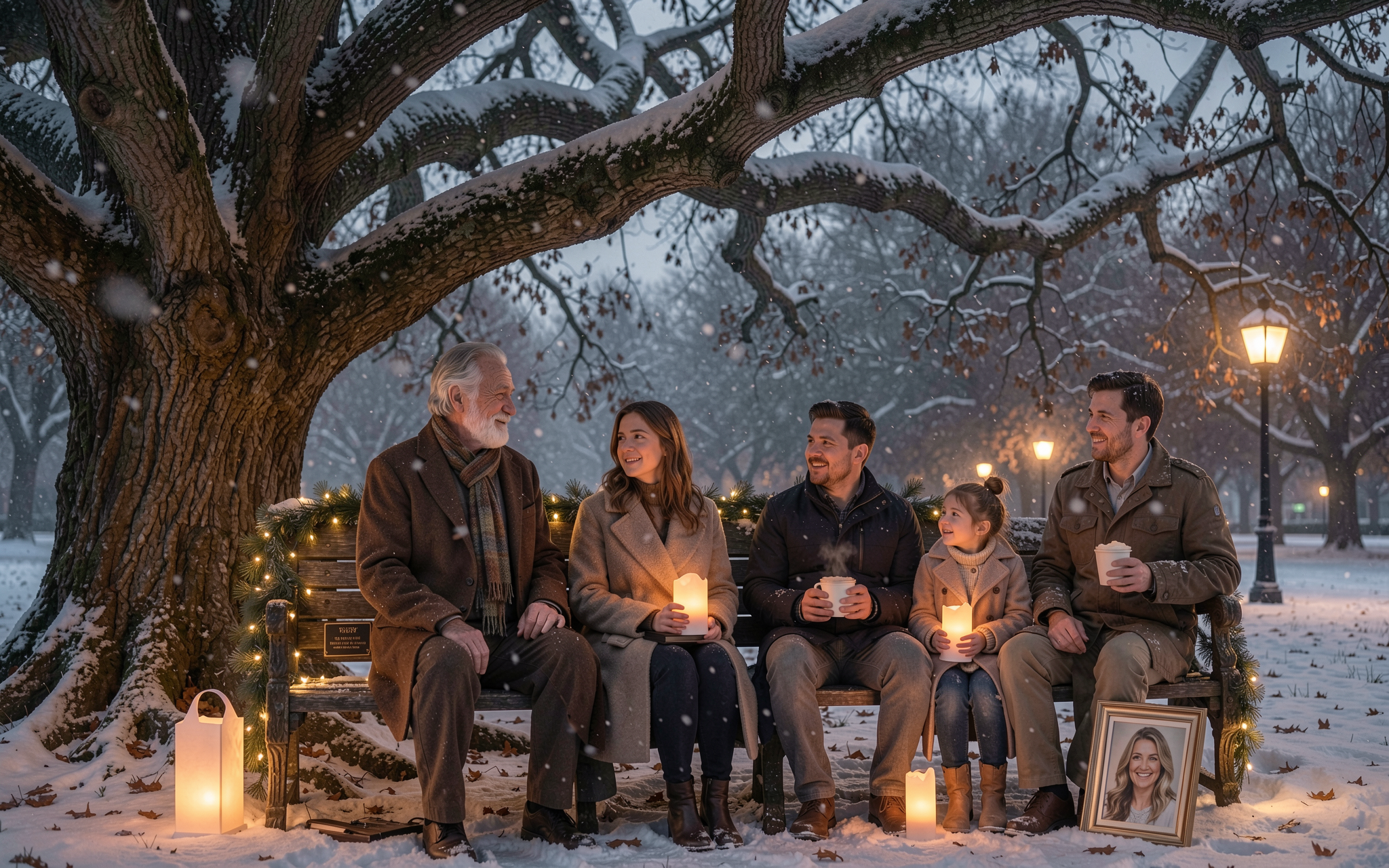
🎨 Image Prompt
Create a magnificent, ultra-photorealistic 8K cinematic Christmas Eve scene in Willowbrook Park beneath a grand ancient oak tree. A beautifully restored wooden bench stands beneath the branches, decorated with a small evergreen garland and delicate warm white lights. A tasteful bronze-colored dedication plaque is attached to the bench, with its lettering not readable. An elderly silver-haired gentleman stands beside the bench with a peaceful expression, surrounded by a young woman, a young man, a father, and a little girl sitting comfortably together. Neighbors hold small glowing paper lanterns and cups of hot chocolate. Gentle snow falls through the branches, and warm park lamps illuminate the gathering. A framed photograph of a smiling woman rests beside the bench. The atmosphere is deeply moving, peaceful, and full of human connection, remembrance, and hope. Cinematic winter lighting, realistic expressions, exquisite detail, no text, no watermark.
The People Who Came to Sit
The following spring, the oak tree began to bloom again.
The little sign remained.
People began leaving small notes in a weatherproof wooden box attached to the bench.
Some thanked the park for creating a peaceful place.
Others left messages for people they missed.
One note read:
I sat here today because I didn't know where else to go. Someone smiled at me. It helped.
Another said:
I finally called my sister. We talked for an hour.
A third was written in a child's handwriting:
I sat with Grandpa. He told me a story about Grandma. I think she was nice.
Samuel visited every afternoon.
He did not try to counsel everyone who sat there.
He did not consider himself responsible for fixing the world.
He simply remained available.
And when someone began speaking, he listened.
Claire eventually returned to writing.
She started with small essays about ordinary people and the moments that changed their lives.
Her first published piece was about a wooden bench beneath an old oak tree.
She called it The Place Where Nobody Had to Pretend.
She dedicated it to Samuel and Helen.
When Samuel read it, he sat beneath the tree for a long time.
Then he smiled.
Because he finally understood that the little bench had never been important because of its age, its wood, or its location.
It mattered because people had been allowed to bring their whole selves to it.
Their worries.
Their memories.
Their fears.
Their unfinished dreams.
And sometimes, simply by being heard, they found enough courage to take the next step.
The bench had not saved everyone.
It had not solved every problem.
But it had reminded people that their lives mattered.
And that was a beautiful beginning.
Sometimes the world does not need another person telling us how to live. Sometimes it needs one more person willing to sit beside us while we find our way.
❤️ Life Lesson
Listening is one of the most generous gifts we can offer another human being.
We often rush to give advice because we want to help. We want to make the sadness disappear, solve the problem, or find the perfect words.
But not every difficult moment needs an immediate solution.
Sometimes people need the freedom to speak without being judged, interrupted, corrected, or compared with someone else's experience.
Samuel learned that listening does not mean taking responsibility for another person's entire life. It means treating their feelings with respect, recognizing when professional support may be needed, and helping them feel less alone as they take their next steps.
Claire did not need Samuel to solve her problems. She needed someone who could hear her without demanding that she pretend to be happy.
And Samuel discovered that even after losing Helen, he could continue sharing the kindness she had taught him.
Never underestimate the power of your presence.
A few minutes of genuine attention may become the moment someone remembers when they needed encouragement most.
❤️ A Thought to Carry Into Tomorrow
The next time someone tells you they are struggling, resist the urge to immediately find the perfect answer.
Look at them.
Listen.
Let them finish.
You may not have the power to change everything they are facing, but you can remind them that they do not have to feel invisible.
And remember this:
You don't always have to be the person with the answers. Sometimes you can be the person who stays. ❤️
Topics
Writing one? Publish your story on the BudgetPixel blog.




 @pocahontas


 @EternaSky

 @suga2309

 @faerierealm