
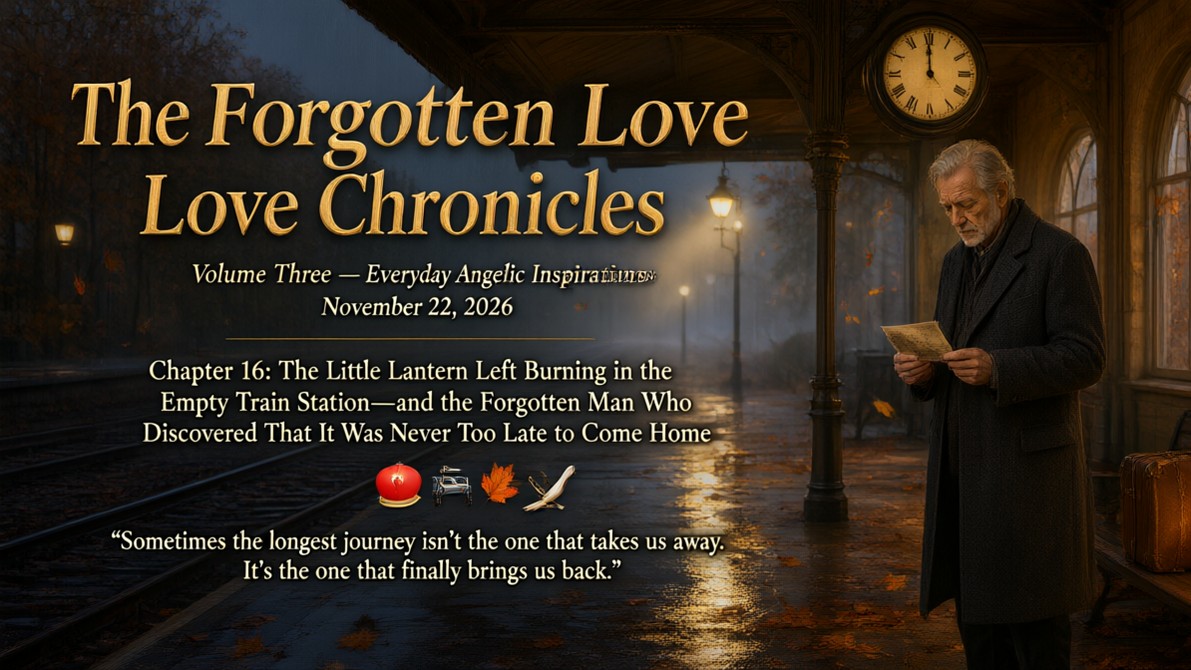
The Forgotten Love Chronicles Volume Three — Everyday Angelic Inspirations November 22, 2026 Chapter 16: The Little Lantern Left Burning in the Empty Train Station—and the Forgotten Man Who Discovered That It Was Never Too Late to Come Home 🏮🚂🍂❤️🪽
 @archangeltara
📷 Image Placement — Opening Scene
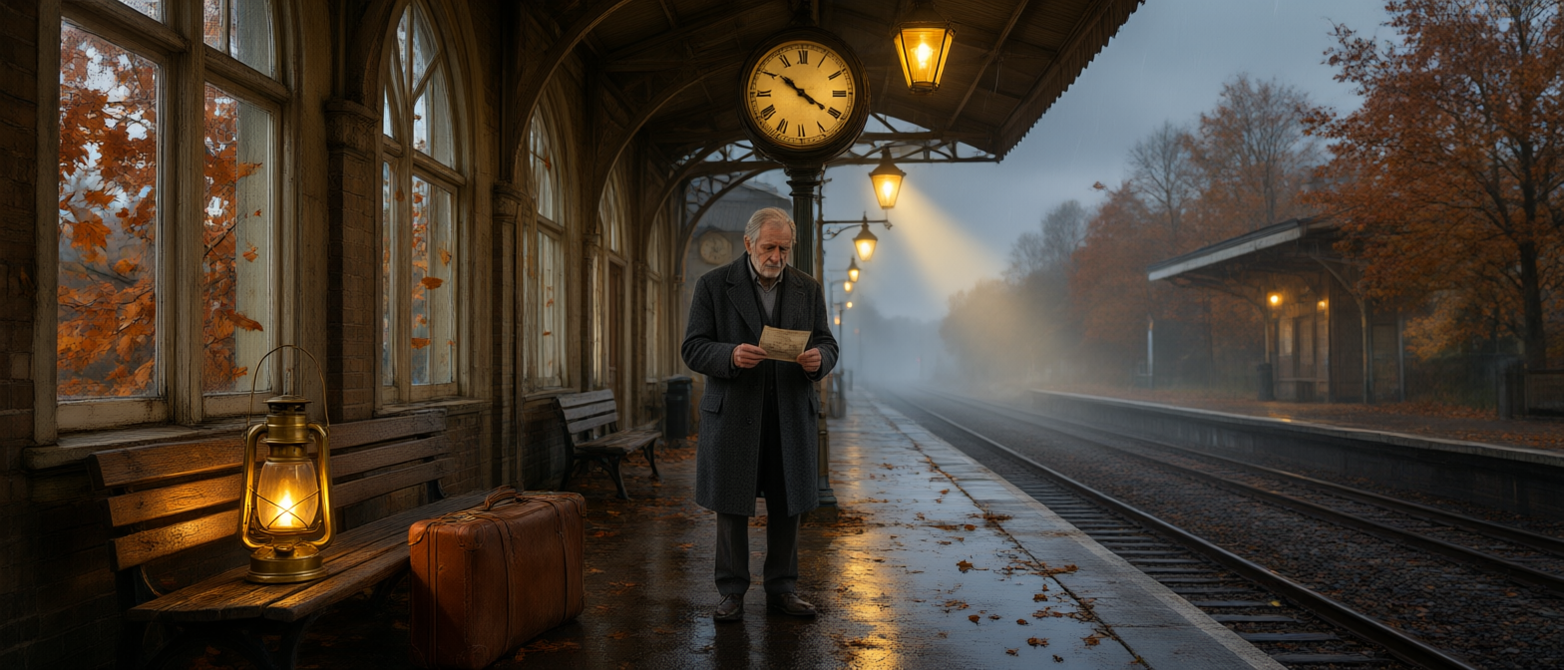
🎨 Image Prompt
Create a breathtaking, ultra-photorealistic 8K cinematic autumn scene inside a small, historic Victorian railway station on a chilly November evening. Rain glistens across the empty railway platform, reflecting the golden glow of antique station lamps. A single old-fashioned brass-and-glass lantern burns warmly on a wooden bench beside a weathered leather suitcase. Through the tall arched windows, amber and copper autumn leaves swirl in the wind. A lonely elderly man in his late seventies stands beneath the station clock, wearing a charcoal wool overcoat and holding a faded photograph. His expression carries years of regret, loneliness, and the fragile possibility of hope. Delicate mist hangs over the distant tracks, while a soft shaft of golden light falls across the lantern as though quietly guiding him home. Rich autumn colors, intricate textures, cinematic depth, realistic human emotion, atmospheric lighting, extraordinary detail, no text, no lettering, no watermark.
“Sometimes the longest journey isn't the one that takes us away. It's the one that finally brings us back.”
The Last Train That Never Came
The little railway station at Bellweather Crossing had not welcomed a passenger train in nearly twelve years.
Its wooden benches had weathered through countless seasons. Ivy climbed the brick walls, the ticket window remained closed, and the old station clock had stopped at 8:17 Pm.
Yet every evening, just before sunset, someone placed a small brass lantern on the bench beside Platform Two.
And every evening, someone made certain it was burning.
Most people in town assumed it was the work of the station caretaker. Others believed it was simply an old tradition that nobody had bothered to question.
But the truth belonged to a man named Arthur Whitcomb.
Arthur was seventy-nine years old.
He lived alone in a modest apartment above a hardware store, where he spent his days repairing clocks, sharpening garden tools, and avoiding conversations about the past.
He had once been a husband, a father, and a man who believed that there would always be another tomorrow.
Then, one terrible argument had changed everything.
Thirty-four years earlier, Arthur had quarreled with his only son, Benjamin.
Benjamin had been twenty-four at the time, full of plans and determined to leave Bellweather Crossing to pursue a career as a landscape architect.
Arthur had wanted him to stay.
His wife, Margaret, had quietly encouraged their son to follow his dreams.
But Arthur believed that leaving meant abandoning the family.
The argument became crueler than either of them intended.
“You're throwing away everything we've built,” Arthur had shouted.
Benjamin had replied, “I'm trying to build something of my own.”
And Arthur, wounded by the thought of losing him, had said the words he would regret for the rest of his life.
“Then don't bother coming back.”
Benjamin had left that afternoon.
He had stood on Platform Two with a suitcase in one hand and a folded letter in his coat pocket.
He had waited for his father to come outside.
Arthur never did.
The train carried Benjamin away.
For years, Arthur told himself his son would return when he was ready to apologize.
But Benjamin never came.
Margaret tried to encourage reconciliation, but Arthur's pride had become a wall neither of them knew how to climb.
Then Margaret became ill.
And when she passed away, Arthur found himself alone with an old house, a quiet kitchen, and a lifetime of words he had never spoken.
He had never learned whether Benjamin had married, whether he had children, or whether he still lived somewhere beneath the same wide sky.
All he knew was that he had once had a son.
And he had told him not to come home.
📷 Image Placement — The Lantern Keeper
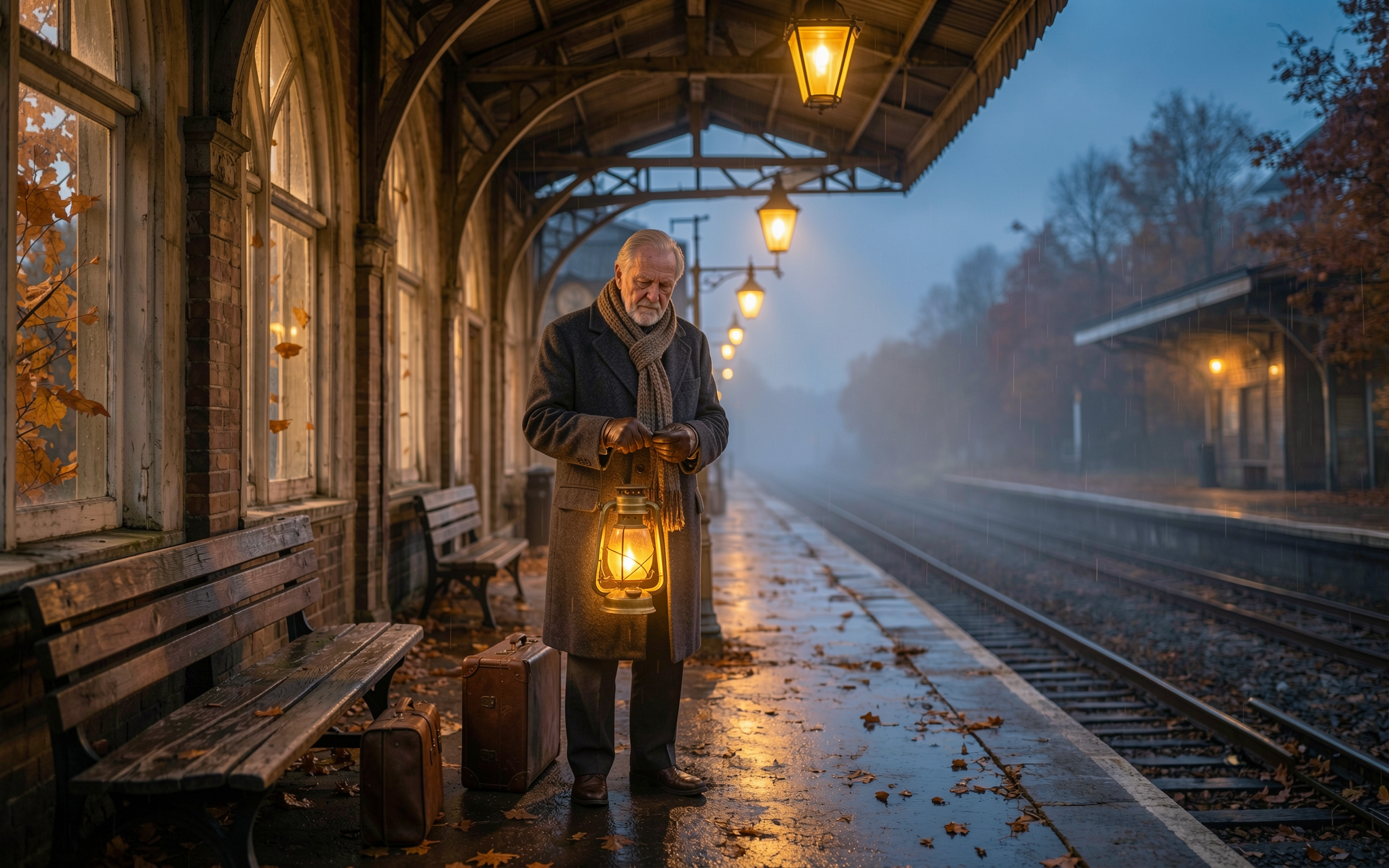
🎨 Image Prompt
Create an ultra-photorealistic 8K cinematic image of a seventy-nine-year-old man named Arthur Whitcomb standing alone on the platform of an abandoned small-town railway station at dusk. He wears a long charcoal wool coat, a knitted scarf, and old leather gloves. In his hands is a delicate brass lantern with a warm glowing flame. Beside him sits a worn wooden bench and a small leather suitcase. Fallen copper and golden leaves gather along the railway tracks, while rainwater reflects the soft amber station lights. Arthur's face shows tenderness, regret, and the quiet determination of someone keeping a promise that nobody else understands. Atmospheric autumn mist, realistic weathered architecture, expressive eyes, warm golden illumination against cool blue twilight, intricate details, no text, no watermark.
The Girl Who Asked the Wrong Question
One Tuesday evening, Arthur was lighting the lantern when he heard a small voice behind him.
“Excuse me, sir?”
He turned.
A girl of about ten stood near the station entrance, holding a yellow umbrella.
Her name was Lucy Bennett.
She lived with her mother, Sarah, in the little white house across from the old railway crossing.
Arthur knew the family by sight but had never spoken to them.
“Can I help you?” he asked.
Lucy pointed toward the lantern.
“Why do you leave that there?”
Arthur looked down at the little flame.
“Because someone might need it.”
Lucy tilted her head.
“But nobody comes here anymore.”
Arthur smiled faintly.
“That's true.”
“So who is it for?”
He looked toward the dark railway tracks.
“Someone who might be trying to find their way home.”
Lucy considered this.
“Is that person lost?”
Arthur took a moment before answering.
“Sometimes people can be lost without knowing where they are.”
Lucy nodded as if that made perfect sense.
“My dad used to say that.”
Arthur looked up.
“Your father?”
Lucy lowered her umbrella.
“He went away when I was little. Mommy says he lives far away. I don't remember him very much.”
Arthur felt something move inside his chest.
“Do you miss him?”
Lucy shrugged.
“I miss having somebody to ask questions about him.”
There was a long silence.
Then Lucy looked at the lantern again.
“Maybe your person is like my dad.”
Arthur couldn't answer.
He simply adjusted the lantern's glass chimney and watched the little flame dance.
Before leaving, Lucy turned back.
“Can I come see it again tomorrow?”
Arthur smiled.
“If you'd like.”
And so began a friendship neither of them had expected.
A Little Girl's Big Idea
Over the next several evenings, Lucy visited Arthur at the station.
Sometimes she brought him a biscuit from home.
Sometimes she brought a drawing.
Once, she brought a tiny paper angel she had made at school.
Arthur placed it carefully beside the lantern.
“What is that for?” he asked.
“Protection,” Lucy replied. “My teacher says angels remind people they're not alone.”
Arthur looked at the paper figure.
“I think your teacher might be right.”
One evening, Lucy arrived carrying a small notebook.
“I have an idea.”
Arthur raised an eyebrow.
“Should I be worried?”
She giggled.
“No. I think you should write a letter.”
“To whom?”
“To your person.”
Arthur's smile faded.
Lucy opened her notebook and showed him a page covered with colorful stars.
“You could leave a message. Maybe if they come back, they'll see it.”
Arthur looked at the empty tracks.
For thirty-four years, he had imagined what he would say to Benjamin if they ever met again.
He had rehearsed apologies in his mind.
He had pictured explanations.
He had even imagined defending himself.
But he had never written the simplest words.
I'm sorry.
“I don't think a letter would change anything,” he said quietly.
Lucy sat beside him.
“Maybe it doesn't have to change everything. Maybe it just has to tell the truth.”
Arthur looked at her.
There was something extraordinary about the way children sometimes understood the things grown-ups spent a lifetime avoiding.
That night, after Lucy had gone home, Arthur returned to his apartment.
He opened the drawer of his old writing desk.
Inside were photographs, a broken pocket watch, and a stack of envelopes he had never mailed.
At the bottom was a photograph of Benjamin standing beside a young maple tree.
On the back, in Margaret's handwriting, were the words:
Our boy, before his first big adventure.
Arthur held the photograph for a long time.
Then he took out a clean sheet of paper.
And he began.
📷 Image Placement — The Unsent Letter
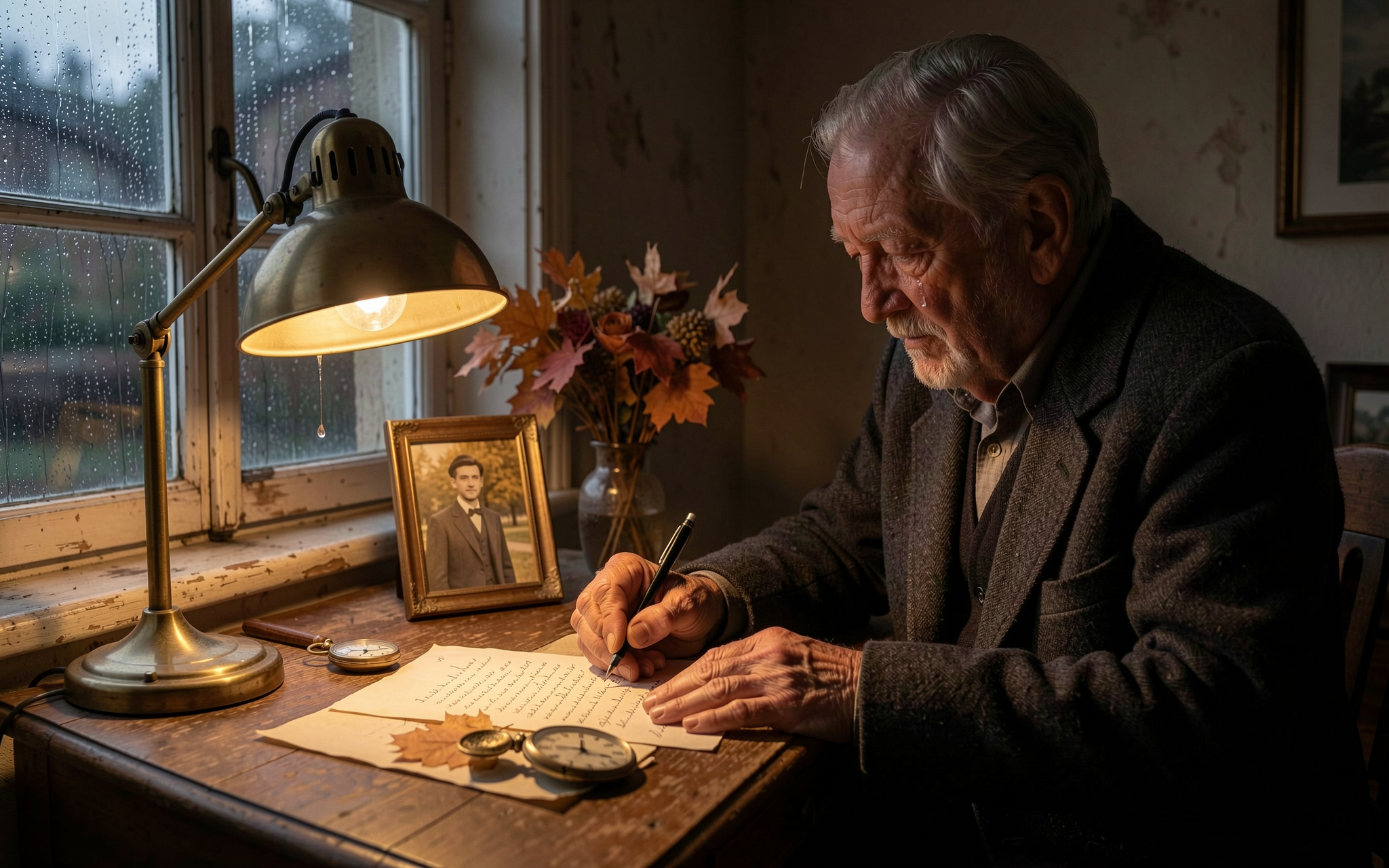
🎨 Image Prompt
Create an intimate, ultra-photorealistic 8K cinematic interior scene in a modest old-fashioned apartment on a November night. An elderly man with silver hair sits at a wooden writing desk beside a rain-streaked window. A brass desk lamp illuminates a handwritten letter, an old family photograph of a young man standing beside a maple tree, and a delicate pocket watch. The elderly man's hand trembles slightly as he writes, and a single tear rests near the corner of his eye. Behind him, a small framed photograph of his late wife sits beside a vase of dried autumn flowers. Warm amber lamplight, deep shadows, realistic aged wood and paper textures, profound human emotion, intimate cinematic composition, no readable text, no watermark.
The Letter That Took Thirty-Four Years
Arthur wrote for nearly two hours.
He did not blame Benjamin.
He did not explain away the argument.
He did not ask his son to understand the fear that had made him so unkind.
Instead, he wrote the truth.
He wrote that he had been wrong.
He wrote that he had confused love with control.
He wrote that he had spent years waiting for his son to return, never realizing that he was the one who had made the road home so difficult.
And finally, he wrote:
Benjamin,
I don't know where life has taken you. I don't know whether you still think of this town or whether you have built a beautiful life somewhere far away.
But I want you to know something.
Your mother was proud of you. I was proud of you, too, even when I was too stubborn to say it.
I should have told you that the day you left.
I am sorry I made you feel that you had to choose between loving your family and becoming the person you were meant to be.
If you ever wish to come home, the door is open.
If you never wish to return, I will understand.
I only hope you know that I never stopped loving you.
Your father,
Arthur.
When he finished, he placed the letter inside an envelope.
But he did not know where to send it.
He had no address.
No telephone number.
No idea whether Benjamin still lived in the same state.
For a moment, Arthur felt defeated.
Then he remembered Lucy's words.
Maybe it just has to tell the truth.
He placed the letter in his coat pocket.
The next evening, he carried it to the station and tucked it beneath the lantern.
Perhaps it was foolish.
Perhaps it was only a way of giving his regret somewhere to rest.
But for the first time in thirty-four years, Arthur felt that he had finally done something other than wait.
A Photograph in the Window
A week passed.
Then another.
The lantern continued to burn.
Lucy noticed that Arthur seemed different.
He smiled more often. He even began bringing a small thermos of hot chocolate to the station.
One afternoon, she arrived with a question.
“Mr. Arthur, can I ask you something?”
“Of course.”
“Would you be sad if your son came back and didn't know what to say?”
Arthur thought about it.
“I suppose I would.”
“Would you be happy anyway?”
He looked at her and smiled.
“Yes. I think I would.”
Lucy nodded.
“Then maybe you should put up a sign.”
“A sign?”
“Something that tells him where to find you.”
Arthur chuckled.
“What would it say?”
Lucy thought for a moment.
“Maybe just, 'The lantern is still burning.'”
Arthur looked at the little girl.
And for the first time, he laughed with his whole heart.
A few days later, Arthur placed an old photograph of himself, Margaret, and Benjamin inside the station's front window.
He did not write a message.
He simply let the photograph speak.
The Stranger on Platform Two
It was a cold Friday evening when the unexpected happened.
Arthur was standing beside the lantern, brushing fallen leaves from the wooden bench, when he noticed a man approaching from the far end of the platform.
The stranger was in his early sixties.
His hair was silver at the temples. He wore a dark green coat and carried a small travel bag.
Arthur barely glanced at him.
The station occasionally attracted people who enjoyed its old architecture or wanted to photograph the abandoned tracks.
But the stranger did not look around.
He looked directly at the lantern.
Then he looked at the photograph in the window.
He took a step closer.
Arthur straightened.
“Evening,” he said.
The stranger's voice was quiet.
“Good evening.”
He stared at the lantern for several seconds.
“Does it burn every night?”
Arthur nodded.
“Every night.”
“Who lights it?”
“I do.”
The stranger swallowed.
“Why?”
Arthur looked toward the tracks.
“Because I made someone believe they weren't welcome here.”
The man's eyes filled with tears.
He looked at Arthur.
“Do you still believe that person might come back?”
Arthur's throat tightened.
“I hope so.”
The stranger set his bag on the bench.
Then he said something that seemed to stop the entire world.
“Dad?”
Arthur froze.
He stared at the man's face.
At the familiar shape of his eyes.
At the small scar above his left eyebrow from the bicycle accident when he was nine.
The years disappeared.
The railway station, the rain, the cold air—all of it seemed to fall away.
“Benjamin?”
The stranger nodded.
For a moment, neither man moved.
Then Arthur took one trembling step forward.
“I thought…”
He could not finish.
Benjamin's eyes filled.
“I know.”
Arthur's hands shook.
“I wrote you a letter.”
Benjamin looked toward the lantern.
“I found it.”
Arthur stared.
“What?”
Benjamin reached into his coat and removed an envelope.
It was the same letter Arthur had placed beneath the lantern.
“I came back last week,” Benjamin explained. “I wasn't sure I could face you. I saw the photograph in the window, and then I found this.”
Arthur's voice broke.
“Why didn't you come sooner?”
Benjamin looked down.
“Because I was afraid you still meant what you said.”
Arthur closed his eyes.
“Oh, son.”
He reached out, then stopped, uncertain whether he still had the right.
Benjamin stepped forward.
And the two men embraced.
It was not a perfect reunion.
Thirty-four years could not be undone in a single moment.
There would be stories to tell, apologies to repeat, and painful memories that deserved to be heard.
But there was something more important than all of that.
They were standing together.
And neither was leaving.
📷 Image Placement — The Reunion Beneath the Lantern
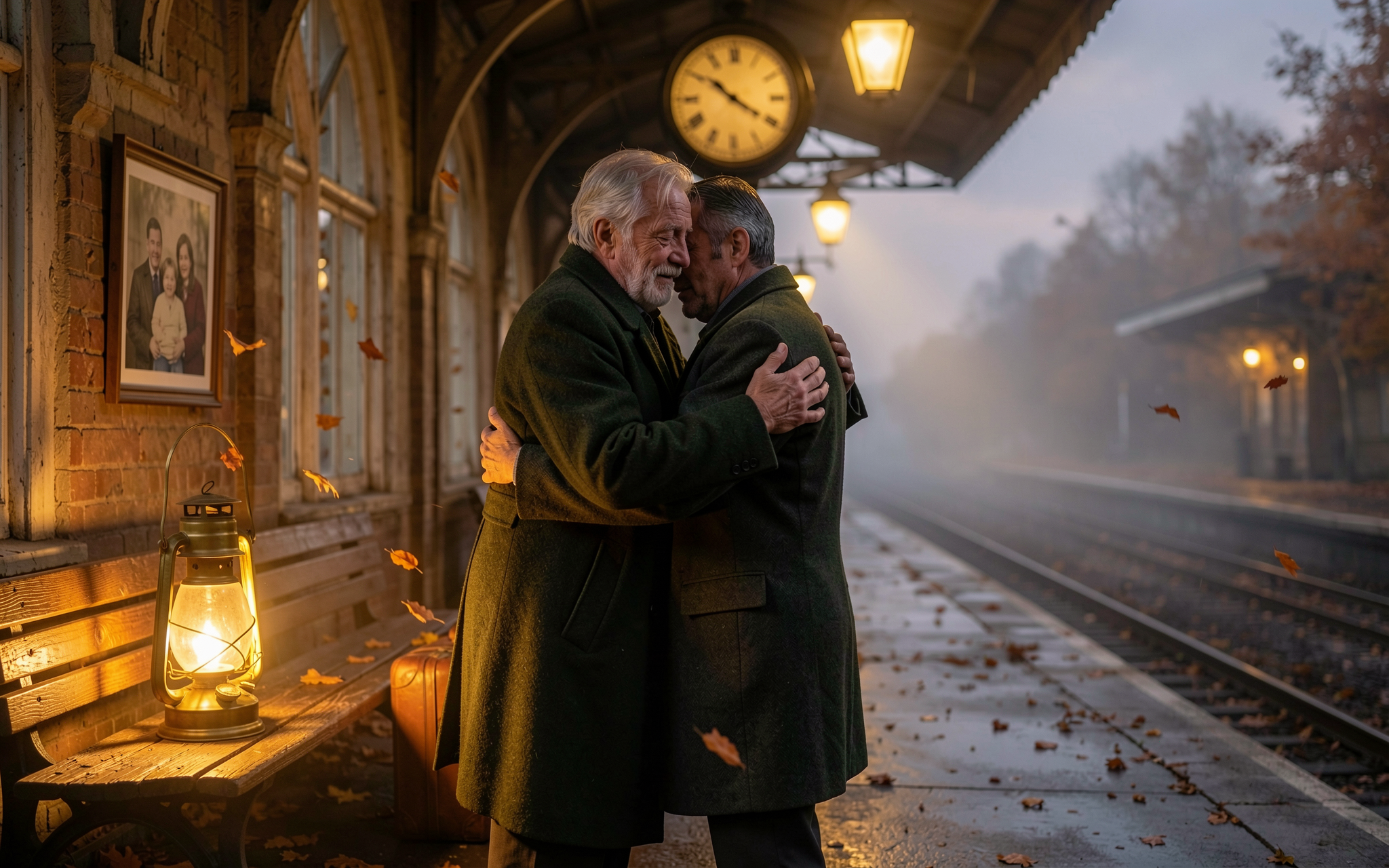
🎨 Image Prompt
Create a deeply moving, ultra-photorealistic 8K cinematic scene on the platform of a historic abandoned railway station at twilight. An elderly father, seventy-nine, with silver hair and a weathered face, embraces his sixty-three-year-old son after decades apart. The father's hands gently clutch the back of his son's dark green wool coat, while the son's eyes are closed and tears are visible on his cheeks. A glowing brass lantern rests on the wooden bench beside them, casting a beautiful golden pool of light across the platform. Behind them, a framed family photograph is visible in the station window. Autumn leaves drift across the wet platform, and distant railway tracks disappear into soft evening mist. Authentic expressions of forgiveness, relief, love, and reconciliation, warm cinematic lighting, realistic skin and fabric textures, emotionally powerful composition, no text, no watermark.
The Things They Had Missed
They sat together on the old wooden bench.
At first, the conversation came slowly.
Benjamin told his father about the years away.
He had married a woman named Helen. They had raised two daughters, Sophie and Grace. He had built a successful career designing gardens and public parks.
He showed Arthur photographs on his phone.
There were pictures of his daughters graduating, a family vacation near the ocean, and a garden he had designed around a small community library.
Arthur studied every photograph.
He smiled at the girls.
Then he looked at one picture for a long time.
“Your mother would have loved them.”
Benjamin nodded.
“She would have.”
Arthur lowered his eyes.
“I missed so much.”
Benjamin was quiet.
“Yes,” he said. “You did.”
The words hurt.
But Arthur did not argue.
He simply nodded.
“I know.”
After a moment, Benjamin reached into his travel bag and removed a small wooden box.
“I brought something.”
Inside was an old pocket watch.
Arthur recognized it immediately.
It had belonged to his father.
He had given it to Benjamin on his eighteenth birthday.
“I thought I lost this,” Arthur whispered.
“You didn't lose it. I kept it.”
Arthur turned the watch over in his hand.
“Why?”
Benjamin smiled sadly.
“Because even when I was angry, I still wanted to remember the good things.”
Arthur held the watch against his chest.
Then Benjamin said, “I brought something else.”
He removed a folded piece of paper.
It was an old drawing.
A child's drawing of a train station, a father, and a little boy holding hands.
At the top, in crooked handwriting, were the words:
My dad and me going on an adventure.
Arthur stared at it.
“I drew that when I was seven,” Benjamin said.
Arthur remembered.
He remembered the crayons scattered across the kitchen table.
He remembered Margaret laughing as their little boy insisted that the train needed a chimney.
And he remembered that he had promised to take Benjamin on a real train adventure someday.
They had never gone.
Arthur's eyes filled.
“I should have taken you.”
Benjamin folded the drawing carefully.
“We still have time to make a few memories.”
Arthur looked at his son.
And that was the moment he understood that forgiveness was not the same as pretending nothing had happened.
It was choosing to build something new without denying what had been broken.
A Journey That Didn't Need a Train
The following morning, Benjamin returned to Arthur's apartment.
He brought coffee, fresh bread, and two photographs of his daughters.
They spent the afternoon walking through the town.
Arthur showed him the old hardware store, the little park where he used to play baseball, and the maple tree that had stood beside the family home for more than sixty years.
Benjamin stopped beneath its branches.
“It's still here.”
Arthur nodded.
“Your mother planted it.”
Benjamin placed his hand against the trunk.
“She always said trees were good at remembering.”
Arthur smiled.
“She was right about most things.”
That afternoon, Benjamin called his daughters.
He told them that he had found their grandfather.
Then he turned the phone toward Arthur.
A young woman appeared on the screen.
“Grandpa?”
Arthur blinked.
He had never heard anyone call him that.
“Hello, sweetheart.”
The young woman smiled.
“Dad says you like old trains.”
Arthur laughed.
“I certainly do.”
“Then I think we should visit. Maybe we can all go somewhere together.”
Arthur looked at Benjamin.
His son nodded.
“Yes,” he said. “I think we should.”
The Lantern for Everyone
By December, the old railway station had become a gathering place.
Not because trains had returned, but because people had.
Lucy and her mother began helping Arthur decorate the platform with evergreen branches and tiny golden lights.
Benjamin visited every weekend.
His daughters came too.
They brought cookies, helped sweep the platform, and listened to Arthur tell stories about their grandmother.
One evening, Lucy arrived carrying a small wooden box.
“I made something,” she announced.
Inside were several tiny brass-colored lanterns, each with a little paper tag attached.
Arthur picked one up.
“What are these for?”
Lucy smiled.
“People who need a little light.”
Together, they placed the lanterns along the station windows.
Some were for people who had lost someone.
Some were for people who were waiting for forgiveness.
Some were for people who had moved away and wondered whether anyone still remembered them.
And one was for Lucy's father.
She placed it beside Arthur's lantern.
“Maybe someday he'll come back too,” she whispered.
Arthur knelt beside her.
“I hope he does.”
Lucy looked up.
“And if he doesn't?”
Arthur gently tucked a loose strand of hair behind her ear.
“Then I hope you always remember that someone else's choices don't decide how much you are loved.”
Lucy thought about that.
Then she leaned against him.
The following Sunday, the town held its first Lantern Evening.
Families gathered at the station with warm drinks and homemade treats. People wrote messages to loved ones they missed, to friends they needed to forgive, and to people they wished they had thanked.
Some letters were mailed.
Others were kept.
A few were placed beside the lanterns.
Arthur stood with Benjamin, Sophie, Grace, and Lucy beneath the old station clock.
The clock still showed 8:17.
It had not moved in twelve years.
But nobody seemed to mind.
Benjamin looked at his father.
“Do you think we should have it repaired?”
Arthur smiled.
“Perhaps.”
Then he looked toward the glowing lanterns.
“But I don't think we're late anymore.”
Benjamin put his arm around him.
And for the first time in decades, Arthur did not look toward the railway tracks hoping someone would return.
He looked beside him.
His family was there.
The lantern was still burning.
And the journey home had finally begun.
📷 Image Placement — A Station Filled With Light
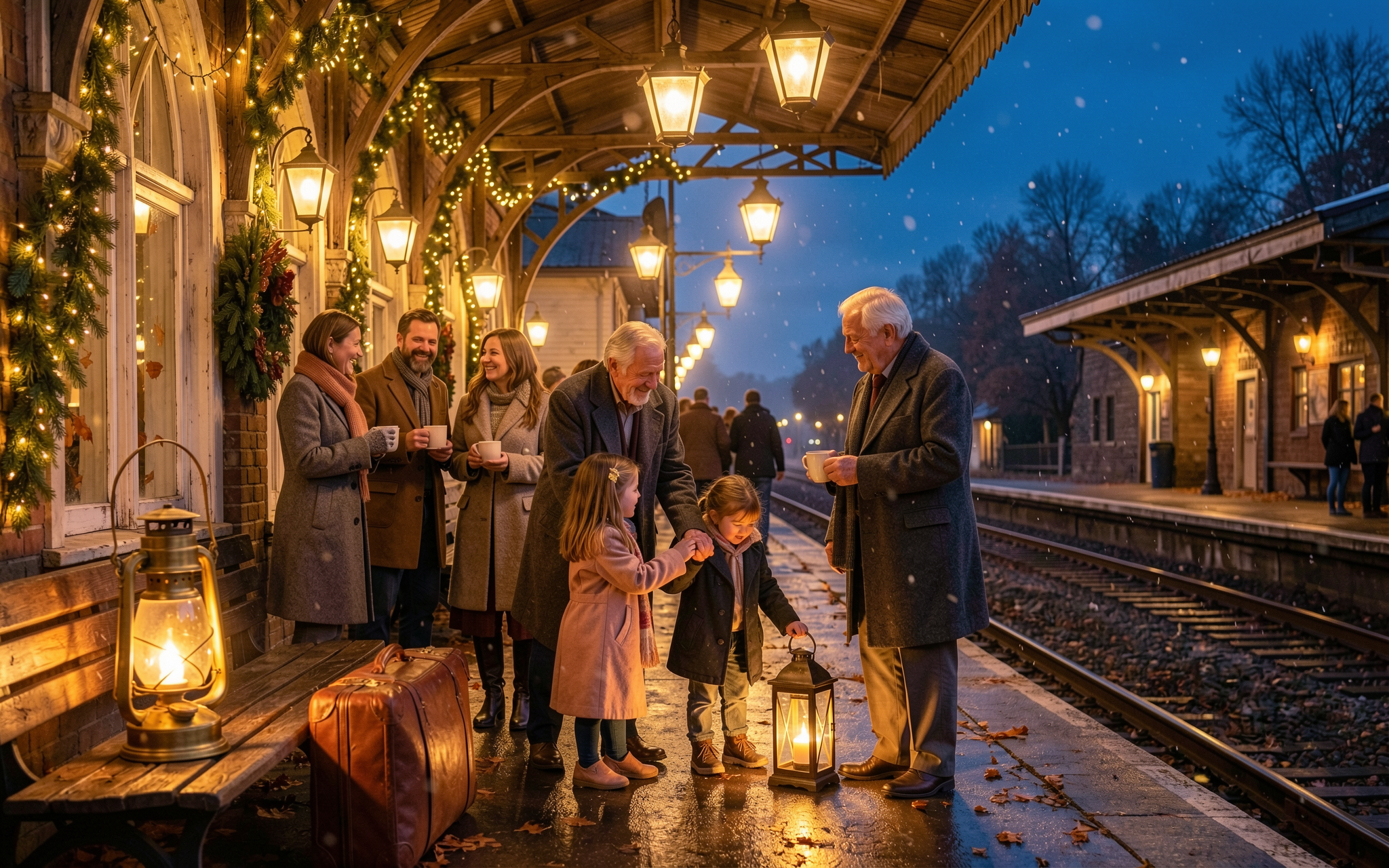
🎨 Image Prompt
Create a magnificent, ultra-photorealistic 8K cinematic Christmas-season evening at a restored historic small-town railway station in late November. The station platform glows with dozens of beautiful brass and glass lanterns, warm golden fairy lights, evergreen garlands, and delicate wreaths. Families and neighbors gather together in wool coats and scarves, sharing hot chocolate and smiling beneath the soft amber lights. In the foreground, an elderly silver-haired father stands with his adult son and two granddaughters, their hands gently joined. A young girl places a tiny lantern beside an older man's glowing lantern. Beyond them, wet railway tracks reflect the golden lights beneath a deep blue twilight sky. A few snowflakes begin drifting through the air as copper autumn leaves remain scattered along the platform. The scene radiates forgiveness, belonging, family reconciliation, and renewed hope. Breathtaking cinematic composition, exquisite detail, authentic joyful expressions, no text, no watermark.
❤️ Life Lesson
Sometimes the greatest distance between two people is not measured in miles.
It is measured in pride, fear, silence, and the words we wish we could take back.
Arthur spent thirty-four years waiting for his son to return, never realizing that his own words had made the journey home seem impossible.
He believed that time would eventually solve what anger had broken.
But time alone does not heal every wound. Sometimes healing begins when someone is brave enough to admit they were wrong.
An apology cannot erase the past, and forgiveness does not require us to pretend that painful things never happened. But an honest apology can open a door that has been closed for years.
We should never assume that the people we love know how much they mean to us.
Tell them.
Call them.
Listen to them.
Make room for their dreams, even when those dreams lead them somewhere different from where you imagined.
And if there is someone you have been meaning to reach out to, do not wait for the perfect words.
A simple, sincere beginning can be enough.
Because sometimes the most beautiful miracle is not that someone comes back.
It is that someone finally makes them feel welcome.
❤️ A Thought to Carry Into Tomorrow
You may not be able to change yesterday's conversation, undo yesterday's mistake, or reclaim all the years that have passed.
But you can decide what kind of words you will speak today.
You can open a door.
You can offer an apology.
You can forgive yourself for being human.
And you can leave a little light burning for someone who may still be finding their way home.
Never underestimate the power of a light left on, a door left open, or a heart willing to begin again. ❤️
Topics
Writing one? Publish your story on the BudgetPixel blog.
 @pocahontas

 @faerierealm

 @EternaSky

 @suga2309