The Best AI Influencer Generators in 2026, Compared
There are three ways to get an AI influencer: cast a ready-made one, train your own on photos, or send reference pictures with every prompt. We compared ten tools from their own docs and pricing pages in October 2026: BudgetPixel for a ready-made cast your AI agent can direct; Higgsfield, OpenArt, Magnific, Foxy and ZenCreator for making your own; HeyGen, Captions and Arcads for talking video; and Midjourney for art-directed stills.
 By BudgetPixel Team12 min readFacts verified
On this page
The best AI influencer generator depends on what you need: a ready-made influencer you can use today, your own character trained on photos, or a talking avatar for video. We compared ten tools on the questions that decide it: how the face stays the same from post to post, whether it makes photos, video or talking clips, what it costs at regular prices, whether you can use it commercially, and whether an AI agent can drive it. Facts come from each company's own pricing, help and terms pages, read on October 28 and 29, 2026. We make BudgetPixel, one of the ten, so weigh that; we say below where others are stronger.
Which AI influencer generator should you use?
Pick by the job: a ready-made cast if you want to post this week, a trained character if the influencer must be one specific face, and an avatar tool if the influencer mostly talks to camera.
| Tool | Best for | How the face stays the same |
|---|---|---|
| BudgetPixel | A ready-made cast, in photos and video, also for AI agents | Cast by @handle: a fixed picture plus its written look; or create your own |
| Higgsfield | Designing your own influencer, effects-heavy video | Build one from 19 menu settings, or train Soul ID on 20 to 80 photos |
| OpenArt | One character across many image and video models | One reference picture, or train on 4 to 100 |
| Magnific (formerly Freepik) | Teams already using Magnific | Train on about 12 to 24 pictures, or save one from 1 to 6 |
| Foxy AI | The quickest trained face, of yourself | Train on 3 photos of you |
| ZenCreator | Pay-as-you-go persona photos | Face swap plus a saved seed |
| HeyGen | Talking-head video in many languages | Stock avatars, or an avatar of you |
| Captions | Talking videos of yourself | An AI Twin from about 10 seconds of video |
| Arcads | UGC-style video ads | 1,000+ stock actors, or a generated face |
| Midjourney | Art-directed stills | Up to 4 reference pictures per prompt |
How do AI influencer generators keep a face consistent?
In one of three ways, and the way decides how fast you can start and whose face it is.
- A ready-made character. The tool already has the face and sends a saved picture of it with every job. BudgetPixel's cast works this way for photos and video, with a written description of the look sent along too; HeyGen, Captions and Arcads do it with stock avatars for talking video. Nothing to train, and you can post the same day.
- A trained character. You upload photos and the tool learns one face: 3 photos of yourself for Foxy, 4 to 100 for OpenArt, about 12 to 24 for Magnific, 20 to 80 for Higgsfield's Soul ID. It takes photos up front, and the right to use that face.
- Reference pictures you send. You pass one to four pictures with each request, as with Midjourney's Edit model, or swap a saved face in, as ZenCreator does. Flexible, but you manage the pictures yourself.
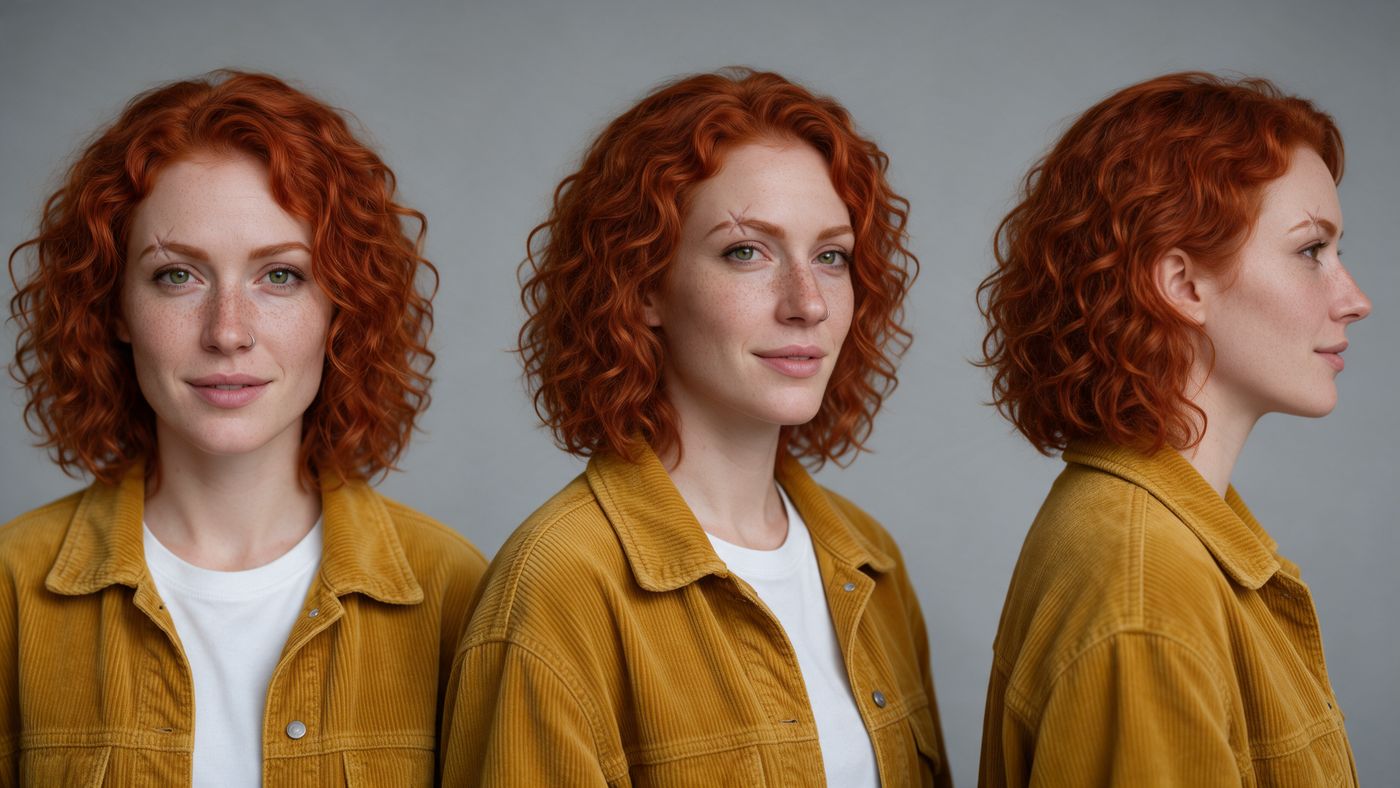
Whichever way you choose, look at a week's pictures side by side before you post: small details like a hairstyle, a logo or freckles can drift.
If you want a ready-made AI influencer
BudgetPixel: a ready-made cast with full briefs
Best for: posting this week, in photos and video, by hand or through an AI agent.
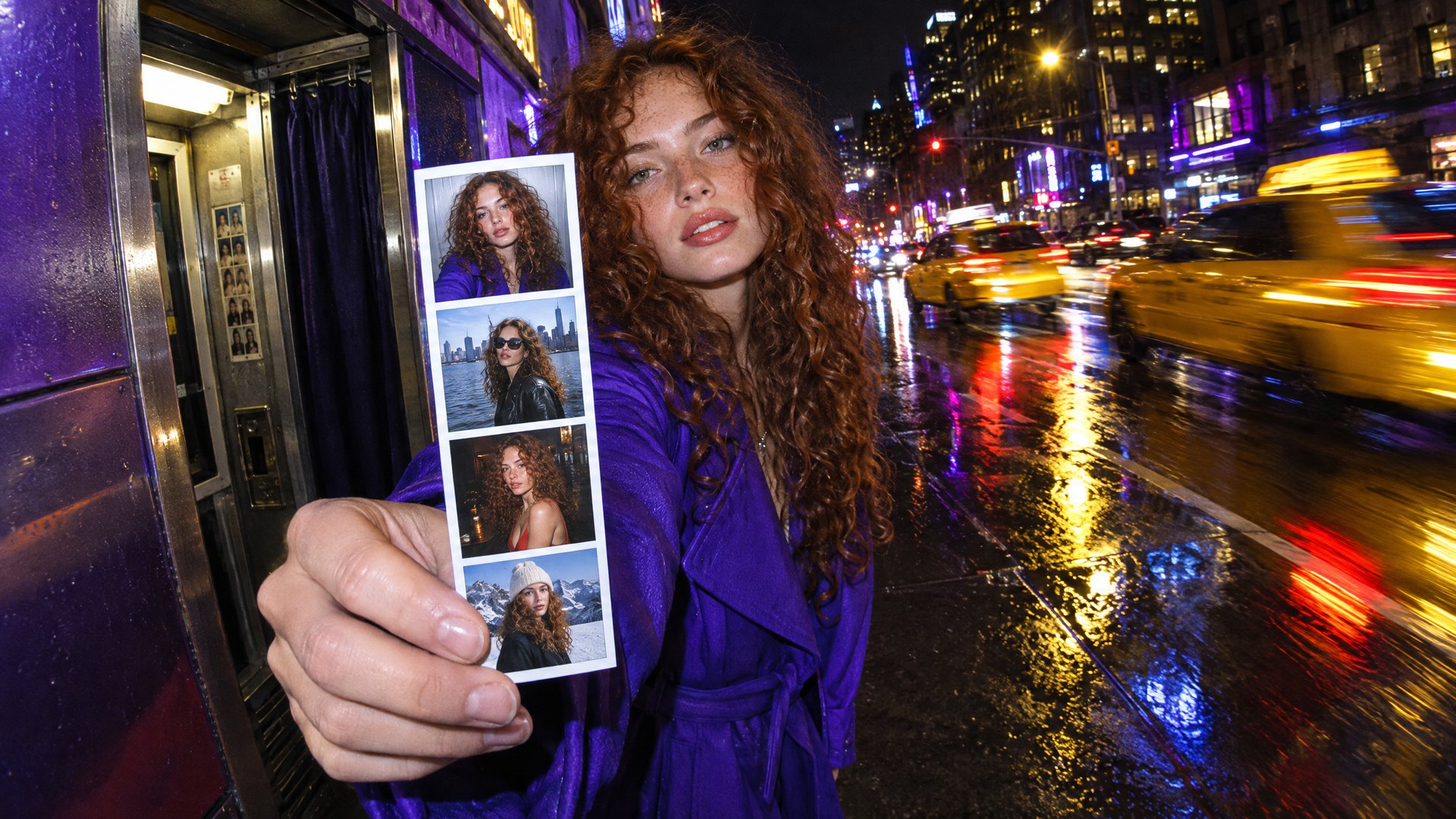
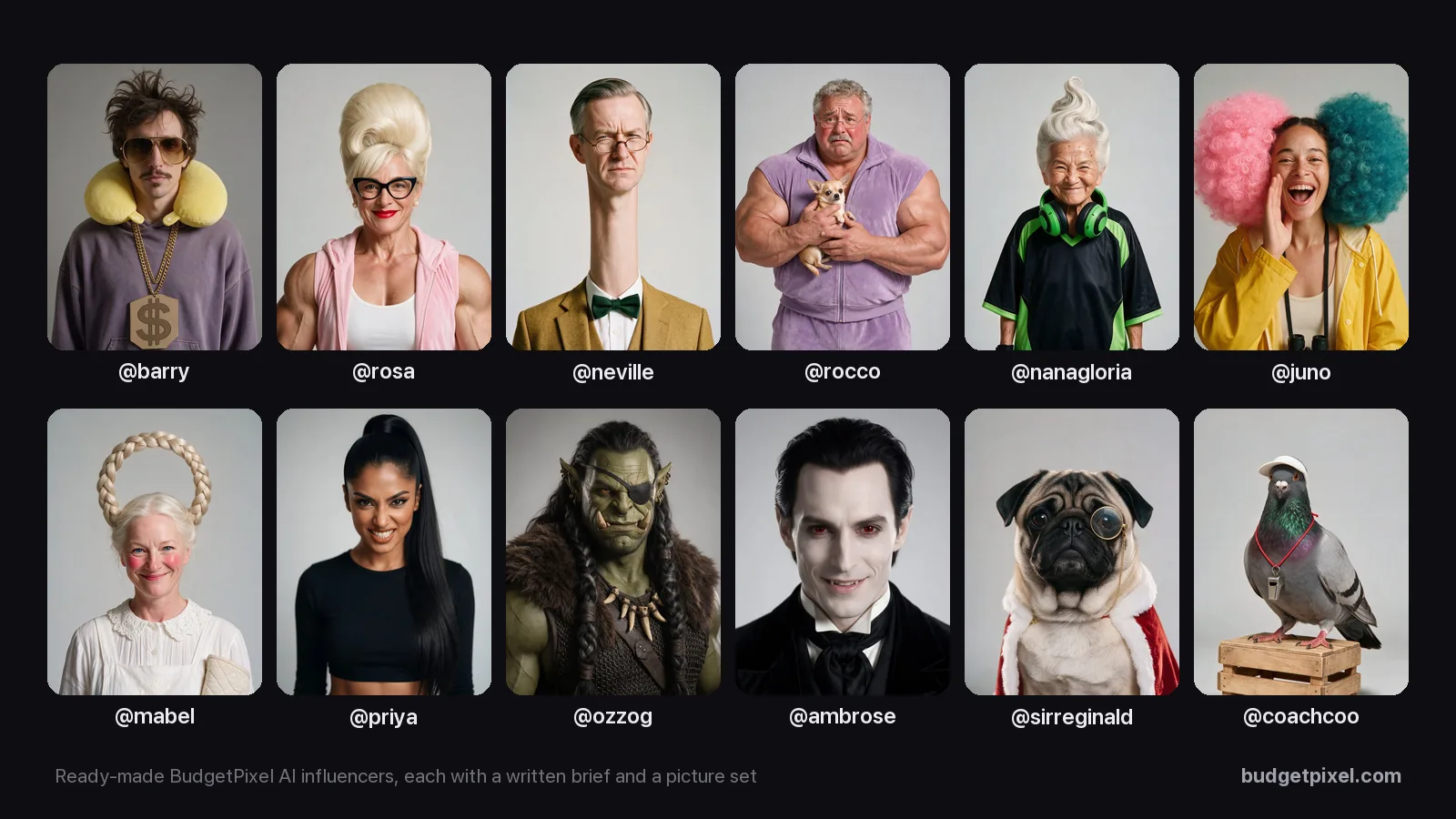
BudgetPixel has a cast of official AI influencers, from funny originals and glam creators to fantasy characters and animals, and you cast one by writing their @handle in a picture or video prompt. Each comes with a kit: a written description of the look, a personality, a speaking style, directing notes, consistency rules and a set of tagged pictures (portrait, full body, selfie, side profile and more). The @handle works on the leading image and video models, such as Nano Banana, Seedream, GPT Image, FLUX 3, Seedance, Kling, Wan and Veo, and on most of them up to four characters can share one picture.
- Makes: photos and video, with sound on models such as Seedance 2.5. You can also create your own characters from a photo or a description.
- Price: the Free plan has 300 credits a month plus daily check-in credits; paid plans start at $10 a month (or $8.33 a month billed yearly) with 11,000 credits. Casting has no fee of its own; you pay for the picture or video, for example 45 credits for a Nano Banana 2.1 picture at 1K (a few models add 5 credits for each extra character).
- Commercial use: personal only on Free, limited on Basic, full from Premium ($22 a month).
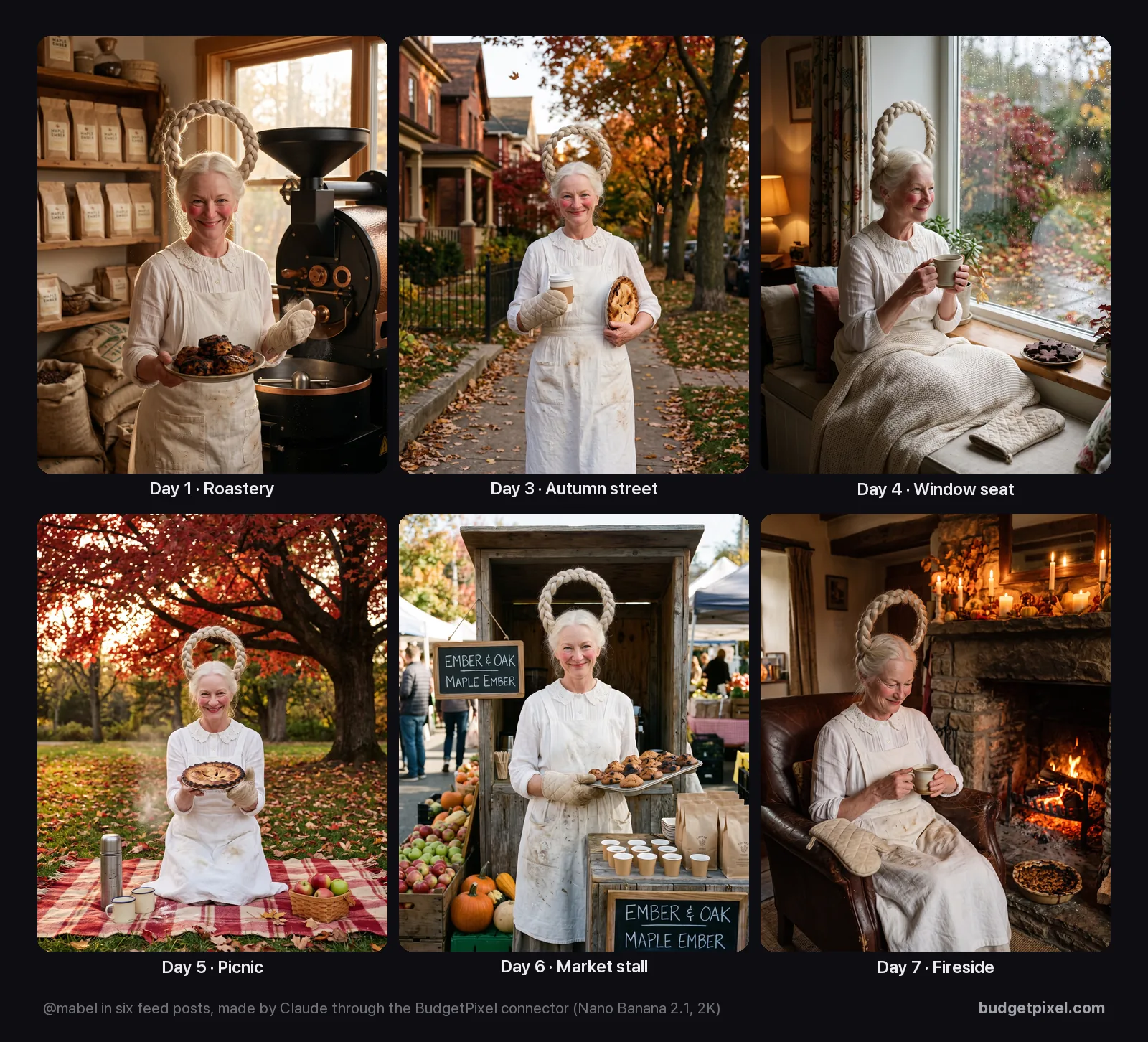
- For agents: the API and an MCP server give Claude, Cursor and other agents the cast, the full briefs and a tool that recommends an influencer for a brief. In our test in Claude, one brief became a week of posts of the same woman. The agent tools need a paid plan.
- Watch out: the influencers have no fixed voice yet, so the voice can change between clips. Anyone can cast the same influencers, so they aren't exclusive to your brand, and BudgetPixel asks you to credit them when you post. For one specific real face, create your own character.
If you want to build or train your own
Higgsfield: design an influencer or train one
Best for: designing an invented influencer from scratch and putting them in effects-heavy video.
Higgsfield's AI Influencer Studio builds a whole character from 19 menu settings, with an optional photo of you or of someone who agreed, and its Soul ID trains a character on 20 to 80 photos of a person who agreed to it. It makes a portrait and a full-body shot per run, and video in the same studio (motion transfer or object swap), with lip sync in a separate tool.
- Price: plans start at $15 to $19 a month, depending on which of Higgsfield's own pages you read. Its pricing post of October 24, 2026 lists Starter at $15 a month for 200 credits, Plus at $49 for 1,000 ($39 a month billed yearly, per its October 20 post) and Ultra at $129 for 3,000; its US pricing guide of October 23 lists Starter at $19 for 270 and Plus at $59 for 1,200. A character generation costs 1.12 credits, but on monthly billing Starter, Plus and Ultra allow only 6, 33 and 100 a month. The free plan allows one character generation, with no commercial use.
- For agents: an MCP server, on paid plans, that spends plan credits.
- Watch out: the monthly cap on character generations, and prices that vary by page and by region.
OpenArt: one character across many models
Best for: keeping one character across many image and video models.
OpenArt makes a character from one reference picture (its Multi-View tool can turn it into nine angles), from text, or by training on 4 to 100 pictures, then lets you tag it in images and video and add lip sync with a cloned or synthetic voice.
- Price: Starter $14 a month with 4,000 credits, but without commercial use; Plus $34 a month ($27 a month billed yearly) with 12,000 credits allows it. New accounts get 40 trial credits for 7 days, and free results can carry a watermark.
- For agents: an MCP server on every plan, though characters aren't in it yet.
- Watch out: the cheapest plan doesn't allow commercial use.
Magnific (formerly Freepik): characters for Magnific teams
Best for: teams already making their designs with Magnific.
Magnific trains a custom character on about 12 to 24 pictures (8 to 20 through its API) or saves a lighter library character from 1 to 6, then uses it in images, and as the first frame of a video.
- Price: Premium $20 a month, or $14.50 a month billed yearly. Training costs 3,000 credits per character, and a Nano Banana 2 picture at 2K 75 credits. There's no free plan card, though a free account gets limited daily use.
- For agents: an API and an MCP server.
- Watch out: two character systems that need different numbers of photos.
Foxy AI: the quickest trained face, of yourself
Best for: one consistent face of yourself for photos, with little setup.
Foxy trains a character on three photos of you, one of the face and two full-body, usually in under a minute, after checking your ID; a made-up persona is bought ready-made from its shop. It makes photos and short videos with sound added automatically.
- Price: Starter $9 a month, or $6 a month billed yearly, for 80 credits; a basic picture costs about 8 to 11 cents. No free tier is listed.
- For agents: no API listed.
- Watch out: no voice clone or talking video yet (both "coming soon"), and lip sync only where a scene calls for it. Its help pages allow commercial use, while its terms say it depends on the plan.
ZenCreator: pay-as-you-go persona photos
Best for: people who'd rather buy credits than subscribe.
ZenCreator keeps a face with face swap plus a saved prompt, seed and presets, and makes images and animated video with lip sync.
- Price: credit packs from $19.99 for 200 credits, which don't expire; a picture costs 1 to 3 credits, about 10 to 30 cents at that pack's rate.
- For agents: an API, and an MCP server in beta.
- Watch out: it links uncensored tools. Its terms do allow commercial use of what you make.
If your influencer mostly talks to camera
HeyGen: talking avatars in many languages
Best for: talking-head video, voice cloning and translation. It's stronger than everything else here for spoken video.
HeyGen says it has more than 1,100 stock influencer-style avatars (its pricing table lists 700+ on paid plans), or makes an avatar of you, and turns a script into a talking video with lip sync, a cloned voice and translation.
- Price: Free makes 3 videos a month, up to a minute, watermarked and for personal use; Creator is $29 a month ($24 a month billed yearly) with 600 credits.
- For agents: an API from $5, and an MCP server whose video agent can pick an avatar itself.
- Watch out: it makes talking video, not a photo feed.
Captions: talking videos of yourself
Best for: creators who want an AI version of themselves.
Captions, from the company now called Mirage, makes an AI Twin from about 10 seconds of footage or a selfie, or uses one of 200+ stock avatars, and dubs video into 30+ languages.
- Price: the Max plan, which includes twins, is $24.99 a month (its iOS price) with 500 credits. The free tier gets no monthly AI credits, only 60 to 200 one-time ones.
- For agents: the Mirage API; its docs mention an MCP server, but the setup page is gone.
- Watch out: its site says avatar videos can be used commercially, but its terms bar commercial use of its content "except as authorized", and you need written consent from anyone identifiable.
Arcads: UGC-style video ads
Best for: ad teams testing many talking-actor videos.
Arcads has more than 1,000 stock AI actors, which it says are based on real actors who consented and are paid, or generates a face, and makes talking-actor videos in 70+ languages.
- Price: shown only inside the app. The Starter plan's 8,000 monthly credits cover about ten talking videos of up to 2 minutes; the 72-hour trial needs a card and rolls into Starter.
- For agents: an API for talking actors and lip sync (Pro plan and up), and an MCP server on every plan, including the trial.
- Watch out: the trial turns into a paid plan unless you cancel.
If you want art-directed stills
Midjourney: the strongest stills
Best for: art-directed photos where the look matters more than speed. For pure image quality, it's stronger than most tools here.
Midjourney keeps a character by passing up to four reference pictures with each prompt, with its V8 Edit model, and makes stills and short image-to-video clips.
- Price: Basic $10 a month ($8 a month billed yearly). Companies with more than $1 million a year in revenue, and their employees, need Pro ($60) or Mega ($120). No free tier.
- For agents: none; Midjourney says it doesn't offer an API.
- Watch out: its Omni Reference guide (for V7) warns that small details like freckles or logos may not match perfectly.
What does an AI influencer cost?
Most tools let you start for $10 to $30 a month; the catches are commercial use and caps. These are the cheapest regular plans for each, as listed on October 28 and 29, 2026:
| Tool | Cheapest paid plan | Free to try? |
|---|---|---|
| BudgetPixel | $10 a month, or $8.33 billed yearly | Yes: 300 credits a month, personal use |
| Higgsfield | $15 to $19 a month (its pages differ) | 1 character, no commercial use |
| OpenArt | $14 a month; commercial use from $34 | 40 trial credits for 7 days |
| Magnific | $20 a month, or $14.50 billed yearly | Free account, daily limits |
| Foxy AI | $9 a month, or $6 billed yearly | No |
| ZenCreator | $19.99 credit pack | No |
| HeyGen | $29 a month, or $24 billed yearly | 3 videos a month, personal use |
| Captions | $24.99 a month (iOS price) | No monthly AI credits |
| Arcads | In-app only | 72-hour trial, card needed |
| Midjourney | $10 a month, or $8 billed yearly | No |
Do AI influencers have to be labeled?
Usually, yes. Instagram asks accounts built around an AI-generated person to turn on its AI-generated profile label, YouTube requires creators to disclose realistic AI content and labels it, and the EU's AI Act has required deepfakes to be disclosed since August 2, 2026. In the US, the FTC expects sponsored posts by virtual influencers to carry a clear ad disclosure, and bans fake testimonials, such as ones that pass off a made-up person as real. OpenArt and Foxy, for two, tell you outright to say the persona is AI. Our guide to AI influencers in Claude has the details and an example of a labeled caption. And only train a character on your own face, or on someone who agreed to it.
How we compared
We didn't use or pay for any competitor's tool for this comparison. Every fact about them comes from their own pricing, help, terms and blog pages, read on October 28 and 29, 2026. Prices are regular US list prices, without promotions; where a company's own pages disagree, as Higgsfield's do, we show both, and credit maths is approximate. We asked every tool the same questions: how the face stays the same, what it makes, the cheapest plan that allows commercial use, the free tier, and API or MCP access. BudgetPixel's results are from our own test, run on October 29, 2026. We make BudgetPixel, we use no affiliate links, and we left out companion-chat apps and claims about earnings or "undetectable" AI influencers.
Questions people ask
What is the best AI influencer generator?
It depends on what you need. For a ready-made influencer you can use right away in photos and video, BudgetPixel has a cast with full written briefs. To build or train your own, Higgsfield and OpenArt are the most complete. For talking-head video, HeyGen; for UGC-style video ads, Arcads; for art-directed stills, Midjourney.
How do AI influencer generators keep the same face?
In one of three ways: a ready-made character the tool already has (BudgetPixel's cast, and the stock avatars in HeyGen, Captions and Arcads), a character trained on your photos (Higgsfield, OpenArt, Magnific, Foxy), or reference pictures sent with each prompt (Midjourney, or ZenCreator's saved face swap).
Can I make an AI influencer for free?
You can try several for free, mostly for personal use only. BudgetPixel's Free plan has 300 credits a month plus daily check-in credits; OpenArt gives 40 trial credits for 7 days; HeyGen's free plan makes 3 watermarked videos a month; Higgsfield's free plan allows one character generation. For commercial use, all four need a paid plan.
Do I need photos of a real person?
Not for a ready-made cast or a character built from menus. Training a character takes photos: 3 of yourself for Foxy, 4 to 100 for OpenArt, about 12 to 24 for Magnific and 20 to 80 for Higgsfield's Soul ID. Only use your own face, or the face of someone who agreed to it.
Can an AI influencer talk?
Yes. HeyGen, Captions and Arcads are built for talking video with lip sync and voices. BudgetPixel's influencers can speak in clips made with models such as Seedance 2.5, but they don't have a fixed voice yet, so the voice can change from clip to clip.
Which AI influencer tools work with AI agents like Claude?
BudgetPixel, Higgsfield, HeyGen, Magnific, OpenArt, Arcads and ZenCreator (in beta) run MCP servers that agents such as Claude can use. BudgetPixel's is the only one we found whose agent tools give each ready-made character a written brief and include a tool that recommends one for a brief; HeyGen's and Arcads' tools can list their stock casts.
Do AI influencers have to be labeled?
Usually, yes. Instagram asks accounts built around an AI-generated person to turn on its AI-generated profile label, YouTube requires creators to disclose realistic AI content, the EU's AI Act requires deepfakes to be disclosed, and in the US sponsored posts by virtual influencers still need a clear ad disclosure.
See for yourself
A ready-made cast you can put in pictures and video, with no casting fee. Or create your own character from a photo or a description.