
NIGHT SHIFT
 @germancowboy
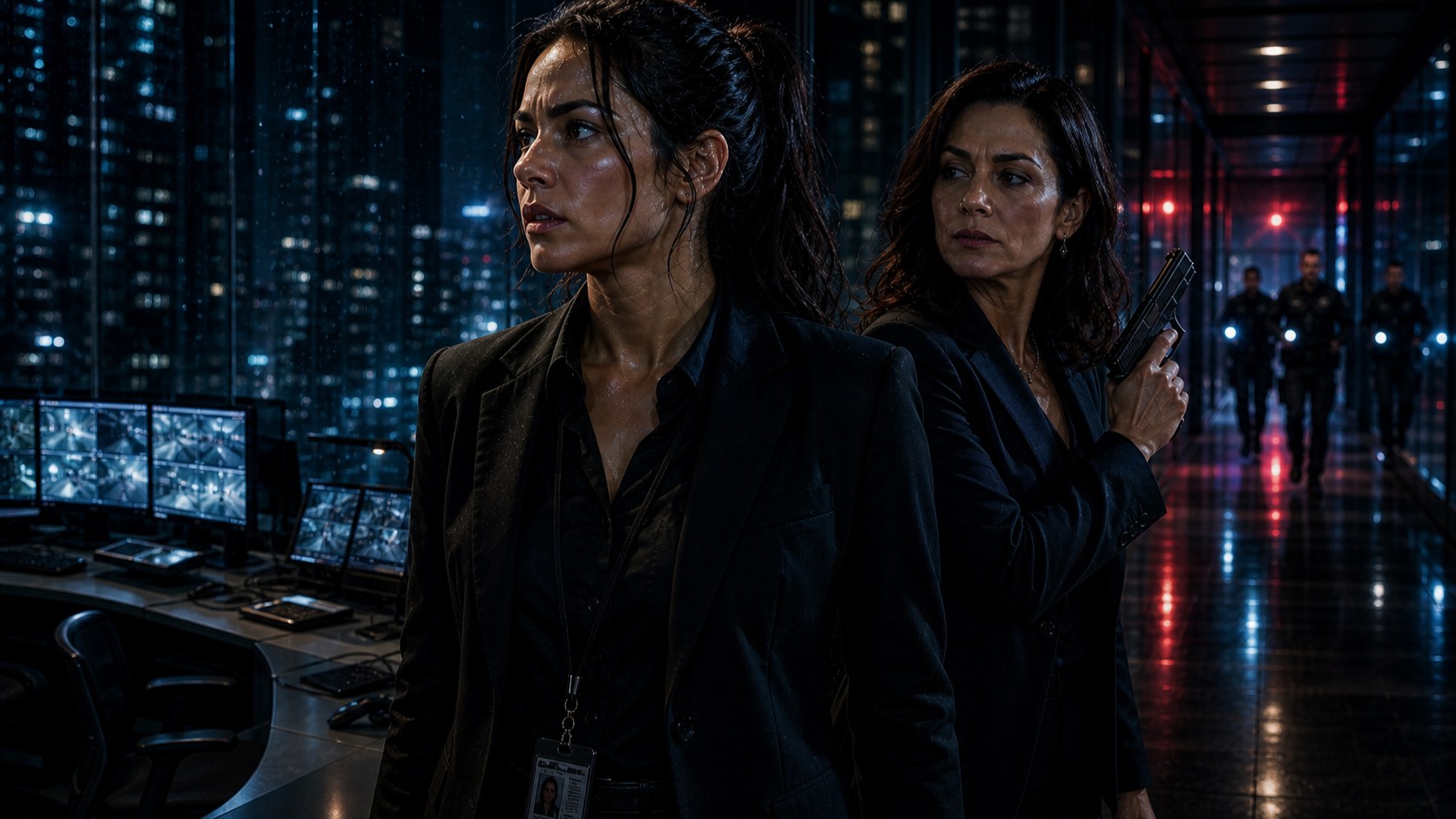
The danger wasn’t the breach.
The alarm did not simply sound—it ruptured the stillness of the night.
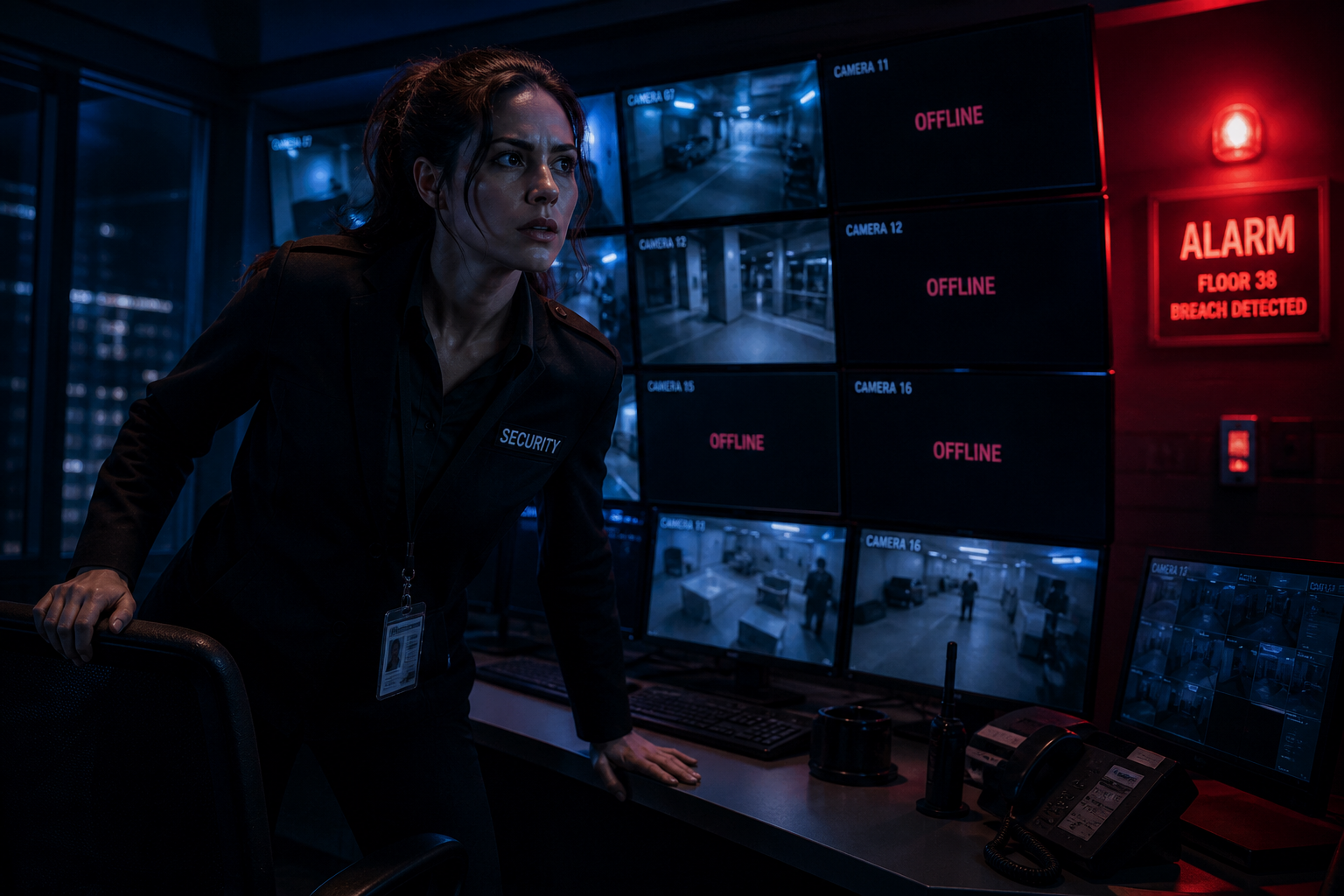
At precisely 2:17 a.m., it tore through the building with a force that felt almost physical, a harsh metallic pulse that reverberated through glass, steel, and the quiet concentration of the security office where Nina had, only seconds before, been half-absorbed in the steady rhythm of surveillance. She straightened instinctively, her attention snapping to the monitors as they began to fail in sequence, one after another dissolving into black with a precision that immediately set her on edge.
This was no system glitch.
There was intention in the pattern, a deliberate hand guiding the blackout.
She reached for her radio, her voice composed even as a subtle tension coiled beneath it. “Camera twelve is down. I’m heading to thirty-eight.”
The silence that followed lingered just long enough to feel unnatural, and in that absence of response, Nina felt the first real indication that something was wrong—not just in the system, but in the structure of the night itself.
She did not wait for confirmation. The elevator would be too slow, too predictable, so she moved instead toward the stairwell, pushing through the heavy door and ascending with measured urgency. Her footsteps echoed against the concrete, steady and controlled, each level passing beneath her with increasing clarity of purpose.
By the time she reached the thirty-eighth floor, her breathing had deepened, but her movements remained precise. It was only when she saw the door ahead that she allowed herself to slow.
It stood slightly open.
Not forced.
Not damaged.
Simply left that way, as though whoever had passed through it had done so without hesitation—or fear of being followed.
Nina pressed her hand against the edge and pushed it inward.
The corridor beyond was dim, illuminated only by narrow strips of emergency lighting that cast elongated shadows across glass-walled offices and polished floors. The alarm still pulsed somewhere beyond, but here it seemed distant, almost contained, as though the space itself had absorbed the urgency and reduced it to something quieter, more controlled.
She stepped inside, her senses sharpening as she listened—to the hum of the building, to the faint shift of air, to the absence of movement that felt more deliberate than reassuring.
It was the small sound behind her—a quiet, precise click—that confirmed she was no longer alone.
“Don’t move.”
The voice was low, steady, and close enough that she felt it before she fully processed the words.
Nina stilled immediately, her hands rising in a slow, deliberate gesture that had nothing to do with fear and everything to do with timing. “You’ve picked the wrong place,” she said, her tone even, almost conversational despite the circumstances.
A faint exhale followed, carrying with it the suggestion of amusement.
“I don’t make those kinds of mistakes.”
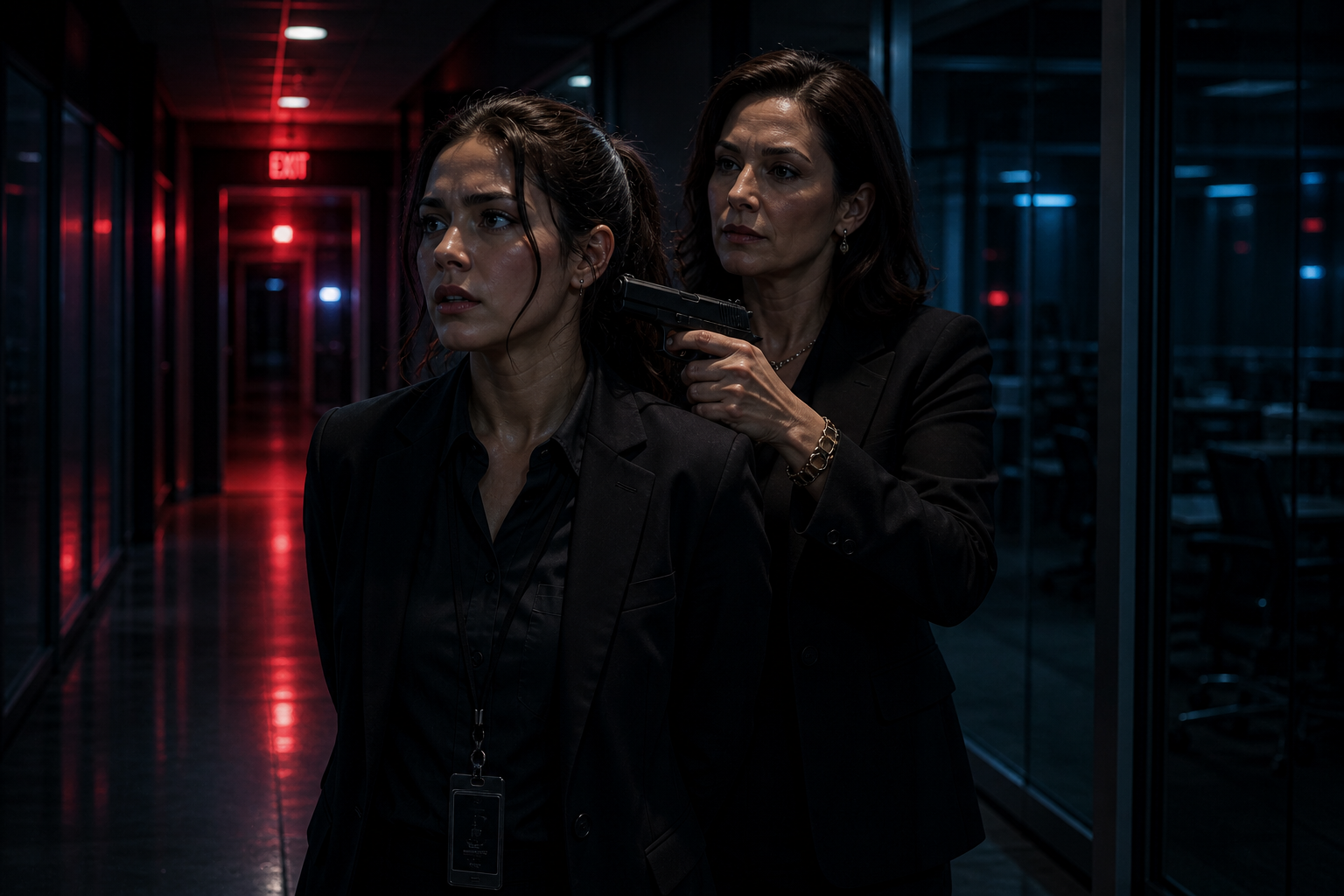
Nina turned her head slightly, just enough to bring the woman behind her into view, and in that moment something shifted—not in the situation, but in the way she understood it.
The woman was composed in a way that did not belong to chaos. There was no urgency in her posture, no strain in her expression, only a controlled stillness that suggested she had anticipated every possible outcome. Her black suit was sharply tailored, her silhouette precise, her presence contained. And then there were the heels—silent now against the floor, yet unmistakable in their intention, in the deliberate elegance they carried even into a moment like this.
She was older than Nina, though the difference felt less like distance and more like refinement.
“You’re not security,” Nina observed quietly.
“No.”
“Then you’re lost.”
The faintest smile touched the woman’s lips, subtle and knowing.
“Hardly.”
Nina’s gaze shifted briefly past her, catching sight of an open office where a terminal still glowed in the dark, lines of data moving steadily across the screen. Whatever this was, it was not random. It had purpose.
“What do you want?” she asked.
“A file.”
“Then take it and leave.”
“I intend to.”
The pause that followed was measured, deliberate, as though something unspoken had entered the space between them.
“But now you’re here.”
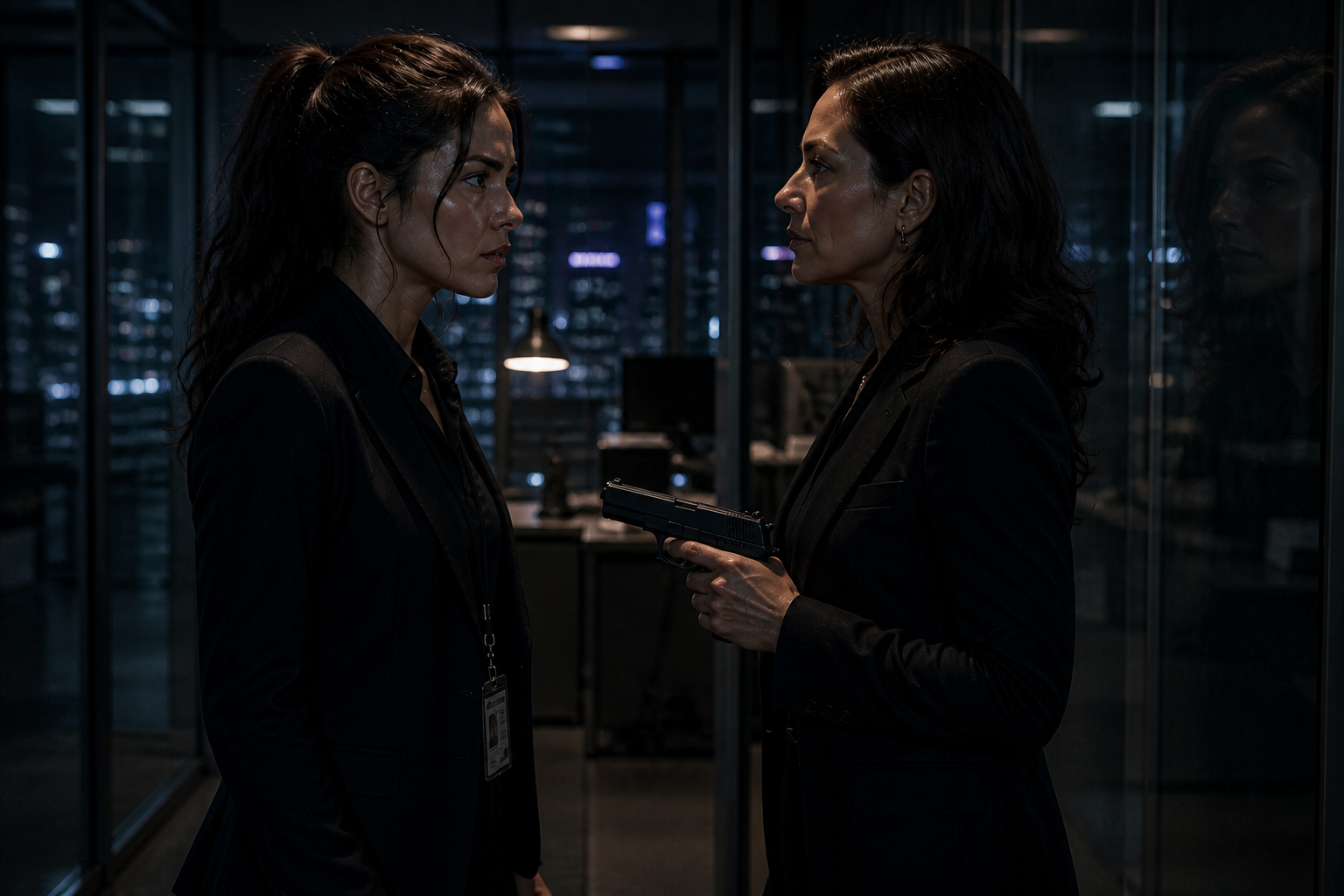
The distant sound of approaching footsteps began to thread its way into the corridor, faint but unmistakable, marking the narrowing window of time. Nina felt the shift immediately, the pressure of urgency returning, though something else remained beneath it—something sharper, more difficult to name.
“You’re out of time,” she said.
“Then I won’t waste it.”
The movement that followed was subtle—a slight lowering of the weapon, barely perceptible, yet enough.
Nina acted without hesitation.
She caught the woman’s wrist and redirected the line of the gun with controlled precision, their momentum carrying them together as they collided against the glass wall. The impact was sharp, but brief, absorbed quickly by the tension that followed as their bodies stilled in close proximity.
For a moment, everything reduced to contact—the pressure of her grip, the steadiness beneath it, the absence of resistance where she expected it most.
The woman did not struggle.
She did not pull away.
Instead, she watched her.
“Careful,” she murmured, her voice lower now, closer, carrying something that no longer resembled a warning so much as a recognition.
Nina tightened her hold slightly, meeting her gaze without flinching. “Or what?”
The hesitation that followed was fleeting, but undeniable.
The woman’s eyes shifted—briefly, precisely—to Nina’s mouth before returning to meet her gaze, and in that small, unguarded movement something changed between them.
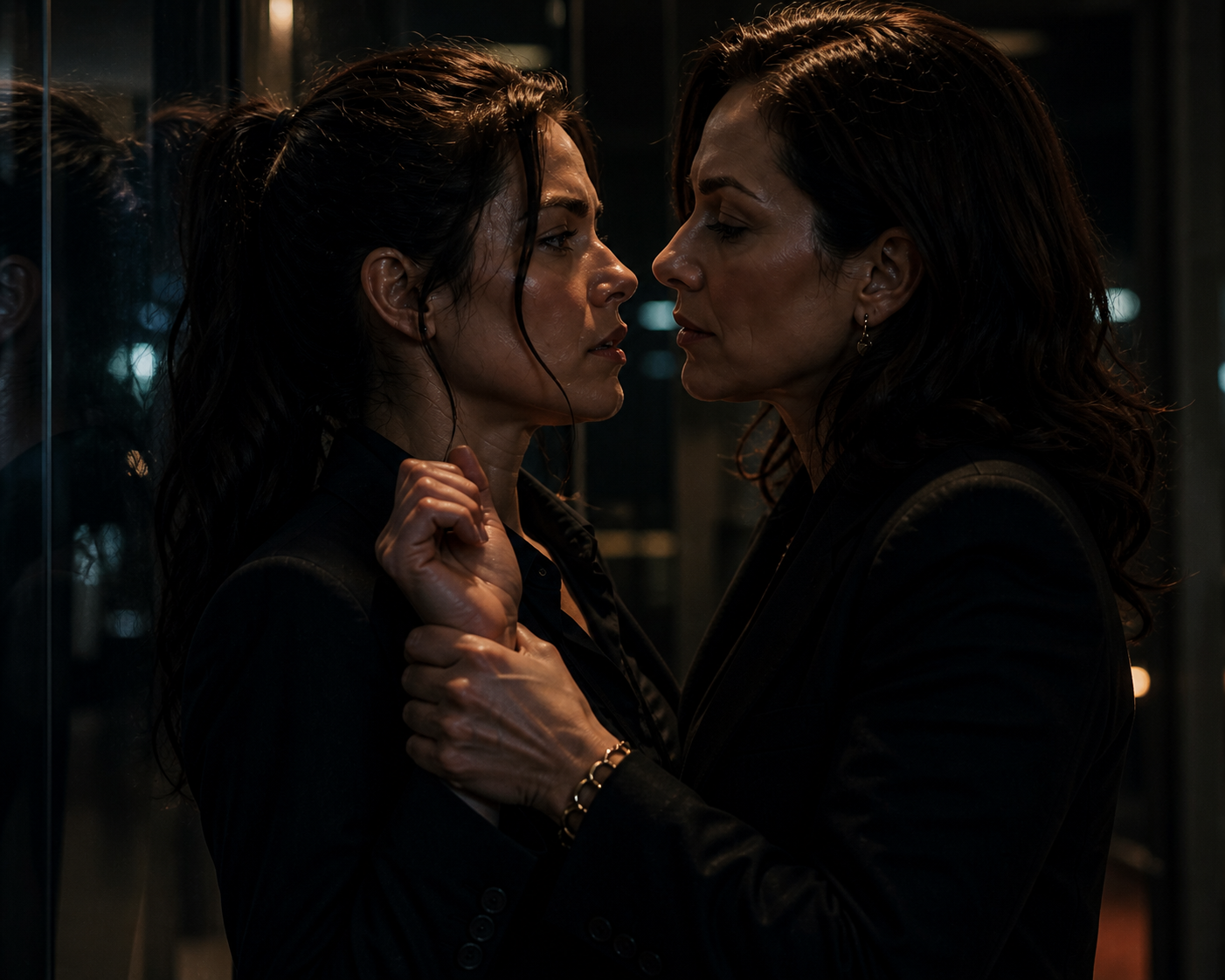
The alarm receded into the background, no longer the dominant force in the room. What remained was quieter, more immediate, a tension that no longer belonged entirely to the situation at hand.
“You don’t hesitate,” the woman said softly.
“Neither do you.”
The distance between them was no longer measured in space, but in choice.
And Nina, aware of that in a way she could not fully explain, chose.
She drew the woman closer.
The kiss was not planned, nor was it gentle. It carried the sharp edge of impulse, the collision of tension and curiosity breaking through restraint. It was brief, but not insignificant—defined less by softness than by its immediacy, by the way it existed entirely within that suspended moment where consequence had yet to reassert itself.
When they parted, the space between them felt altered, as though something had been set into motion that neither of them could fully reclaim.
The approaching footsteps returned with force, voices cutting through the corridor, pulling the world back into alignment.
Nina released her and stepped back, though the distance did little to restore what had been there before.
“Left corridor,” she said quietly. “Service stairs.”
The woman remained still for a moment, studying her with a focus that felt newly sharpened. “Why?” she asked.
Nina held her gaze. “Because I don’t like who you’re stealing from.”
The answer seemed to settle something.
“Alex,” the woman said at last, offering the name not as an explanation, but as something closer to acknowledgment.
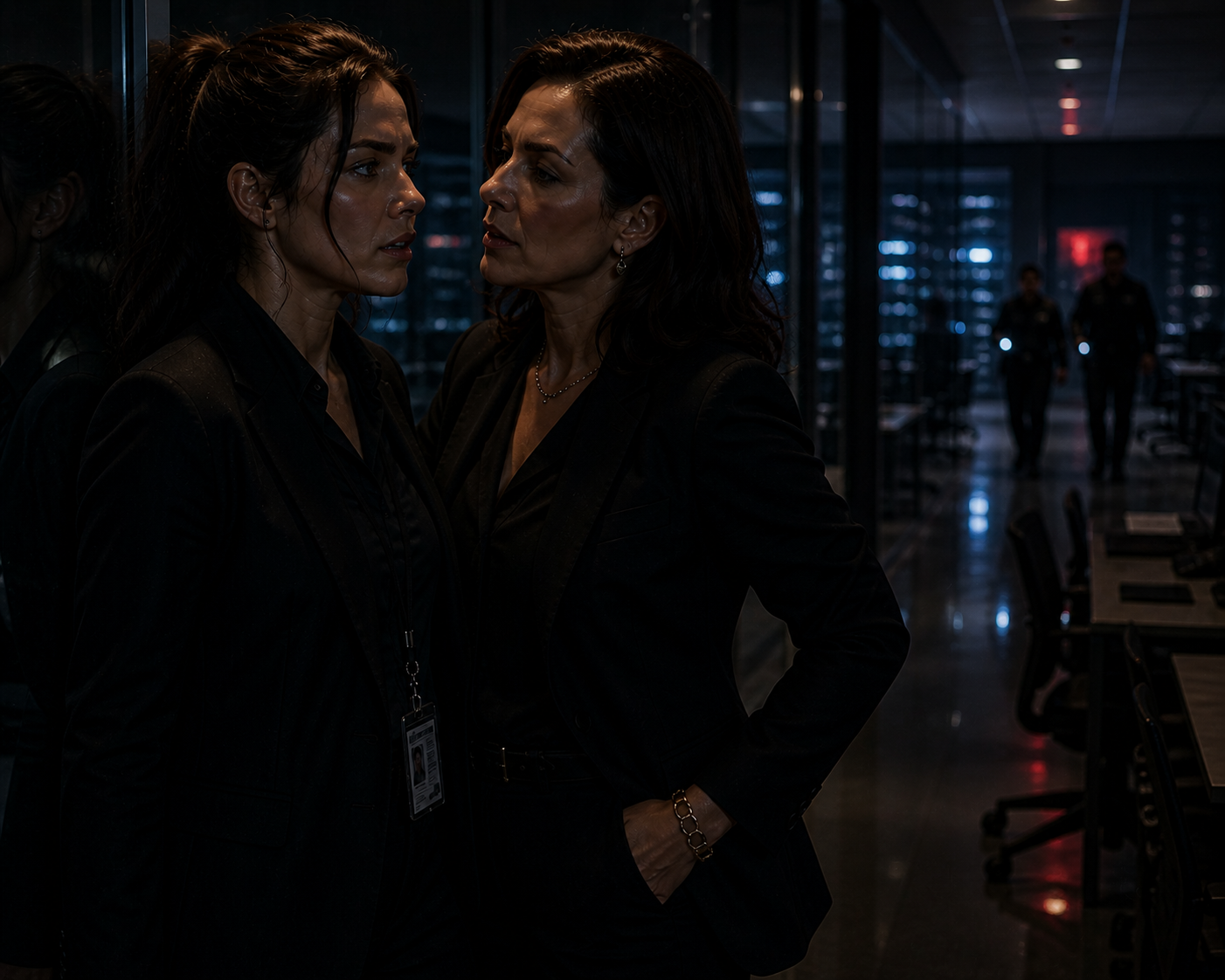
She moved then, her composure returning in a single fluid motion as she turned and disappeared into the corridor, her presence dissolving into shadow with practiced ease.
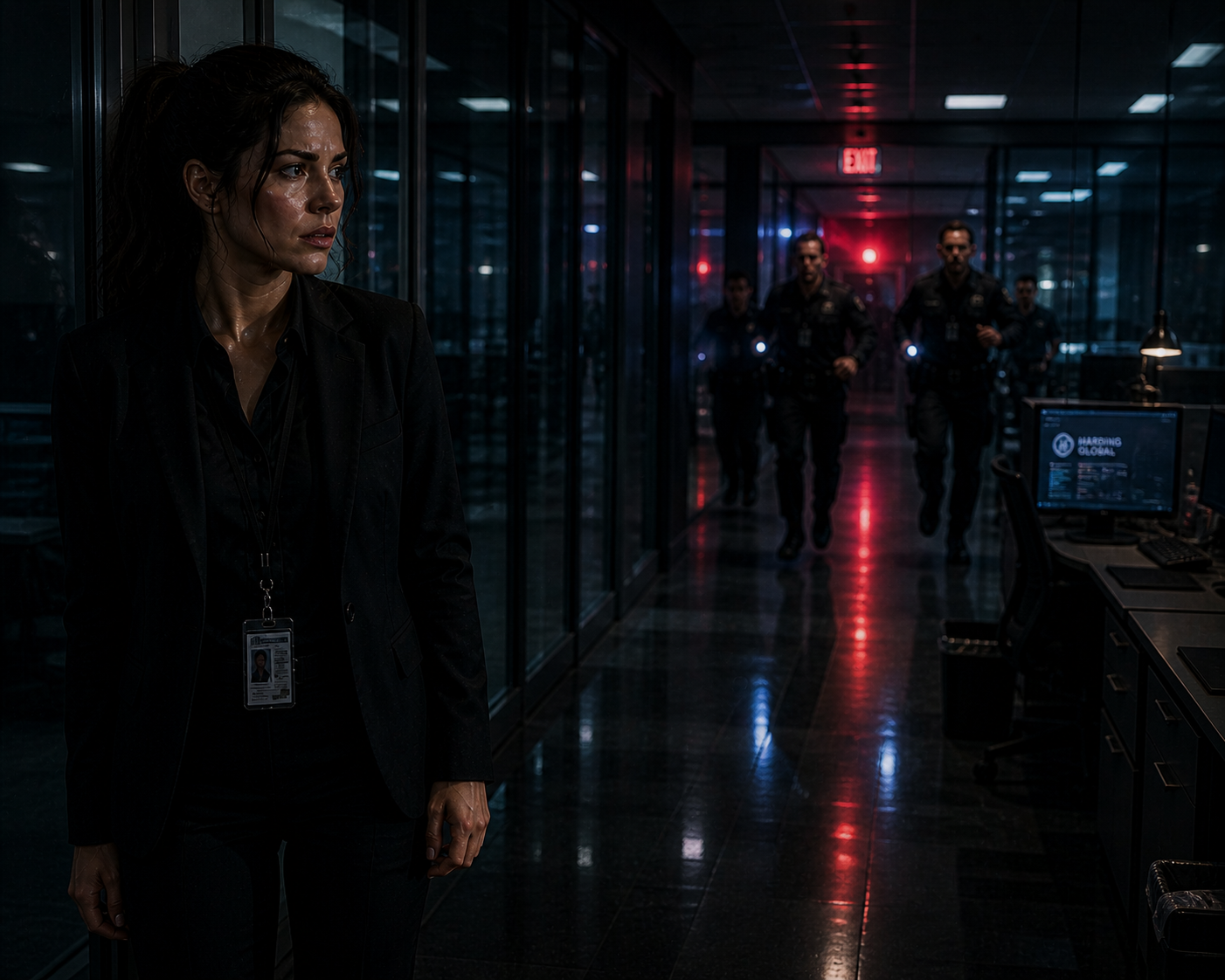
By the time the security team reached the floor, filling the space with light and urgency, Nina remained where she was.
She did not respond immediately to the voices that called out to her. Instead, she listened, her attention drawn not to the noise around her, but to something quieter, more distant.
And there it was—the faint, unmistakable rhythm of heels striking against the stairwell below. Measured. Controlled. Unhurried.
Not gone.
Only beyond reach.
When she finally turned, her expression had settled into something composed, something carefully neutral.
“She’s gone,” she said.
But even as she spoke, she understood that what had passed between them had not disappeared with the sound of those retreating steps.
It had simply shifted.
And somewhere beneath the fading alarm, it remained.
A Story by Germaine Corbeau - Click here for links to all Germaine Corbeau Stories!
Topics
Writing one? Publish your story on the BudgetPixel blog.






 @JustAsh

 @faerierealm


 @winter_witch
Comments (6)
Thanks - I didn't. So many mentions lost in the flodd of QT mentions. And especially in the work week, I am consumed by responding to comments, which includes paying commenters a visit. Thanks for the reply. That is pretty much what I imagined. And not for a second did I think it would necessarily be a quick and easy 'wham bang thank you ma'am exercise. I usually write mine, both the literorica and now Davydos in The Zone, and use my AI as a research assistant and editor. As something different I am now in process of trying the approach you described. Thanks again for the feedback and apologies for missing it on Monday.
@germancowboy just curious, what is your workflow to create these stories? My guess is the narrative is AI generated? Do you give AI a general prompt and create images to illustrate afterwards? Or maybe create a series of images - "Story without words" and give AI free reign? I've no issues however you generate the blogs, just curious
@DavidP, did you see my answer below?
I like the question. It is still quite a project: First of course I have to come up with a story concept that I want, pretty much as detailed as possible. Character selection etc. is usually interactive, like I mentioned in the past AI is terribly lazy, it requires lots of intervention. Then AI drafts an outline or a text immediately. The outline indirectly defines the locations for the images or Ai image prompts to be used in whatever model. I try to keep it at 6. The early versions of the text are often error-ridden; typical issues character mix-up, boring lines, not enough dialogue, not following the expected concept, etc. So changes have to be done, multiple rewrites, then suddenly continuation errors start because it remembers previous versions and forgets to put them back in the rewrites. Ultimately you have a sturdy story, and the location for the images, those are creating basically out of the context. Some stories go rather quickly simple storyline, easy to follow for AI, others are a nightmare. Example the Office Affair Story: AI did not understand the concept of deceiving the husband, it immediately assumed the husband would know about the affair and AI went completely off-script. I basically had to write that part myself and also the ending it could not fathom either. There is a lot of interaction, e.g. "For A While" needed many decisions, location, era etc. The dream would be to tell AI what you want and boom the whole story is there. It is not there yet. So in short: Concept Human, Characters Human/AI, Narrative AI/Human. Images are usually done afterwards, but the locations are predefined.
Sign in to read all 6 comments and add yours.