
Fire and Ash: How I Prompted the Volcanic Side of Pandora
 @pikpoo
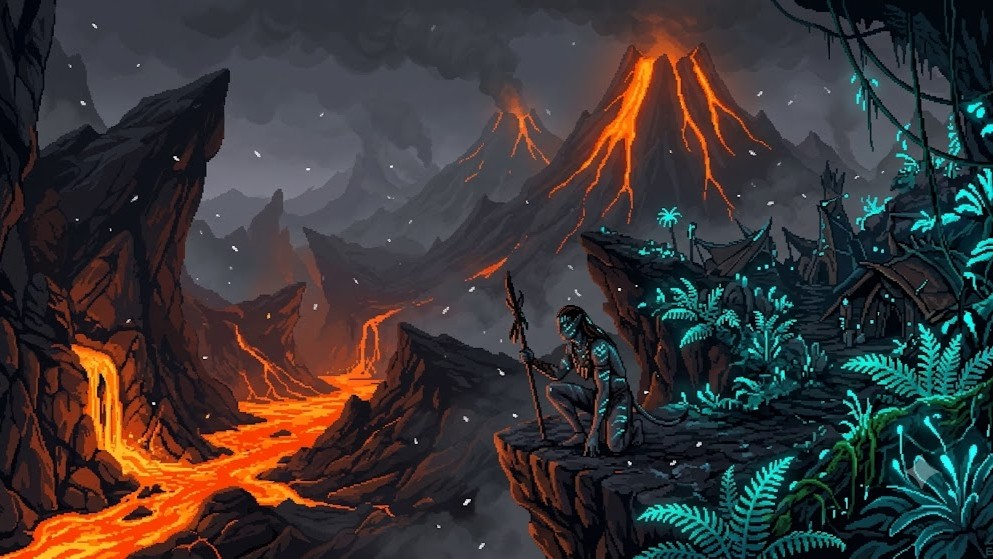
With the first official teaser trailers for Avatar 3: Fire and Ash absolutely dominating global entertainment news, I felt an intense creative urge to explore the unseen, harsher side of Pandora. We are all deeply familiar with the lush, serene floating mountains and deep blue oceans from the previous films. However, animating a brand-new, aggressive volcanic Na'vi clan—surrounded by molten rock, heavy smoke, and falling ash—requires a completely different technical approach when working within a 16-bit pixel art constraint.
Merging bright, hot volcanic magma with cold, glowing bioluminescent alien flora is an absolute nightmare for standard AI generators. They almost always muddy the color spectrum into an awkward brown soup. Here is the technical breakdown of how I engineered this high-contrast tribute.
1. Conquering the Dual-Element Lighting Battle
The main hurdle of this prompt was balancing two opposing light sources: the intense, destructive orange radiation from a flowing lava river and the delicate, cool neon cyan glowing from the Na'vi's bioluminescent skin patterns and surrounding jungle vines. To prevent the model from choosing one light source over the other, I structured the prompt to create a hard physical barrier. I explicitly requested "molten orange magma flowing through the left side of a dark rocky canyon, clashing against a dense thicket of glowing neon-blue bioluminescent jungle ferns on the right." This forced the model to divide the lighting vectors perfectly down the middle.
2. Rendering Particle Clutter: The Ash Problem
To make a volcanic wasteland feel alive, you need atmosphere. If the air is too clear, it doesn't look like a volcanic zone. I initially tested standard turbo generation models, but they turned air particles into blocky, distracting grey squares that ruined the scenery. By switching over to advanced detail-retention settings and specifying "delicate, individual floating white ash particles drifting through the smoky air," the model successfully scattered micro-pixels across the canvas, perfectly capturing that heavy, suffocating atmosphere without sacrificing clarity.
3. Creating a Cinematic Scale in 16-Bit
To truly honor the epic scale of the franchise, the composition needed a massive sense of depth. I anchored the foreground with a single, highly detailed Na'vi warrior crouched on a cliffside overlooking a massive burning valley. By defining the foreground character sharply and prompting "distant, towering volcanic mountains faded into dense, dark gray volcanic smog," the model generated a beautiful atmospheric haze that makes the entire pixel world stretch out infinitely.
Topics



 @crabmouse
 @EternaSky
 @CaylaCatz

 @germancowboy
 @Sealine
Comments (1)
I only watched the first movie - what an amazing film. Thanks for sharing your thought processes to create this image @pikpoo
Sign in to join the conversation.